Costa's Hummingbird

Costa's Hummingbird

Sunday, March 9, 2014

New Mexico Adventure - Part 1

Have to go back to the fall of 2013 to start this post, as that was when I mentioned to a few birding friends about the thought of taking a road trip in the winter to Sandia Crest in New Mexico in the search of the 3 Rosy Finch species.  After much enthusiasm and agreement, we set a date for February 2014 to make the trek eastward from Arizona.  By the time the date arrived, we were down to just 2 of us, Chris Rohrer and myself.  Due to other obligations a couple of the original 4 was not able to attend.  So Chris and I made our plans and headed out early on a Thursday morning with plans to stop in Whiteriver, AZ to try for a couple of other specialties along the way.  Although we dipped on the American Dipper, we did find a new life bird for both of us, the Cassin's Finch.  Along the rushing water of the White River, the Cassin's Finch arrived and perched in the trees and surveyed the area for a long time before finally dropping down to the stream to take a drink.
Cassin's Finch - Male
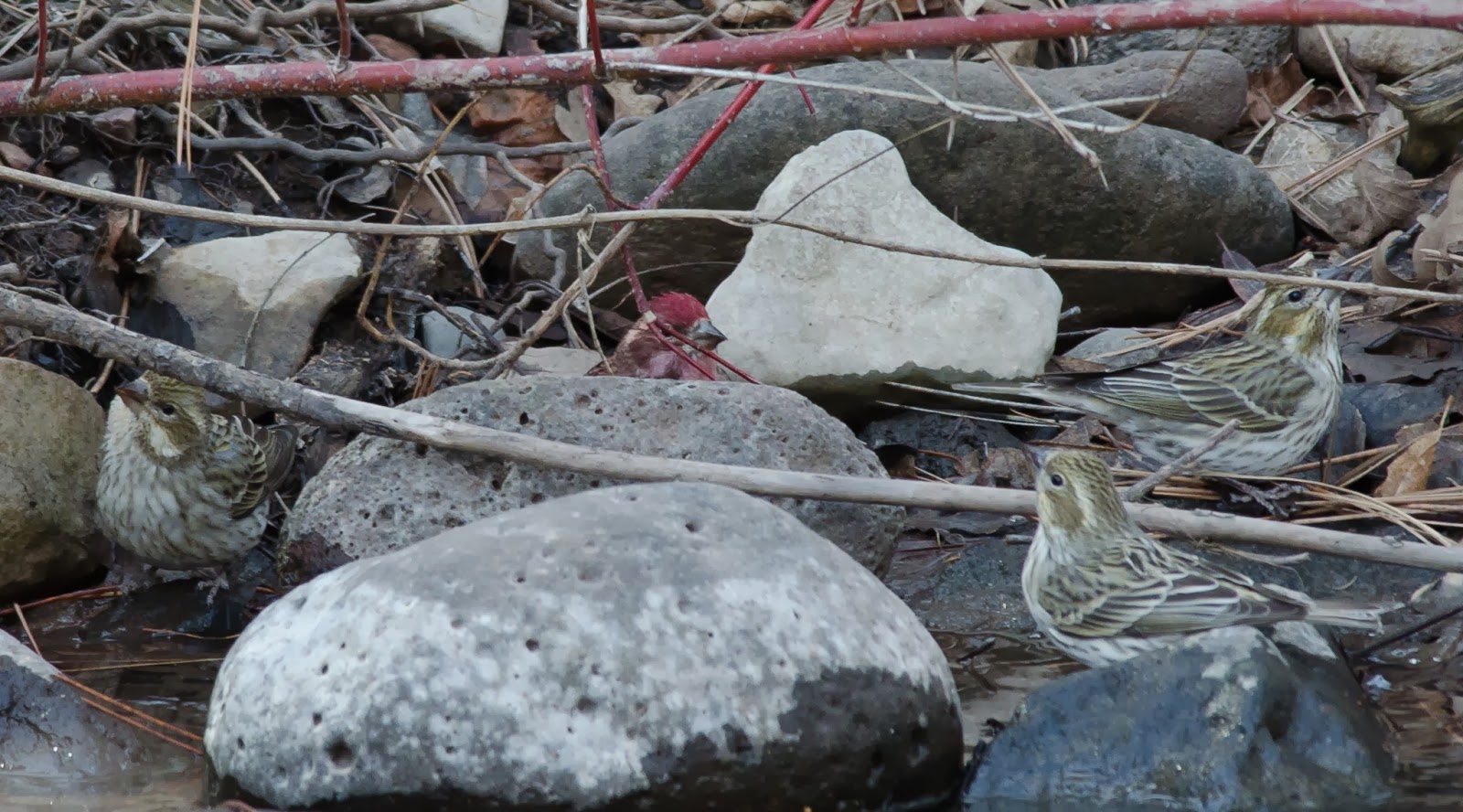
 Cassin's Finch - Male and 3 Females

A couple of Townsend's Solitaires were also in the vicinity and gave us great looks and fairly decent photo shots.

 Townsend's Solitaire

Since we missed the American Dipper on this trip, we decided they will have to wait until a possible summer trip to the White Mountains.  So from here we headed north and took some back roads towards Albuquerque making some short stops along the way to admire all the Mountain and Western Bluebirds that were found in various spots along the way. 

 Mountain Bluebird

Thursday night we arrived in the Albuquerque area and we were treated to a fabulous meal and offered wonderful accommodations with a new birding friend, Linda Rockwell. The next day we headed out early to our destination, Sandia Crest just east of Albuquerque and along the way, we had to make a brief stop to try and locate a Juniper Titmouse for Chris.  Linda was not able to ride with us on Friday, but gave us a sure fire place to locate this bird and as soon as we parked the car, we heard them and it took us less than 5 minutes to locate them and get photos.  They might be an all gray bird, but they are just about as cute as it gets.

 Juniper Titmouse

After a long drive to the top of Sandia Crest, we arrived at the summit and we quickly discovered how cold it was at the top with that brisk high altitude wind.  We quickly determined that the bird of the day was the Mountain Chickadee; they were everywhere and as usual very much on the move.  Always a lot of fun to watch these small bundles of energy.

Mountain Chickadee

We also had visits by a Red-breasted Nuthatch and a Stellar's Jay.

 Red-breasted Nuthatch
Steller's Jay

After spending time outside we went inside of the Sandia Crest store and warmed up with some hot chocolate and coffee and watched for the Rosy Finches from inside and it was not long until the feeder had a visit from a Black Rosy Finch and a Brown-capped Rosy Finch.  We were taking photos through the windows, so it was not the best conditions for photography.  But adding two new life birds to our lists was an incredible rush.  We had succeeded in our quest.  The Gray-crowned Rosy Finch had not been seen this year, so we felt that our chances of seeing all 3 species were not that great. 

 Brown-capped Rosy Finch
Black Rosy Finch

Mission accomplished, at least for now.  We started the trek back down the mountain and our next goal was the Rio Grande Nature Center along the Rio Grande River in Albuquerque.  And that visit turned into quite an awesome ending for the rest of the day and will need to be covered in my next blog post.


Thursday, March 6, 2014

Ruby, Arizona - A Gem in the Desert


About 6 weeks ago, Chris Rohrer and I were invited by Kathy Cooper to join in an all night outing with a group of tracking experts in the ghost town of Ruby, Arizona.  After a short discussion we decided to accept and this was going to be a somewhat new experience for me as we were going to spend a night camping out in tents.  I have only spent 2 nights in a tent in my life and that was when I was in Army basic training a very long time ago (early 70's to be exact)!  So with some borrowed equipment, I was packed and ready to try my luck and now I have learned a couple of do's and don'ts about any future camping that I might want to do. 
 
Ruby is considered the second best preserved ghost town in the state of Arizona.  This was a mining town that was at its peak in the 1930's but after the mining operations ceased, the town was deserted by the early 1940's.  Many of the buildings are still standing and the mine's tailings definitely left a mark on the landscape as a large sand dune and beach area.  Ruby does have quite an interesting history and was very fascinating to read.  However, Chris and I came for the birds and although we did not see anything rare and exciting, we did get some great looks at a few that sometimes like to play hard to get. The best birds for photos right in Ruby consisted of a Ladder-backed Woodpecker, a couple of soaring Red-tailed Hawks, and a Rock Wren that has taken up quarters in the open attic area of the old deserted school house.
 
Ladder-backed Woodpecker
 
 Red-tailed Hawk
 
Rock Wren
 
The topographical landmark to Ruby is Montana Peak with an elevation of 5073 feet; not huge by any standard, but its unique shape and height stands out from the surrounding summits. 
 
 Montana Peak


 Trailings created by the mining operation
 
 Remains of part of the old mine
 
 
Some of the most accommodating birds for us were actually seen at Pena Blanca Lake which we visited on the way to Ruby.  Here we had Northern Cardinals and Pyrrhuloxia in mixed company.  One of the Northern Cardinals appeared to be gathering nesting material and kept coming back to a spot near us and gathering some fine plant material which it whisked away and came back for more.  At least 4 Pyrrhuloxia were seen right nearby and a very handsome Pied-billed Grebe was trying to be a star in a small finger of the lake which was very close by.
 
 Northern Cardinal
 
 Northern Cardinal
 
 Pyrrhuloxia
 
Pied-billed Grebe
 
Sunday morning dawned very cold with frost on the tents and time for us to start thinking about the trip home and while we were that far out in the wilderness, we decided to take the back road home through Arivaca, AZ.  Another place I had not been to before and after our brief visit on the road back to Tucson, I definitely want to return to this great birding spot with its boardwalk area and pathways that lead to some incredible birds and other wildlife.  Birds included a handsome American Kestrel and some more Pyrrhuloxia and the nmammals included some Collared Peccary (aka Javalina) and a Coyote stealthily hunting for food in the dry grasses.
 
 American Kestrel
 
 Pyrrhuloxia
 
 Coyote in the grass
 
Collared Peccary
 
Definitely a worthwhile visit and the rewards of seeing more of what lies within the borders of the fascinating state of Arizona and its wonderful bird life.


Tuesday, February 11, 2014

Birding in Prescott, Arizona

On Sunday 2 February 2014, I teamed up with Jason Morgan and headed north to the areas of Prescott and Prescott Valley to do some birding.  Jason along with a couple others were getting some very nice photos of the Common Goldeneye.  This duck is quite spectacular in appearance and while I have seen them many times in the past, the birds were always at quite a distance and my photos always left a little to be desired.  My goal was to try and get a better photo than I had in the past, so our first stop was Yavapai Lake and I was not disappointed.  Amongst the 100 or so Ring-necked Ducks were at least 6 male Common Goldeneyes and a single male Canvasback, which was a bonus to me.  Had to search a different spot, Fain Park to find the females.
 
 Common Goldeye - Male
 
Common Goldeye - Female
 
Canvasback - Male
 
While we did not linger too long in Fain Park, we did find some other cool waterfowl including a female Lesser Scaup and some Common Mergansers of which the females were the only ones that I could approach close enough for photos. 
 
 Lesser Scaup - Female
 
Common Merganser - Female
 
During our brief visit we were witness to one of Mother Nature's events in the survival of birds, a raptor capturing another bird for its daily existence.  In this case, it was a Cooper's Hawk that captured a Western Scrub-Jay.  Typically, jays are notorious for finding the location of a raptor and then sounding the alarm to other birds by sending out alarm calls to let others know of the raptor's location.  In this case the Cooper's Hawk got the jump on them and once the victim had been captured, the rest of the Western Scrub-Jays really did a lot of scolding to no avail.  Yes, is a bit disturbing to see this, but this happens daily in nature and we could only revel in what we had just witnessed.
 
Cooper's Hawk with prey, a Western Scrub-Jay
 
Our next destination was going to be Watson Lake and this is where we had agreed to meet up with another Facebook birder, Cynthia White.  She knows the Prescott area well and we were very happy to meet her and actually get the chance to do some birding with her.  Watson Lake was covered with waterfowl and it was mindboggling to try to count the various ducks.  A couple of highlights were actually raptors that were putting on a show for us.  The first was a juvenile Bald Eagle that was being harassed by a couple of Common Ravens.  But this eagle really seemed unperturbed by all the commotion and continued to ride the thermals and in fact at one time they were flying almost side-by-side.  For those that are reading this and are a bit confused by the coloration of the Bald Eagle, this is a juvenile.  It takes about 4 years for a Bald Eagle to obtain its complete white head and tail and dark brown body, which is the vision most people think of when they hear Bald Eagle.  A good example in showing that identifying birds can be a bit confusing, especially to new birders and to non-birders. 
 
 Bald Eagle - Juvenile
 
Bald Eagle and Common Raven - (note the size difference)
 
We also had a Northern Harrier put on quite a show for us as it was flying over the reeds in the lake hunting for prey.  A one point it landed on a tree snag and gave us really good close up views of this winter visitor to Arizona.  This bird has an 'owl-like' appearance to it, but usually is hard to see as these birds rarely pose close for photos and for viewing.
 
Northern Harrier
 
Once we finished our walk around Watson Lake, we then discussed our other options and I had heard that a Tundra Swan had been reported a few days ago at Willow Lake and we agreed that since we were in the neighborhood, we should at least stop by to take a look.  Thanks to Cynthia for knowing how to get there quickly and finding easy access parking.  We got out of our vehicles and I noticed a white mound that kind of looked like a white rock or maybe a white piece of trash out in the lake.  We all looked a little close and decided it might be the swan with its head tucked under the wing taking a nap.  We quickly made out way to the lake edge and the closer we got, I knew we had found our target bird, the Tundra Swan.  I had really never seen a swan in the wild before, but I knew they were big and when we got to looking at this one and noticing the company it was keeping; Northern Shovelers, Green-winged Teal, and American Coots, then I realized how huge these birds really are.  This one never took flight for us, but it think it would be an amazing sight to see these birds take to the air.
 
 Tundra Swan
 
Tundra Swan
 
In our (or was it my?) obsession to get closer to the swan to try for photos, I observed another unusual bird flying towards us; a White-tailed Kite!  I have seen this bird before a few times in Maricopa County and was rather surprised to see one in this location.  We made a note of where it might have went and once we finished our business with the swan, we headed in the direction of where we thought it might be and once we got around the large cottonwood tree, we found it perched in another shorter tree.  We took a couple of distant photos and as we tried to approach it to get closer it took flight again and it put on a 'kiting' show for us where it would hover in flight without moving forward.  This was especially rewarding as I found out that this bird was a life bird for both Jason and Cynthia!  While my photos leave a lot to be desired, they are at least good enough for an ID if needed.  Cynthia managed a very nice in-flight photo when we first discovered this bird.
 
White-tailed Kite
 
This turned out to be a great day for all three of us with Jason getting 3 life birds and Cynthia and myself 1 each.  This is definitely a spot that I need to visit more often and I encourage others to do so as well.


Thursday, February 6, 2014

Seven Springs Wash - The Morning After

'There's got to be a morning after', or so goes the theme song from the Poseidon Adventure movie and such was the case after spending a pretty full day of birding the Santa Cruz Flats (see previous post).  I contacted another birding friend, Muriel Neddermeyer, to see if she might be interested in checking out the Seven Springs Wash area, north of Carefree, Arizona on Sunday morning.  She too had spent a full day on Saturday at the infamous Thrasher Spot, and we both decided to go for a couple of hours as there had been several reports of Bluebirds in this area and we thought it would be nice to see if we could get some photos of some of them. We were only going to spend a couple of hours and then get home.  Wrong!  We found the Bluebirds and more and had a very enjoyable day of birding. 
 
We started out by following some instructions by our friends, Scott and Fonda Christopher, and found FR 562 and drove up the road to the cattle guard and parked and started walking.  The grasses and trees were full of birds; several species of sparrows, Western Bluebirds, and American Robins.  Then Muriel noticed something a bit different and we quickly discovered it was a Sage Thrasher.  Not a rare bird by any means, but also not that common and not always easy to find.  This one decided it did not want to come out in the sun to show itself very well, so most of our photos had to contend with a lot of shade, but we did manage to obtain a couple of photos. 
 
 Sage Thrasher
 
Sage Thrasher
 
We returned to the turnoff at the bottom of the wash and discovered the various pools of water and at the same time, we discovered that was the attraction at this time of the day for the Bluebirds.  By far the most numerous were Mountain Bluebirds followed closely by Western Bluebirds.  The Mountain Bluebird male is stunning especially if you like the color blue.  I have seen these birds in higher elevations in the summer in pairs, but this was winter and they had migrated to lower elevations in vast numbers.  What a sight to behold as they would land in the trees, then survey the area around the water and once they felt safe, they went down to drink and bathe.
 
 Mountain Bluebirds
 
Mountain Bluebirds
 
 Mountain Bluebird
 
 Mountain Bluebirds
 
Mountain Bluebird
 
Now that you are tired of looking at this shade of blue, how about tossing in another shade of blue, along with a bit of orange, that of the Western Bluebird. 
 
Western Bluebird
 
Bluebirds were not the only visitors that stopped by for a visit.  We were also blessed to have a small group of Cedar Waxwings stop by to check us out.  This is one of my favorite birds as they have a very sleek appearance to them.  Their call is a very high pitched whistle that often goes undetected, but in this case we were hearing them quite well.
 
 Cedar Waxwing
 
 Cedar Waxwing
 
Cedar Waxwing
 
We had other birds visiting as well, but usually considered not quite as colorful as these first 3 species.  This included a Chipping Sparrow and a Rock Wren that was enjoying the water as much as the other birds. 
 
 Chipping Sparrow
 
 Rock Wren
 
Rock Wren
 
Well our couple of hours turned out to be a bit longer than we planned, but how can one leave a spot like this with all the great birds that we were seeing?  Just reminds me of how great Arizona is for birding, year round.