Costa's Hummingbird

Costa's Hummingbird
Showing posts with label Common Murre. Show all posts

Sunday, April 2, 2017

The Water Birds of Oregon

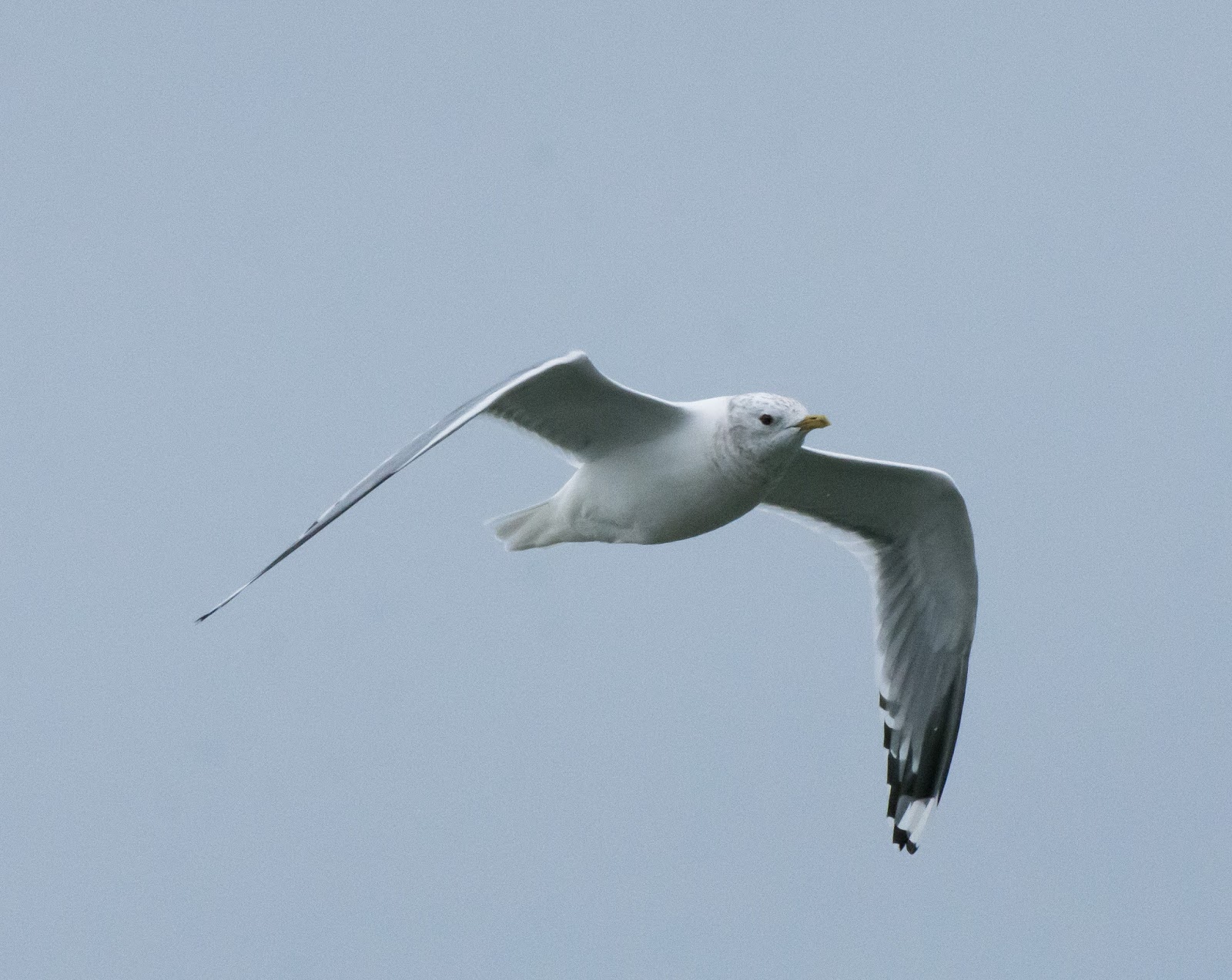
I have saved all the water-related birds for the last blog post.  After all, my last lifer on this trip was a water bird, the Mew Gull.  And we got it on the last day before our flights carried us back to the sunshine of Arizona.  And, par for the course, Chris and I had to deal with the rain to find it.  They are fairly common, but trying to locate one in the rain with binoculars getting wet, proved to be a challenge.  So we just stood on the shoreline of the Columbia River at Broughton Beach and started taking photos of a lot of gulls that were traveling upstream in the rain.  

Mew Gull


Gulls are not my forte in the birding world and not one that I would chase a lot.  There are a couple of species that would definitely get my interest to chase, but doubt if either will show up in Arizona.  We were challenged with the identification of the various gulls in Oregon.  Gulls are notorious for hybridizing and we quickly found out that some of the hybrids in this area are quite common.  So we had to approach the gull identification process with caution.  We did have other gulls that were not hybrids and one of them was the Glaucous-winged Gull.  This was not a lifer for me, but it was the first time I got to see one in adult plumage.  My previous sighting was a juvenile in Arizona several years ago.

Glaucous-winged Gull

Below are a few photos of some of the other water birds we observed during our stay.  Some I have seen in Arizona in the past, and some I have not.  But always fun to see and observe some of these species that I do not see as often.  

Horned Grebe

Common Murre

Common Murre

Surf Scoter - Male

White-winged Scoter

Black Oystercatcher

Black Turnstone

Belted Kingfisher

Belted Kingfisher

Golden-crowned Sparrow

Was also pleased to see a few other unusual flora and fauna.  My first ever sighting of a Vole.  I know they are a common rodent and are frequently seen as part of the diet of many raptors including owls. 

My first ever photo of a Vole

Western Skunk Cabbage was a new and interesting plant that we found.  Had heard of it before, but never knew much about it until now.  It is sightings like this that are fascinating as I read up on things like this and understand more about our natural world.

Western Skunk Cabbage

These last 2 photos are of a spider species that was fairly common clambering around on the snow in the vicinity of where we had the gorgeous male Spruce Grouse.  I have no idea what species it might be, but I had never seen a spider on snow before and seeing several of them leaves me in awe of what else is out there yet to be discovered.
  
Spider in the snow!


I returned to Arizona with 9 more new life birds so it was a great trip with some really awesome birds.  If anyone is planning a trip to the Pacific Northwest and have some of these birds on your wish list, I highly recommend contacting Khanh Tran.  He knows his birds well and not only knows where to find many of them, but also how to find them and what time of the year is best to observe them.  


Sunday, February 19, 2017

Target Birding

What is 'Target Birding'?  It probably means many things to different birders, but to me, it means making a trek to focus on one particular species of bird.  The one species might mean a rarity that has shown up in the most unlikely place such as the Lesser Sand Plover that showed up in northern Arizona last fall.  Or it might mean chasing a bird that has a limited range and is endemic to a particular area or region.  Such was the case this past week for me and I made a trip to southern California to 'target' an endemic species.

This species for me was the Island Scrub-Jay that is found only on Santa Cruz Island which is part of the Channel Island National Park off the coast of California near Ventura.  The only access to Santa Cruz Island is by sea via a boat and taking the ferry was my only option.  I opted to take the ferry to Prisoner's Harbor where most reports were coming in for the ISSJ (banding code for Island Scrub-Jay), and where most people recommend for seeing this bird.  The ferry does stop at Scorpion Bay before venturing on to Prisoner's Harbor and that is the point that most people got off.  My primary focus was to find the Island Scrub-Jay, so that is what I did before focusing on other birds and interesting flora and fauna.  I could hear the jays calling from the hillsides, but those hillsides were on the Nature Conservancy property where we were not allowed access.  Eventually, 2 of them ventured down to the stream and I finally got my first views of them and managed to capture a few photos.  

Island Scrub-Jay


Allen'a and Anna's Hummingbirds were fairly common on the island, and since Anna's is a species I get in my back yard, I focused on the Allen's Hummingbirds.  I have seen this species once before in southern California, but this was a long time ago and I had never gotten any photos.  It was a treat to see these and observe their behavior and listen to them for a change.

Allen's Hummingbird - Male

During my stay on the island, I was constantly hearing a call that I was unfamiliar with and eventually I was able to track it down and found out it was an Orange-crowned Warbler and they were plentiful.  This is a sub-species (sordida) that is endemic to the Channel Islands and they look different and sound different than the other sub-species of Orange-crowned Warblers. 

 Orange-crowned Warbler (sordida)


There were also many sea birds that we observed on the ocean from the ferry and also from land.  Birds on the ferry were almost impossible to identify and photograph as this boat was fast moving and they were not focusing on the pelagic birds.  Only when it slowed down or stopped for whales or dolphins, I was able to snap off a few photos.   

 Brandt's Cormorant

 Black-vented Shearwater


 Caspian Tern

Common Murre

The ferry did not focus on sea birds, but it would stop when ever they spotted mammals in the ocean such as whales, dolphins, and seals.  Of course everyone on the boat got excited in seeing whales, as did yours truly!  I had the privilege to see 2 groups of these whales from the boat; a group of 2 and then later a group of 6.  Pacific Gray Whales migrate down the coast of California this time of year to areas off the coast of Baja California where females give birth to calves.  
    
 Pacific Gray Whale


Also VERY numerous out on the water were large groups of Common Dolphins.  One group we encountered was estimated at over 2000 by the crew and they would swim up to ans around the boat as if playing games.  They are very fast and nimble and hard to photograph, but what a wonderous sight to see.

 Common Dolphin


Elephant seals were also seen, specially on the ride out to the island in the early morning.  They will raise their flippers out of the water to expose them to the sun for warmth.

Elephant Seal

On the island I found this butterfly that I had never seen before and after a little research, I came up with an identification of Gray Hairstreak.  A very striking butterfly in my opinion.

 Gray Hairstreak


I was also impressed by the Giant Coreopsis that grows on the Channels Islands.  This variety is almost like a small tree as it grows up to 3½ feet tall with a trunk that is almost 4 inches in diameter.  

 Giant Coreopsis


More adventures of my birding trip will be covered in another post in the very new future.  The rest of the trip involved birding on the mainland and chasing a couple of introduced species that have established some breeding regularity in the United States.


Sunday, October 13, 2013

California: The Pelagic Trip

Monday was the last day of our gathering and the day that I had chosen for the pelagic trip searching for birds.  There had been a trip on Sunday as well, and the reports from that trip were awesome as they enjoyed sunshine and calm waters out in the Pacific Ocean.  Monday dawned with a heavy fog which did not bode well for an ocean voyage of about 12 hours searching for birds on the high seas in a fairly small boat.  We also experienced some fairly heavy swells along with the fog, which was going to make photography tough.  I had read everything I could about how to attempt to prevent any seasickness and follow everything to a T as much as possible.  One of the tips was to focus on the horizon while on the boat.  Well, when it is foggy, there is no horizon to focus on and I was one of about 9 others that succumbed to a bout of sickness.  This really was a downer as I missed out on at least attempting photos of some of the great birds we saw.  I was fortunate enough to catch some brief glimpses of some of these birds as they were in flight over the water and all around us.  This was a first for me and birding in the open ocean is far different than birding on land.  The species to be found in the open waters is astonishing; many are flying constantly and many are sitting in the water occasionally diving or maybe just feeding on the surface of the water.  I added 12 new life birds during this pelagic trip, but as you will see, not nearly that many photos.  It is tough trying to focus on flying birds while the boat is rocking to the swells, so I simply attempted to get best that I could get of birds on the water.  That too is a bit difficult as they were swimming, diving and rocking with the swells as well, plus we were dealing with fog all day so lighting was not the best to work with.  I will say that had we not had 4 excellent guides on our boat, I would not have been able to identify many of these birds with the brief sightings that I had and not being familiar with most of these species.

As we left the harbor, (at a very slow speed by the way), the jetties that reached out of the harbor were covered with birds on just about every rock that could be found.  There were Brown Pelicans, Western, California, and Heerman's Gulls, Black Oystercatchers, Pelagic, Brant's and Double-crested Cormorants, Surfbirds and probably many more that I have already forgotten.  

One of the most common birds seen on the water was the Common Murre.  I had seen some from the beaches a couple of days earlier, but they were far out into the water.  Being on the boat we were able to get much closer and considering the conditions, this bird provided the best photos.  

Common Murre - diving

Common Murre

Common Murre

Common Murre

Early in the voyage, we found a Rhinoceros Auklet which coincidentally became my 400th life bird.  My photo left a lot to be desired, but it was much further from the boat than the Common Murre, and the fog is clearly visible.  Not a great photo by any means, but good enough for identification.  

Rhinoceros Auklet - #400

We also found a few Red-throated Loons and the boat got close enough and I got lucky enough to capture a couple of photos.  This was another new life bird for me.

Red-throated Loon

Red-throated Loon

Can't say for sure exactly where we saw this next bird, the Red Phalarope, but it had to have been close to 20 miles out in the Pacific and it just struck me as such an odd thing to see this single small bird less than 9")
sitting and feeding on the surface of this HUGE body of water all by itself.  But I guess this is their normal range and habitat.  It is just amazing that nature has been able to offer us these marvelous creatures that survive in some of the most inhospitable habitats. (Yes, another new life bird for me.)

Red Phalarope

The last bird on the water that I was able to photograph was the Marbled Murrelet.  This is another very small bird and the guides had been searching for them all day.  When they spotted them in the distance as 2 small dark specks on the water, with my binoculars I struggled to see them well.  But once I was able to get my photos processed and cropped back home, there is no doubt what they are.  This is another one of those examples of having very knowledgeable guides for these trips.  I would never have seen these birds and identified them on my own.  (Yes, another new life bird for me.)

Marbled Murrelet

Time to move on to non-avian creatures.  While we were not fortunate enough to see any whales, we did encounter a few other cool sightings.  One of the coolest was a couple of Mola Mola that had come to the surface of the water and the boat was able to get fairly close to them.  They are more commonly known as Sunfish.  Here is my photo of one and it is hard to discern the uniqueness of this fish; this one was estimated at about 6' to 7' in size.  For more information and better images of this awesome fish, here is a link to them on Wikipedia:
http://en.wikipedia.org/wiki/Mola_mola 

Mola Mola (Sunfish)

We also happened to come across a raft of California Seal Lions that probably numbered well over 200 individuals.  Quite noisy, but were also quite interested in our boat.  Even at close range, you can see the fog that we had to deal with most of the day.

California Sea Lions

California Sea Lions

At 2 different locations we also came across a couple of Northern Fur Seals and once again our guides were invaluable in sighting and then identifying these pinnipeds. 

Northern Fur Seal

Northern Fur Seal

Finally our voyage came to an end and we docked back at where we started and by now the sun had come out and it was at the dock that I was able to capture my first photo of a bird in the sunlight for the day; a Black-crowned night Heron in a tree near the dock in the waning moments of sunlight.

Black-crowned Night Heron

And for the record, this is a photo of the vessel that gave us a tour of the fog shrouded waters of the Pacific Ocean off the coast from Half Moon Bay, CA.

New Captain Pete

Yes, this was a first and new adventure and will I do it again?  The rest of that day and the next, I said 'never again'.  But now that I have had time to reflect back on it, I think it deserves another chance and maybe with better weather conditions, it might turn out on a more positive note.