Costa's Hummingbird

Costa's Hummingbird
Showing posts with label Bridled Titmouse. Show all posts

Sunday, April 5, 2015

AAAA+ - An Amazing Arizona Adventure (Part 2)

After dropping Josh off at his hotel and family in Green Valley on Tuesday night, Tommy and I headed back to Madera Canyon to set up camp at Bog Springs Campground.  While Tommy and I were discussing the best place to try and locate the Elegant Trogon search for the next day, Josh was busy in the motel checking out the latest reports of this bird on eBird.  Josh texted us stating that two days prior there was a report of 2 male Elegant Trogons in Madera Canyon about ¼ a mile from the parking lot and on the Super Trail.  So Tommy and I decided to try scouting this trail before darkness set in and away we went.  Discovered it was a great trail and prime habitat for the Trogon, but we did not detect one in the twilight, however we did hear one calling a bit up on the ridge from the actual trail.  So plans were made to pick up Josh early in the morning and hike the Super Trail and hope for the best.
 
With darkness setting in on Madera Canyon, Tommy and I decided to see if we could hear any owls when total darkness descended on the canyon.  We were hanging out in the Amphitheater parking area listening to the Wild Turkeys settle in for the night when suddenly Tommy heard a Whiskered Screech-Owl calling.  We took off on foot towards the hooting and within 5 minutes, Tommy had located one of them with his flashlight, just waking up from a day of slumber. This is a bird that I have heard before and already added it to my life list as a 'heard only' species.  So this was a real treat for me to actually see one for the first time. I was surprised at how small they are at only 7¼ inches, which is about a inch smaller than the Eastern and Western Screech-Owls.  The range of this species is predominately in Mexico, but it does reach into southeastern Arizona and possibly a very tiny area of New Mexico.  Now my camera, does not do well in low light situations, so I was not expecting much in the way of photos and I am not fond of using my flash on nocturnal birds.  So I bumped my ISO up to 3200 and hoped for the best with light from Tommy's flashlight.  He would shine it on the owl briefly for a couple of photos, then point it away to avoid continual light in its eyes.  All my photos were taken without a flash and I was quite pleased with how some of them turned out considering this is a nocturnal bird that is going to be hard to photograph.  While we were watching the first owl, we heard a noise behind us and turned around to find a second one had landed in a tree behind us and had a lizard in its grasp and its wings spread out.  We later found another one, but it may have been one of the first 2; we are not certain on that.
 
 Whiskered Screech-Owl
 
 Whiskered Screech-Owl
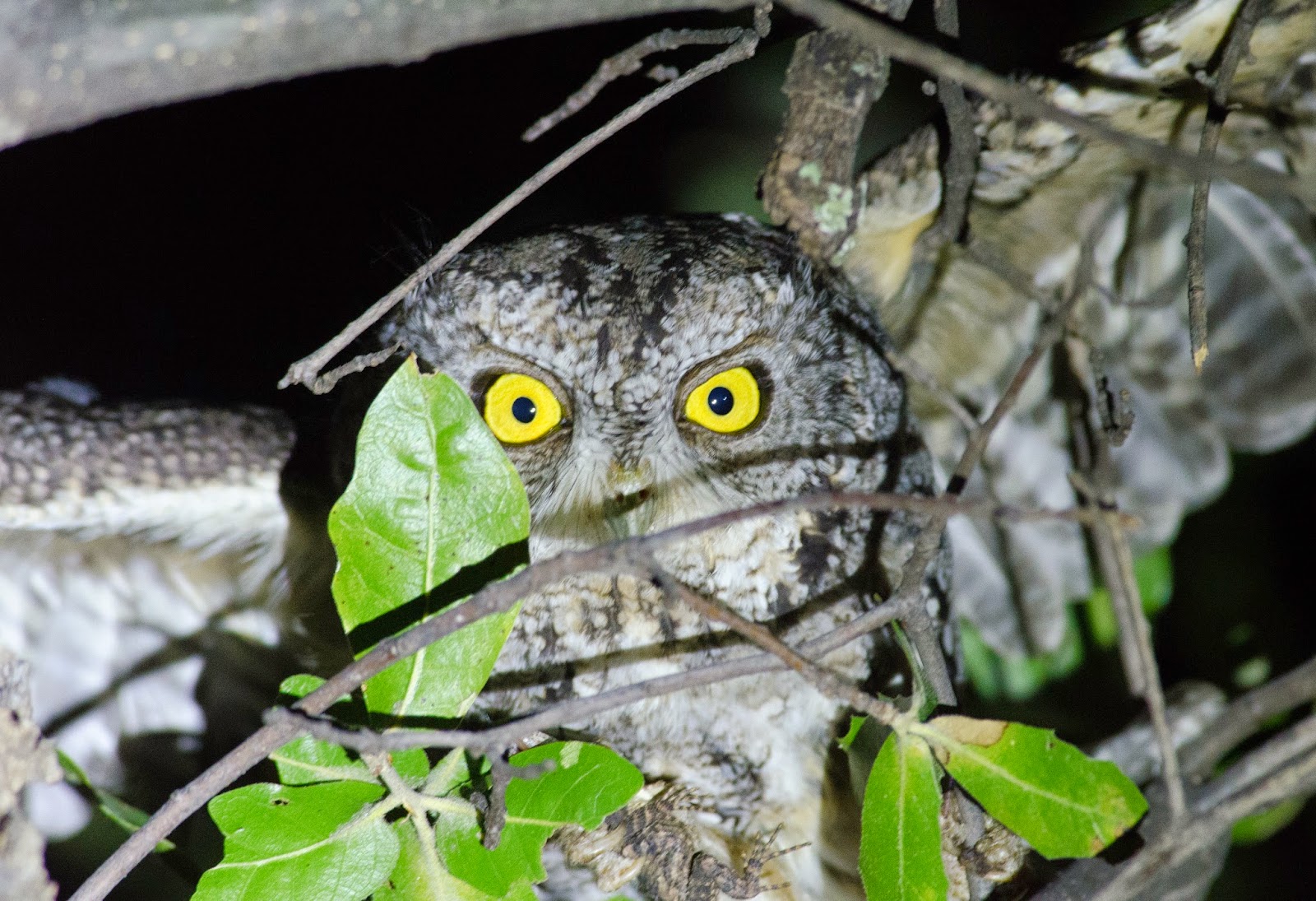
 
 Whiskered Screech-Owl - Note lizard foot in bottom of photo
 
 Whiskered Screech-Owl
 
Whiskered Screech-Owl
 
We also heard and got some brief views of Elf Owls, but were not able to get photos.  What an incredible time birding at night. 
 
The next morning we picked up Josh and we were lucky to have his son Evan join us for the morning of birding.  This youngster has quite the eye and loves to add birds to his life list as well.  We headed straight to the Super Trail at the top parking lot in Madera Canyon.  We had not traveled far on the trail when Josh quickly pointed out an unusual mammal coming down the trail towards us.  It just happened to be a Hooded Skunk.  I have seen many skunks in my life, but not this species and it was quite a treat.  When it sensed our presence, it quickly left the trail and went down to the stream bed leaving us to contend with photos from above. 
 
 Hooded Skunk
 
Hooded Skunk
 
As we headed up the trail, we finally heard an Elegant Trogon and we pursued the sound and were treated to some brief views of it.  I tried to keep my eyes focused on where it landed as it moved up the slope so that Josh and Evan could get some good looks of it and some photos.  This was the number 1 target bird for Josh and we were happy that we found one for him on this trip.  Although it was not the most cooperative for photos, it still is a fantastic bird to find in the United States. (The photo that I am including in this post, is one that I captured in 2013.  Wanted to include a photo of this really awesome bird so others understand why this is so special for Josh, Evan and many others.)
 
Elegant Trogon (photo from 2013)
 
After another search that was deemed successful, we headed back down the trail and just before we reached the trailhead, a small flock of Bridled Titmouse made an appearance and it has to be one of the cutest little birds around. 
 
 Bridled Titmouse
 
Bridled Titmouse
 
We stopped for a short time near the Santa Rita Lodge and found this Band-tailed Pigeon.
 
Band-tailed Pigeon
 
We then returned Josh and Evan back to the motel in Green Valley so they could check out with their family.  But they took out a little time to show Tommy and me a pair of Great-horned Owls that Evan had discovered the day before hanging around the motel.  We took an elevator to the 3rd floor and once the elevator door opened, there was one on them viewable on the roof just outside the window.  Another one was trying to remain unseen in one of the palm trees outside. 
 
 Great-horned Owl
 
 Great-horned Owl - Photo taken through window of hotel
 
 Great-horned Owl - Photo taken through window of hotel
 
 Great-horned Owl
 
Great-horned Owl
 
What an incredible two days of birding!  Anytime someone gets the privilege of seeing an Elegant Trogon it is a great day of birding.  Really enjoyed my time birding with Tommy and also meeting Josh and Evan and being able to find some cool birds.  A very enjoyable two days.  (Now to start planning on owling in Minnesota in the winter in the future!!!!) 


Sunday, October 12, 2014

A Weekend of AZFO Activities

The first weekend in October is usually the weekend that AZFO (Arizona Field Ornithologists) holds their annual gathering.  Every year it is held in a different location which is a great way to introduce others from around the state to new spots for birding.  This year the meeting was held in the Globe/Miami area in Arizona and since the Pinal Mountains are close by, I was familiar with a bit of the area.  The meeting was being held on Saturday, but there was a couple of mini expeditions set to take place on Friday afternoon.  Chris Rohrer decided to attend so he drove up from Tucson and we met on Friday morning to make a quick trip into the Pinal Mountains as he had never been there before.  Knowing the time we had to work with, we hurried through many of the spots I would normally stop at as I wanted to get Chris to the top.  Turned out to be a very lucky plan because we found some really great birds at the top.

The first bird that caught our attention flew over our heads from the rear and quickly flew on the back side of some pine trees, but it quickly returned and it turned out to be a Lewis's Woodpecker.  Not a rare bird in Arizona by any means, but one that I had never observed in Gila County.  While the photo is not the best, it is at least diagnostic of the species.

Lewis's Woodpecker

About the same time that I was trying to get some photos of this bird on the other side of a small pond, Chris noticed a Band-tailed Pigeon in one of the oaks on the south side. Once again, not a rare bird, but a bit uncommon and not always easy to find and photograph.  My previous sightings only consist of one photograph of the bottom end of one of these birds, but high up in a pine tree snag.  This one was cooperative with us for photos, but the angle of the sunlight was not where we would have preferred.  Regardless, it was nice to get some identifiable photos of this bird.

Band-tailed Pigeon

Band-tailed Pigeon

Band-tailed Pigeon

As we were really enjoying the moment with good looks of these 2 species of birds, another small flock of smaller birds flew over and into the tops of the pines.  Once again this was another bird that was new to me for this location.  In fact, this same bird was a life bird for both Chris and I back in February of this year; Cassin's Finch.  I believe this made the 3rd sighting of this bird for us this year.

 Cassin's Finch

Cassin's Finch - There are 3 of these birds in this photo

It would have been great to have more time to explore this area, but since we had to be back into Globe by about noon, we did not have the luxury of excess time on our hands.  Even though it was a relatively quick trip up and back, we did find some remarkable birds.  

We had signed up for a mini Field Expedition in the afternoon to visit Timber Campground and Jones Water Campgrounds so we met up with the very large group that had signed up.  Both spots offered great birding but as usual, afternoon birding is not always the best time to explore.  We did get to see some really nice birds, but photography was not at its best except for a Bridled Titmouse.  Both spots are now on my list of places to visit and spend more time exploring.  

Bridled Titmouse

The meeting on Saturday was a success with lots of great presentations and information to be absorbed.  Sunday we had signed up for the Sierra Ancha Wilderness area field trip and we were introduced to some amazing wilderness with outstanding scenery.  The first stop included an inside viewing of the habitat near the Rossevelt Lake Diversion Dam.  We had a lot of birds and had a great time, unfortunately, my only photos for that day consisted of an Ash-throated Flycatcher and a Gray Flycatcher.  

 Ash-throated Flycatcher

Gray Flycatcher

When we returned to the entrance area we discovered a Great-horned Owl on the steps to the restrooms.  The owl will probably never know how lucky it was to be found by this group of humans.  There were several in the group that were familiar with rescue and rehabilitation.  It was captured and found to be very emancipated and it was then transported to Liberty Wildlife in Scottsdale, AZ and was found to have suffered a leg fracture that had already started to heal.  It was given food and an IV for re-hydration and is expected to make a full recovery.  That was good news to all.

Great-horned Owl

This was a great weekend for Arizona birding.  Got to see many birding friends and meet many more.  Definitely will be an annual event for me.  In ending this post, just want to share a couple of other photos that I got on this weekend of things other than birds.

 Brown Trout

 Flame Skimmer


 Coyote Gourd

 Hackberry Emperor

Painted Lady


Monday, January 13, 2014

CBC's - (Christmas Bird Counts)

Every year from mid December to early January, the National Audubon Society hosts their annual Christmas Bird Counts.  Most take place within the United States however there are many more that are being held in various spots throughout the world and the list is growing.  These counts are a well defined circle with a 15 mile diameter and each circle is divided up into smaller sections where teams of birders join forces and attempt to document as many species in their section and the number of birds of each species.  This data is then complied by the circle coordinator and the final reports are submitted to Audubon.  (Its more complicated than that, but this is the short version.) 
Annually, I attempt to participate in these counts as time allows.  This year, due to my work schedule, I was only able to take part in 2 of them and they were 2 days apart.  The first one took place on January 2 and is know as the Carefree CBC north of Scottsdale, Arizona.  I have been part of this one the past 3 years now and I have been a part of a small group that surveys one of the remote areas know as the Quein Saba area.  Our team leader is Grant Loomis and the other members consisted of Tyler Loomis, Lisa Fitzner, and myself.  When taking part in one of these CBC's photography definitely becomes secondary as the main focus is finding and counting birds.  However, it is nice to have a camera available in case a rarity is spotted and needs to be documented.  We did not find any rarities in our section this year, but we did find a few birds of interest which included our annual Gray Flycatcher, Black-chinned and Rufous-crowned Sparrows and a pair of American Pipits that looked completely out of place when they landed in the campsite where we were eating lunch.  Definitely not their normal habitat, but that is what is cool about birds; they can drop in at an unusual location any time.  We had an abundance of Bushtits this year and these busy little birds are one of the most amusing to watch.  They are like little monkeys foraging through the trees; upside down, sideways and every other direction possible as they hang from leaves and twigs.  And they travel in small flocks from tree to tree all the while chipping away.  My photos indicate males as they have dark eyes.  Females have light yellow eyes.
 Bushtit - Male
Bushtit - Male

There is also a wonderful Crested Saguaro in this area that I look forward to seeing every year.  It is a mutation of the normal Saguaro Cactus, but are pretty rare and hard to find.  (Update on this cactus, it is called a Cristate Saguaro!  Thanks to FB friends for the correction!)

 Cristate Saguaro Cactus
Cristate Saguaro Cactus - same cactus, different angle

Then on January 4th, I took part in the Payson, Arizona CBC and was assigned to assist Brian Ison in another remote area of this circle known as the Control Road.  Payson is a little over an hour north and east of the Mesa and Phoenix.  It is just below the Mogollon Rim at an elevation of just little over 5000'.  The Control road is further north of Payson and even a bit higher in altitude and situated just below the Rim which is about 7000' in elevation.  This is a totally different habitat than what is found in and around the Phoenix area; lots of conifers and much different birds and of course with the higher elevation the temperatures were a bit colder at the start, but when the sun came out, it warmed up very nicely.  Once again photography was not the focus, but later in the morning at least one of my photos helped with an identification confirmation that we needed later.  We hiked a little over a mile up one of the trails off of Control Road.  Most of my photos came from this hike.  We had a lot of birds at various places including Stellar's Jays, Hairy Woodpeckers, and in one spot a Golden-crowned Kinglet.  This is a bird that I had only seen once before, so getting to see one again was a real treat. We also had a few Bridled Titmouse and lots of Bushtits.

 Hairy Woodpecker
 Steller's Jay
Golden-crowned Kinglet

Bridled Titmouse (photobombed by a Bushtit in the background)

Near the end of this trail just before we turned around to head back, Brian noticed some eagles soaring in the sky above the Mogollon Rim.  They were quite a distance away, but the first one we saw was an adult Bald Eagle and shortly after that we saw a couple more eagles and we quickly identified them as Golden Eagles.  Finally we had what appeared to be 5 Golden Eagles soaring around above the Rim.  I took photos and did not expect much due to the distance, but at least one of the photos does show 3 eagles in the view with one of them being a juvenile Golden Eagle, based on the white patches on the underside of the wings.

Golden Eagle - juvenile is in lower left corner, white wing patches

This was also the day of the Dark-eyed Junco.  This bird is a single species, but has numerous sub-species with different looks and in the winter, they are quite common but can be confusing to identify the various sub-species.  On this day we actually saw 4 of the sub-species and below is a lesson in Dark-eyed Juncos and 3 of the sub-species.

 Dark-eyed Junco - Gray-headed
 Dark-eyed Junco - Pink Sided
Dark-eyed Junco - Red-backed

Pink sided is fairly easy to identify, but the Gray-headed and the Red-backed look very similar.  But note the color of the upper mandible on the Red-backed.  It is very dark, almost black whereas the Gray-headed has an over all pinkish color to it. 

My next blog post will have another Dark-eyed Junco and some more information on this incredibly diverse species and the many sub-species that makes up this bird.


Sunday, December 30, 2012

Superior CBC - 26 Dec 2012

On Wednesday, 26 Dec, I took part in the Superior CBC (Christmas Bird Count) and was assigned to area 4 which included the Oak Flats Campground.  Thanks to our great team leader, Cynthia, along with Grant, Tyler, Ellen and Vic, we had a great day.  Since the focus of this excursion was about 'counting' birds, I spent much less time photographing birds.  (Also to add to that, I had a minor malfunction with my photography gear, teleconverter was out of commission, which really hindered the photography portion during this all day event.) 
 
Probably the funnest and cutest bird that day was a Bridled Titmouse.  These little birds make their appearance in the United States in Arizona and New Mexico.  And like many very small birds, they are very active in gleaning insects from the foliage of trees.  Had one spend some time in the sun for me and allowed me to capture some photos of it in various poses. 
 
 Bridled Titmouse
 
 Bridled Titmouse
 Bridled Titmouse
 
Bridled Titmouse
 
Another unique bird that is not as common as the Curve-billed Thrasher is the Crissal Thrasher, another bird of the American Southwest.  It has a long, slender curved bill that almost appears like a lethal weapon.  This bird is known for its rich chestnut colored undertail patch, which is unlike other thrashers.  Most thrashers are great singers and this one was not an exception, singing from the top of a small shrub.
 
 Crissal Thrasher
 
Crissal Thrasher
 
Other birds found at Oak Flats CG, were the Canyon Towhee, Northern Cardinal, and Dark-eyed Juncos.
 
 Canyon Towhee
 
 Northern Cardinal-male
 
Dark-eyed Junco
 
Late in the afternoon, we all met at Boyce Thompson Arboretum for a wrap-up of our counts.  I also used the bit of free time to capture a couple other photos.  Had to capture an equally beautiful female Northern Cardinal as well since I already had the male from earlier in the day.  After having counted endless numbers of White-crowned Sparrows, I figured a photo or two of them might be nice.  And I found the lingering White-winged Dove at BTA that must have decided to spend its winter a bit further north than usual. 
 
 
 Northern Cardinal-female
 
 White-crowned Sparrow-juvenile
 
 White-crowned Sparrow-adult
 
White-winged Dove