Costa's Hummingbird

Costa's Hummingbird
Showing posts with label Olive Warbler. Show all posts

Saturday, April 4, 2015

AAAA+ - An Amazing Arizona Adventure

This past week, I had the pleasure of birding once again with Tommy DeBardeleben and joining forces with a birder from the great state of Minnesota, Josh Wallestad.  Josh was visiting Arizona and wanted to add a few new birds to his life list and Tommy offered to show him around for a couple of days and invited me to join them.  So a two day bird trip to southeastern AZ was planned in the middle of the week.  Josh's main two target birds were the Painted Redstart and the Elegant Trogon.  Tommy and I knew the Painted Redstart would be easy, but the Elegant Trogon has the potential of being a hit or miss. And of course there were several other birds that could be added to his list as well. 
 
On Tuesday, Tommy and I picked up Josh on the way to Tucson and our first destination was Mt Lemmon just on the east and north side of Tucson. We made our way to Rose Canyon Lake and it did not take long to start piling up on the life birds for Josh.  Painted Redstarts were everywhere and success was quickly in the books and crossing off the first of his two target birds.
 
 Painted Redstart
 
Painted Redstart
 
Buff-breasted Flycatcher and Olive Warbler were a couple more that we added for assurance.
 
 Buff-breasted Flycatcher
 
 Olive Warbler - Female
 
Olive Warbler - Male
 
After finding about 8 new life birds on Mt Lemmon for Josh, we then ventured further south to Florida Canyon which is not far from Madera Canyon.  This location has been a spot for Elegant Trogons this past winter, so this was going to be our first try for this bird.  Alas, it was not meant to be, as we did not have any luck in locating that bird at this location.  However, we did have some rather cool birds to add to our list.
 
Broad-billed Hummingbirds were plentiful at many stops in the lower elevations and in Florida Canyon we had some stunning males, and also an attentive female tending to her nest.
 
 Broad-billed Hummingbird - Male
 
 Broad-billed Hummingbird - Female on nest
 
  Broad-billed Hummingbird - Female on nest
 
 Broad-billed Hummingbird - Female on nest
 
Another stunning bird was a male Rufous Hummingbird.
 
 Rufous Hummingbird on left - (photobombed by a Broad-billed Hummingbird on the right).
 
 Rufous Hummingbird - Male
 
Rufous Hummingbird - Male
 
A Hooded Oriole was another nice addition.
 
Hooded Oriole
 
But the bird that stole the show in Florida Canyon were a couple of Northern Beardless-Tyrannulets.  At only 4½ inches in length, this is the smallest flycatcher in the United States.  It is so small that it can go undetected very easily if it does not move.  I had only seen this bird once before on a trip to Graham County in July of 2014 with Tommy.  So this sighting and viewing was really awesome as they really stole the show and allowed a lot of photos. 
 
 Northern Beardless-Tyrannulet
 
 Northern Beardless-Tyrannulet
 
 Northern Beardless-Tyrannulet
 
 Northern Beardless-Tyrannulet
 
 Northern Beardless-Tyrannulet
 
  Northern Beardless-Tyrannulet
 
After Florida Canyon, we made a brief stop at the Santa Rita Lodge in Madera Canyon before taking Josh to meet his family in Green Valley.   Tommy and I had plans to camp out in Madera Canyon and then meet up with Josh again the next morning.  Once darkness fell, our evening turned into some more great birding.  More to come in the second part of this 2 day adventure. 


Monday, March 9, 2015

The Olives on Mt Ord

The title of this post is a bit confusing, but makes sense once you read through the post.  The details come a little later.
 
This weekend, I decided to visit a couple of my favorite spots off the Beeline Highway north and east of Mesa; Sunflower and Mt Ord and time permitting a stop at Bushnell Tanks.  First stop was Sunflower, I figured Mt Ord would be quite chilly until the sun rose high enough to start warming the 1688 trail and Sunflower is right long the highway before reaching Mt Ord turnoff, plus it is a lower elevation and consequently a bit warmer in the wee hours of the morning.  Glad I made that decision as the birds were already active. 
 
Cassin's Finches were still being seen at this location.  This is an irruptive year for this species and they have ventured further south and into lower elevations than normal.  I had seen them a couple of weeks ago in this location, but at least this time, I did manage to capture a photo of a male and female getting a drink of water on the edge of the creek.
 
Cassin's Finch
 
Dark-eyed Juncos were everywhere, which is normal for the winter months in Arizona.  But this was the first time this winter that I was able to detect the 'Pink-sided' sub-species.
 
'Pink-sided' Dark-eyed Junco
 
Had wonderful views of Townsend's Solitaire, a seemingly drab gray bird, for most non-birder people.  But for a birder, they are rather cool with that bold eye-ring and when they fly, they show off their buffy wing patches and white outer tail feathers. This day they were very vocal and singing their wonderful song instead of the normal 1 note whistle that I normally hear.
 
Townsend's Solitaire
 
 Townsend's Solitaire
 
Townsend's Solitaire - Note the buff colored wing patches
 
After about only an hour at this location, I decided it was time to head up to Mt Ord, a short 3 miles further north on the highway.  Not far up the rough and rocky road, I found another vehicle parked at the first small pull off and was surprised to find Steve and Joan Hosmer already there and searching for birds.  As I pulled up and started visiting with them, I noticed a large flock of fairly good sized birds flying in the pines across a canyon and about midway up on the ridge.  Very unusual sight and we quickly got our binoculars on them and I discover that they were Band-tailed Pigeons!  Not a new life bird for me, but a first for me in Maricopa County.  Always exciting to add a new county bird even if I was not able to get photos.  It was fairly windy on the lower slopes, but Steve and Joan joined up with me and we then continued to head further up the mountain road to the 1688 trail.  At least when we arrived in that area, the wind seemed to be a bit less gusty as the pine trees gave us some shelter from the wind.   
 
The 1688 trail on Mt Ord is probably my most favorite spot to bird.  It starts out in tall pines and the leads to the west and south and skirts the edges of the mountain on the west side with openings out into the scrub oak habitat.  The trail meanders between these habitat zones and really creates the best of two areas and a wide variety and abundance of birds.  Today the birding was a bit sparse, so when we headed back, we took off through the forest instead and it was a wise decision as we were finding many more birds than in the windy exposed areas of the trail.  Among all these birds I discovered one of the great birds to be found on Mt Ord, the Olive Warbler.  (Now you can finally see the connection to the title of this post and the reference to olives!)  I ended up seeing 2 of this gorgeous birds.  This bird is grouped with all the warblers, but is placed in a separate family because its relationships are a bit uncertain.  Most field guides will show this bird as a summer resident in Arizona, but that is bound to change in the future as they are quite at home in the winter in higher elevations and I have even seen them foraging in snow covered trees.  As more sightings are reported, many of the field guide range maps will have to be rewritten. 

Olive Warbler (One of the olives on Mt Ord)
 
As we neared our parked vehicles, we also got to add Bushtit to our list for the day.  Guess it did not want to show my camera it's short little bill.  This is a male which can be identified by its dark eye.  Females have a light yellowish colored eye. 
 
Bushtit - Male
 
Yes, this was another great trip to Mt Ord and will be heading up there a few more times this spring and summer.  More migrants are poised to join in on the fabulous birding to be found at this spot.


Monday, July 21, 2014

Pinal Mountain Respite

On Saturday, July 19th, birding buddy and friend, Tommy DeBardeleben and I ventured east from the desert valley and the Phoenix area to check out the birding in this awesome place just a short distance to the east.  The Pinal Mountains rise to an elevation just a little shy of 8000'.  This place sort of reminds me of Mt Ord in Maricopa County but at a much larger scale as it covers a much larger area and has an elevation a little bit higher than Mt Ord.  Consequently, this results in a larger diversity of wildlife.

Starting out on Russell Road in Globe, a person can make many stops along the way and it is amazing how the habitat changes as the road slowly gains in elevation.  The birding is excellent in the lower elevations, and we did stop a few places to add birds to our list, but our ultimate goal was to reach the higher elevations and some of the specialty birds found there. One of the birds that we found was the Greater Pewee and both of us wanted to attempt to get some decent photos of this bird.  Definitely easier said than done.  These birds made us work for our photos and we still want better.  But I know I at least got some better photos than any I had gotten in the past.  Our first viewing was early morning where it was overcast (even a few drops of rain) and then the birds wanted to perch in some fairly dense shade and then usually up high.  We even bushwhacked up the slopes hoping to get up higher than the birds, so we could look down on them while they perched in trees lower down.  A couple of the males were singing which is how we located them, but they were a bit lazy in their song.  Their song is one of the funnest to set to words, "Jose, Jose Maria".  But the 2 we were hearing were dropping the last syllable and calling "Jose, Jose Marie".  Twas actually quite funny.

Greater Pewee

Greater Pewee

Greater Pewee

Greater Pewee - finally one in the sunlight but still far away

While the Greater Pewee did provide better photos than any I had in the past, it will continue to be a bird that I want to observe more often in the future.  Other birds that we encountered included Brown Creeper and Red-faced Warbler.  The Brown Creeper is a master of disguise and can be easily overlooked and is often detected by its high pitched calls to make a person aware that they are in the area and also by their movement.  They glean insects from the trunks of trees by landing close to the bottom of a tree then work their way up and around the trunk and once they are done with that tree they fly to the base of another nearby tree and start all over.  And the Red-faced Warbler?  Well, it kind of speaks for itself.  Probably the most dynamic warbler in the United States in my opinion.  Not very easy to get photos, but that is the case with most warblers.

Brown Creeper

Brown Creeper

Red-faced Warbler

Red-faced Warbler

At one place I walked back to the car while Tommy continued to do some bushwhacking and birding and a couple of birds made themselves available for photos; a male Black-headed Grosbeak and a Plumbeous Vireo.  

Black-headed Grosbeak

Plumbeous Vireo

A brief stop at Sulfide del Rey Picnic area gave us the Dusky-capped Flycatcher which is one of the sometimes hard-to-identify species in the myiarchus family. There are visual differences in the 3 to 4 species found in Arizona, but habitat and range along with the call notes is the most reliable way to ID these birds.

Dusky-capped Flycatcher

Once we reached the top of the mountain area, a visit to one of the cabins near the top really produced some great birds.  It was here that we discovered a Hairy Woodpecker nest cavity that had a lot of activity taking place.  This is woodpecker of higher elevations in Arizona and can be distinguished from the much more uncommon Downy Woodpecker by its large bill.

 Hairy Woodpecker - at nest cavity

Hairy Woodpecker - nest cavity up and to the right

In this same area we were visited by a first year Olive Warbler which always a cool bird to find as they are limited in range to high elevations only in Arizona and New Mexico in the United States.

Olive Warbler

The hummingbird feeders were attracting a lot of attention by several Broad-tailed Hummingbirds along with a couple of Magnificent Hummingbirds and a couple of Rufous Hummingbirds.  Obviously for me the Broad-tailed Hummingbirds provided me my best photos.

 Broad-tailed Hummingbird

Broad-tailed Hummingbird

As we descended back down the mountain we pulled off at a couple of spots to see what we could find and react to our pishing and one spot we kind of hit the jackpot with a Red-breasted Nuthatch that was very inquisitive and was begging for attention.  I have never before had a photo opportunity of this hyperactive little bird like this one.  This nuthatch species is most generally the hardest of the 3 species in Arizona to be found.  

 Red-breasted Nuthatch

 Red-breasted Nuthatch

 Red-breasted Nuthatch

Red-breasted Nuthatch

Oh yeah, I almost forgot, we had Mountain Chickadees that came in to our pishing as well.

Mountain Chickadee

The scenery in this area is enough justification to travel here, and then with the bird life as well, it is an awesome place to visit.  And to finish this post, I do have to thank Tommy DeBardeleben for sharing with me much of his knowledge about birding, especially in Maricopa County of Arizona.  Thanks to his great web site; http://www.birderfrommaricopa.com/ I have learned much about birding in Maricopa County and beyond.  I would not be as knowledgeable as I am today without his willingness to share and help me find birds.


Definitely a cool spot to visit when the heat of the desert gets to be too much!


Tuesday, May 27, 2014

Navajo County NAMBC 2014

Saturday morning arrived and we were up and on the road early as we had a lot of ground to cover.  This year, we were assigned some different areas; Twin Springs near Heber, Zeniff agricultural area, and then several spots in the Pintop/Lakeside area.  This is the second year for me taking part in the Navajo County NAMBC (North American Migratory Bird Count).  This is a day where the main focus is to count every bird one sees or hears at your designated spots within the county.  So photography and photos were secondary on this day.  Since we were birding in places at over 7000' elevation and there was a stiff wind out of the southwest, in spots it was quite chilly.  The winds also kept many birds low and hiding and made the counting a bit more difficult. 

At Twin Springs, a small spot off Highway 260 and FR122, we found a couple of Olive Warblers. Before this year I had only seen 3 Olive Warblers, but now this year I have seen 4 of them.  This is a bird that is not found on a regular basis in the United States outside of the states of Arizona and New Mexico.  Always a treat to find and see and I call it the warbler with a Zorro mask.

Olive Warbler

Olive Warbler

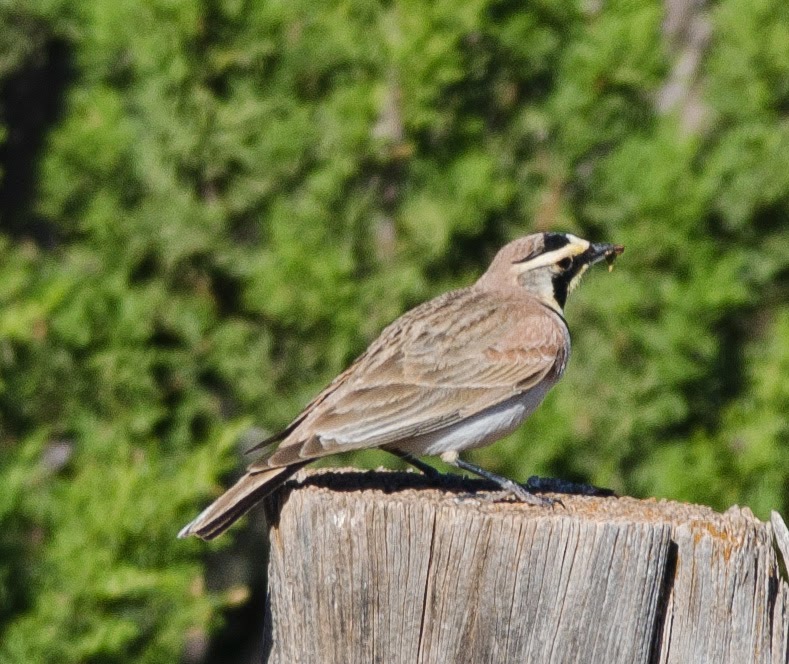
In the Zeniff area, the only photo that I able to get was one of a Horned Lark.  They were quite plentiful in the area along with both Eastern and Western Meadowlarks, a Bullock Oriole and several others.

Horned Lark

From there we headed east and south to the Pinetop/Lakeside community where we have several spots to visit.  The first was Jacques Marsh, which was a new spot for me.  Rather tricky finding the way into this area but quite the spot for birds associated with water.  On this day, the wind made the birding a little more difficult as the wind gusts were quite strong, up to 35 mph.  It is quite an extensive area with several ponds of water and lots of marshy areas.  I discovered a small flock of Canada Goose that included a leusictic one (a genetic mutation that occurs resulting in partial absence of melanin).  It occurs with some regularity in birds, but unfortunately many of the bird born with this fail to live to adulthood.  An odd colored one in a flock is an easier target for predators to focus on.  

Canada Geese - one leucistic

Canada Geese - one leucistic

We also had several Cinnamon Teal in this area and they are pretty darned close to being one of the best looking ducks around.  I have always found them a bit skittish and not always easy to capture in photos but at least one of them cooperated to some degree for me.

Cinnamon Teal

And Yellow-headed Blackbirds were in abundant numbers at this location.

Yellow-headed Blackbird

At Woodland Lake Park, we expected to see Lewis's Woodpeckers and were not disappointed. This is one of the most reliable spots to find this oddly colored woodpecker with its pinkish belly and its red facial patch.

 Lewis's Woodpecker

Lewis's Woodpecker

A Northern Rough-winged Swallow took some time out for a rest from the normal incessant flying like most swallows.  

Northern Rough-winged Swallow

At Billy Creek Trailhead we had several smaller birds including a Acorn Woodpecker and a Mountain Chickadee.  This is a spot that will need more attention in next year's count.

 Acorn Woodpecker

Mountain Chickadee

Also near the trail head and the residential area, an Abert's Squirrel attempted to hide from us by blending in with the branch of a tree.  Those ear tufts are quite an eye catching look.

Abert's Squirrel

We had a totally enjoyable day of birding and counting, even with the strong winds, so it was back to Heber for the night and a glass of wine for the evening.  The next day we were to head home, so we got up early to go to breakfast at one of the best little cafes around and found out they were not yet open, so with about 10 to 15 minutes to kill, we headed to the Navajo County Park in Overgaard and it was lucky that we did as we got to witness a fairly large flock of Pinyon Jays moving through.  Must have been 40 to 50 of them and I was finally able to get a photo of one of them to add to my photo gallery.

Pinyon Jay

Anytime one ends a birding trip with a Pinyon Jay is ending with a great bird!