Costa's Hummingbird

Costa's Hummingbird
Showing posts with label Tricolored Heron. Show all posts

Sunday, September 4, 2016

Rain or Shine

A recent 3 day trip to the White Mountains of Arizona, was just what was needed by 4 of us that needed a break from the Arizona summer heat.  We had to deal with rain off-and-on for the first couple of days, but it was so cool and refreshing, none of us were complaining. Joined by Muriel Neddermeyer, Babs Buck, and Chris Rohrer, we had a couple of target birds as our goal.  The first was the Dusky Grouse, which would be a lifer for all 4 of us. The second target species was the American Three-toed Woodpecker, which would be a lifer for 2 in the party.  It would not be a lifer for me however, as I had seen one in 2012 and after 4 years, it would be nice to see one again.  

In spite of 3 visits to the top of Green's Peak, we dipped on the Dusky Grouse, but we definitely gave it our best shot.  However, on a side note, on our second visit and walking down the trail on the north side, we were stunned to have a very brief glimpse of a Gray Wolf, trotting down the trail and quickly out of view. After that brief sighting, it helped us understand the distant unusual barking that we were hearing.  

The hunt for the American Three-toed Woodpecker ended with better results and a new life bird for both Muriel and Chris.  We checked several spots where they had been reported in the past, with the Butler Canyon Trail in Greer being the most promising location.  After our first visit and getting rained out, the second visit proved to be fortuitous for us.  Once we got far enough up the trail and into the right habitat, then it was a matter of listening and watching and waiting.  Sure enough, a male finally revealed his location.  It wasn't until it flew to a different tree that we were able to get photos. While I failed to get photos of the yellow crown on this bird, Muriel and Chris did which was very gratifying for all since it was a life bird for them.  


The rest of the photos in this blog are just some of the other interesting and cool discoveries that I found intriguing.  

 Horned Lark

 'Red-shafted' Northern Flicker

 Pied-billed Grebe - Parent and juvenile

 Pied-billed Grebe Juvenile

 Pygmy Nuthatch

 Rufous Hummingbird

 Sora
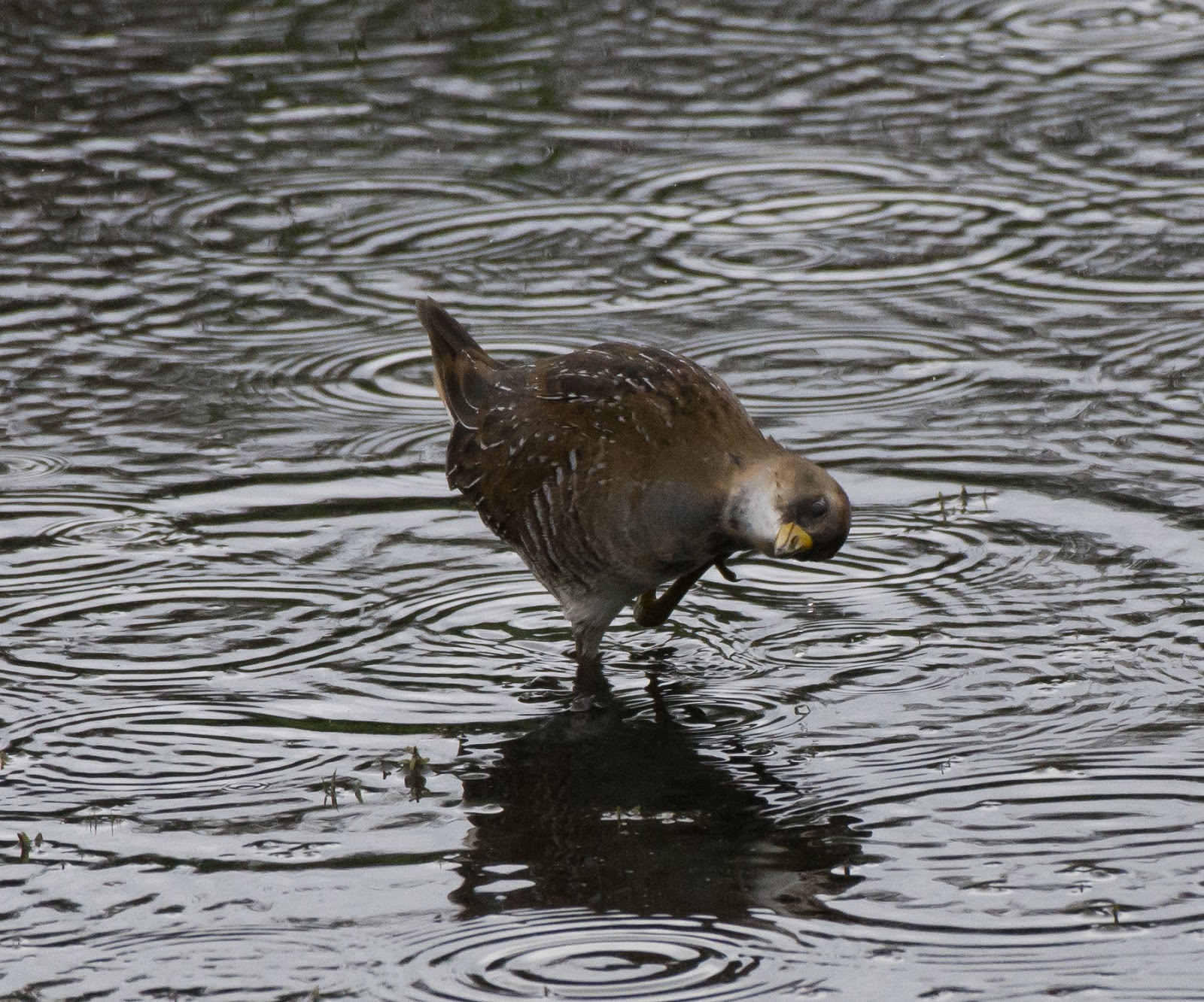
 Sora - With an itch

 Western Bluebird - Juvenile

 Western Bluebird - Juvenile

Willow Flycatcher

 Abert's Squirrel

 Cliff Chipmunk

 Unknown flower with unknown ant.

Nokomis Fritillary - A very vibrant and colorful butterfly

 American Dipper

 Lobster Mushrooom - something new to me and it is edible.

 Mormon Fritillary

 Unknown fungi

 Olive-sided Flycatcher


Williamson's Sapsucker

As we were preparing to depart this area, I received a notice from a friend that a Tricolored Heron was discovered at the Gilbert Riparian Water Ranch back in the valley.  So we hatched a plan to stop there on our return.  Yes, it took us about 3 hours to return and when we did, we quickly got a slap in the face with the triple digit temperatures.  But we persevered and went to the water ranch and split up.  Muriel was the one the found it on pond 6.  She quickly got the rest of us on it.  What a great way to end the 3 day road trip!

 Tricolored Heron


All four of us had a very enjoyable 3 day trip with some good friends and some good food in Springerville, Arizona.


Wednesday, July 16, 2014

A One Day Escape to Madera

Most generally when I think of the term 'cabin fever', I tend to think of long months of cold winter weather keeping a person confined indoors for an extended period of time.  That thinking is probably due to the fact that I can recall many cold winters in Nebraska in the past.  However, this same term can be applied to Arizona's summers; the heat can make it miserable to be outdoors in the desert.  But the summer cabin fever in Arizona does have a fairly easy cure; head to higher elevations.  So this past Saturday, I joined forces with fellow birders, Tommy DeBardeleben, Mark Ochs, and Chris Rohrer.  Tommy and I left the Phoenix area about 4:00 am and picked up Mark at Picacho Peak and then the 3 of us picked up Chris in Tucson and we headed to Madera Canyon for the day.  We had a couple of target birds that we wanted to try and locate and get photos.  We dipped on the Whiskered Screech Owl, which is a bird that I have heard before, but never seen.  We visited the Whiskered Screech Owl's nest cavity several times but never got a glimpse of them or their fledglings which were seen and photographed the day before.

The second target bird was the Plain-capped Starthroat which is native to Mexico, but every year it seems that a couple of them show up in Arizona and this year was no exception.  In fact this year seems to be a banner year as a few more than normal have been discovered.  This is a bird that I have only seen once before about 2 years ago, so seeing it again was really quite wonderful.  This is one of the larger hummingbird species and once it makes its appearance, there is no confusion of what it is compared the rest of the hummers flitting about.  It is about an inch longer than the rest at the feeders this day and its long straight bill is quite remarkable.  (While I really prefer to capture photos of birds away from feeders, sometimes one has to endure and take what one can get!)

 Plain-capped Starthroat


 Plain-capped Starthroat


Plain-capped Starthroat (with a Black-chinned Hummingbird on the left)

Late in the afternoon the feeders at Santa Rita Lodge received a visit by a male Rufous Hummingbird, that added a dynamic to the Black-chinned and Broad-billed Hummingbirds that were by far the most common species to be found at the feeders that day.

Rufous Hummingbird - on the left

We also had a couple of species of woodpeckers that returned frequently for our enjoyment.  The Acorn Woodpeckers were heard and seen quite frequently, but the most intriguing one for me was the Arizona Woodpecker.  This is another bird that I had seen on various occasions and at various locations, but have never really been able to obtain any decent photos of this species.  Well, my luck was a bit better on this day with several visits by a couple of these birds.  In the United States the range of this woodpecker is pretty much restricted to extreme southeastern Arizona and just a little bit into the southwest corner of New Mexico.  

 Acorn Woodpecker


Arizona Woodpecker

Some of the other birds that visited Santa Rita Lodge during our visit were the resident flock of Wild Turkey, Blue and Black-headed Grosbeaks, Bridled Titmouse, Mexican Jay, Hepatic Tanager, and a Sulphur-bellied Flycatcher playing with it's food, which provided a nice array of color and interest to our birds for the day at Santa Rita Lodge.

 Wild Turkey


 Black-headed Grosbeak - Male


Blue Grosbeak - Male

 Bridled Titmouse


 Hepatic Tanager


Mexican Jay

 Sulphur-bellied Flycatcher playing with prey


Sulphur-bellied Flycatcher - with prey

Late morning we decided to make a short trip down to Florida Canyon to see if we could locate the Rufous-capped Warblers, another bird that is hard to find in the United States.  While we struck out on the warblers, our consolation prize turned out to be 3 Black-capped Gnatcatchers, another Mexican species that can only be found in the United States in Arizona.  I have seen one of these birds once (or maybe twice) before, but this time I got photos that leave a lot to be desired, but that is all the more reason to search for them again and maybe find a male in breeding plumage in the future.  A couple of the keys in identification of this species is the long bill and the white underside of the tail. 

 Black-capped Gnatcatcher


Black-capped Gnatcatcher

A couple of other fine birds to find in this location were the Indigo and the Varied Bunting.  Both were a bit far off and did not allow for the best of photos, but it is hard not to attempt to snap a couple of photos anyway.

Indigo Bunting

Varied Bunting

The day was not yet over as we had seen on the list that a juvenile Tricolored Heron had been found the day before in Tucson, so when we returned to Tucson, we stopped to try and locate it.  And at that time of the day, it was resting and was pretty well hidden in a tree, but this is another fairly rare bird in Arizona.  I had seen several on my trip to Texas in April, but this was a first for me to see in Arizona.  

Tricolored heron

In the same vicinity, we found a pair of Cooper's Hawks and they must be fairly used to people as they did not seem to be as wary as most that I encounter.

 Cooper's Hawk

Madera Canyon is always a great place to visit as there seems to be no end to the wonderful birds and other critters that can be found in this area.  


Tuesday, May 6, 2014

Texas: 2nd Day, Part 2

Too many birds in one day to include all in one post, so this second part is going to focus more on waterbirds and another previously mentioned bird.  At noon, the Houston Audubon Society had another field trip and this one took us to the actual Gulf Coast and some great water birds.  First stop was Rollover Pass and the first birds we found up close and personal, were some Ruddy Turnstones.  This is one gorgeous shorebird and can really stand out in a crowd of other shorebirds.  We were so close we could see the awesome coloration of the legs and feet.  Love the black lines on the feet and the black 'knees'.

Ruddy Turnstone

Additional shorebirds included Black-bellied Plover and Wilson's Plover.    

Black-bellied Plover

Wilson's Plover

We had a total of 7 species of terns at this location, plus a Black Skimmer and of course some gulls and a few other shorebirds.  All of them were resting quite comfortably on the sand bar until an unexpected Broad-winged Hawk decided to make a brief appearance in the sky and that created pandemonium with all the birds taking flight but to return very shortly after the hawk disappeared.  

 Various terns

 Royal Tern

Broad-winged Hawk

At one brief stop near the shore, we had another 'Common' Nighthawk sitting on the ground.  Having never seen this species before this trip, now I had seen one the day before in flight, one in the morning at High Island on a wire, and now a third one resting on the ground in broad daylight.  (Be prepared to see more on a couple future posts as this was not the end of seeing this very unique bird.)

Common Nighthawk

So now back to High Island and this time my focus was to check out the rookery in Smith Oaks Woods in the afternoon.  This spot is a photographer's dream in late afternoon in spring with all the nesting and breeding birds.  They have built some great platforms that gives photographers great viewing with an abundance of subjects for your photography skills.  Here is a sampling of what I was able to capture.

 Cattle Egret

 Great Egret with chicks

Neotropic Cormorant with chicks

 Purple Gallinule

 Tricolored Heron

Tricolored Heron

 Roseate Spoonbill

 Roseate Spoonbill on nest with egg

Roseate Spoonbill

By the time this day had come to a close for me and my birding I had added a total of 15 new life birds.  Some were not photograph-able, but I did get some good looks at some.  When birding with a group, photos are always not going to happen as it is quite enjoyable to let others see these birds as well.  List for the day includes; Dickcissel, Tri-colored heron, Yellow-crowned Night Heron, Broad-winged Hawk, Tennessee Warbler, Ruby-throated Hummingbird, Rose-breasted Grosbeak, Scarlet Tanager, Red-eyed Vireo, Ovenbird, Golden-winged Warbler, Common Tern, Sandwich Tern, Hooded Warbler, and Black-throated Green Warbler.  Not a bad day at all.