Costa's Hummingbird

Costa's Hummingbird
Showing posts with label Lapland Longspur. Show all posts

Saturday, February 3, 2018

Continuing Education: Grasslands and Riparian

It did not take long for me to head back south to the grasslands of southeastern Arizona after my first trip with Barb and Jeanne.  Four days later, I was heading back again and this time I asked Kyle Waites if he would be interested in checking out some of these grasslands.  He readily accepted and off we went.  This time we headed straight to the grasslands and the longspur pond just east of the town of Sonoita, Arizona.  We arrived early, around sunrise, and it was overcast, cloudy and windy.  But we had prepared for that and we bundled up, got out our scopes and started scanning.  We actually arrived a bit too early as the only activity we had in the beginning was a few Horned Larks and Savannah Sparrows. It did not take long to hear the first of the longspurs flying in.  Once again, this was educational for me to experience their flight calls as they arrived and to also observe the flight patterns and compare those flight patterns to the Horned Lark flocks.  One can read about these details in books and hear it from other birders, but to actually experience it, it then gives a new meaning to continuing education. Hopefully, I will remember these points for the future.

On this visit I managed to capture a photo of the single Lapland Longspur that had eluded me on the first visit. Sad fact to this photo was that after finding the bird in my scope, and then trying to find it in my binoculars, when I raised my camera, I had no idea what I was seeing.  I just saw something moving in all the piles of cattle manure, I just started taking photos.  Surprised to get home and find I had the right bird.  We did manage to find and see all 3 species of longspurs;  Chestnut-collared, McCown's, and Lapland .

Lapland Longspur

Grsshopper Sparrow - Nice have this one pay a visit as well.

Pronghorn - I always love seeing these mammals.

From here we headed to the quaint and fun town of Patagonia to stop in for a visit to Paton's Hummingbird Haven which is now managed by the Tucson Audubon Society.  This place is well known to most birders in the United States as the best place to find the Violet-crowned Hummingbird.  And once again it lived up to its expectations as one came in to visit one of the feeders.  

 Violet-crowned Hummingbird


Keeping an eye to the sky!

Finding Cassin's Finches at this location was a bit unexpected and was a welcome bird to add to my Santa Cruz County list.  

 Cassin's Finch - Female


 Cassin's Finch - Male


 Lincoln's Sparrow

And of course Pyrrhuloxia is never a bad bird to see.

 Pyrrhuloxia - Male

Pyrrhuloxia - Female

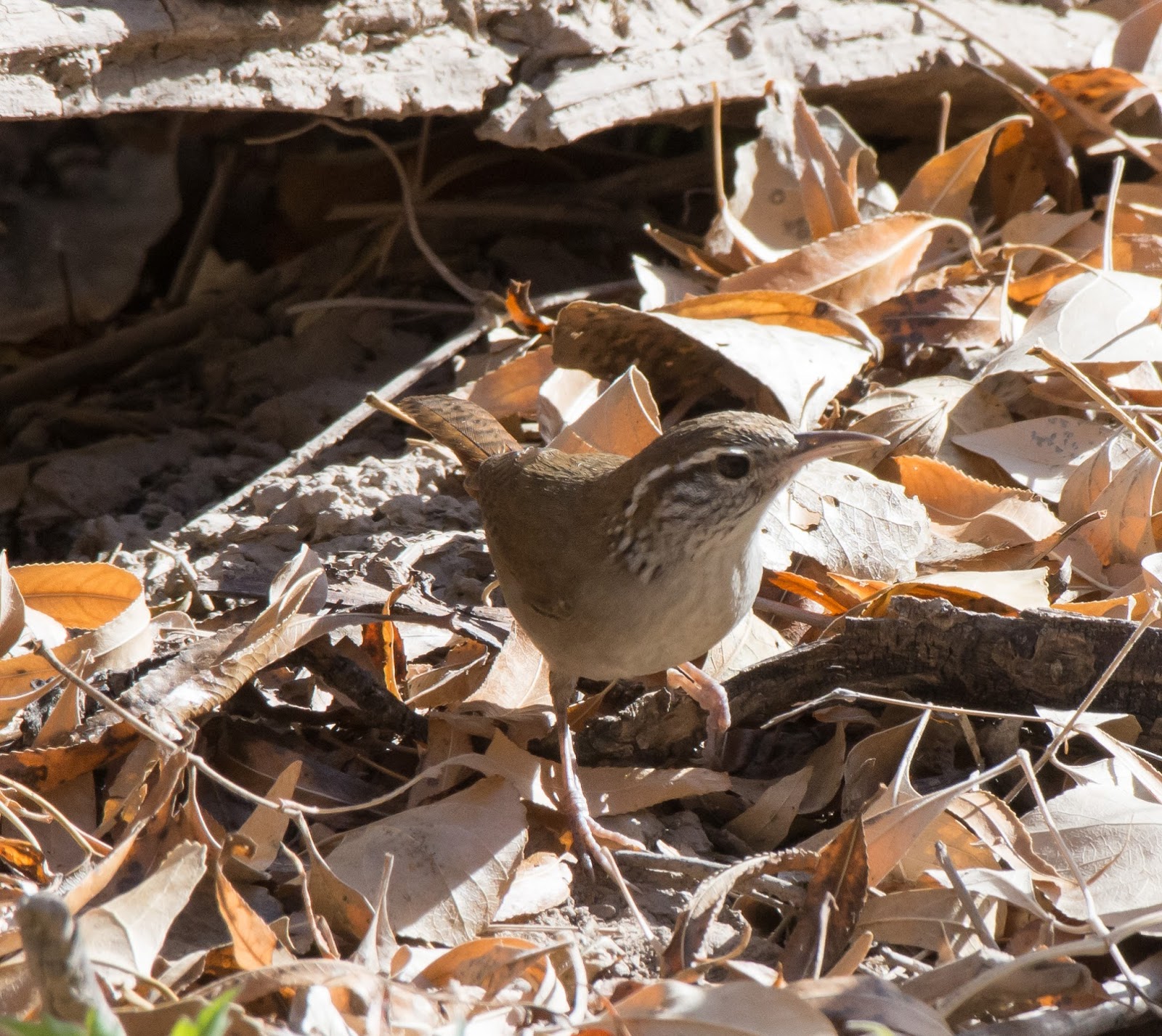
Since we were already that far south and needed to plan a route home, I suggested stopping at Santa Gertrudis Lane on the west side of the Santa Rita Mountains.  There had been reports of a Sinaloa Wren in the recent past, but it had proven to be a bit difficult to find and did not always cooperate with many birders.  Guess this day, it decided to cooperate with a few of us birders that were there. This is Mexican species that seems to be a bit more regular in the past few years in Arizona.  It has not been reported in any other state in the United States. 

Sinaloa Wren


Our final stop was at the Santa Rita Lodge in Madera Canyon, which is one of my favorite spots in the entire state of Arizona.  They have created a great setup for birders to watch and enjoy the birds.  And they have made it very friendly for the birds themselves.  

 Arizona Woodpecker


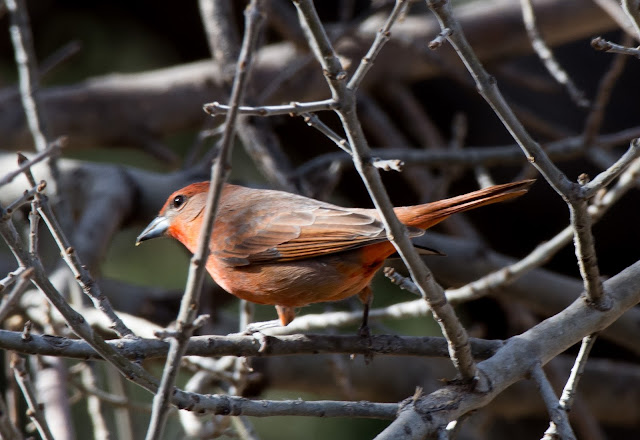
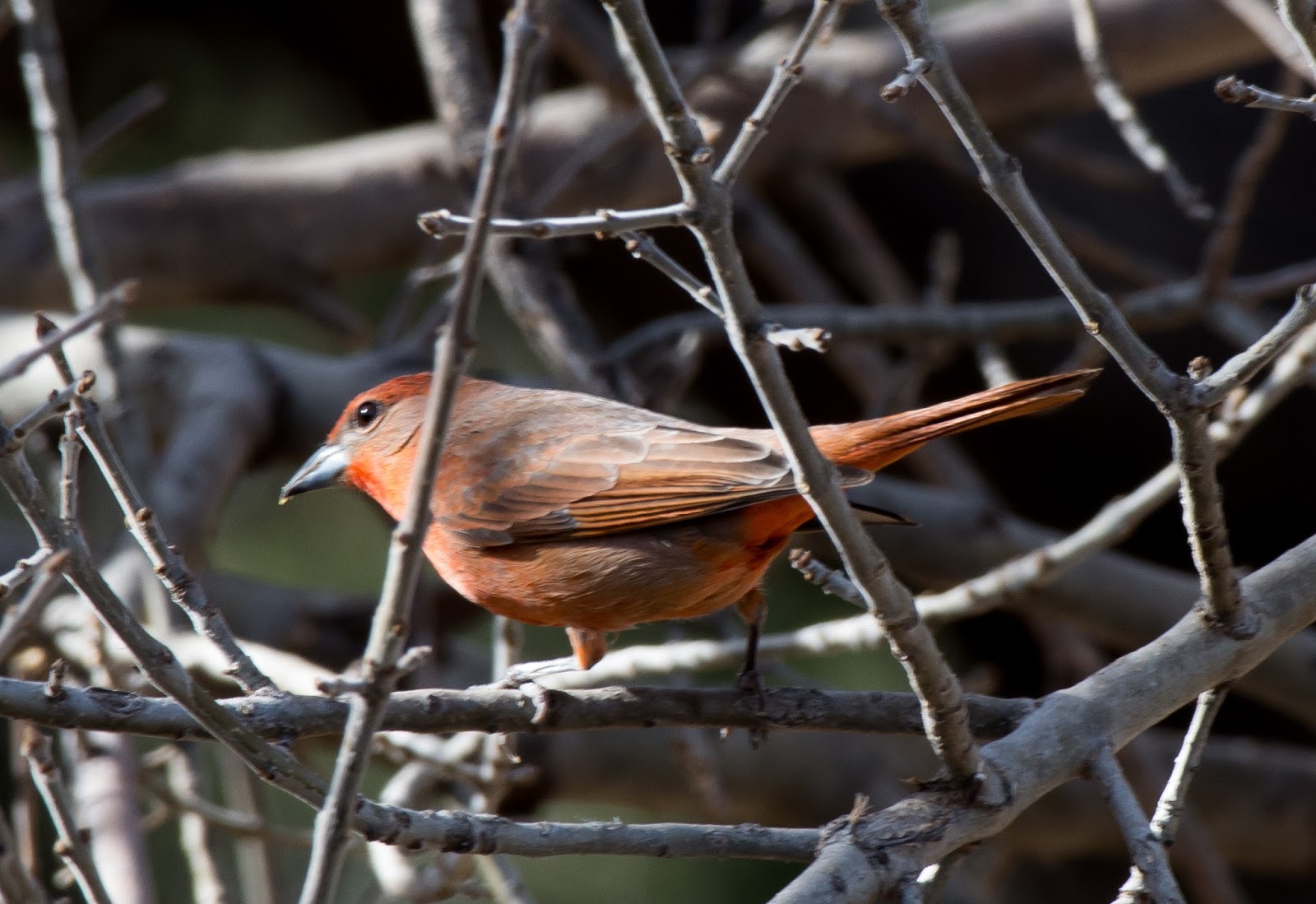
 Hepatic Tanager - Male


 Rivoli's Hummingbird


 Rufous-winged Sparrow


Wild Turkey - Male

We had an amazing day of birding and was able to see many of the southeastern Arizona specialties along with a lot of the really great regulars as well.  I believe Kyle ended up with 8 new life birds and he now knows where to find some great birds in some amazing spots in that part of the state. I am sure he will venture to the southeastern part of the state a bit more in the future.  It is amazing in the diversity of birds only a couple hours away from the Phoenix metro area.  We have our specialties as well, so many from the southeast also make the trek northward to see some of our great birds.    


Sunday, October 30, 2016

Back-door Lifers

Been quite a long time since my last post which featured the unexpected Wedge-rumped Storm-Petrel, which was an incredible new bird for Arizona and Maricopa County as well, and most importantly a new lifer for me.  Living in Arizona for over 10 years and vigorously birding for the last 6 or 7 years, I have gotten to the point that there are not a lot of regular Arizona birds that I could get for lifers.  The two that remain are the Ducky Grouse and the Black Rail.  Both are secretive and both are located on opposite sides of the state from each other in totally different habitats.  Dusky Grouse I have tried everal times and have dipped on it every time, but it will probably make its view to me when I least expect it.  The Black Rail is so secretive that very few people have actually seen one in the state.  They are most often heard.  I have been told by someone that a Black Rail could be standing 3 feet in front of you and it would practically be invisible.  

What I did not plan on, were the rarer migrants that occasionally show up within the state, and lo and behold, 3 of these birds did just that and what was more amazing were that they showed up in Maricopa County, which makes it all the more special.  The first was a Blackpoll Warbler that was found by Dale Clark in Chandler one day.  As quickly as I could get away, I made a beeline to the spot and arrived to find one other birder there that had just photographed it.  I quickly looked to the tree where it was reportedly hanging out and I could not believe how easy that bird was to see with my binoculars and take note of the field marks.  Then I decided to try for photos and by the time I lifted my camera to the spot, it had disappeared and was not seen again that day and when I tried again the next morning with several other birders, it was not seen ever again.  So I was the last person to see it, but alas, I missed out on photos.  That was the first of 4 new life birds that I have added since the Storm-Petrel.

Number 2 took place on October 10th.  With a report of a Lapland Longspur in the eastern part of Scottsdale on some agricultural farm lands, I knew that I had to make an attempt to find it.  And I knew that it would be a difficult search.  So early the next morning, I headed to the location and not surprising, I ran into Tommy D also out searching for this bird, so we headed to the spot that was given to try our luck.  While searching with scopes and listening very intently for its call, several more birders joined us, so that goes to show how special this bird can be.  While scanning and looking through all the Horned Larks and American Pipits that were in great numbers, we did hear the rattle of this bird fly over at one time, but could never find it in the fields.  Finally most people departed after not seeing it except for 3 of us and we hung around on a different road for about 30 minutes longer and were discussing that we were probably going to take off as well, when I turned around and looked across the road in front of my car and lifted my binoculars, saw a longspur next to a pipit and I quickly got the other 2 birders on them.  Luckily, I was able to get some photos before it flew away with the pipit and then eventually scared away by a Merlin that had flown in.  Getting the Lapland Longspur and photos of it as well, really made my day!

 Lapland Longspur

 The blurred bird in front is an American Pipit


Horned Lark (wanted to throw this in for something a bit more common)

About 5 days later, I noticed a post on a Facebook page that Tyler Loomis had discovered a Palm Warbler at Tempe Town Lake.  That place is less than 20 minutes form my house and even though it was late afternoon, I hopped in my car and headed out.  Yes, I had to endure a little rush hour traffic, but I got there in time to see this bird in the waning light of the day.  I hastily took some mediocre photos in the last light of the day with the ISO bumped up real high.  This was life bird number 3 in this short time span.

 Palm Warbler - early evening light


Was not happy with my photos, so I decided to go back again the next morning to see if I could refind it, but I also remembered that experience with the Blackpoll Warbler where it disappeared fairly quickly.  So I did not have very high hopes.  What a surprise to find that Tommy D had the same idea as well, as I ran into him again at this spot.  Took us a few minutes, but we re-found the Palm Warbler and this time the lighting was so much better.  I really enjoyed watching the behavior of this bird and its constant tail wagging.  

Tommy looking for the Palm Warbler

 Palm Warbler the next morning in better light


The last one that I want to mention, is the Black Rail.  Last weekend, AZFO (Arizona Field Ornithologists), held their annual meeting in Yuma, Arizona.  And Yuma is the best place to get the Black Rail in Arizona.  I attended and on Friday I had the luck of joining one of the Friday afternoon field trips and during that time, our leaders showed us the best spot to 'hear' Black Rails and they also mentioned that the month of March and a bit of early April is a better time to be hearing them.  I decided that I would get up early and head out on Saturday morning and try my luck.  What I figured out, was that it was hard to find that spot in the pitch black of the early morning, but I eventually found it and parked and then stood out in the dark listening for rails.  Great Horned Owls were calling from 4 different spots and when I clapped my hands in the dark, Virginia Rails and Sora were quite vocal.  Also heard heard Least Bitterns and Ridgeway's Rails calling.  I noticed the mosquitoes were a bit bothersome, and then glanced down at my legs to find them covered with them.  I started swatting them and found that I was leaving blood splatters on my legs.  About this time another car pulled up and lo and behold it was a couple of young birding marvels, Caleb Strand and Joshua Smith, both of which I had spent a lot of time in the past doing some birding together.  We continued to stand there listening to all the other rails and finally we heard the telltale call 'Kee-kee-der' and so I lucked out and added another new life bird.   While adding life birds by sound only is a little frustrating, sometimes, that is all a person gets which tells them the bird is there.  I can also say that I definitely donated some blood for this bird!  Would I like to actually see a Black Rail?  Of course!!!!  And a photo would be awesome as well.  It may not happen in my lifetime, but one never knows with birding what might make an appearance sometime in the future!

This gave me 5 new life birds in Arizona in less than a 2 month time frame.  Slowly but surely, I am creeping to that 700 mark!