Costa's Hummingbird

Costa's Hummingbird
Showing posts with label Northern Shrike. Show all posts

Monday, January 27, 2020

Winter's Respite

The month of January 2020, was month of highs and lows. There were two low points in the month and it was the low points that dictated my return to Nebraska and my home stomping grounds and where I grew up.  The number one low point was that my only sister lost her battle with multiple myeloma, a type of blood cancer that she had been battling for about the last nine years.  So sad to lose her, but she is no longer suffering from this terrible infliction.  During this period, I also attended the funeral of an aunt who had a great life that ended at the age of 96 years.  She was the last of my mother and father's generation.  

The weather in Nebraska in January can be a mixed bag, and during that time, that fact was true.  Had days that began with single digit temperatures that only warmed up into the 20's during the day, but also had some days that got as high as the upper 40's during the day with sunshine.  Some days were windy which exacerbated the cold, but also had some days with no wind and very pleasant.  Staying indoors all day, every day, is not usually my norm.  I had to get out when I could to revel in some nature, (plus, I had to get away from all the food that was being delivered to the house!)  I could have easily put on 20 lbs!  My sister would have encouraged me to get out and see some birds and those were the high points of the trip to Nebraska.  

Birding in Nebraska in January is not something that I have done since getting into the birding hobby, and I was able to add 10 new species to my Nebraska list during that time.  On my 2nd day there, I discovered a Marsh Wren in some dried cattails in a park near McCook.  This species is not normally a rare bird in the state by any means, but in the month of January, it is considered pretty rare and most have migrated to southern and warmer climes.  In researching eBird, I could find only 6 other reports for a Marsh Wren in the state of Nebraska for the month of January, and none of those reports were from Red Willow County, which is where I discovered this one. I first detected it by its chit-chit-chit notes and with a little pishing it popped up for a distant photo and eventually came in a bit closer for better photos.  This species can be quite shy and hard to photograph.  

 Marsh Wren


Another bird that showed up rare on my eBird report on the second to last day was Greater White-fronted Goose.  Not super rare by any means, as reporting 1 would not have been a problem, but anything over that number was rare according to the filters set for Red Willow County.  I had 24 of them.  In my one photo, I am able to count 23, could not fit in the 24th bird since it was bit further away from the main flock. Easy to count count them by counting the number of orange legs and then dividing by two.  HaHa! 

Greater White-fronted Geese - they can be identified by the orange legs and feet.

On that same outing a Trumpeter Swan flew in with two Canada Geese.  The geese landed in the pond, but the swan apparently was not impressed.  It flew around for a couple circles and then headed west.  Nevertheless, it was a new county bird for me. 

 Trumpeter Swan


Other new birds to my Nebraska list included a Northern Shrike and Harris's Sparrow.  The Harris's Sparrow kind of caught me off guard, but as soon as I saw it, I thought to myself, 'Of course, this a likely winter species in Nebraska'.  The Northern Shrike had crossed my mind as being a potential bird to find in winter, but was not sure of my chances.  Thankfully, I missed my turnoff to a lake and went about a mile north before I discovered my error and there was my Northern Shrike.  

 Harris's Sparrow

Northern Shrike

Three species of woodpeckers were nice which included both Downy and Hairy, which can be a bit confusing to novice birders.  And a Red-bellied is always a nice addition. 

 Downy Woodpecker

 Hairy Woodpecker

 Red-bellied Woodpecker


Two species of nuthatch were accommodating for photos: White-breasted and Red-breasted.  I was rather pleased with the photos of the Red-breasted.  Will have keep that one in contention for next year's calendar.  

 Red-breasted Nuthatch


 White-breasted Nuthatch


Many other winter birds were fun to observe and photograph in the cold.  Many of these are fairly common and also fairly well known.  However, when a common bird presents itself in a nice setting with the right light, I usually have no hesitation in lifting the camera for photos, as you will see in some of the following pictures.  

 American Robin - Immature

 American Robin - Adult

 Cedar Waxwing

Cedar Waxwing - Note the red on the wing feathers that look like red wax. Hence the name waxwing.   

 Blue Jay

 Northern Cardinal - Female

Northern Cardinal - Male

 'Slate-colored' Dark-eyed Junco

Bald Eagle - Juvenile, probably transitioning into 2nd year.

 American Tree Sparrow

 Black-capped Chichadee

 Cedar Waxwing

More Cedar Waxwings - This is one of my favorite birds.

My departure from Nebraska, took me back through the northeastern part of Colorado where I made a couple of stops for more birding before flying out of the Denver airport.  I added 9 new birds to my Colorado list including this Song Sparrow, which is a different subspecies than what we normally see in Arizona. 

Song Sparrow

While the trip was not a trip filled with joy, I know my sister would have been happy for me in finding and enjoying the birds that I did find during my brief forays into nature.  It is a visit and a trip that I will never forget.  All of these photos are for you Kathy.  I know you would have enjoyed them. 

For those readers that have followed this blog post to the end, I am including some photos of the old house where I spent the first 18 years of my life.  The house is now vacant but still standing.  My bedroom was in the northwest corner and when winter hit, that room was the coldest in the house. No indoor plumbing until I was about 8 or 9 and we relied on an old outhouse.  The house had stucco walls, which probably has kept it standing all these years.  Many old wooden houses that are now vacant have collapsed and fallen into disrepair.  All the rest of the original buildings on the farm are now gone, except for a couple of old steel grain bins.  From what I understand the house is occasionally used as a lodge for hunters these days.

 Hayes County, Nebraska


Saturday, February 6, 2016

The Call of the Wild: A Far North Birding Adventure - Duluth & Superior

MINNESOTA & WISCONSIN

For our second day, Josh had decided to take us to the Duluth area, which included nearby Superior, Wisconsin.  This was located about 75 miles from our base near Virginia, Minnesota, but encompasses a vastly different array of habitat and birds as these twin cities are located on the western point of Lake Superior, the largest freshwater lake in the world by surface area.  So this day meant looking for gulls instead of owls, and gulls are probably one of my weakest strengths when it comes to bird identification.  There are a couple of reasons for the tough identification of these birds.  First they are notoriously known for hybridizing which adds to the confusion of field marks.  Secondly, gulls do not mature until they are anywhere from 2 years in age to 4 years in age and each year they appear a bit different.  And on top of this, residing in Arizona, adds to the difficulty in learning ID gulls.  After all, Arizona is not considered a gull mecca by any stretch of the imagination.  Yes, we do see gulls, but not in large numbers and in large variety of species.  Earlier in January, a couple of Ivory Gulls paid a visit to this area, which is a mega rarity and it drew birders from far and wide.  Unfortunately, at least one of them perished and most likely the second did as well and we were to miss out on this specialty do to some unfortunate timing.

Gulls were not the only birds on the slate for this day.  Some other keys birds were being reported in Superior; Snowy Owl and Gyrfalcon.  And both of these birds were targets for us as well.  We started out early in the morning attempting to find Snowy Owls.  They had been reported at several different spots in Superior.  After spending an hour or more and not being able to locate any, we decided to look for the Gyrfalcon that seemed to call the Peavey grain elevators his home.  Excellent choice by this bird as the number of Rock Pigeons in this area is extremely high and a great food source from day to day.  Josh had seen a report that it had been seen a short ½ hour before we arrived and as we scrutinized and scoped the top of the grain elevator we were not having any luck, but suddenly we spied it flying in and landing on the corner of the highest point and a long distance away.  It did not stay long and it took us while to relocate it and then it actually flew towards us and landed on a roof  where we could observe it well, but still far away for great photos.  But in this case one has to take what one can get as this bird is not an easy bird to find in the lower 48.  Not only did I take photos with my camera, I also attempted to take my first digiscope photo by holding my iPhone up to Tommy's spotting scope.   The first life bird of the day for Tommy and I.

 Gyrfalcon - Digiscoped photo

 Gyrfalcon


As we were observing this bird a couple other vehicles pulled up and started watching as well and it was not long until the Gyrfalcon took flight and flew over the road behind us.  It happened so fast, but I attempted one in-flight shot as it torpedoed across the road.

Gyrfalcon

After this we headed to Canal Park in Duluth where we spent some time on the shores of Lake Superior and had to skip a few rocks across the water. 


After a short trip to Two Harbors and seeing a male Long-tailed Duck and also having lunch, we headed back to Canal Park to start observing the gulls.  Just was we pulled in, Josh received a text from one of his birding friends, Randy, and he mentioned that the Great Black-backed Gull had just showed up at Canal Park.  We rushed over as quickly as possible to see the world's largest gull and it stood out from all the others due to its size and its very dark black back and wings.  Although it stayed far out on the ice flows, we got great looks and some distant photos.  Our second life bird for the day.

 Great Black-backed Gull

 Great Black-backed Gull - Note size difference with the gull on the right.


By this time, a fairly large crowd of gull watchers had accumulated on the pier and we were treated to all of their expertise and experience, probably more for me than Tommy and Josh.  Seeing the Great Black-backed gull and then within a 30 minute time span I added 3 more new life birds, (all gulls), to my list very quickly;  Iceland Gull, Thayer's Gull, and Glaucous Gull.  Four lifers in 30 minutes is rather incredible.  Although my experience with gulls is limited, it is times like these with the experts on these birds that add to my knowledge.  Obtaining photos of them will only help me with the identification process and hopefully in the future I will learn to understand this group of birds a bit better.

 Iceland Gull


 Thayer's Gull


 Glaucous Gull


Since our search for the Snowy Owl did not do so well in the early morning, we once again headed back to the airport area in Superior and as we were driving around, Tommy spied another Northern Shrike.  This was a bird that I had seen the day before, but disappeared far too soon to get any photos.  Even though it was approaching darkness, this time I was able to at least get a photo or two for identification purposes.  

 Northern Shrike


Now we could really focus on the Snowy Owl hunt as daylight was waning.  The search for the one that had been frequenting the airport area did not make it easy, so we headed to a different area where one or two had been reported and it was not long before Josh spied one on a light pole near a Fedex building.

  Snowy Owl - Number 1

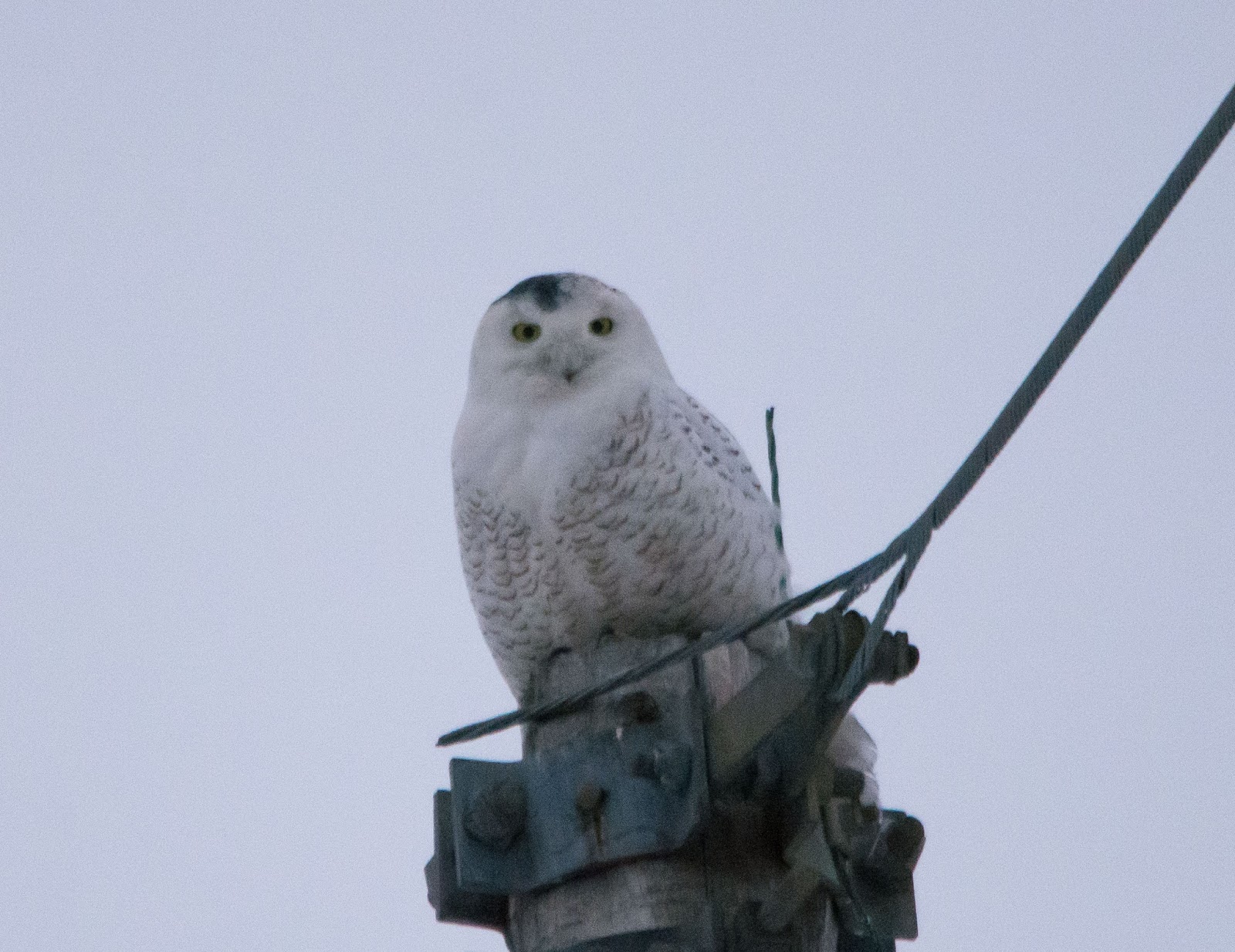
While we were attempting to get a little closer to this owl, we met another vehicle of birders and they advised us of a second Snowy Owl not too far away and about the same time, this one flew to the ground so we decided to chase the second bird and found it about ¼ mile away on a power pole.  This second bird had more white in its plumage.

 Snowy Owl - Number 2


Finally, we had seen not 1, but 2 Snowy Owls in a fairly short time span.  This is probably one of the most iconic and sought after owls in the United States by birders and non-birders.  After enjoying this second bird for some time, we did one more drive back to the vicinity of the first owl that we spied and found it on a business sign about 100 yards from its first perch on a light pole.  This time we were able to drive into the lot and get much closer to it with better looks and a bit better photos.

 Snowy Owl - Number 1 again


What another awesome day by adding 6 more new life birds, 4 of them were gulls.  Josh once again exceeded all expectations for us and day 2 was in the books as we headed back to home base.  The next day was going to be a big adventure to a part of the state that even Josh had not yet been to for birding and all of us were very excited to explore with him, but it was going to be an early start.

 Kayak on Lake Superior

 Lake Superior

Lighthouse on Lake Superior