Costa's Hummingbird

Costa's Hummingbird
Showing posts with label Scissor-tailed Flycatcher. Show all posts

Sunday, May 19, 2019

Central Texas

Central Texas has always been a target location for me to search for some birds.  Yes, the Lower Rio Grande River Valley is also high on my list, but with limited time, one has to choose their priorities when planning birding trips.  When Chris and I were planning this trip to Texas and New Mexico, one of our prime targets was the Lesser Prairie-Chicken which was covered in my last blog post.  That bird alone was the deciding factor to drive instead of fly to Texas.  

We had contacted a good friend of ours, Laurie Foss, who lives in the Austin vicinity.  She is an excellent birder and is very actively involved with the local Audubon Society in that area and she possess a wealth of knowledge concerning some of the endemics in central Texas.  She graciously volunteered to show us around and help us find some of our target birds.  I was able to add 10 new life birds on this trip, plus the 11th lifer was the Lesser Prairie-Chicken in New Mexico.

Two of the main targets were the Golden-cheeked Warbler and the Black-capped Vireo.  The warbler has a breeding range in the hill country of Texas only and no where else.  It is a habitat specialist and relies on Ashe Juniper trees to provide nesting material for their nests. They strip pieces of bark from this tree for lining of their nests. They are listed as endangered due to the fact that this specialized habitat is in jeopardy, due to urban sprawl.  Thankfully, Laurie knew exactly where this habitat could be found.  After hearing several of them calling and catching glimpses of one, I stayed in one spot and figured out a pattern of one of the calling males and then waited for it to return.  And it did, and I got great views through the trees and managed a few photos.  What a handsome warbler!

 Golden-cheeked Warbler


The Black-capped Vireo is another species that has a restricted range in the United States.  The biggest area lies in Texas, with a small area in Oklahoma and southward into Mexico.  In my humble opinion, this is probably the best looking vireo in North America.  This bird was once classified as endangered, but was removed from the endangered list in 2018 and is now classified as 'threatened'.  They too require a certain habitat called 'shinneries', which primarily consist of brushy areas with scattered trees of Shin Oak or Sumac.     

Black-capped Vireo

Other lifers that I was able to photograph were Carolina Chickadee, White-eyed Vireo, Upland Sandpiper, Black-crested Titmouse, and Eastern Screech-Owl.

 Carolina Chickadee

White-eyed Vireo

Upland Sandpiper

Black-crested Titmouse

Eastern Screech-Owl was one of the last 2 owl species of the United States that I needed.  I am still missing Boreal Owl.  (Josh W, if you are reading this, I might have to visit you some winter when the Boreal has another irruption year!)  This photo is the best view that I had of the Eastern Screech-Owl and obviously the best photos. We did manage to see a red morph as well, but my photo is far below acceptable for adding to this blog post.

 Eastern Screech-Owl

The next few photos are birds that were NOT lifers for me, but birds that I don't see that often since I live in Arizona, The Golden-fronted Woodpecker and the Sedge Wren were the first photos that I was able to obtain for these 2 species.  

 Golden-fronted Woodpecker

Sedge Wren

 Pectoral Sandpiper

 American Golden Plover - Have only seen 2 of these before.  To see 10 of them was outstanding!

 Purple Martin

 Scissor-tailed Flycatcher

Scissor-tailed Flycatcher

The two most common wildflowers were these 2 and when they occurred side by side, the color combination was outstanding!

 Texas Bluebonnet

Texas Indian Paintbrush

This butterfly represented a new species of butterfly for me.  A gorgeous Eastern Tiger Swallowtail.

This trip was really turned out to be a great adventure.  Getting 11 life birds was pretty special.  I do need to plan a trip to the Lower Rio Grande Valley someday.  There are definitely some life birds to find down there and others to boost my ABA list as well.


Monday, July 11, 2016

Southeast Arizona - Catching Up

On Tuesday, July 5th, a group of 4 of us birders decided to head south and east from the Phoenix area to try for a couple of rarities that had been reported.  The team consisted of myself, Susan Fishburn, Caleb Strand, and Josh Smith.  There were a few target birds for Caleb and Josh as they would be lifers.  No new lifers for me, but I would have the chance to add the Scissor-tailed Flycatcher to my Arizona list.  After stopping at Sweetwater Wetlands in Tucson to try to locate a Purple Gallinule that had been reported the day before, we found out that they were closed that morning to perform their weekly mosquito spraying.  So we continued on down the road to the Sierra Vista area to look for the Scissor-tailed Flycatcher.

This was not a life bird for me as I recall one that visited our farm in southwestern Nebraska when I was a kid, and then I got to see them in Texas a few years back.  Once a person sees this bird, it definitely creates a memory for years to come and I can still picture that one from my childhood in Nebraska.  Well this one was pretty easy to find and it put on quite a show for all of us and we all got great looks at it.  It was a life bird for both Caleb and Josh.

 Scissor-tailed Flycatcher


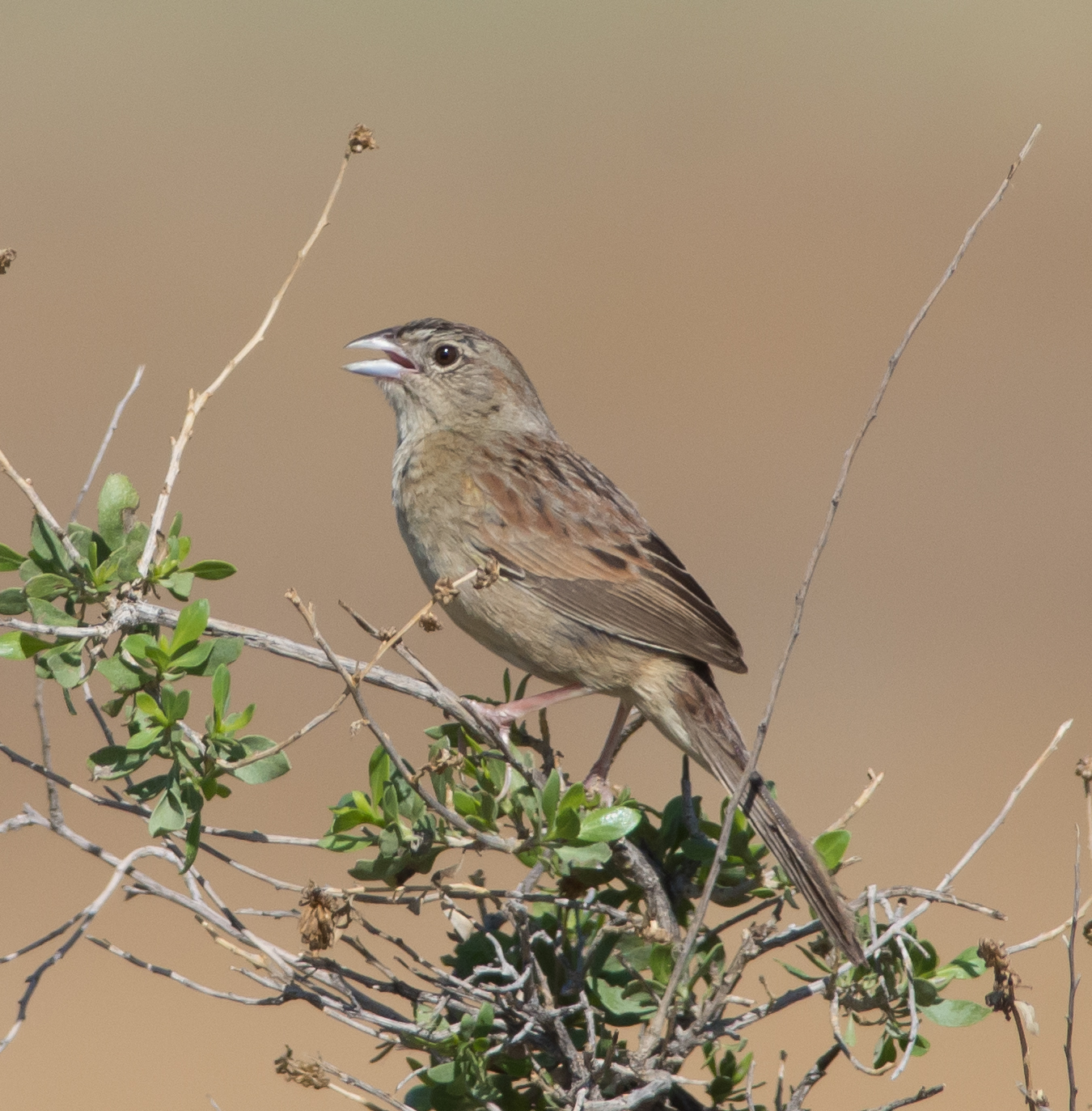
What I had not expected was the sparrows we had on the road just before the STFL.  We had Black-throated, Cassin's, and Botteri's Sparrows.  Black-throated are fairly common in and around the Phoenix area, but the Cassin's and Botteri's are not.  So to see these two species of sparrows and also being able to capture photos of them is pretty special.  

 Botteri's Sparrow


 Cassin's Sparrow


Another bird found on the road was a pair of Chihuahuan Ravens.  This is another bird I do not see too often and have never really been able to get decent photos of them.  They provided us with great views and for once some decent photos.

 Chihuahuan Raven (with a drgonfly for good measure)


By now it was staring to warm up and since we were close to the San Pedro House, we made a brief stop there where the only bird I photographed was a Barn Swallow.  But the coolest thing was a Coachwhip snake that was relaxing in one of the trees.

 Barn Swallow


 Coachwhip body

Coachwhip head

It turned out to be a great day for Caleb and Josh.  I believe Caleb garnered 3 life birds that day and Josh added 4 to his life list.  It was hot as Arizona summers usually are.  

A couple of photos to finish this post are a Cooper's Hawk at Sweetwater Wetlands and a 'Coue's' White-tailed Deer at Miller Canyon.

 Cooper's Hawk

 Coue's White-tailed Deer


Saturday, May 3, 2014

Texas: The Beginning

About a year ago, a great birding friend, Muriel Neddermeyer, returned from a birding trip to the coastal areas near Houston, Texas and brought back some incredible photos of some very different and unique birds.  I was so impressed that I decided to make the same trek myself this year.  The area is highlighted by High Island, the Bolivar Peninsula, and Anahuac National Wildlife Refuge. Timing is crucial for the most birds.  April and early May are the best times for migrating birds especially warblers.  Many of these migrants are flying straight from the Yucatan Peninsula in Mexico over the Gulf of Mexico and the first land fall is around High Island.  Of course birding is great there throughout the year, so any time is great.  

I arrived on Sunday shortly after noon and was greeted by humidity and very strong winds blowing out of the south.  These winds prevailed for all of Sunday and Monday which does affect the birding prospects a bit as a strong southerly wind helps to push those migrants further inland before making landfall.  So the weather plays a big part in a person's birding chances.  Sunday afternoon I spent driving some roads hoping to maybe find some Swallow-tailed Kites, but the wind made those chances pretty slim, but I did settle for a nice Red-shouldered Hawk on Highway 90.  This is a bird I have seen in Arizona, but it is not common there, so being able to get a fairly decent photo was a good start on a bad weather day.  Even the hawk was having trouble balancing itself against those strong southerly winds.

 Red-shouldered Hawk

Red-shouldered Hawk

I was staying in the town of Winnie, TX, so I checked in and then ventured out to drive some of the roads near there.  I came across a few parked cars of other birders that were scoping a flooded field and thankfully a couple of them were gracious enough to allow me to view through their scopes, where I picked up life birds #1, Buff-breasted Sandpiper and #2 American Golden-Plover.  Number one was too far out to get photos and number 2 was not much better, but at least good enough for ID purposes.

American Golden-Plover on the right; Semipalmated Plover on the left

After I left the group, I continued driving the roads and in doing so I found a couple of birds that I recollect from my youth on the farm in southwestern Nebraska; the Eastern Kingbird and the Scissor-tailed Flycatcher.  It was very exciting to see both again after such a long time.  The Scissor-tailed Flycatcher I had only seen once on the farm and it left a very vivid memory imprinted in my brain.  As it turned out I saw several of these magnificent birds during my stay in Texas.  

 Eastern Kingbird

Scissor-tailed Flycatcher

At other places along the road I discovered life birds 3, 4, and 5.  Number 3 was the Orchard Oriole and number 4 was the Boat-tailed Grackle.  Although I did not get photos at the time, before my trip was over I was able to photograph both of these birds in other locations.  Number 5 was the Common Nighhawk and this sighting really got me excited as it was a bird that I finally wanted to add to my list with full confidence that is was a Common Nighhawk and not a Lesser Nighhawk, which is very similar but also much more common in Arizona.  This bird was in-flight and calling its single note call that is unmistakable.  

Common Nighthawk

One last photo for this half day of birding was one of a Cattle Egret.  Another bird that is not new to me, but not overly common in Arizona, but this one is showing off some of its breeding plumage which makes it much more colorful.

Cattle Egret

So the beginning which really only consisted of about ½ day came to a close and knowing that the next day would be a full day of birding was very exciting.  Getting 5 life birds on the first ½ day was definitely a good start even if the weather did not cooperate so well.  Much more to come!