Costa's Hummingbird

Costa's Hummingbird
Showing posts with label Sulphur-bellied Flycatcher. Show all posts

Sunday, August 9, 2015

Chiapas: A Day of Rest ???

Our 5 days of guided field trips had finally come to an end and most of the group were all headed home the next day.  But Chris, being the wise man that he is, had suggested when we booked our airline flights to maybe spend a couple extra days while we were there to do some birding on our own.  And I agreed and it ended up being a very wise decision.  We were exhausted from the 5 daily field trips So we decided to take it easy on the first of our 2 free days.  A day of rest?  Not!!  No, we did not sleep all day, but had decided to check out a park across the street from our motel and maybe anything else within walking distance from the motel.  

During our entire stay so far, we had been surrounded by at least 2 species of parrots flying overhead and around the neighborhood of the motel.  We knew we had Green Parakeets and White-fronted Parrots, but we were never able to get very close for photos of either one.  Well that was about to change for both species.  We had already figured out how to identify both species in flight; the Green Parakeets had long pointed tails, while the White-fronted Parrot had a short rounded tail.  Before we got across the street a pair of Green Parakeets flew into one of the trees on our side of the street.  This is the tropics and there are many species of parrots and parakeets that are native to the tropics.

 Green Parakeets

Green Parakeets

Once we got to the park we quickly discovered White-fronted Parrots everywhere feeding in the trees.  Some were feeding on mangoes that were thick in the trees.  Thankfully these birds were quite gregarious and noisy which helped to give away their location.  Had they not been so noisy, they would have been easy to overlook and hide in the green leaves since their basic color was green.

 White-fronted Parrot


One of the most common birds that we saw in Chiapas at just about everyplace we went was the Clay-colored Thrush.  They remind me of a brown American Robin in behavior and structure.  They do not sound like our robin in the US though, as they have a varied repertoire of calls. They are so common that one person referred to them as Clay-colored Trash.  A few have been reported in the United States over the years, and when then do, they are quite the hot commodity for listers to get on their US bird list.

Clay-colored Thrush

Going to this park is a great way to get photos of some of the birds, because the ones that frequent these places are accustomed to humans and are more tolerant and allow for better photo opportunities.  Such is the case with the Great Kiskadee.  We had heard and seen them on a couple of the field trips, but here, I was able to observe them, listen to them and get some photos.  This is another bird who's range extends to southern Texas in the United States, but it was new to me.

 Great Kiskadee

Great Kiskadee

(Update:  Thankfully I have some faithful and very excellent birders reading my blog.  This next photo, I had mis-identified as Great Kiskadee, but instead they are Boat-billed Flycatchers.  I had seen this species on the trip to Sumidero, but did not get any photos, so I am glad, this photo has now been corrected with the proper ID.  Thank you Francesca and Jeanette!)

Boat-billed Flycatchers

We also found a pair of White-throated Magpie-Jays which I had seen on some earlier trips, and since it is such a unique bird, I had to take some more photos.

 White-throated Magpie-Jay


We also had a few birds that we have in Arizona that were a bit more photogenic.  Sulphur-bellied Flycatcher is annually regular in southeastern Arizona in the right habitat, but not always easy to photograph.  The Plain-capped Starthroat is being seen pretty much annually in southeast AZ as well, but definitely not a common bird and much rarer than the Sulphur-bellied Flycatcher.  The Groove-billed Ani is pretty rare in Arizona, but one does show up every few years.

 Sulphur-blllied Flycatcher


Plain-capped Starthroat

 Groove-billed Ani


Up in the trees above the river that flowed through the park we discovered a pair of iguanas.  I am not 100% certain of the species, but I believe these are called Green Iguana.  They are quite large, probably close to 4' long.

Green Iguanas

And I just have to share one butterfly with everyone on this post; a Malachite butterfly that was attracted to the remaining flesh on a mango pit that had been discarded by one of the parrots.

Malachite Butterfly

After the park, we did take a break for a while at the motel, but later in the day, we headed out and down the busy street to the west for a late lunch and surprisingly, some more birds in this humanity.  These will be covered in my next blog post.


Wednesday, July 16, 2014

A One Day Escape to Madera

Most generally when I think of the term 'cabin fever', I tend to think of long months of cold winter weather keeping a person confined indoors for an extended period of time.  That thinking is probably due to the fact that I can recall many cold winters in Nebraska in the past.  However, this same term can be applied to Arizona's summers; the heat can make it miserable to be outdoors in the desert.  But the summer cabin fever in Arizona does have a fairly easy cure; head to higher elevations.  So this past Saturday, I joined forces with fellow birders, Tommy DeBardeleben, Mark Ochs, and Chris Rohrer.  Tommy and I left the Phoenix area about 4:00 am and picked up Mark at Picacho Peak and then the 3 of us picked up Chris in Tucson and we headed to Madera Canyon for the day.  We had a couple of target birds that we wanted to try and locate and get photos.  We dipped on the Whiskered Screech Owl, which is a bird that I have heard before, but never seen.  We visited the Whiskered Screech Owl's nest cavity several times but never got a glimpse of them or their fledglings which were seen and photographed the day before.

The second target bird was the Plain-capped Starthroat which is native to Mexico, but every year it seems that a couple of them show up in Arizona and this year was no exception.  In fact this year seems to be a banner year as a few more than normal have been discovered.  This is a bird that I have only seen once before about 2 years ago, so seeing it again was really quite wonderful.  This is one of the larger hummingbird species and once it makes its appearance, there is no confusion of what it is compared the rest of the hummers flitting about.  It is about an inch longer than the rest at the feeders this day and its long straight bill is quite remarkable.  (While I really prefer to capture photos of birds away from feeders, sometimes one has to endure and take what one can get!)

 Plain-capped Starthroat


 Plain-capped Starthroat


Plain-capped Starthroat (with a Black-chinned Hummingbird on the left)

Late in the afternoon the feeders at Santa Rita Lodge received a visit by a male Rufous Hummingbird, that added a dynamic to the Black-chinned and Broad-billed Hummingbirds that were by far the most common species to be found at the feeders that day.

Rufous Hummingbird - on the left

We also had a couple of species of woodpeckers that returned frequently for our enjoyment.  The Acorn Woodpeckers were heard and seen quite frequently, but the most intriguing one for me was the Arizona Woodpecker.  This is another bird that I had seen on various occasions and at various locations, but have never really been able to obtain any decent photos of this species.  Well, my luck was a bit better on this day with several visits by a couple of these birds.  In the United States the range of this woodpecker is pretty much restricted to extreme southeastern Arizona and just a little bit into the southwest corner of New Mexico.  

 Acorn Woodpecker


Arizona Woodpecker

Some of the other birds that visited Santa Rita Lodge during our visit were the resident flock of Wild Turkey, Blue and Black-headed Grosbeaks, Bridled Titmouse, Mexican Jay, Hepatic Tanager, and a Sulphur-bellied Flycatcher playing with it's food, which provided a nice array of color and interest to our birds for the day at Santa Rita Lodge.

 Wild Turkey


 Black-headed Grosbeak - Male


Blue Grosbeak - Male

 Bridled Titmouse


 Hepatic Tanager


Mexican Jay

 Sulphur-bellied Flycatcher playing with prey


Sulphur-bellied Flycatcher - with prey

Late morning we decided to make a short trip down to Florida Canyon to see if we could locate the Rufous-capped Warblers, another bird that is hard to find in the United States.  While we struck out on the warblers, our consolation prize turned out to be 3 Black-capped Gnatcatchers, another Mexican species that can only be found in the United States in Arizona.  I have seen one of these birds once (or maybe twice) before, but this time I got photos that leave a lot to be desired, but that is all the more reason to search for them again and maybe find a male in breeding plumage in the future.  A couple of the keys in identification of this species is the long bill and the white underside of the tail. 

 Black-capped Gnatcatcher


Black-capped Gnatcatcher

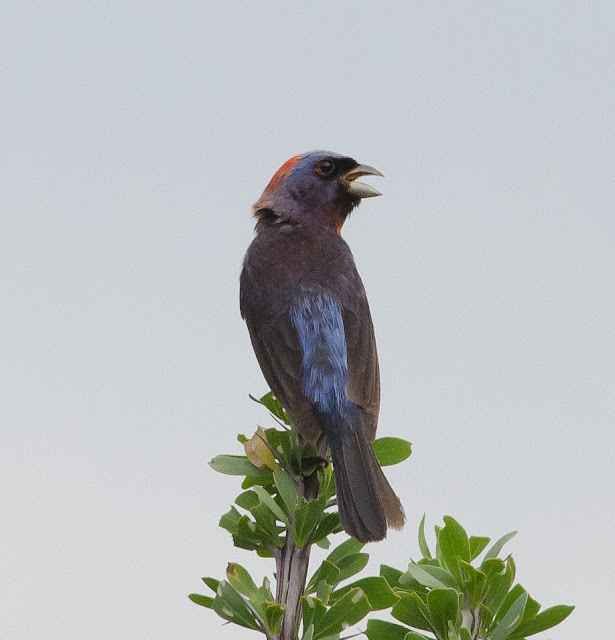
A couple of other fine birds to find in this location were the Indigo and the Varied Bunting.  Both were a bit far off and did not allow for the best of photos, but it is hard not to attempt to snap a couple of photos anyway.

Indigo Bunting

Varied Bunting

The day was not yet over as we had seen on the list that a juvenile Tricolored Heron had been found the day before in Tucson, so when we returned to Tucson, we stopped to try and locate it.  And at that time of the day, it was resting and was pretty well hidden in a tree, but this is another fairly rare bird in Arizona.  I had seen several on my trip to Texas in April, but this was a first for me to see in Arizona.  

Tricolored heron

In the same vicinity, we found a pair of Cooper's Hawks and they must be fairly used to people as they did not seem to be as wary as most that I encounter.

 Cooper's Hawk

Madera Canyon is always a great place to visit as there seems to be no end to the wonderful birds and other critters that can be found in this area.  


Sunday, September 1, 2013

Day 2 with Muriel & Tommy

After having such a successful first day of birding in SE Arizona, day 2 started early with a drive to Montosa Canyon which is on the west side of the Santa Rita Mountains.  Our goal at this location was to try and locate another rare bird that a few had seen for a couple of days, a specialty of Mexico, the Yellow-green Vireo.  From the sketchy reports, we knew it would not be an easy find and alas, it is one of the birds we missed.  There were probably another dozen birders also there looking for it and one gentleman had seen it briefly, but we were not so lucky.  We did catch a fleeting glimpse of another rare bird, the Black-capped Gnatcatcher which breeds in this canyon and a couple of other places in Arizona and no where else in the US.  The best bird that we found and photographed was one that we had all seen numerous times before, but it is not one that is easily photographed, the Varied Bunting.  It likes to hide in dense thickets most of the time, but we had some males at this location that were perching high and singing loudly. It unique coloration is also a bit difficult to capture the true colors without the right light.

 Varied Bunting

 Varied Bunting

Varied Bunting

From Montosa Canyon, we then headed to Florida Canyon which is a well known location to find the Rufous-capped Warbler.  Once again we missed this bird, but someone else had been there about 2 hours earlier and got good looks at it.  This is a spiffy little warbler with really good looks and one that I will have to return for in the future.  A great consolation prize, was a beautiful Gray Hawk along the road on the way to Florida Canyon.

Gray Hawk

We wanted to finish the day in Madera Canyon with some of its specialties.  Along the road to Madera Canyon, Muriel knew of a nice little side road to check out and so we checked it out and once again we had Botteri's Sparrows, but I also discovered an adult with a juvenile Rufous-winged Sparrow in the low part of the wash.  Was able to get photos of each and it is always nice to compare the differences between adults and juveniles.

 Rufuos-winged Sparrow, adult

Rufous-winged Sparrow, juvenile

At this same place a Spiny Lizard stuck its head out to check me out and with my zoom lens the photo kind of reminds me of something from Jurassic Park!

Spiny Lizard

One of the keys birds we wanted to find in Madera Canyon was the Sulphur-bellied Flycatcher which is probably the most colorful and interesting flycatcher to be found in Arizona.  It was not a new bird to any of us, but I have never gotten a very good photo of one.  Amazingly, we found a whole family of them; 2 adults and 3 fledglings and even witnessed one of the adults feeding one of the fledglings.  For once I got some decent photos of this wonderful bird.  Their call sounds like a squeaky dog toy, so they are very unique.

 Sulphur-bellied Flycatchers

 Sulphur-bellied Flycatcher, adult

Sulphur-bellied Flycatcher, fledgling

The flycatchers were found just a short distance from Santa Rita Lodge, so it was almost certain that we would spend some time viewing their hummingbird feeders as a Lucifer Hummingbird had recently been reported visiting this place.  Sure enough, it did not take long for this stunning male to show up and make an appearance at the feeders.  We also observed several Rufous Hummingbirds at the feeders.

 Lucifer Hummingbird

Lucifer Hummingbird

Rufous Hummingbird

This last photo of the Rufous Hummingbird also shows that the rain had started to fall, notice the couple of white lines in the background.  With that we bid adieu to Madera Canyon and headed for home.  We had all had a great weekend of birding and the trip home was quite enjoyable.  One last photo to share was a cactus within the shady trees at Montosa Canyon that was covered in blossoms ready to open.  The color was a nice stark contrast to the surrounding shady trees and the beads of dew gave it a cool and inviting look.