Costa's Hummingbird

Costa's Hummingbird
Showing posts with label Vesper Sparrow. Show all posts

Tuesday, March 29, 2016

Santa Rita Mountains Visit

One thing that I really enjoy since I retired and think I have a bit more free time on my hands, is to assist out-of-state avian enthusiasts find some of the wonderful and special birds that Arizona has to offer.  Recently, I was put into contact with one of these birders, through a mutual friend, Jennifer Rycenga.

Michael Gertz and his family was moving from San Francisco to Ohio, and Mike was going to drive to Ohio via Arizona, while his family was flying to Ohio.  We made arrangements to meet in Madera Canyon as I thought that would be the easiest place to use as a base camp for the day and a half that I had to spare and the place he might see the biggest diversity of our avian wonders.  What I quickly discovered is that Mike is an excellent birder.  He has a very good ear and a very quick eye.  He does not miss much when it comes to birding and he has studied his birds well and needed very little assistance from someone like me.  It is always fun to watch birders new to Arizona react to some of these new birds they get to witness.

After spending some time at the feeders at Santa Rita Lodge, and racking up some birds for Mike, we headed to Florida Canyon.  This past winter, several reports with photographs indicated that a male Elegant Trogon had been seen fairly frequently near the parking area.  I knew there were possibilities for other birds in this location as well and even though it was already afternoon, we decided to check it out.  We did not find the Elegant Trogon when we arrived and when we returned from the hike, so that was a miss.  However, we did have some success on the trail.  At one point, we had stopped on the trail and while we were talking, we noticed something move in the dry grass about 3 feet in front of us.  Did not get a good look so was not sure what it might be, but just a few seconds after the first movement, a second and a third critter moved and that was when we caught a good glimpse of them:  3 Montezuma Quail, rustling away in the undercover of the dried grass!  This is not always an easy bird to detect, so every viewing of one is pretty exciting.  Obviously, we were not able to get photos, but the next bird along the trail was a different story.

We had detected a gnatcatcher, and knowing that this location is a good spot for Black-capped Gnatcatcher, I had a hunch this was our bird.  (Although, we did have a Blue-gray Gnatcatcher calling earlier on along the trail.)  Arizona is about the only reliable spot in the United States to see Black-capped Gnatcatcher, and we not only got to see it and photograph a nice male, we also got to witness it in the construction of a new nest.

Black-capped Gnatcatcher


Black-capped Gnatcatcher - Nest Construction

With daylight waning, we decided to call it a day, but as dusk arrived in Madera Canyon, the calls of the Whiskered Screech Owls kept us entertained.  We even hiked up one of the trails in the dark, but they did not cooperate with us by showing themselves.

The next morning, our target was the Madera Picnic area as regular reports were coming in daily of a pair of Hepatic Tanagers were visiting the spot.  It was just a short drive to the spot, but what greeted us on the road was really quite amazing.  A Hog-nosed Skunk had apparently laid claim to the road was was sauntering down the road and pretty much staying in the middle on the double yellow lines.

 Hog-nosed Skunk


(Follow the yellow brick road.)

Once we reached the picnic area, it was just a matter of waiting for the sun to rise up over the mountains in the east.  Once that happened, then the female Hepatic Tanager flew in and followed shortly thereafter by the male.

 Hepatic Tanager - Female


 Hepatic Tanager - Male


From here I had decided to go the Patagonia Lake State Park; another spot where the Elegant Trogon has been known to spend the winter.  This place was very birdy and we had a hard time keeping to our schedule to look for the trogon, as witnessed by these next 2 photos of a Vesper Sparrow and a Broad-billed Hummingbird that we found as we headed towards the trail.  

 Broad-billed Hummingbird


Vesper Sparrow

Along the trail as we headed down, we met a few birders that were headed back up and they had informed us that they had seen the trogon and they gave us an idea as to where they had seen it.  One of the birders mentioned that there were still more birders down there watching it so it would be easy to find.  We arrived in the general area that they had mentioned and all we found was an older couple sitting on a bench looking out at the lake, so I asked them if they had seen the trogon and they said yes, they had and that it took off into a ravine back behind them and were the last to see it.  So much for getting it easy and handed to us on a silver platter.  

So the two of us headed back into the drainage area where this couple advised it had flown.  We split up a bit and were checking out any and all trees.  A Northern Cardinal male had flown into an evergreen green and was incessantly calling and singing.   I tried to ignore it, but it finally got the best of me and I went to take a look at it.  Boy did that bright red bird stand out in the shade in that evergreen.  But wait, off to the left, I noticed another splotch of red in the tree and its sure was not another cardinal.  I quickly called out to Mike to let him know that I had found it and he did not waste any time in getting there.  It was rather deep in the trees, but we found an angle that provided us some good views and photos.  We did not want to approach it any closer and cause it to fly.  Not sure that it would have as it was busily preening itself and seemed unconcerned with us.  By that time we had attracted another birder that also came in to watch and get photos.  This bird is probably one of the most sought after birds in the United States and Arizona is one of the best places to find it.

Elegant Trogon


Success in finding such a special bird is always an exciting thing and I knew this just made my day.  Even I enjoy seeing this bird anytime I can.  We had one more stop to make and that was at Paton's in Patagonia where we were going to try locating a Violet-crowned Hummingbird.  This spot is probably the most reliable spot for this hummingbird from Mexico, that just barely makes its range into the United States.  When we arrived, the other birders that were there advised us that it had been coming in and had a favorite feeder so we tried keeping our eyes on that feeder while also watching all the other birds come and go.  It did not take long for Mike to spy its arrival on its preferred feeder.
  
Violet-crowned Hummingbird

We then returned to Madera Canyon and Santa Rita Lodge as we planned to both depart early the next morning.  I was heading home to Mesa and Mike was headed to some other spots in Arizona before heading out to Ohio.  In the short time that I spent with Mike, he had accumulated 16 new lifers, but he got many more on his own at other spots.  On our return to Madera Canyon, the Wild Turkeys were still present including one Tom that was putting on a display.  Later as dusk settled in, the Whiskered Screech Owls began calling again and on this second night Elf Owls started calling as they had returned as well.  Mike caught a brief look at one of the Elf Owls, so it was a fitting end to our adventure.

 Wild Turkey - Hen


Wild Turkey - Tom

Mike is an exceptional birder and with his new residence in Ohio, he is going to have a very interesting spring and summer with all the new eastern birds that he will be exposed to this year.  Who knows, maybe someday in the future our paths will cross and I will have an opportunity to go birding with him again.  


Friday, February 27, 2015

A Windy Day Down South

On Sunday, February 22, 2015, Muriel Neddermeyer and I headed down to southeastern Arizona to search for a few rarities and along the way, we picked up Chris Rohrer in Tucson and began our quest.  Muriel had checked the forecast and found that the weather was not going to be the best for birding with some strong and gusty winds.  We decided to go for it anyway as staying at home would produce 'nothing'!  Our first stop was Huachuca Canyon to try for the Sinaloa Wren that has been there for some time.  We had mixed success with this bird.  Chris saw it briefly and called us to his location where we did not see it again. A short time later, we heard it give its infamous ratchet call, but once again it did not present itself.  We finally left there feeling a bit unfulfilled; but there will be another time. 
 
We then headed west towards the grasslands of Sonoita and Elgin where a Rough-legged Hawk had been reported recently.  This area is where the strong gusty winds made for some difficult birding.  With no wind breaks in sight, even the birds were having a difficult time.  The raptors were almost non-existent, except for a couple far off in the distance.  But the smaller grassland birds helped to make up for the miss on the RLHA.  Vesper Sparrows were fairly common, but did not flush from the grasses too often, except for one that landed on a fence near a vineyard and was desperately hanging on to avoid getting blown off the wire.
 
Vesper Sparrow
  
We also observed several flocks of Chestnut-collared Longspurs.  These birds will burst out of some tall dried grass with no warning and circle around and eventually all land back in another spot of tall dry grass.  Once they are in the grass, they are almost impossible to find.  But I somehow had a bit of fortune on this day as one of them landed on a post within camera range.  This a male just starting to molt into its summer plumage.
 
Chestnut-collared Longspurs
 

Chestnut-collared Longspur
 
Also in the grasslands, we found a mangy looking Coyote and a very impressive herd of Pronghorn.


From here we moved on to our last target bird the Yellow-throated Warbler that has spent the winter on the main street common of the small town of Patagonia.  We quickly spied a male Hepatic Tanager in a pine tree.  Even this species is a bit on the uncommon side at this time of the year. Not too long after that we all caught sight of a bird or two that flew in and Chris and Muriel were quick to see that a female Hepatic Tanager had also arrived in the tree.  Interestingly, I had noticed a much smaller bird flit in, but was having trouble re-finding it.  But with a little perseverance, I finally located it again and there was our target bird the Yellow-throated Warbler.  We then followed this bird around the tree as it foraged higher up in the limbs of the pine.  At times it seemed to disappear and then one of us would relocate it again.  We were even able to assist a couple of other people that arrived locate it as well.  This bird is fairly rare for Arizona as it is a bird that breeds in the eastern part of the United States.  Success!  Another new life bird!  Adding new life birds in Arizona is getting more difficult for me as most of the common birds have been documented.  I have to rely on some of the rarities these days to add new species. 
 
Yellow-throated Warbler
 

Yellow-throated Warbler
 

Yellow-throated Warbler
 

Yellow-throated Warbler
 
And just for good measure, here are the male and female Hepatic Tanagers.
 
Hepatic Tanager - male
 

 Hepatic Tanager - female
 
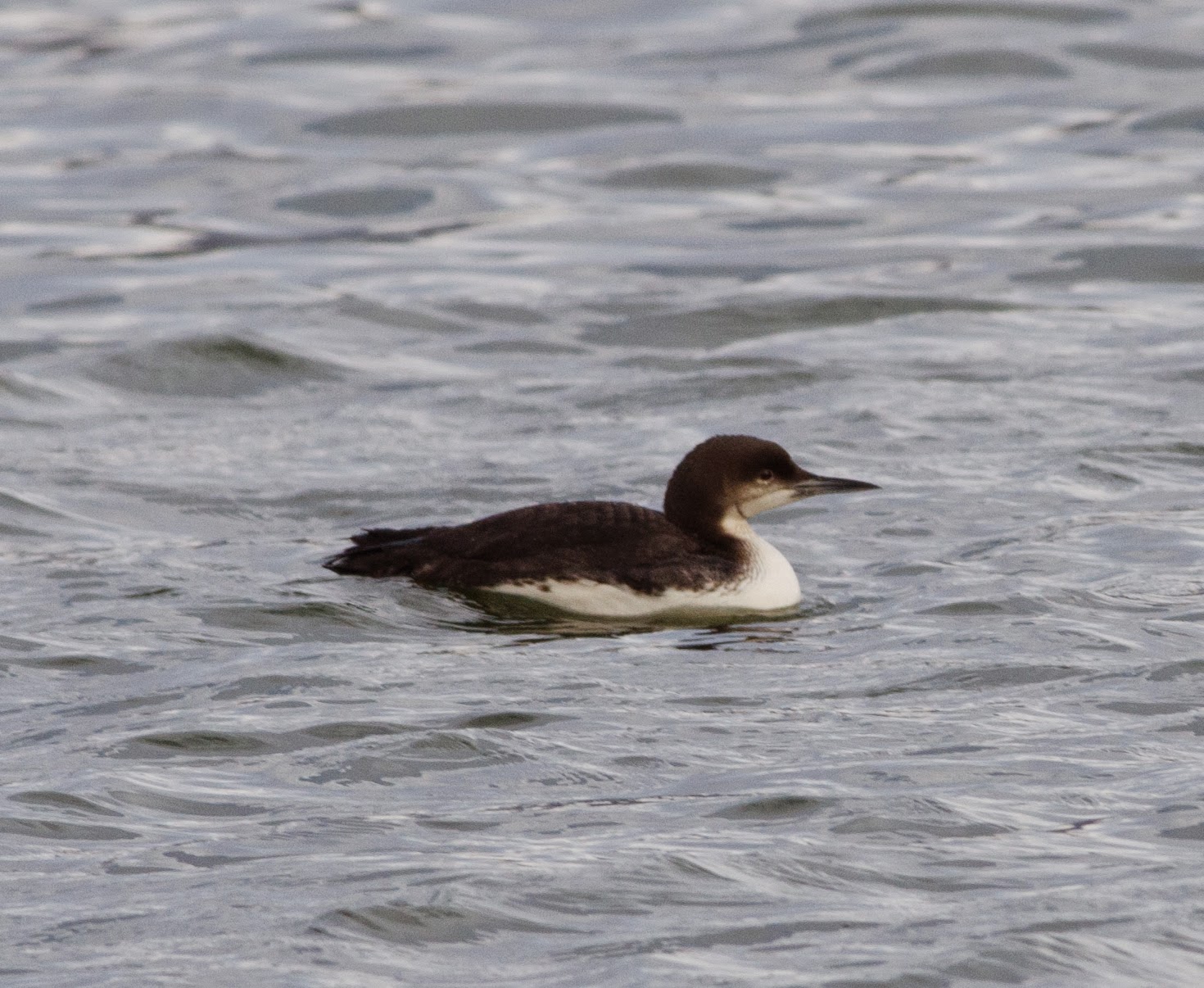
Finally we departed back for Tucson to drop off Chris and Muriel and I headed back to the Phoenix area.  But we did make one short stop at Amado Pond to check up on the Pacific Loon that has spent most of the winter in this location.  Surprisingly small pond for this bird, but it appears healthy suggesting there are plenty of fish in the pond for feeding.
 
Pacific Loon
 

 Pacific Loon
 
The wind definitely played a part in some of our success, but in some cases, some of the birds hunkered down a bit more and it added to some of our success.  Cannot complain about a little wind compared to some ugly weather in other parts of the US right now.

Friday, February 6, 2015

Buckeye/Arlington for the Third Time!

On the last day of January I had planned on taking part in a birding field trip that was being led by an extraordinary young man to some spots in the west valley in and around Buckeye and Arlington.  I have been out west twice already in January, but knowing Caleb Strand and birding with him before, I knew how good he was and I wanted to join him and support him.  Friday the rains hit Arizona and the decision was made to postpone that birding outing because of the many roads that were not paved and would be muddy.  I had already made plans to ride with 3 other familiar and great birders; Susan Fishburn, Babs Buck, and Barb Meding.  Once the four of us heard of the cancelation, we got together and decided we would go out anyway and at least try to do some birding from the paved roads and I contacted Caleb to see if he would like to join us.  He was happy to join us and with the threat of possible rain showers on Saturday, the 5 of us headed out to see what we could find. 
 
With dark clouds and an overcast sky, we started out at the infamous Thrasher Spot.  First thrasher we heard and saw was Bendire's Thrasher, but our focus was the more difficult species, the Le Conte's Thrasher.  After a bit of walking around on the northeast side, we heard a Le Conte's singing in the distance.  Eventually we found it on top of a bush singing away.  While my photos on this day did not compare to the one a couple of weeks earlier, it is still a bird I will photograph anytime I can find it. We also had sparrows in the shrubs, but they were very reluctant to show themselves very well.  Of course the most common sparrow was the White-crowned Sparrow, but we also had Sagebrush Sparrows and Bell's Sparrows.  At least on this trip, I was able to get a photo of a Bell's Sparrow, which I missed last fall when I got my first view of them.
 
Le Conte's Thrasher

Bell's Sparrow
 
 The muddy roads definitely kept us away from many places that we have like to drive to so we were definitely put at a disadvantage.  A trip down Arlington School Road presented us with a few Vesper Sparrows and one that really fits the description of 'LBJ', Little Brown Job.  Many new birders are less intrigued with sparrows due to the difficulties of identifying some of them.  Yes, it takes a lot of exposure to them to start learning how to ID them, but they are definitely worth learning and getting to know.   

 Vesper Sparrow

Vesper Sparrow
 
Also along the paved roads we did spy a few raptors, including a very wet Osprey and a handsome Peregrine Falcon.
 
 Osprey

 Peregrine Falcon

Peregrine Falcon
 
The bird that presented us the best photo op was a Burrowing Owl.  We were all looking on the left side of the car for this bird when I turned around and there it was by the car on the right side.  The windows went down and the cameras started clicking. 
 
 Burrowing Owl

 Burrowing Owl

Burrowing Owl
 
The most exciting bird of the day, at least for me, was a bird that Caleb had discovered about a week before in his neighborhood.  The Greater Pewee is a summer resident in Arizona, so just being in Arizona this time of the year is rare.  When it is a resident, it is found in higher elevations, so this lower elevation added a bit more intrigue to the find.  I have seen this bird elsewhere in Arizona several times, but had never seen it in Maricopa County and figured that I would have to find it on Mt Ord sometime in the summer.  Caleb's find was definitely a great find and nice to add to my Maricopa list.
 
 Greater Pewee

 Greater Pewee

Greater Pewee
 
This may not be the most colorful blog post, but nonetheless, there are some great birds that we got to observe on a dark and dreary day in Arizona.  Thanks to Caleb for showing us around and thanks to Susan, Babs, and Barb for joining forces and making this a great day of birding.


Tuesday, November 19, 2013

Hackberry Springs Loop Trail

A couple of weeks ago I was looking for a new trail to hike and a FB and birder friend suggested I try the Hackberry Springs Loop Trail.  (Thank you Pam Barnhart.)  So I took off after reading a link about this trail and I discovered that it is not marked with any kind of markers and I got to a point that I was not sure which fork I should take and I used my GPS app to direct me back to the trailhead parking lot.  When I researched it again, I discovered where I went wrong and today I decided to go back and give it another shot.  All I can say is WOW!  I missed a lot on the first trip and today I discovered how great this place really is.  It is beautiful and scenic and has a variety of habitats.  And the best part, almost no other hikers.  I never met one person on the first trip, and today I only met 2 other hikers.  Great solitude and lots of time to check out birds and other critters.
 
My hike around this loop was 5.8 miles in length with an accumulative elevation gain of 700' which tells you that it is not the easiest trail to hike on, but definitely not one of the most difficult.  There are some areas of scrambling over some boulders, but nothing too difficult.  I tallied 25 species of birds today which is not earthshattering, but found a really good mix and I am excited to check this place out during spring or fall migration as it appears to maybe be a good migrant trap.  If taking the trail counterclockwise, it starts out in typical desert terrain of canyons and dry washes.  It was along this stretch of trail that I got my first photos of the day and it happens to be a very handsome bird, the Spotted Towhee.  This species at one time, along with the Eastern Towhee, was lumped into one species, the Rufous-sided Towhee.  Some years ago, they were split into 2 distinct species with different ranges. Usually a somewhat shy and elusive bird, they do not always pose for photos, but spend a great deal of time like most towhees, scratching in leaf litter under shrubs and bushes.
 
Spotted Towhee
 
Eventually the trail ascended to a flat plain and along that uphill walk a Black-throated Sparrow posed for me.  This bird was the second most common bird for me on the hike today and I heard their tinkling call notes at many places along the trail and got to see many of them flying from one grassy-shrubby area to another. 
 
Black-throated Sparrow
 
At the top of this climb is a flat grassy plain interspersed with Mesquites, Cholla and Saguaro Cactus.  I was finding a lot of Northern and Gilded Flickers, Gambel's Quail, Curve-billed Thrashers, Cactus Wrens, and the most abundant species today, the White-crowned Sparrow.  Nothing rare, but it is always a delight when one can find Northern and Gilded Flickers in the same habitat. The Cactus Wrens were very vocal throughout the hike, but not too many actually made themselves visible.  Also had a lone Vesper Sparrow kind of hanging out with the White-crowned Sparrows.
 
Cactus Wren
 
Vesper Sparrow
 
This is where the trail can get a bit tricky as the trail to Hackberry Springs is not marked and one has to know where to head west.  This area being flat is very easy walking and eventually one comes to a huge canyon where the trail leads down and around.  The views are outstanding and the trail, which is rocky where you really need to watch your footing, eventually leads down to the bottom of the wash area and into the dry streambed itself.  Here is a photo of the landscape just before descending down into the wash area.  What a view!
 
View looking NE from the top of the flat plateau area just before decending
 
Once in the bottom area, a few old Cottonwood Trees were found which only adds to the great habitat for birds and other critters.  This is also where the trail starts heading south along the bed of the wash and the canyons start closing in to a narrow gorge and channel which is strewn with boulders.
 
 Entering the riparian stream bed area
 

This is the beginning of entering the narrow gorge
 
Walking through this gorge was awesome and upon emerging on the other side I discovered small pools of water in the stream bed which really adds to the flora and fauna of this area amid the dry desert landscape.  Of course water means life for more animals and birds and one of the first birds I found in this area was Rufous-crowned Sparrows.  Guess I was a bit surprised at first as this is a species that I have found only in 2 other locations in Maricopa county and both of those locations are higher altitudes.  But this is another reason that this place appears to be something special with a lot of potential.  Within 10 yards of the Rufous-crowned Sparrows a group of 4 Ruby-crowned Kinglets were also foraging in the trees and just another 20 yards down the wash I came upon the first of 2 Canyon Wrens.  This is perfect habitat for these most colorful of the North American wrens.  And with the narrow walls in this area they were fairly easy to see and photograph. 
 
Rufous-crowned Sparrow
 
 Canyon Wren Number 1
 
Canyon Wren Number 2
 
 Some of the small pools of water
 
This is a view of the narrow gorge looking back from where I walked
 
As I was making my way back to the trailhead a Black-tailed Gnatcatcher made an appearance and since it is one of my favorite birds I could not help trying to capture a couple of photos even though I have dozens of photos of this species already.  And in the process of shooting multiple shots, it decided to take flight.  Usually when that happens I end up with a photo with nothing but a branch or twig.  Well this time that split second captured the take-off flight and the underside of the tail really shows why this bird is called 'Black-tailed' Gnatcatcher.
 
 Black-tailed Gnatcatcher
 
Black-tailed Gnatcatcher
 
Of course my avian friends were not the only creatures I saw, so will leave with a few photos of these other wonderful creatures.
 
 Cloudless Sulphur Butterfly (open for corrections)
 
 Dragonfly Nymph, this was new to me, had never seen one before, under about an inch of water in one of the pools of water.
 
Red-spotted Toad
 
 Unknown Butterfly (open for identification)
 
 Orange Sulphur Butterfly
 
Arizona Desert Tarantula
 
This has to have been one of my favorite hikes with the gorgeous scenery and then to top it off all the great avian and other wildlife that I encountered.  I will be visiting this place a bit more often, especially in bird migration season to see what it might hold.  If one is a fairly experienced hiker, it is not too difficult; I would rate it as a moderate hike.  But since it is very isolated and very few people are seen, if you are unsure of yourself or getting lost, then tackle it with a bit of caution.  Now that I know the trail, I am no longer apprehensive of how to get there and get around.  (Would not want to get caught in the narrow gorge during a heavy monsoon downpour of rain!)