Costa's Hummingbird

Costa's Hummingbird
Showing posts with label Black-headed Grosbeak. Show all posts

Sunday, May 8, 2016

A Prelude to Awesomeness

With a meeting planned at Slate Creek Divide with a couple more birders, I headed out early on April 28, 2016, to do a little birding on the way.  I first visited Sycamore Creek and then Bushnell Tank which are both located on Hwy 87, also known as the Beeline Highway.  The actual visit to Slate Creek Divide will be covered in the second post and it was an Awesome visit!

My first stop was Sycamore Creek and as soon as I parked my vehicle, a Bell's Vireo was so noisy and making sure I did not ignore it.  I have the feeling that it might have been feeding young in a nest somewhere close, however, I was not able to locate a nest. But it was actively hunting insects and was carrying one morsel around as it moved from bush to bush.
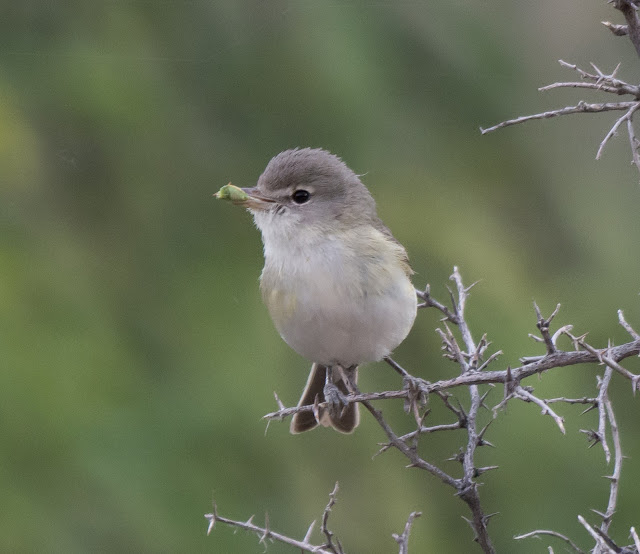
 Bell's Vireo with prey


Spring time is always a great time to enjoy the birds because many of them are migrating through Arizona.  Some have already arrived and have nested, such as the Bell's Vireo above.  But many more are still arriving.  Different species most generally have a their own migration schedule, so the viewing is an ever changing phenomenon.  

Black-headed Grosbeaks just started arriving a couple of weeks ago and are becoming more abundant. 

Black-headed Grosbeaks

Bullock's Orioles arrived a week or two before the grosbeaks, so they are probably already setting up breeding territories, as least for those that will be staying in Arizona.

Bullock's Oriole

Lucy's Warblers arrived about a month ago and many are already feeding babies about now.

Lucy's Warbler

The Zone-tailed Hawks were found at Bushnell Tank which is about 2 miles from a known nesting pair reside, so there is a good chance this is a second nesting pair, however I failed to find a nest.

 Zone-tailed Hawk


And being the nature lover that I am and intrigued by many different creatures, including butterflies, I take photos of them when offered a chance.  

 Dainty Sulphur Butterfly

 Variegated Fritillary Butterfly

Water bugs of some sort on top of the water at a small pool.

After visiting these 2 spots, I then headed up the rough and rocky road to the Mt Pelee Trailhead on Slate Creek Divide where I was planning on camping that night with a couple of others and we will going to do some nocturnal birding.  Stay tuned for part 2 of this 2 part post.


Wednesday, August 13, 2014

Hummingbirds in Arizona

This last Sunday, good friend and birder, Muriel Neddermeyer and I headed to the southern parts of Arizona specifically to check out the hummingbirds.  Arizona has more species of hummingbirds in the United States than any other state, so if a person has a love of hummingbirds, this is the place to visit.  Of course not all the species are year-round residents as some are migrants and the time of the year will dictate a lot of what one can see.  Some of the species are more common in parts of Mexico, but there is always a few that cross the border into Arizona providing for some great birds.  There are several hotspots in southern Arizona that cater to the hummingbirds and most of them ask for a nominal fee of about $5.00 when visiting their facilities.  This helps to defray their costs to keep the feeders maintained.  Trust me, that small charge is definitely a bargain to see some of these amazing hummingbirds. 

First stop was Ash Canyon B & B, which is probably the best known location to view the Lucifer Hummingbird.  It's range extends into southeastern Arizona, an extreme very small area of southwestern new Mexico, and also into the Big Bend area of Texas.  Not to be confused with the more common Costa's Hummingbird, this bird has a long curved bill that is a key identification mark.  Still have not been able to capture a photo of this bird away from a feeder, but someday I am sure with enough visits, that will happen.

Lucifer Hummingbird

We counted 6 species of hummingbirds at this location on this day, but I have been there before when I got 10 species in one day.  Broad-billed Hummingbirds were in abundance here and at the other places where we stopped.  It is another stunning bird and unfortunately, I most generally focus on photographing the males, this time I did make an attempt at getting some photos of some of the females.  I do not ever recall getting a photo of a female Broad-billed Hummingbird, so on this day I did manage to do so and am glad that I did.

Broad-billed Hummingbird - male

Broad-billed Hummingbird - female

And of course the most common hummingbird in Arizona is Anna's Hummingbird which I have throughout the year in my back yard at my feeders.  Kind of enjoyed the markings on this juvenile male with the magenta coming in on its molt in streaks and patches.

Anna's Hummingbird

Of course there are more than just hummingbirds to be found here and I just could not resist taking a few photos of some of the rest: Acorn Woodpecker, Bewick's Wren, Black-headed Grosbeak, House Finch, and the Mexican Jay.

Acorn Woodpecker

Bewick's Wren

Black-headed Grosbeak

House Finch - not a bird that I photograph very often, but this one was redder than most.

Mexican Jay

Next stop was at Beatty's B&B in Miller Canyon, just a short distance up the road.  This location is just a bit higher in elevation and results in some different habitat.  Usually one of the best places to find Blue-throated Hummingbird and White-eared Hummingbird, but this day we did not have that luck.  But we still got lots of hummingbirds including the Magnificent Hummingbirds, Rufous Hummingbirds, Broad-tailed Hummingbirds, and Black-chinned Hummingbirds.  Hope you enjoy the photos and the variety of hummingbirds, including some females.

 Black-chinned Hummingbird - female

Black-chinned Hummingbird - male

Black-chinned Hummingbird - male

Broad-tailed Hummingbird - male

 Rufous Hummingbird with yellow pollen on its bill

Rufous Hummingbird with yellow pollen on its bill

 Magnificent Hummingbird - male

Magnificent Hummingbird - male

As the afternoon was quickly arriving, we headed west to Patagonia and to Paton's Bird Sanctuary, one of the most reliable spots to find the Violet-crowned Hummingbird.  Host, Larry Morgan, is always a pleasure to visit with and is glad to help anyone find some special birds that visit this spot.  And the Violet-crowned Hummingbird did not let us down, although it did spend most of its time at the feeders, it is still a very different appearing hummingbird with that pure white throat, chest, and belly to offset that violet crown.

Violet-crowned Hummingbird

When the day was done, we had observed 8 species of hummingbirds and if we would have taken the time to visit Madera Canyon, we might have been able to add a 9th species, the Plain-capped Starthroat.  As mentioned in the early part of this blog, Arizona is an awesome state to see hummingbirds!!!


Friday, August 8, 2014

Taking Advantage of a Cool Down

As mentioned many times in previous posts, the Arizona summers in and around the city of Phoenix can be quite brutal with the excessive heat.  When one gets up before the sun rises and the outside temperature is 94° F in the dark, then you know the daytime temperature will be very uncomfortable.  That's when it is time to head to higher elevations in the summer to go birding.  But every once in a while there is a slight break in the weather especially during monsoon season and the first weekend of August was one of those times.  Our day time highs did not quite reach the 100° range and the overnight lows were in the low 80's.  With this break, I decided it was time to get out early in the morning to see what I could find in an hour or two before the sun made it miserable.

Saturday, I decided to visit one of my regular spots, Pima Canyon Wash in South Mountain Park.  I arrived while it was still dark, and I began my hike in the dark, and was listening to the Common Poorwills calling higher up on the slopes of the canyon. I could vaguely see some movement in the sky as the sky started letting go of the pitch black darkness and I figure those were the Common Poorwills remaining activity before going to roost for the day.  All of a sudden I detected another bird movement, very close and right  across the path in front of me and it was very silent, reminiscent of an owl as they are very silent flyers. Sure enough I was able to pick out and count 3 Western Screech Owls with my flashlight.  Obviously as dark as it was, I was not going to get any photos, but it was great to find them and then I made a mental note of the tree they had flown into as I wanted to check it on my return hike.  Sure enough, on the return, I approached the tree with caution and one of them was perched on a branch in the tree.  The colors blended in quite well with the tree limbs and most people would walk right by and not notice this bird sitting there.  Approaching slowly and cautiously, I was trying to get some photos as this is one bird that has been difficult to photograph mostly due to their nocturnal habits.  First photos of it consisted of squinting eyes, then they opened a bit as I got closer and once it's eyes were open and I got a couple of photos, I quickly retreated to leave it rest in peace for the day.  I have always known these owls were in this location as I had heard them many times in the past.  Looking forward to a return visit to see if this particular tree is a common roost for them.

Western Screech Owl

Western Screech Owl

Western Screech Owl

What an elated feeling and glad I made the decision to get in a short hike that morning.  Then as I approached the parking lot I stopped in the wash as I had heard a different call from a nearby tree and just about that time, a Black-headed Grosbeak flew from the distant tree into the tree I was standing under and gave me a chance at a couple of photos.  I suspect that this bird is a first fall male with that bright yellow chest and belly stripe.

Black-headed Grosbeak

Black-headed Grosbeak

Sunday, I decided to check out Glendale Recharge Ponds in the western part of Phoenix.  Some nice shore birds were being seen and I wanted to check it out.  (Have to make a mental note to try and find a reasonable priced spotting scope to use in places like this.  Those ponds are fairly large and a scope will greatly assist the viewing of the birds on the opposite shores.)  There were lots of shore birds on the two ponds that held water, including 37 Wilson's Phalaropes.  These birds are a lot of fun to watch as they forage.  They swim in circles in a spinning motion like a top to stir up larvae, crustaceans, and insects to feed on.  They were so busy spinning in circles that I was able to at least approach them close enough to get a photo or two.  

Wilson's Phalarope

Wilson's Phalarope

Long-billed Dowitchers were quite numerous as well and some were still sporting the remnants of their summer breeding plumage as was a Neotropic Cormorant.

Long-billed Dowitcher

Neotropic Cormorant

After about an hour of scanning the ponds, and the sun staring to make its mark, I decided to calls it quits for this day except for the fact that I made one last stop at the southwest corner of this area.  There is a concrete bridge here that is at the dead end road and one can park and go exploring.  Glad I stopped for a few minutes as I was treated to a couple of very nice birds; Lazuli Buntings and a Sora.  Lazuli Bunting males are downright stunning in breeding plumage and usually we see them in and around Phoenix only in migration in the spring and in the fall.  Springtime sightings are a hit or miss on the breeding plumage, but early fall can be a great time to see them so colorful.

 Lazuli Bunting

 Lazuli Bunting

As I was observing these colorful birds from the bridge, I also caught glimpse of a Sora that flew into the area.  Always a great bird to see as they can be a bit secretive most of the time.  But of all the rails, this species is not as shy as the rest.

Sora

As an added bonus, a first year male Red-winged Blackbird also paid a visit.  Not a bird that I usually spend a lot of time observing, but that bright red patch on the wing really stood out, giving an indication of how handsome it would be next spring.

Red-winged Blackbird - first year male

So two short excursions turned into some nice birds when I was least expecting to find much in the heat of the summer.  Just shows that even with the heat, many birds are doing well.


Wednesday, July 16, 2014

A One Day Escape to Madera

Most generally when I think of the term 'cabin fever', I tend to think of long months of cold winter weather keeping a person confined indoors for an extended period of time.  That thinking is probably due to the fact that I can recall many cold winters in Nebraska in the past.  However, this same term can be applied to Arizona's summers; the heat can make it miserable to be outdoors in the desert.  But the summer cabin fever in Arizona does have a fairly easy cure; head to higher elevations.  So this past Saturday, I joined forces with fellow birders, Tommy DeBardeleben, Mark Ochs, and Chris Rohrer.  Tommy and I left the Phoenix area about 4:00 am and picked up Mark at Picacho Peak and then the 3 of us picked up Chris in Tucson and we headed to Madera Canyon for the day.  We had a couple of target birds that we wanted to try and locate and get photos.  We dipped on the Whiskered Screech Owl, which is a bird that I have heard before, but never seen.  We visited the Whiskered Screech Owl's nest cavity several times but never got a glimpse of them or their fledglings which were seen and photographed the day before.

The second target bird was the Plain-capped Starthroat which is native to Mexico, but every year it seems that a couple of them show up in Arizona and this year was no exception.  In fact this year seems to be a banner year as a few more than normal have been discovered.  This is a bird that I have only seen once before about 2 years ago, so seeing it again was really quite wonderful.  This is one of the larger hummingbird species and once it makes its appearance, there is no confusion of what it is compared the rest of the hummers flitting about.  It is about an inch longer than the rest at the feeders this day and its long straight bill is quite remarkable.  (While I really prefer to capture photos of birds away from feeders, sometimes one has to endure and take what one can get!)

 Plain-capped Starthroat


 Plain-capped Starthroat


Plain-capped Starthroat (with a Black-chinned Hummingbird on the left)

Late in the afternoon the feeders at Santa Rita Lodge received a visit by a male Rufous Hummingbird, that added a dynamic to the Black-chinned and Broad-billed Hummingbirds that were by far the most common species to be found at the feeders that day.

Rufous Hummingbird - on the left

We also had a couple of species of woodpeckers that returned frequently for our enjoyment.  The Acorn Woodpeckers were heard and seen quite frequently, but the most intriguing one for me was the Arizona Woodpecker.  This is another bird that I had seen on various occasions and at various locations, but have never really been able to obtain any decent photos of this species.  Well, my luck was a bit better on this day with several visits by a couple of these birds.  In the United States the range of this woodpecker is pretty much restricted to extreme southeastern Arizona and just a little bit into the southwest corner of New Mexico.  

 Acorn Woodpecker


Arizona Woodpecker

Some of the other birds that visited Santa Rita Lodge during our visit were the resident flock of Wild Turkey, Blue and Black-headed Grosbeaks, Bridled Titmouse, Mexican Jay, Hepatic Tanager, and a Sulphur-bellied Flycatcher playing with it's food, which provided a nice array of color and interest to our birds for the day at Santa Rita Lodge.

 Wild Turkey


 Black-headed Grosbeak - Male


Blue Grosbeak - Male

 Bridled Titmouse


 Hepatic Tanager


Mexican Jay

 Sulphur-bellied Flycatcher playing with prey


Sulphur-bellied Flycatcher - with prey

Late morning we decided to make a short trip down to Florida Canyon to see if we could locate the Rufous-capped Warblers, another bird that is hard to find in the United States.  While we struck out on the warblers, our consolation prize turned out to be 3 Black-capped Gnatcatchers, another Mexican species that can only be found in the United States in Arizona.  I have seen one of these birds once (or maybe twice) before, but this time I got photos that leave a lot to be desired, but that is all the more reason to search for them again and maybe find a male in breeding plumage in the future.  A couple of the keys in identification of this species is the long bill and the white underside of the tail. 

 Black-capped Gnatcatcher


Black-capped Gnatcatcher

A couple of other fine birds to find in this location were the Indigo and the Varied Bunting.  Both were a bit far off and did not allow for the best of photos, but it is hard not to attempt to snap a couple of photos anyway.

Indigo Bunting

Varied Bunting

The day was not yet over as we had seen on the list that a juvenile Tricolored Heron had been found the day before in Tucson, so when we returned to Tucson, we stopped to try and locate it.  And at that time of the day, it was resting and was pretty well hidden in a tree, but this is another fairly rare bird in Arizona.  I had seen several on my trip to Texas in April, but this was a first for me to see in Arizona.  

Tricolored heron

In the same vicinity, we found a pair of Cooper's Hawks and they must be fairly used to people as they did not seem to be as wary as most that I encounter.

 Cooper's Hawk

Madera Canyon is always a great place to visit as there seems to be no end to the wonderful birds and other critters that can be found in this area.