Costa's Hummingbird

Costa's Hummingbird
Showing posts with label Great Horned Owl. Show all posts

Sunday, April 5, 2015

AAAA+ - An Amazing Arizona Adventure (Part 2)

After dropping Josh off at his hotel and family in Green Valley on Tuesday night, Tommy and I headed back to Madera Canyon to set up camp at Bog Springs Campground.  While Tommy and I were discussing the best place to try and locate the Elegant Trogon search for the next day, Josh was busy in the motel checking out the latest reports of this bird on eBird.  Josh texted us stating that two days prior there was a report of 2 male Elegant Trogons in Madera Canyon about ¼ a mile from the parking lot and on the Super Trail.  So Tommy and I decided to try scouting this trail before darkness set in and away we went.  Discovered it was a great trail and prime habitat for the Trogon, but we did not detect one in the twilight, however we did hear one calling a bit up on the ridge from the actual trail.  So plans were made to pick up Josh early in the morning and hike the Super Trail and hope for the best.
 
With darkness setting in on Madera Canyon, Tommy and I decided to see if we could hear any owls when total darkness descended on the canyon.  We were hanging out in the Amphitheater parking area listening to the Wild Turkeys settle in for the night when suddenly Tommy heard a Whiskered Screech-Owl calling.  We took off on foot towards the hooting and within 5 minutes, Tommy had located one of them with his flashlight, just waking up from a day of slumber. This is a bird that I have heard before and already added it to my life list as a 'heard only' species.  So this was a real treat for me to actually see one for the first time. I was surprised at how small they are at only 7¼ inches, which is about a inch smaller than the Eastern and Western Screech-Owls.  The range of this species is predominately in Mexico, but it does reach into southeastern Arizona and possibly a very tiny area of New Mexico.  Now my camera, does not do well in low light situations, so I was not expecting much in the way of photos and I am not fond of using my flash on nocturnal birds.  So I bumped my ISO up to 3200 and hoped for the best with light from Tommy's flashlight.  He would shine it on the owl briefly for a couple of photos, then point it away to avoid continual light in its eyes.  All my photos were taken without a flash and I was quite pleased with how some of them turned out considering this is a nocturnal bird that is going to be hard to photograph.  While we were watching the first owl, we heard a noise behind us and turned around to find a second one had landed in a tree behind us and had a lizard in its grasp and its wings spread out.  We later found another one, but it may have been one of the first 2; we are not certain on that.
 
 Whiskered Screech-Owl
 
 Whiskered Screech-Owl
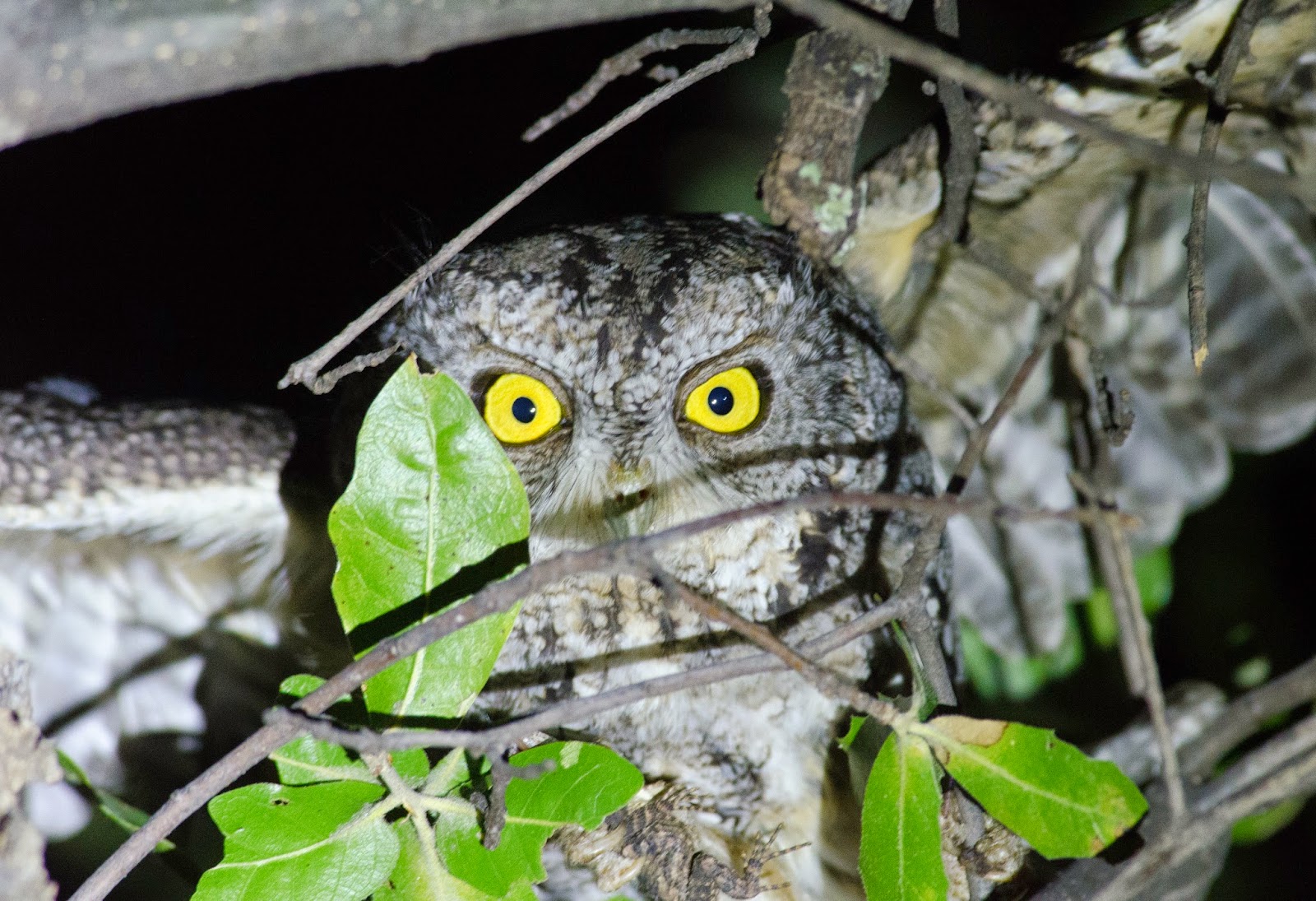
 
 Whiskered Screech-Owl - Note lizard foot in bottom of photo
 
 Whiskered Screech-Owl
 
Whiskered Screech-Owl
 
We also heard and got some brief views of Elf Owls, but were not able to get photos.  What an incredible time birding at night. 
 
The next morning we picked up Josh and we were lucky to have his son Evan join us for the morning of birding.  This youngster has quite the eye and loves to add birds to his life list as well.  We headed straight to the Super Trail at the top parking lot in Madera Canyon.  We had not traveled far on the trail when Josh quickly pointed out an unusual mammal coming down the trail towards us.  It just happened to be a Hooded Skunk.  I have seen many skunks in my life, but not this species and it was quite a treat.  When it sensed our presence, it quickly left the trail and went down to the stream bed leaving us to contend with photos from above. 
 
 Hooded Skunk
 
Hooded Skunk
 
As we headed up the trail, we finally heard an Elegant Trogon and we pursued the sound and were treated to some brief views of it.  I tried to keep my eyes focused on where it landed as it moved up the slope so that Josh and Evan could get some good looks of it and some photos.  This was the number 1 target bird for Josh and we were happy that we found one for him on this trip.  Although it was not the most cooperative for photos, it still is a fantastic bird to find in the United States. (The photo that I am including in this post, is one that I captured in 2013.  Wanted to include a photo of this really awesome bird so others understand why this is so special for Josh, Evan and many others.)
 
Elegant Trogon (photo from 2013)
 
After another search that was deemed successful, we headed back down the trail and just before we reached the trailhead, a small flock of Bridled Titmouse made an appearance and it has to be one of the cutest little birds around. 
 
 Bridled Titmouse
 
Bridled Titmouse
 
We stopped for a short time near the Santa Rita Lodge and found this Band-tailed Pigeon.
 
Band-tailed Pigeon
 
We then returned Josh and Evan back to the motel in Green Valley so they could check out with their family.  But they took out a little time to show Tommy and me a pair of Great-horned Owls that Evan had discovered the day before hanging around the motel.  We took an elevator to the 3rd floor and once the elevator door opened, there was one on them viewable on the roof just outside the window.  Another one was trying to remain unseen in one of the palm trees outside. 
 
 Great-horned Owl
 
 Great-horned Owl - Photo taken through window of hotel
 
 Great-horned Owl - Photo taken through window of hotel
 
 Great-horned Owl
 
Great-horned Owl
 
What an incredible two days of birding!  Anytime someone gets the privilege of seeing an Elegant Trogon it is a great day of birding.  Really enjoyed my time birding with Tommy and also meeting Josh and Evan and being able to find some cool birds.  A very enjoyable two days.  (Now to start planning on owling in Minnesota in the winter in the future!!!!) 


Sunday, October 12, 2014

A Weekend of AZFO Activities

The first weekend in October is usually the weekend that AZFO (Arizona Field Ornithologists) holds their annual gathering.  Every year it is held in a different location which is a great way to introduce others from around the state to new spots for birding.  This year the meeting was held in the Globe/Miami area in Arizona and since the Pinal Mountains are close by, I was familiar with a bit of the area.  The meeting was being held on Saturday, but there was a couple of mini expeditions set to take place on Friday afternoon.  Chris Rohrer decided to attend so he drove up from Tucson and we met on Friday morning to make a quick trip into the Pinal Mountains as he had never been there before.  Knowing the time we had to work with, we hurried through many of the spots I would normally stop at as I wanted to get Chris to the top.  Turned out to be a very lucky plan because we found some really great birds at the top.

The first bird that caught our attention flew over our heads from the rear and quickly flew on the back side of some pine trees, but it quickly returned and it turned out to be a Lewis's Woodpecker.  Not a rare bird in Arizona by any means, but one that I had never observed in Gila County.  While the photo is not the best, it is at least diagnostic of the species.

Lewis's Woodpecker

About the same time that I was trying to get some photos of this bird on the other side of a small pond, Chris noticed a Band-tailed Pigeon in one of the oaks on the south side. Once again, not a rare bird, but a bit uncommon and not always easy to find and photograph.  My previous sightings only consist of one photograph of the bottom end of one of these birds, but high up in a pine tree snag.  This one was cooperative with us for photos, but the angle of the sunlight was not where we would have preferred.  Regardless, it was nice to get some identifiable photos of this bird.

Band-tailed Pigeon

Band-tailed Pigeon

Band-tailed Pigeon

As we were really enjoying the moment with good looks of these 2 species of birds, another small flock of smaller birds flew over and into the tops of the pines.  Once again this was another bird that was new to me for this location.  In fact, this same bird was a life bird for both Chris and I back in February of this year; Cassin's Finch.  I believe this made the 3rd sighting of this bird for us this year.

 Cassin's Finch

Cassin's Finch - There are 3 of these birds in this photo

It would have been great to have more time to explore this area, but since we had to be back into Globe by about noon, we did not have the luxury of excess time on our hands.  Even though it was a relatively quick trip up and back, we did find some remarkable birds.  

We had signed up for a mini Field Expedition in the afternoon to visit Timber Campground and Jones Water Campgrounds so we met up with the very large group that had signed up.  Both spots offered great birding but as usual, afternoon birding is not always the best time to explore.  We did get to see some really nice birds, but photography was not at its best except for a Bridled Titmouse.  Both spots are now on my list of places to visit and spend more time exploring.  

Bridled Titmouse

The meeting on Saturday was a success with lots of great presentations and information to be absorbed.  Sunday we had signed up for the Sierra Ancha Wilderness area field trip and we were introduced to some amazing wilderness with outstanding scenery.  The first stop included an inside viewing of the habitat near the Rossevelt Lake Diversion Dam.  We had a lot of birds and had a great time, unfortunately, my only photos for that day consisted of an Ash-throated Flycatcher and a Gray Flycatcher.  

 Ash-throated Flycatcher

Gray Flycatcher

When we returned to the entrance area we discovered a Great-horned Owl on the steps to the restrooms.  The owl will probably never know how lucky it was to be found by this group of humans.  There were several in the group that were familiar with rescue and rehabilitation.  It was captured and found to be very emancipated and it was then transported to Liberty Wildlife in Scottsdale, AZ and was found to have suffered a leg fracture that had already started to heal.  It was given food and an IV for re-hydration and is expected to make a full recovery.  That was good news to all.

Great-horned Owl

This was a great weekend for Arizona birding.  Got to see many birding friends and meet many more.  Definitely will be an annual event for me.  In ending this post, just want to share a couple of other photos that I got on this weekend of things other than birds.

 Brown Trout

 Flame Skimmer


 Coyote Gourd

 Hackberry Emperor

Painted Lady


Tuesday, July 8, 2014

Summer Birding in the Desert

Most people are aware of how hot it can be in and around the Phoenix vicinity in the summer.  Daytime temperatures are consistently over 100° F every day and can range upwards to 119° F on the most extreme side.  Needless to say, that kind of heat creates more challenges for birders as it gets to be unbearable to be outdoors and in the sun for any length of time.  Even in the shade it is downright HOT.  The only logical thing to do is to try getting an hour of birding in the very early morning before the sun starts beating down.  Personally, I prefer to get out of the Phoenix valley area and head to upper elevations where the temperatures moderate quite a bit and the night time lows make a big difference in morning birding.  Near the Phoenix area, even the night time lows might only fall to about 90° F, which is not much relief.  

There are birds to be seen in this heat and it amazes me that some survive these 2 to 3 months of extreme heat, but they do.  This heat makes for proper planning for any kind of a birding trip.  But even locally, one has the chance to see some wonderful and awesome birds in the heat of the summer.  One recent warm Sunday morning I ventured out with a mission to try and get a photograph of a Barn Owl and I met up with a couple of other birders, Pam Barnhart and Louis Hoeniger at about 5:30 in the morning..  I have seen Barn Owls several times, but most generally they are rather skittish and spook quite easily and all I get to see is the view of it flying away.  This time, we had much better luck and one was sitting tight and not too concerned with my presence.  Yes, the eyes appear to be closed, but I think it was only squinting and was keenly watching us.  After all, daytime is usually their roosting time and one should avoid stressing them by getting too close.

Barn Owl

Barn Owl

Also in the same area a Great Horned Owl was trying to find a roost for an undisturbed day of resting.  And only a mile a way, a pair of Burrowing Owls were seen along the road side near their burrow and perched on the power lines above.

Great Horned Owl

Burrowing Owl

Burrowing Owl

Burrowing Owl

Always nice to find 3 species of owls in one day, but there were other birds as well.  Had the opportunity to see a couple Least Bitterns in flight which did not present any photos, but a female Black-chinned Hummingbird, a Gambel's Quail, and an oddly colored singing Blue Grosbeak all allowed a couple of photos.

Black-chinned Hummingbird - Female

Gambel's Quail

Blue Grosbeak

Once 8:00 AM rolls around, you quickly realize that summer is here and it is high time to seek cooler environments, such as air conditioned homes or vehicles.  It made for a short time for birding, but it was a trip that was necessary for me and my urgent need to see and observe more birds.  Have some cooler trips planned for later on this summer to escape the heat of the desert, and when fall rolls around, then it is a free for all and some great birding.   

Sunday, September 15, 2013

Not Again! (Yes, another post on Pima Canyon Wash)

This will be the last post from this location for awhile.  Been hitting this trail kind of hot and heavy recently for a couple reasons.  1. I need to get myself in shape for an upcoming hike to Tom's Thumb which is a bit more strenuous as it has an altitude gain of almost 1100 feet which can be a bit of a challenge.  2. I have recently found some new and incredible birds at Pima Canyon Wash that make me want to go back to check them out a bit closer.  One of those birds is the Common Poorwill which is one of those nocturnal birds belonging to the family of Goatsuckers.  A week ago I arrived very early, before the sun was up and I heard a bird calling from up on the banks of the canyon that I was unfamiliar with.  I narrowed it down to one of the species in this family since it was nocturnal and calling while it was pitch black out and after listening to the Common Poorwill's call, I knew immediately what it was.  I had never encountered this bird there before, but then I have never went birding out there in the dark.  There is a good chance that this species has been there all this time and perhaps even breeds in this location.  Since then I have gone out while it was dark in hopes of actually finding one.  That is going to be a tough mission to accomplish as they sit on the ground or rocks in the daytime, completely motionless and they blend in so well you would never see them unless you stepped on it.  

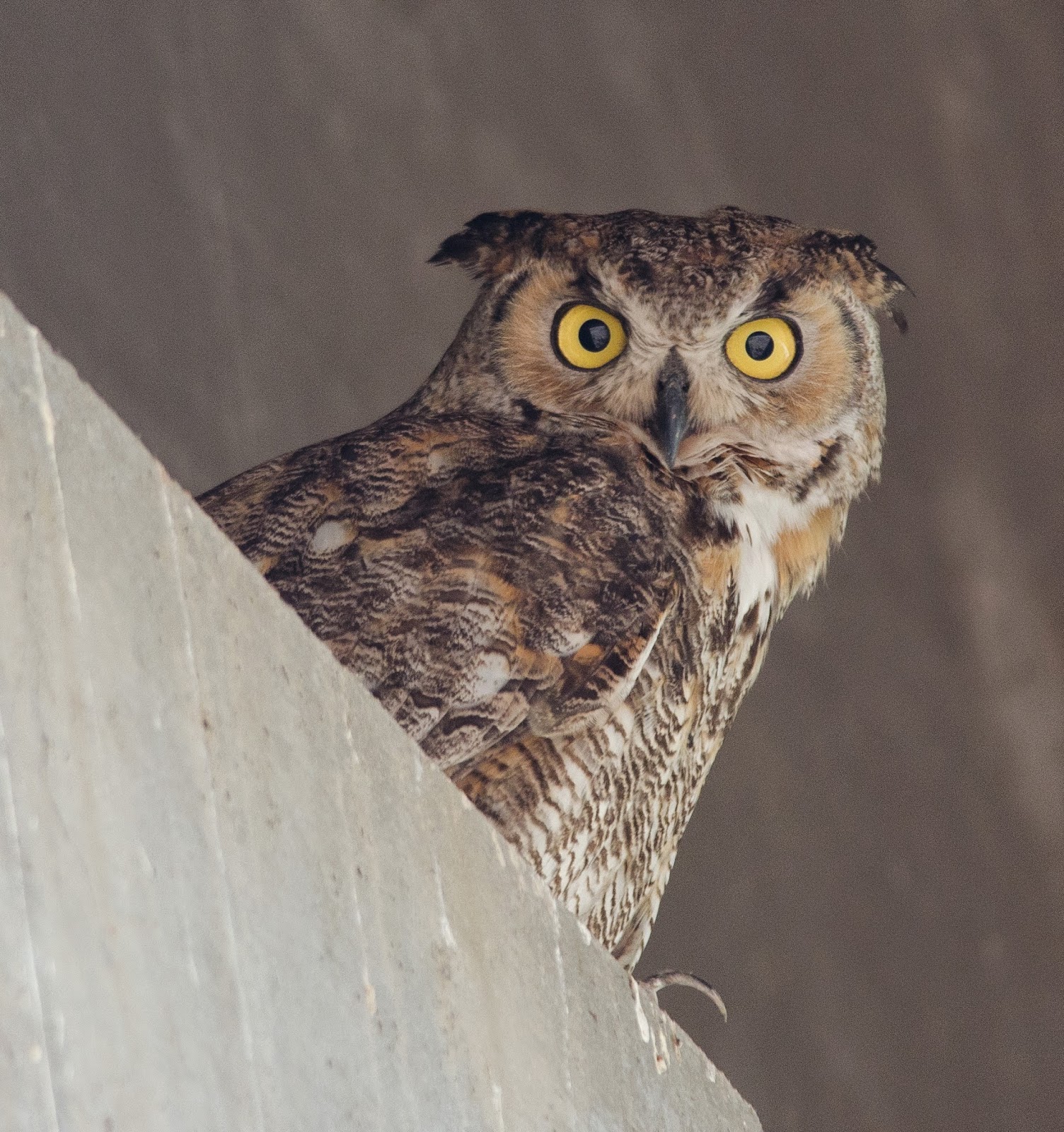
This morning my mission was early again to try finding the Common Poorwill and sure enough I heard them calling again, but no sightings.  Then I also heard two Western Screech Owls calling their soft hooting calls.  I actually saw one of these in the dark fly to a nearby tree, but I was never able to get my flashlight on it for viewing or a photo.  So these two species has rekindled my interest once again for this area.  On this day, I deviated off onto another drainage wash that I had never hiked before and found out that it led to some incredible new areas that is definitely worth exploring more in the future.  Another positive note to this hike today, is that when I checked the Great Horned Owl roost, we now have two owls, not one.  Maybe it is the same pair that raised young for 2 years in row in 2010 and 2011.  I don't think most hikers are even aware that these magnificent birds are perched in the rocks every day.

Great Horned Owls

One of the most common birds in this habitat is the Black-throated Sparrow.  It is so common that I have gotten pretty good at identifying it by its single note chip call.  I hear them constantly, but do not always see them as they have a tendency to forage on the ground and they blend in well with the rocks, gravel and vegetation fairly easy.  Today, very in early in the morning, one of them presented itself on a rock for me.  One has to agree that this is one dapper looking sparrow with that black bib and contrasting facial markings.

Black-throated Sparrow

A Gilded Flicker flew into my area just long enough to snap off a photo.  This is another bird that most of the time I will heard off in the distance and not see it.  To have one come in close enough for a photo is always a plus.  In this photo, the yellow coloring on the underside of it primaries can be seen along the edge of the wing.  This is one of the key identification marks on this bird.

Gilded Flicker

Another bird that I have noticed more frequently in the past few weeks is the Phainopepla (otherwise known as one of those 'P' birds in Arizona that is hard to pronounce, the other being the Pyrrhuloxia!).  I have seen Phainopepla in this canyon before, but they are not very common, and I am not totally sure why as there seems to be an abundant supply of mistletoe, which is one of their foods sources.  Maybe they are starting to expand their range into this area.  Always a great bird to see.

Phainopepla

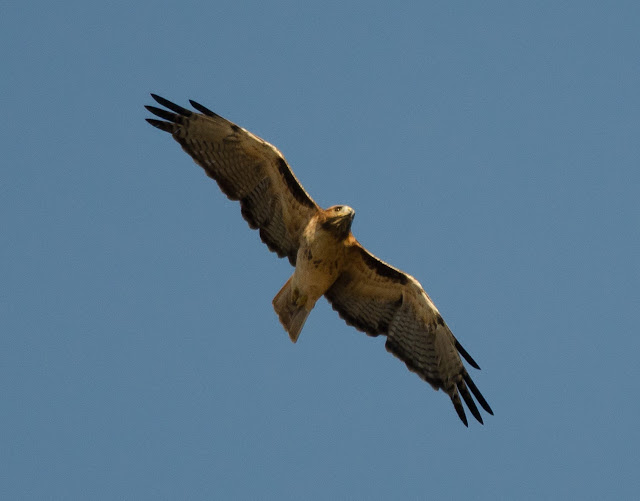
Found two species of raptors today; a Red-tailed Hawk and a pair of American Kestrels.  The Red-tail was a fly over and while the photo is not a great one, it does point out a couple of the key identification marks.  Notice the belly band of dark feather across the middle of its belly, and also note the dark patagial bars on the front edge of the underside of its wings.  Key marks in most of these birds, however there are a few color morphs where these markings cannot be seen.

 Red-tailed Hawk

American Kestrel

On my return, I discovered a Black-headed Grosbeak and for once it wasn't quite so skittish and came out into the open for some photos.  Yes, it still preferred to stay in the shade, but with this bird I will take any photo I can get.  You can definitely see how this group of birds got their names 'grosbeak'.  That is one massive beak on a bird this size.

 Black-headed Grosbeak

Black-headed Grosbeak

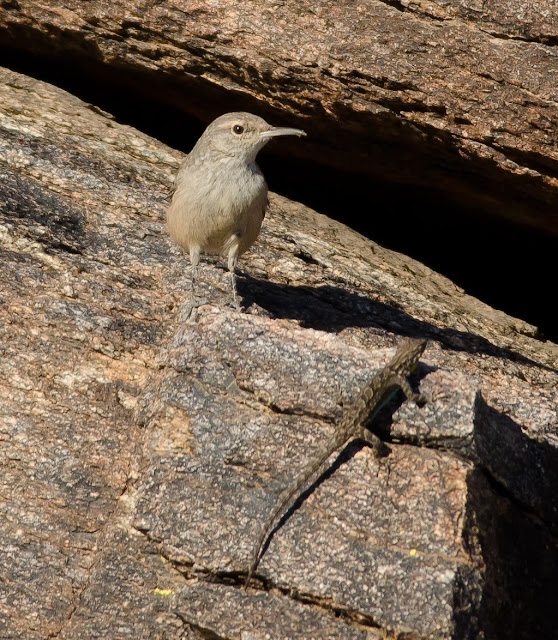
But the day probably belonged to the Rock Wrens.  They were quite common and calling from the hillsides and deep in the wash, I found a pair that I think might be preparing to breed once more as they were favoring a rock crevice and watching me with interest.  The recent monsoon rains will often set in motion another breeding cycle for many birds.  In one of my photos I discovered an Ornate Tree Lizard trying to get in on the act.  Funny part was that I had no idea it was there until I started processing my photos at home.

 Rock Wren

 Rock Wren

Rock Wren with Ornate Tree Lizard

One bird photo then a couple more of non-avian critters.  Of course there is always Black-tailed Gnatcatchers and of course I am always taking photos of them, so anyone can skip over this photo if they are tired of seeing photos of this bird.

Black-tailed Gnatcatcher

Saw lots of lizards during the hike, but this time I caught one in the action of feeding on a bee.  It is not often I see a lizard with prey.  This is a Common Side-blotched Lizard that caught a bee and I think the bee lost.

Common Side-blotched Lizard with prey

And finally I found a Coyote that did not even pay attention to me.  Not sure if it knew I was around or not, but it was slowly working its way up a secluded wash very leisurely, but never once turned around to even stare at me.

Coyote

Tomorrow is a different destination and next weekend who knows where I will venture.