Costa's Hummingbird

Costa's Hummingbird
Showing posts with label White-breasted Nuthatch. Show all posts

Thursday, January 30, 2014

The Addition of 2 New LIfe Birds

On January 11, 2014, I decided to venture to the southern part of Arizona to try for a second time to locate another new life bird that resides in some very select canyons in that area; the Rufous-capped Warbler.  I contacted my Tucson birding friend, Chris Rohrer to see if he would be interested in going along.  And of course, he said yes and we made our plans.  There was another rare bird being seen in Tucson at the time.  A Harris's Sparrow had been hanging out with several House Sparrows in a very well used city park.  This is normally a bird of the central part of the United States, but one had managed to head west for the winter.  This park was not far from where Chris lived, so we headed directly there and within 10 minutes we caught our first glimpse of it and within another 10 minutes, it was allowing us some photos.  Very early in the morning and 1 new life bird found and enjoyed!
 
 Harris's Sparrow
 
Harris's Sparrow
 
The main focus life bird, the Rufous-capped Warbler, which is found frequently in Florida Canyon, and we felt timing was critical to catch this bird.  I had made an attempt last August to find this bird and came away with no sighting, but found out there were chiggers in that grass where they reside.  This time was much colder the so chiggers were absent.  We arrived early and hiked to location they were being reported.  We knew we were probably early, so decided to wait a bit and sure enough, the first one was seen about 15 minutes later and we eventually had 2 of them flitting around for us.  This is one sexy bird in my opinion and one of my birding highlights.  Will have to go back for hopefully some better photos someday, but happy I got to see this bird and capture a few images.
 
 Rufous-capped Warbler
 
Rufous-capped Warbler
 
Oddly we had another warbler in the same vicinity of the Rufous-capped Warblers (there were 2 of them) and I was really so wrapped up in trying to photograph the Rufous-capped Warblers, that it came a quite a surprise when I got home and started processing photos and discovered this photo of a Wilson's Warbler right in the midst of the others.  While this is not a rare warbler to Arizona during spring or fall migration, it is uncommon to find one this far north in January as they spend winters much further south in Mexico.
 

Wilson's Warbler
 
A Loggerhead Shrike presented itself to us well on our drive out of Florida Canyon. Fairly common bird, but when they pose for the camera, one cannot resist the photo opportunity.
 
Loggerhead Shrike
 
From Florida Canyon we then ventured further south and then east to make a visit to Patagonia Lake State Park which just happens to be a very reliable spot the past few years to find in the winter one of the most sought after birds in the United States, the Elegant Trogon.  And we were not disappointed in our visit.  This has to be one of the most unusual and fascinating, but also most beautiful birds to find in the US.  Birding in Arizona is really awesome!
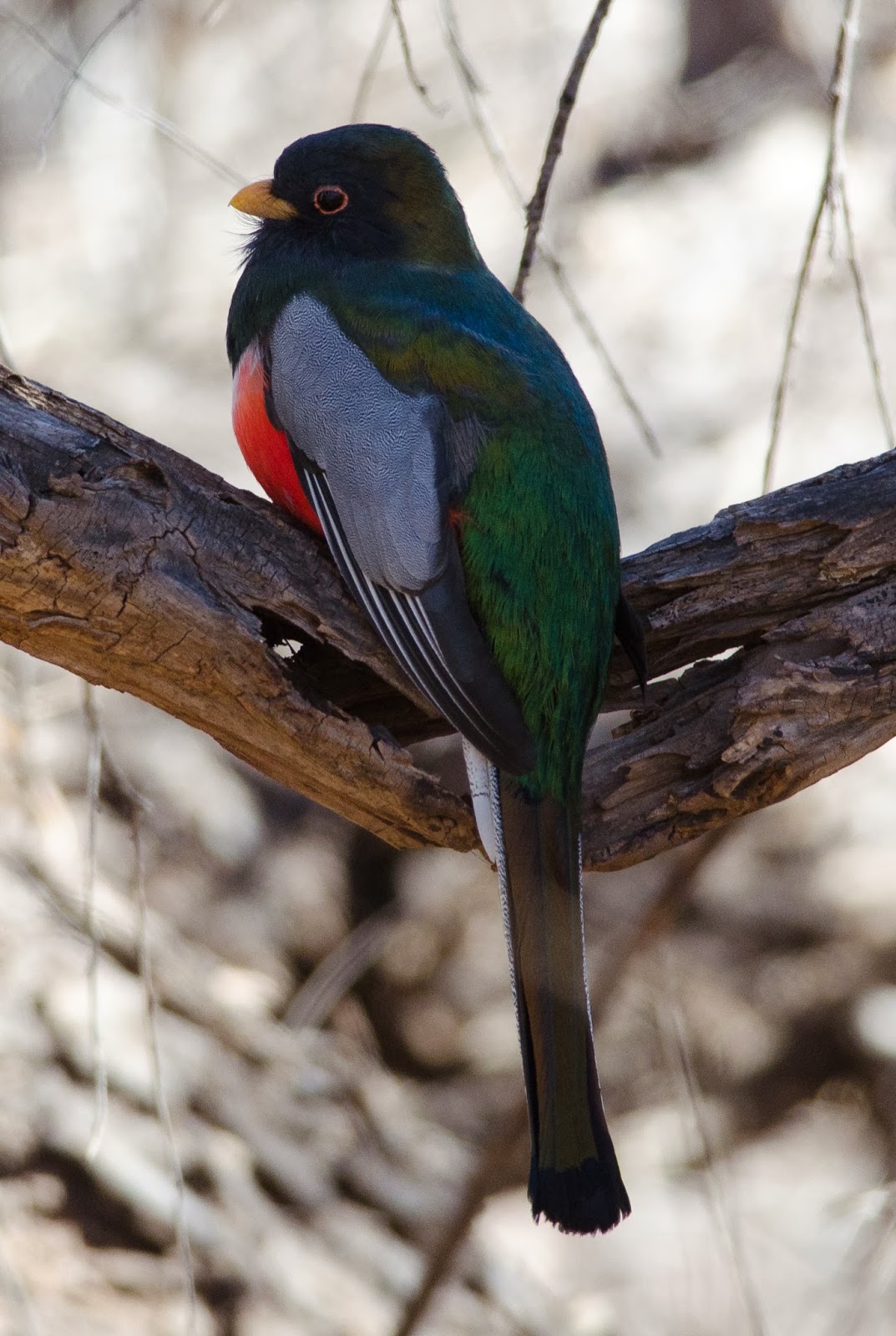
 
Elegant Trogon
 
While there a pair of Western Bluebirds came down for a drink and displayed some more wonderful colors of the rainbow. 
 
Western Bluebirds
 
One last stop on our way home was at Paton's in Patagonia.  Host Larry Morgan is the host extraordinaire and it is always a pleasure to stop and say hi and see what is new showing up in his yard.  The yard is always full of wonderful and interesting birds and this visit was no exception.
 
 Acorn Woodpecker
 
 Anna's Hummingbird
 
 Bewick's Wren
 
White-breasted Nuthatch
 
 Another great day of birding with great birds and great friends!


Wednesday, August 14, 2013

Pinal Mountains - A Warbler Bonanza

Once again this summer I had the privilege to go birding in the Pinal Mountains south of Globe, Arizona.  This is always a great place to visit especially in the summer months as the higher elevation is so much cooler.  Plus this area can be a great spot for migrants. Joining me were our driver Ed Jeter, along with Ellen Hairston and a new birder, Steve Maurer.

Our little trip turned out to be my highest count of warbler species in one day.  We ended up with 11 species of warblers which is pretty awesome and that number included several migrants starting to return south.  Here is the list of warblers we found:  Virginia's Warbler, Grace's Warbler, Wilson's Warbler, Nashville Warbler, Red-faced Warbler, Orange-crowned Warbler, Townsend's Warbler, Hermit Warbler, Black-throated Gray Warbler, Yellow-rumped Warbler, and Painted Redstart.  Unfortunately, I was not able to get photos of all the species, but did get a few that I can post.  At one spot where we stopped along the road, we looked over the bank and down about 20 yards to a very small stream bed with just a bit of water running in it and discovered a small opening in the shade and among some rocks where many of these warblers were taking turns bathing.  So trying to focus my camera into a dark, shady spot and focusing through a small opening in the vegetation, was rather difficult.  I at least got some identifiable photos and and in one photo I was lucky to capture 3 different warblers all at the same time.

 Virginia's Warbler in full bath mode

Virginia's Warbler

 Orange-crowned Warbler

 Townsend's Warbler

Townsend's Warbler

 Hermit Warbler

Hermit Warbler in full bath mode

 Black-throated Gray and Wilson's Warblers

 Black-throated Gray and Grace's Warblers

Black-throated Gray and Wilson's Warblers

Black-throated Gray, Wilson's, and Grace's Warblers

OK, enough of those wonderful warblers!  We did find other birds on our visit including a couple nuthatches.  White-breasted Nuthatches are really quite common in Arizona and throughout much of the United States, but at times, getting good photos of them can be a bit difficult as they usually are found in fairly shady spots.  This day I happened to get a pretty decent photo of one flaking off a bit of bark.  The Red-breasted Nuthatch is much less common in Arizona.  They can be found but not nearly as numerous as the White-breasted species.  I came across 4 of them near the cabin with feeders near the top of Pinal Peak.

 Red-breasted Nuthatch

White-breasted Nuthatch

The hummingbird feeders were very active with Broad-tailed Hummingbirds, Black-chinned Hummingbirds, Rufous Hummingbirds and Magnificent Hummingbirds also near the top.  For once I refrained from taking a lot of photos of them and just enjoyed watching them vie for the feeders and the the nectar that was available for them.  The trip was another great adventure and full of wonderful birds!


Saturday, April 27, 2013

The Views of Blues Above the Rim - 18 April 2013

After spending few days in the southern part of Arizona, I traveled north to the towns of Heber/Overgaard and the surrounding area which is above the Mogollon Rim and at an elevation around 7000' and higher.  Quite a different landscape and much cooler temperatures.  Included in this area is Black Canyon Lake, which has been a very nice spot for me to go birding.  Last fall, this lake was where I discovered a Pacific Loon, which was apparently the first record of that species in Navajo County.  The entire area is very under birded and I would encourage other avian enthusiasts to visit the area when they get a chance.  

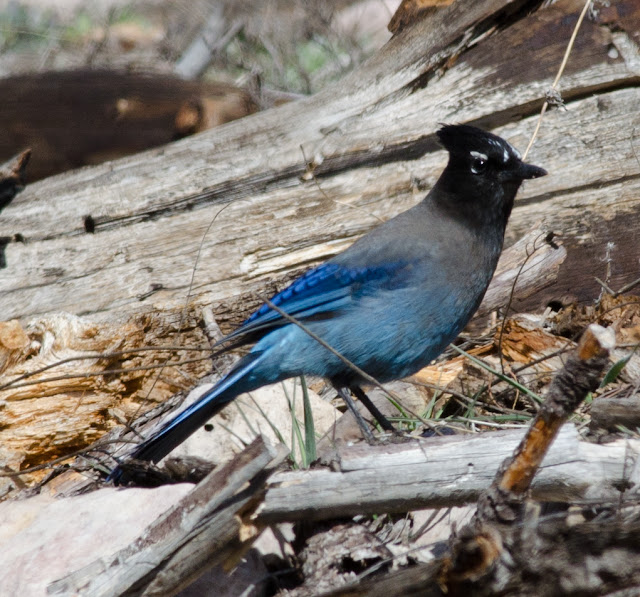
My title of this post, already suggests the color blue, so I should probably start off this post with my collection of birds decked out in the color blue.  The first bird is the bluest of blue; the Mountain Bluebird.  So if you like the color blue, then you have to ♥ this bird.  Then if you like your 'blue' birds a bit larger and with a crest and a little bit of black highlights thrown in, then maybe your preference is the Stellar's Jay.  And to top it off, we have a third 'blue' bird, which is the Western Bluebird and one of the most common birds to be found in this area. And for this species I have photos of both a male and a female.

 Mountain Bluebird

Mountain Bluebird

 Steller's Jay

 Western Bluebird - Male

Western Bluebird - Female

After seeing the Yellow-eyed Junco on Mt Lemmon, the northern areas is the place to find the Dark-eyed Junco.  This bird was the most numerous of all the birds I encountered above the Rim and most of them were the Gray-headed subspecies, but I did see 1 Oregon type. 

Dark-eyed Junco

A rather unusual bird that I found at Black Canyon Lake was a male Vermilion Flycatcher.  The species itself is not rare by any means in Arizona, but they are extremely rare at such a high elevation of about 7100'.  It was very cold on the first day I visited this place and the cold must have slowed down this one's molt, as it has not completely molted into the adult plumage.

Vermilion Flycatcher

Also found lots of nuthatches, especially Pygmy and White-breasted with the Pygmy being the most numerous.  They are dynamic little acrobats in the trees.

 Pygmy Nuthatch

 Pygmy Nuthatch

White-breasted Nuthatch

Will round out this post with another beautiful bird, Grace's Warbler.  This is a bird that I had only seen twice before this year.  Now this year I have seen several and after this trip up north I can honestly say I have seen dozens of them.  They were singing from the pines at just about every place I stopped.  Still not easy to photograph, like most warblers are, but always a pleasure to find and enjoy.

 Grace's Warbler

 Grace's Warbler

Grace's Warbler

Will follow up with one more post from this area and then back to basic birding in the valley again.


Sunday, March 17, 2013

Mt Ord - 16 March 2013

All I can say about this trip 'What an awesome day of birding!'  Mt Ord is in the far northeastern part of Maricopa County and rises to an elevation of about 7100' making it the highest spot in Maricopa County.  I had not been to this location for some time and was wanting to go, so I was joined by Tommy DeBardeleben and Dominic Sherony and away we went.  Tommy is very familiar to this area and thanks to him and his website:  http://www.birderfrommaricopa.com/ this area is a bit easier to locate.  We chose to hike the 1688 trail, which can be a bit strenuous if one is not in pretty good physical condition.  The trail follows the west side of the mountain for about 2 miles in and then one has to return.  If you discover an uncommon bird and you have to deviate from the trail, be prepared to do some bushwhacking and climbing as it will get much more strenuous.  And that is exactly what happened to our party of 3.

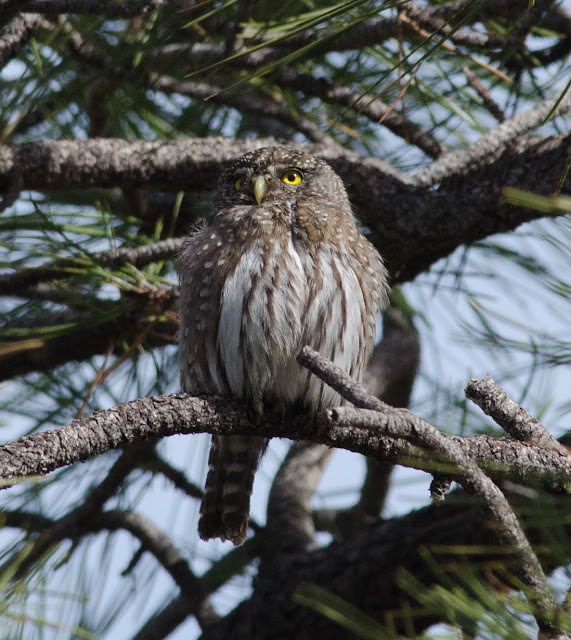
Near the far end of the trail, we heard a Northern Pygmy-Owl and chose to locate it by climbing and bushwhacking and the prize was well worth it.  These tiny, but ferocious, owls (about 6.75 inches) seem to not have much of a fear of humans and once found, this one gave us lots of great views while perched in a pine and at one point even turned around so we could capture photos of the back of its head which shows off the distinct black marks on the nape, which is a key field mark, and give the appearance of 'false eyes'.

 Northern Pygmy-Owl

Northern Pygmy-Owl---back view with false eyes

Northern Pygmy-Owl

This owl was definitely the highlight of the day, but it was far from being the only great bird we saw. We found evidence that the spring migration has begun in earnest.  Black-chinned Sparrows and Rufous-crowned Sparrows were in abundance on the first mile of the road leading to the 1688 trail.  The Black-chinned has a song that reminds one of a bouncing ball and they were singing from the hillsides, but most did not want to make themselves visible, until one of them finally flew in and circled us all the while foraging and singing and giving us fantastic views.  

 Black-chinned Sparrow

 Black-chinned Sparrow---Note the long tail


Black-chinned Sparrow

Rufous-crowned Sparrow

A very welcome find was the Painted Redstart, a warbler of the southwestern US and probably a bit earlier than normal for migrating into this area.  We found about 5 or 6 of these birds singing and foraging high in the trees, constantly flicking their tails and wings, which is a normal behavior of these birds.

 Painted Redstart

Painted Redstart

We also found 3 species of nuthatches, the Pygmy, Red-breasted, and the White-breasted.  Unfortunately the only species I was able to capture with a photo was the White-breasted, which is probably the most common species found throughout the US.  We also heard Spotted Towhees all along the trail and finally one of them popped up out of the dense vegetation and gave us great views and some wonderful photos.

 White-breasted Nuthatch

White-breasted Nuthatch

 Spotted Towhee

Spotted Towhee

Awesome birds, awesome scenery, and awesome company for the day.  We also made a stop at Sunflower on our way back, but have decided to do a separate post on that as we got some new migrants there as well.