Costa's Hummingbird

Costa's Hummingbird
Showing posts with label Curve-billed Thrasher. Show all posts

Saturday, February 11, 2017

South Mountain Park

As mentioned in my previous blog post, I have been spending a lot of time in Pima Canyon Wash in South Mountain Park.  It is a place that I adopted as 'My Patch' in eBird,  It was only natural that I did this becasue this spot is one of the closest locations for me to get some good exercise and over the years I have found some pretty good birds here.  Many of the birds I see now are the more common desert species, but being able to document them and enjoy them on a personal level is really pretty cool.  This post features some of the recent experiences that I have encountered in this location, including a couple of crushing scenes of hummingbirds.  And hummingbirds will be my starting point for this blog post.  

Probably my most favorite hummingbird that is a year-round resident of this part of Arizona is the Costa's Hummingbird. Of course there are others that really trip my trigger during the summer months, but don't tell that to any of the COHUs!  This bird, with its stunning royal purple gorget is really hard to beat.  I have discovered one in Pima Canyon Wash that is a fixture and he has his special favorite perch and he really defends the wolfberry bushes in his territory.  And he is fairly approachable.  Photographing hummingbirds in natural settings are so much more pleasing than those around feeders.  Here are some photos of 'Mr. Reliable'.
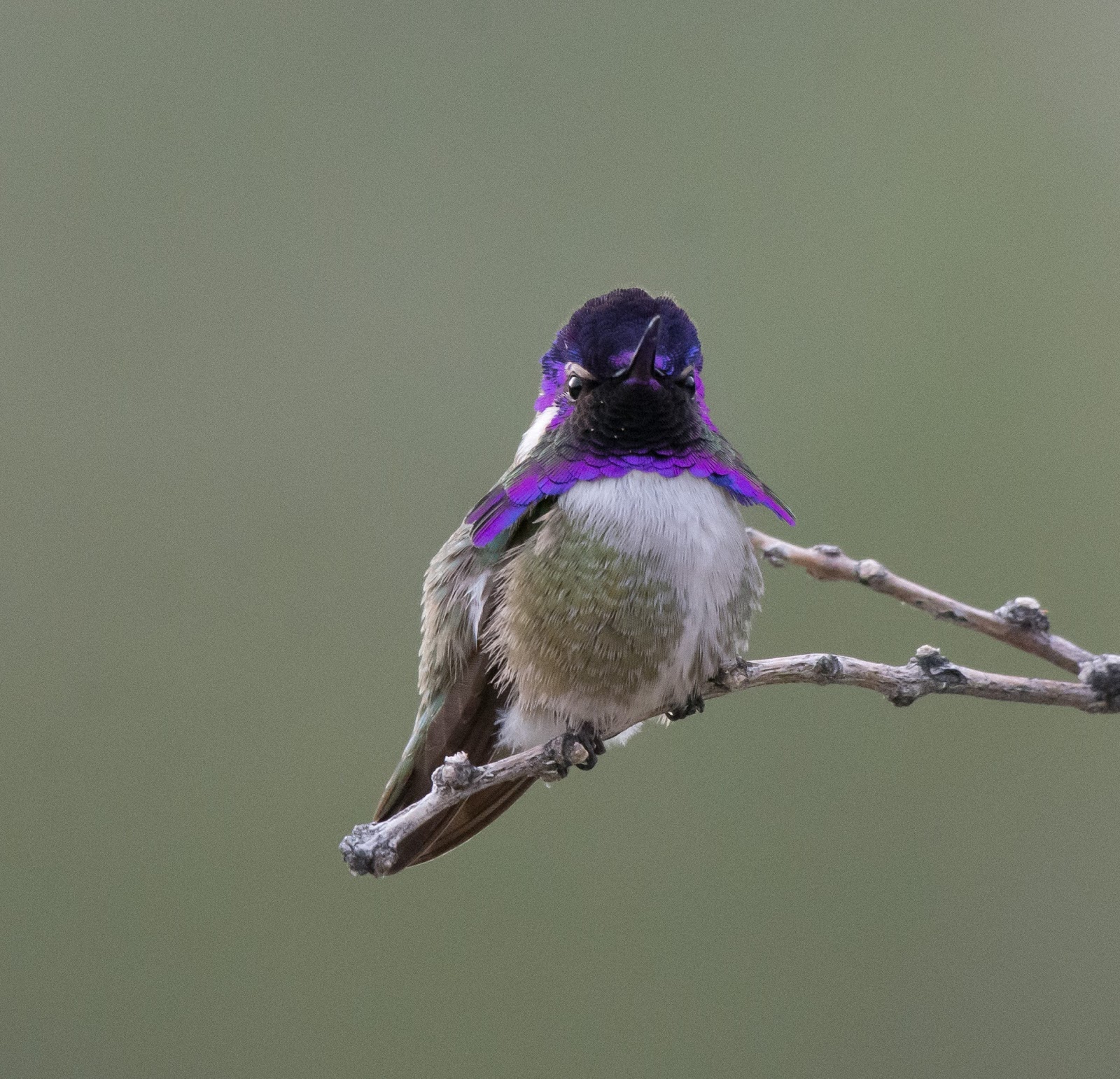
 Costa's Hummingbird


The Anna's Hummingbird is also a year-round resident in this part of Arizona and it ain't no slouch either.  It is by far the most numerous and probably outnumber the Costa's by 8 to 1.  It is the most common and frequent hummingbird to show up at feeders in people's yards.  And when a male is in just the right angle of sunlight, its brilliance is almost blinding.

 Anna's Hummingbird


That just about covers all the hummingbird possibilities for this time of year, but we have other species that are enjoyable and fascinating as well.  Case in point; the Black-tailed Gnatcatcher.  This is another tiny passerine that is very vocal and also very common.  They usually give up their location by their buzzy like notes.  In winter, both sexes are a pretty boring overall gray on top and white underneath, reference the first photo.  However, as spring approaches, and it is definitely approaching in Arizona right now, the male starts donning a spiffy black cap and subsequent photos show one such male beginning to get that dapper look.  

Black-tailed Gnatcatcher


Of course there are many other regular birds in this part of South Mountain Park and when they properly present themselves and cooperate for photos, why not take advantage of it?  Black-throated Sparrows are dapper LBJs (little brown jobs as many novice birders lump them).What's not to love with those very contrasting blacks, browns, whites, and grays on a sharp-dressed bird? 

 Black-throated Sparrow


Curve-billed Thrashers are one of the easiest birds to recognize with their sharply curved bill and bright orange eye.  Now this bird has a proper name that describes it well.

 Curve-billed Thrasher

This one was singing while on the rock, maybe trying to translate the petroglyphs.  However, since I do not speak 'thrasherese' I could not understand it.

When it comes to woodpeckers in the desert, Gila Woodpeckers and Ladder-backed Woodpeckers are in order.  Gila take advantage of the Saguaro Cactus for its nest cavities, creating a new cavity every year.  The Ladder-backed uses the trees it finds for its nesting cavities. 

 Gila Woodpeckers

Ladder-backed Woodpecker and a possible new nest cavity in the making?


The never ending parade of the Verdin entertains an entire hike.

Verdin

As for the wren family, the 2 most common species found are the Cactus Wren and the Rock Wren.  The Cactus Wren has the distinction of being Arizona's State Bird.

 Cactus Wren

Rock Wren

On one of my recent trips, a Lesser Goldfinch had apparently taken a liking to the desert habitat as well.  Not always assured to be found in the desert, but not rare by any means either.

 Lesser Goldfinch

And finally a 'Gambel's' White-crowned Sparrow, which is a winter only resident.  Come springtime, they will be headed north.

White-crowned Sparrow

Now that I have covered all the birds, lets move on to a butterfly and some mammals. The butterfly, a West Coast Lady, seemed a bit early this year, what a bright spot to enjoy in January!

West Coast Lady

The Coyotes seem to be thriving very well in this environment as they all look healthy and not malnourished.  Thankfully, none of them were hungry enough to be viewing me as a possible meal! On one occasion a couple of them starting howling at me as I was walking down the wash.  Really had some neat encounter with the Coyotes so far.  They are very wary and try to stay far away from any humans.    

 A sequence of Coyote photos


 Harris's Ground Squirrels


 Black-tailed Jackrabbit

Desert Cottontail

For those that read my previous blog post, I also made comments that I was also branching out to more diverse groups of organisms.  So with this post, you get to witness a couple of photos of some flora (or plants if you prefer).  

Graham's Fishhook Cactus-love how it puts forth roots in a rock crevice and thrives!

This next one is a very tiny little plant.  I have probably walked right by them countless times, but once a person 'stops and enjoys the roses', little things like catch my eye and the tiny whitish flowers were intriguing for sure.  I was only able to identify this by posting it on a citizen science website, iNaturalist.org.  Exact species is not known but at least someone suggested a 'probable' species.

 Genus Pectocarya-most likely Pectocarya recurvata, note the tiny whitish colored flowers.

Same plant but with the corner of my cell phone next to it for size comparison.

It has been enjoyable following a lot of the regulars and learning new flora and fauna along the way.  Hopefully my next post will be interesting as I am taking a short trip out of the state.


Saturday, November 7, 2015

Pima Canyon: A Visit With a Focus

This past Saturday, October 10th, I volunteered to lead a birding trip for the Maricopa Audubon Society.  I had been contacted a few months ago and I selected this place as it was a place I knew very well and I listed it as a great place for beginners to learn about desert birds and their calls and songs.  What I ended up with was a team of 4 individuals that were excellent birders in their own right.  One of them was from Ohio and in Arizona for the weekend and another was a person new to the Phoenix area and the other 2 were locals that were excellent birders with additional knowledge about the flora and other fauna.  The other 4 members of the team consisted of Virgil Troyer, Laurie Nessel, Joe Chernek, and Joy Bell.  What a great team we had assembled.  It turned out to be an excellent outing.  Doesn't this photo look like a great group?


We started early in the morning, with an objective of trying to locate a couple of nocturnal birds.  One was the Common Poorwill that I hear at almost every visit while it is still dark, and the other was maybe an owl.  Well the Common Poorwills definitely made a liar out of me as they did not give one call during the darkness.  However, we had a little bit better luck with the owl.  When we approached the area where I had seen them last, I caught a glimpse of one flying from one tree to another in the dark in front of us.  At that point I felt good, but shortly started to think the one I saw had disappeared since we had 5 people with flashlights.  Slowly and quietly we moved up the wash a bit and I was scanning the trees with my flashlight and I caught a glimpse of one about 15 yards ahead of us. I tuned the flashlight down quickly and made sure the rest of the team was along side of me and I lifted the light and there it sat on a limb of a palo verde tree and everyone got to see it good in the light.  It was fairly cooperative for us and sat there for some time so that the entire team got great views of it.  This was a life bird for a couple of them.  Now I felt better about the early start and I think the rest were pleased as well.

This was not a trip for me to focus on a lot of photos; I was more concerned that when we found a bird, that everyone got good views of it.  And as usual, some of those birds made that a bit of a challenge, but for the most part, I think we succeeded in getting a good look by everyone.  Not a lot of photos of birds in the blog, but some other interesting photos will be included.

Curve-billed Thrashers were abundant as they always are, and as much as I wanted to find a Bendire's Thrasher, I could not turn this one into Bendire's.

Curve-billed Thrasher

We actually found 3 species of woodpeckers; Gila and Ladder-backed Woodpeckers and also great looks at Gilded Flickers.  Three species of woodpecker in a dry desert wash is a very nice count.  The wrens must have not like that idea because we ended up with 4 species of wren, 3 of which I expected; Rock, Cactus, and Canyon.  The 4th species was the Bewick's Wren which is not a rare bird by any means, but just not that common in this type of habitat.  Only the Canyon Wren gave us close up views and it just happens to be my favorite wren in the United States.

 Canyon Wren


We were also blessed to find find a couple of Townsend's Warblers.  Most of the warblers have now passed through on migration, but some such as this one is still showing up.  By now they have escaped the snow and ice of the Pacific Northwest where they breed and they can make a leisurely trip further south for the winter.  So glad they pass through Arizona in the spring and the fall!

 Townsend's Warbler


As we approached the parking lot on our return, a juvenile White-crowned Sparrow was foraging in the damp sand below us in the wash and was not at all stressed by our presence.  This species is a migrant that spends its winter in the lower elevations of Arizona and beyond.

 White-crowned Sparrow (gambelii) - Juvenile


We had now returned to to our starting point and Laurie had pointed out an Elephant Tree on one of the upper slopes, so 4 of us went to investigate while one had to leave and head to work.  At the tree we studied its leaf structure as a male Phainopepla flew over the ridge and as we got ready to head back down into the wash to go to the parking lot on the other side, Virgil, with an eagle eye, spotted a Spotted Towhee down in the wash, which peaked my interest as I do not recall ever seeing this species in this location in the past.  It is not a rare bird for Arizona by any means, but the location really is not the most ideal habitat for it.  The four of us scrambled down and into the wash to check out the shrubs it had disappeared into and by surrounding the shrubs, it finally flew out and it was unmistakable as a Spotted Towhee.  Once I got home, I looked up my records and sure enough this was a new species for my patch, Pima Canyon Wash.  This was my 100th species for this location and quite a milestone for me.  Wonder how many more I will be able to add in the future. Thanks to Virgil for spotting it and thanks to Laurie and Joe, for helping to flush it out of the shrubs.

At this point, Laurie and Virgil headed out and Joe and I decided to make a quick stop to check out the Pima Canyon Wash where it meets up with the golf course.  We found a second Loggerhead Shrike that was a bit more cooperative and allowed better and closer views.

Loggerhead Shrike

A little more exploring and Joe eyed a flycatcher, and of course it had to be one of those species that belong to the empidonax family that can be difficult to ID.  I remember when I first started birding and found some of these birds; I was at a loss in identifying them and decided there is no way I will ever be able to figure them out.  But guess what?  After a few years of dedicated birding, I have learned to identify many of them.  Still miss a few because of poor looks and other factors, but I had this one pegged while observing it in the field, a Dusky Flycatcher.  The photos do help to confirm the identity, so it goes to show that with a lot of exposure and learning from many of the old time experts, many of these empids can be identified.

 Dusky Flycatcher

Dusky Flycatcher

Having Laurie along was a great benefit as she taught me much about a lot of the plant life out there and she knew to look into rock cracks and crevices because she did locate one of the local Chuckwallas that are found here and with the assistance of a flashlight everyone was able to peer into the crack to view it.  We also had other lizards including the one below, which is a Clark's Spiny Lizard.  The barring on the forelimbs is a key field mark for Clark's Spiny Lizard.

Clark's Spiny Lizard

Another point of interest was some of the petroglyphs that were visible to those not familiar with Arizona.  These can be found at various spots in South Mountain Park.  They were the original artwork of the Hohokam people that lived in this area about 700 years ago.


What an enjoyable hike with great company, and I think all had a great time and lot of knowledge was learned by all.  Our final tally of bird species was 34 which is a very good count for this location.  Can't wait to lead more walks like this.  Thank you Maricopa Audubon for allowing me to take part in your field trips this fall; I hope to do more in the the future.