Costa's Hummingbird

Costa's Hummingbird
Showing posts with label Clark's Nutcracker. Show all posts

Friday, September 4, 2020

2020: A Chaotic Year

 Not even sure where to begin, as the year 2020 has become probably the most Chaotic Year in my lifetime.  First couple of months of the year were pretty much normal and I was anticipating new and exciting international adventures.  When March rolled around, things changed quickly.  Covid-19 was a new coronavirus that affected all of our lives, and in many different aspects.  Just as tighter security and restrictions affected all of us in 2001 due to the World Trade Center incident, Covid-19, has changed our daily lives by learning to assist in stopping the spread of this deadly virus.  Most of us have now started wearing face masks, gloves, (when appropriate), hand sanitizers, and disinfectant wipes.  Finally, about six months later, we are seeing hope that a vaccine might be on the horizon.  Unfortunately, even when a proven effective one is approved for distribution, it is going to be a very long process for people to get vaccinated.  So it is not going to be a quick solution that will make this virus disappear.  

The need for social distancing, and taking proactive measures, has greatly changed the world of birding.  The birding guides in the tropics have been especially hit hard as it stopped all of the birders throughout the world from visiting those countries and left many people without jobs and income.  

For me, all birding with friends and guiding came to an abrupt halt and I decided to stay home for much of the time to avoid the possibly of being exposed.  Then at the end of April, Chuck, became ill and ended up in the hospital for a total of 10 days and then another 2½ weeks in a rehab center.  Once he was released, I became an at-home care giver and it has curtailed a lot of my birding adventures.  He is making improvement and I can now leave for a day or two and he can care for himself.  Since my quarantining at home, I have had few opportunities to get out and go birding alone. With all the great rarities showing up in Arizona, I had to stay home and miss out on most of them.  However, I finally broke down and chased a rarity in southeast Arizona;  the Eared Quetzal.

It is bird that I have often pondered when looking through bird field guide books and longed to see, but figured it was rare enough that it might not show up in Arizona in my lifetime.  It is a bird from the Sierra Madre Occidental in Mexico and there have been a handful of reports of this bird in Arizona in the past but they are not frequent.  A pair has been reported in the Chiricuahua Mountains in southeast Arizona this year and many people were getting good views of them.  So I decided to take on a one day trip to try for them even though it was a 4 hour drive to the location from home and another 4 hours back.  I went with the option of maybe spending a night somewhere in case I missed them the first day.  Luckily, I did not have to do that and I made the trip there and back in one day. There were many other birders also searching for it and all of them were showing constraint and not chasing or stressing out the paid that was there.  My photos were a little soft since I got to see them at a distance, but the welfare of the birds is more important than perfect photos.

Eared Quetzal


Brown Creeper

Yellow-eyed Junco

I also found a way to do a little birding in Navajo and Apache Counties of Arizona.  We have had a brutally HOT summer this year which broke a lot of records, including the number of days that Phoenix has hit 110° +.  Before this year, we normally had 19 days at those extremes.  Last year we recorded 33 days, and this year we have currently had 50 days at 110° or higher with a few more on the way.  Plus our monsoon season has been a bust with very little rain, leaving the desert parched and dry which in turn has created a very high wildfire danger.  My trips to Navajo and Apache Counties at least got me into higher elevations with cooler temperatures and some intermittent rain showers. 

On these two trips, I was able to add 18 new species of birds to my Navajo County list and 3 new species to my Apache County list.  The trips were definitely worth it and I had my friends Barb and Jeanne to assist me and accompany me on my forays. 

Rufous Hummingbird -male

Rufous Hummingbird - male, with light reflecting at a different angle.


American Dipper - One of my favorite birds and I enjoy seeing them.

Band-tailed Pigeon - This is the best photo I have ever got of this species.

Lazuli Buntings - What's not to love?

Western Bluebird - Juvenile, recently fledged.
 
Another Western Bluebird - Juvenile and recently fledged.

Green-tailed Towhee - recently fledged juvenile.  Had never seen a juvenile before.

Clark's Nutcracker - Not a super common bird in Arizona.

Broad-tailed Hummingbird

Arroyo Bluet - This was a new new for me.

Mexican Forktail - Another new one for me.

Plains Forktail

Spotted Spreadwing - Another new one for me.

Blue-eyed Darner

Blue-eyed Darner

Eight-spotted Skimmer

Arizona Sister - Did not notice the little fly until I added this photo to this bog post.

Western Pygmy-Blue - Often mentioned as the smallest butterfly in the world.

Greater Short-horned Lizard - Just a baby and the next photo will give some perspective of its size.

Here it is in my hand.  What a cutie and glad I was alert enough to spot it.

With Covid-19 coupled with the severe summer heat in Arizona this year,it has been a challenge to really enjoy the outdoors and all that nature has to offer.  But with the summer starting to wind down and lower temperatures on the way, I hope to get out and see and enjoy a lot more of nature in very near future.  Just getting out into nature and some solitude can do wonders for my soul.  


Sunday, July 10, 2016

White Mountains of Arizona

After my return to Arizona, I had the privilege to escort a birding friend from New York to the White Mountain area of eastern Arizona.  A trip to this area in the middle of summer is always welcomed.  It is a great place to escape the unbearable heat of central Arizona and also a fantastic place to see some really cool birds that cannot be found in the lower elevations amidst all the heat.

Ernie Welsh and I met on the same trip to Chiapas, Mexico, last July.  Those kind of trips are awesome in the fact that one meets other birders from other parts of the country and it is nice to know these people as they can assist in finding birds in their own turf if one should ever decide to visit.  Ernie is an accomplished birder and was approaching the mystical number of 800 on his life bird list.  So the pressure was on for me to help him hit that magical number.  Our route to the Greer area took us through the communities of Pinetop/Lakeside where I knew we could most likely find a Lewis's Woodpecker, which was one of Ernie's target birds.  Just driving on the main highway through town, Ernie quickly spied a Lewis's Woodpecker.  We got amazing views of it, even though we were parked on a busy street.  We then headed to Woodland Lake Park, where I figured we would get much better views and they did not disappoint us.  A rather unusual colored bird, especially for a woodpecker, but one this is highly sought for many birders. 

 Lewis's Woodpecker


Pygmy Nuthatches seemed to not be concerned with us as well.  They were bold and brazen while feeding just a few feet from us in some low bushes.

 Pygmy Nuthatch


In Greer we were treated to a Red-naped Sapsucker that also seemed unconcerned about us and was busy tapping away on these saplings along the Little Colorado River.

Red-naped Sapsucker

Gosh I love Golden-crowned Kinglets!  They are such a nice treat to see especially having seen many of their counterparts, the Ruby-crowned Kinglets in the winter.

 Golden-crowned Kinglet


Bridge over the Salt River between Globe and Show Low.


After checking out both the East and West Forks of the Little Colorado River in Greer, and srriking out, we finally made it to Sheep's Crossing at the Old Baldy Trailhead in the search for an American Dipper.  Congratulations go out to Ernie when he spied one flying down the river and in the process, we also discovered they had a nest under the bridge.  They were making forays to the river to find food for the babies in the nest.  This bird was number 800 for Ernie on his life list and I was happy to be with him to celebrate the occasion.  Even went so far to write it on the rear window of my vehicle for documentation purposes!

 American Dipper


American Dipper nest and babies.

And here is the traveling billboard!


When we got to South Fork, just west of Eager, we found a bit of a surprise.  As we were walking the road we found a couple small birds flitting around in trees overhead.  Once I got my binoculars on them, I realized that they were American Redstart juveniles!  (This can be determined by the small patches of dark feathers in the chest area.)  Normally this is a bird that I see in Arizona in migration and casually in winter.  All the range maps of this species indicate it breeds much further east.  The general western limit of its breeding range only extends to the far eastern part of Texas and the eastern part of the United States.  To see juveniles in Arizona at this time of year indicates they were hatched in AZ.  After returning home and consulting the Arizona Breeding Atlas, it appears there has been a history of this species breeding in this area in Arizona irregularly since 1936.  But has been some time since any evidence had been discovered,  It is experiences like this that goes to show how the study of birds is an ongoing and fact finding of research.  Every little bit of data collected and notated, is immensely helpful to the trends of avian knowledge.  
   
 American Redstart


One other bird that caught my attention was this Brown-headed Cowbird with food in its beak.  Normally not much to ponder with most species as it would appear it is fetching food for some nestlings.  However, since this species is a brood parasite and it lays it eggs in the nests of other species for the unsuspecting other species to raise, it should not have a nest of babies to feed.  Quite puzzling to me, but I am sure there is a logical explanation for this.

 Brown-headed Cowbird

Another life bird for Ernie was this pair of Clark's Nutcrackers.  

 Clark's Nutcrackers

This Townsend's Solitaire was also a welcome sight at the river where it took a bath.

 Townsend's Solitaire


This was a much needed short break to an area of the state that I dearly love.  And to see all the diversity of these different birds is always exciting.  I think I assisted Ernie in getting about 6 or 7 life birds on this trip.  


Tuesday, September 9, 2014

A Little Bit of AZ & UT

When Tuesday arrived, we headed north and west from Jacob Lake, AZ with a lot of ground to cover in one day.  I had found a spot on eBird that had a fairly substantial bird list, but a place that would be quite easy to drive right by.  Pipe Spring National Monument is a fairly small area where a natural spring exists and provides and small but continual flow of water.  It did not go unnoticed by the natives that lived here in years past and was also discovered and used by some of the first settlers once they discovered this source of water in the high desert.  Of course the water supply provided a great trap for migrants. I highly recommend anyone traveling by this spot on Highway 389 to stop in and check it out for birds.  I am sure that different times of the year will result in totally different species.  
Some of the highlights that I found on this day included a first year juvenile Cedar Waxwing.  Their breeding range is much further north and most generally we only see these birds in winter in their adult plumage.  Was interesting to see one with streaks on its breast and sides.  But that profile is definitely a Cedar Waxwing.  

Cedar Waxwing - Juvenile

Other birds that I was able to photograph included a posing and cute little Wilson's Warbler, some Western Tanagers, and some Brewer's Sparrows.

Wilson's Warbler

Western Tanager

Brewer's Sparrow

From there we headed to Zion National Park in Utah.  Great place for scenery, but the birding there did not appeal to me especially due to the large crowds and not having enough time to really explore the place to find some welcoming spots.  

Zion National Park

The next stop is a lesser known spot; Cedar Breaks National Monument.  Obviously it is on a much smaller scale than a national park, but the scenery here was outstanding.  Birding was not so great here either so we did not linger, but I was able to photograph a 'Gray-headed' Dark-eyed Junco and a couple of new butterflies.

Dark-eyed Junco

Hoary Comma Butterfly

Milbert's Tortoiseshell Butterfly

Next stop, Bryce Canyon National Park and this turned out to be my favorite stop.  Awesome scenery and some awesome birds including the Clark's Nutcracker.  This time this bird just flew into the pines at one of the viewing points where I stopped and put on quite a show for me.  Was quite fun to watch their antics and feeding on seeds from pine cones.  They can be quite the acrobats.

 Clark's Nutcracker


 Yep, still more of the Clark's Nutcracker


Common Ravens were evident everywhere and at one stop, there was a pair that had no fear of humans and I suspect they were used to many handouts by visitors as they waited for their next meal.  In the close-up photo, notice the bristles on the upper beak and how far down it extends on the beak.

 Common Raven

Common Raven, note the bristles on the upper mandible

Bryce Canyon National Park was also a fabulous place to find some really cool mammals.  Of course Elk are always awesome to see and this is probably the closest I have been able to get to them for decent photos.

Elk

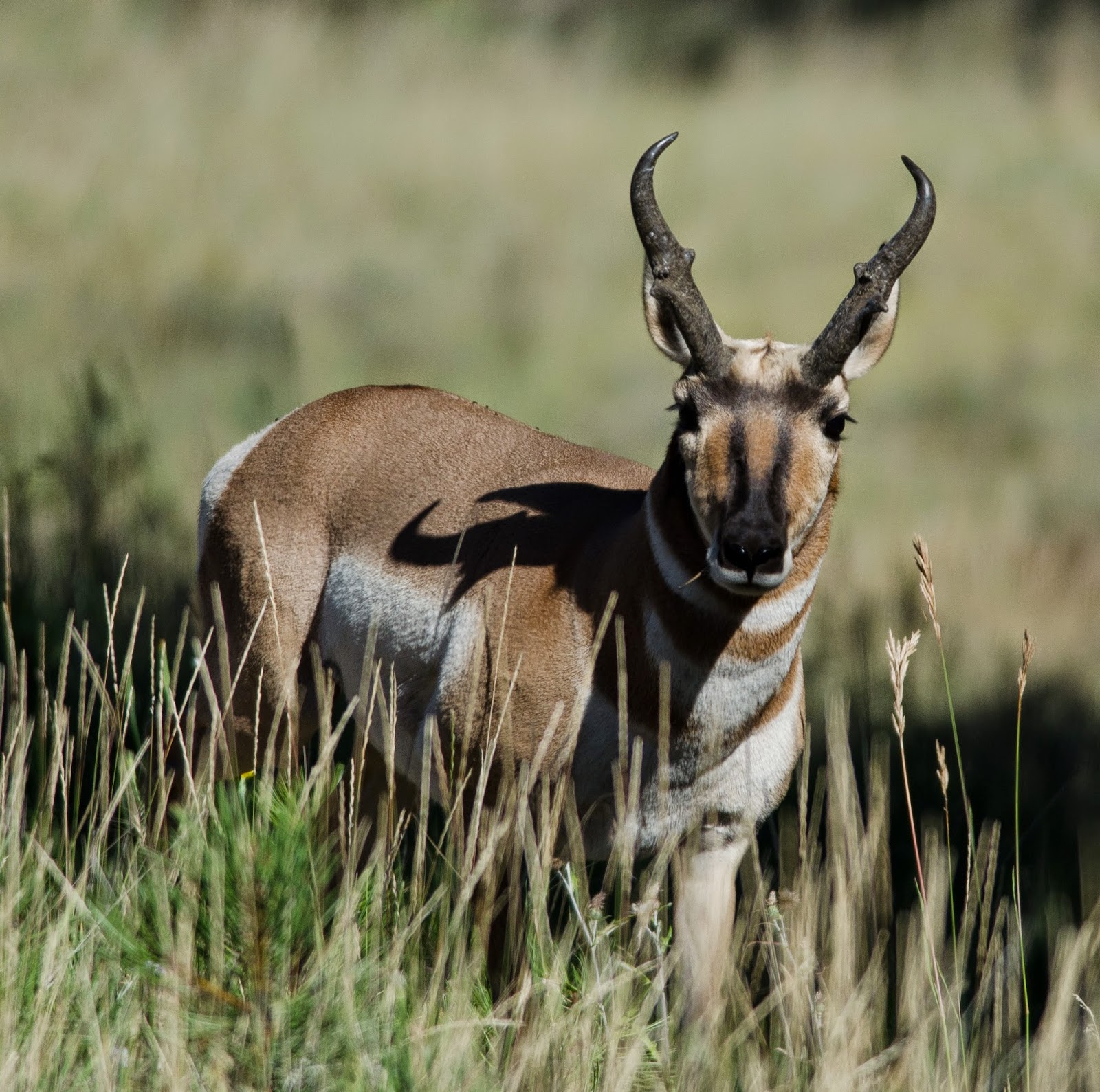
But the most exciting was the small heard of Pronghorn that we found along the highway and they crossed the highway right in front of us while we sat in the car and watched.  The herd consisted mostly of females with a couple of young and one adult male that crossed the highway last after the rest of the herd went first.  Usually an animal that bolts at the sight of a human, but this herd might not spook so easily since they are on National Park land and hunting is not allowed.

 Pronghorn - Female

Pronghorn - Juvenile

 Pronghorn - Male


The second day was a full day and we covered a lot of ground, but it was definitely a day to remember.  More to come on future posts.