Costa's Hummingbird

Costa's Hummingbird
Showing posts with label Surf Scoter. Show all posts

Sunday, April 2, 2017

The Water Birds of Oregon

I have saved all the water-related birds for the last blog post.  After all, my last lifer on this trip was a water bird, the Mew Gull.  And we got it on the last day before our flights carried us back to the sunshine of Arizona.  And, par for the course, Chris and I had to deal with the rain to find it.  They are fairly common, but trying to locate one in the rain with binoculars getting wet, proved to be a challenge.  So we just stood on the shoreline of the Columbia River at Broughton Beach and started taking photos of a lot of gulls that were traveling upstream in the rain.  

Mew Gull
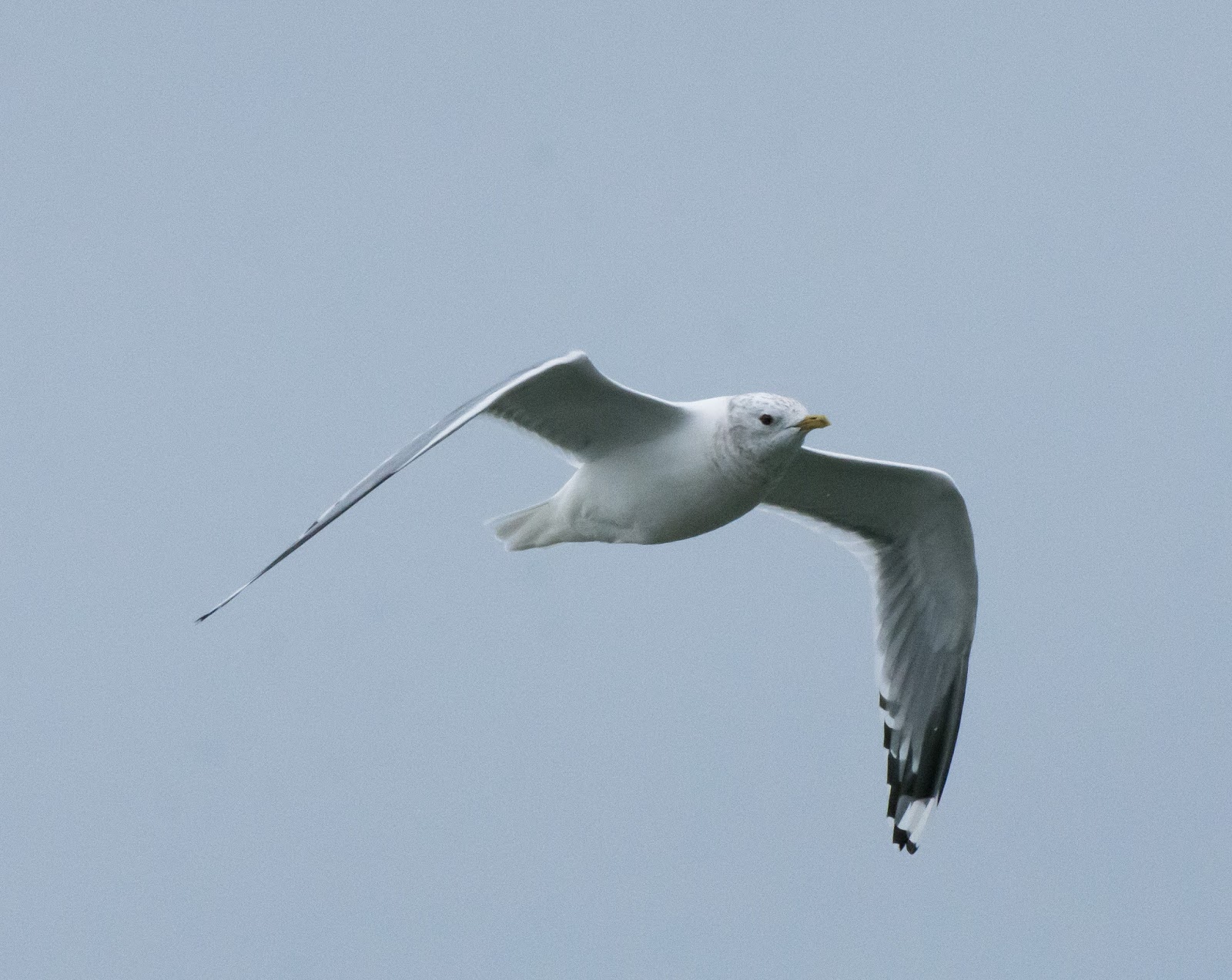


Gulls are not my forte in the birding world and not one that I would chase a lot.  There are a couple of species that would definitely get my interest to chase, but doubt if either will show up in Arizona.  We were challenged with the identification of the various gulls in Oregon.  Gulls are notorious for hybridizing and we quickly found out that some of the hybrids in this area are quite common.  So we had to approach the gull identification process with caution.  We did have other gulls that were not hybrids and one of them was the Glaucous-winged Gull.  This was not a lifer for me, but it was the first time I got to see one in adult plumage.  My previous sighting was a juvenile in Arizona several years ago.

Glaucous-winged Gull

Below are a few photos of some of the other water birds we observed during our stay.  Some I have seen in Arizona in the past, and some I have not.  But always fun to see and observe some of these species that I do not see as often.  

Horned Grebe

Common Murre

Common Murre

Surf Scoter - Male

White-winged Scoter

Black Oystercatcher

Black Turnstone

Belted Kingfisher

Belted Kingfisher

Golden-crowned Sparrow

Was also pleased to see a few other unusual flora and fauna.  My first ever sighting of a Vole.  I know they are a common rodent and are frequently seen as part of the diet of many raptors including owls. 

My first ever photo of a Vole

Western Skunk Cabbage was a new and interesting plant that we found.  Had heard of it before, but never knew much about it until now.  It is sightings like this that are fascinating as I read up on things like this and understand more about our natural world.

Western Skunk Cabbage

These last 2 photos are of a spider species that was fairly common clambering around on the snow in the vicinity of where we had the gorgeous male Spruce Grouse.  I have no idea what species it might be, but I had never seen a spider on snow before and seeing several of them leaves me in awe of what else is out there yet to be discovered.
  
Spider in the snow!


I returned to Arizona with 9 more new life birds so it was a great trip with some really awesome birds.  If anyone is planning a trip to the Pacific Northwest and have some of these birds on your wish list, I highly recommend contacting Khanh Tran.  He knows his birds well and not only knows where to find many of them, but also how to find them and what time of the year is best to observe them.  


Thursday, February 11, 2016

San Diego: The Quest For a Tattler

In preparing for this trip to San Diego, I had gone through a lot of lists and reports to see what new birds I could possibly find in San Diego.  Surprisingly, the list was relatively small.  Only 2 life birds stood out for me, without taking a pelagic trip for sea birds out on the ocean, the Wandering Tattler and the Scaly-breasted Munia.  Most of the other species in southern California were either birds that could also be found in Arizona, or birds that I had already found on a few previous trips to the area.  Prime target was Wandering Tattler.  After perusing the many eBird reports on this bird for the month of January, it appeared that it was most frequently encountered around the La Jolla Cove area on the coastline.  I decided that this would be my first stop to see if one might be hanging out in this area. Thanks to all the new smart technology and the use of my iPhone, I was able to locate this place in a reasonable amount of time.  What a view this was from the parking along the street high above the ocean waves crashing on the rocks below.  It was early morning and the cliffs were covered with cormorants; Brandt's, Pelagic, and a couple of Double-crested in the mix.  A few Brown Pelicans dotted the rocks as well.  But what quickly caught my attention was a Brown Booby on the cliffs with all the cormorants. Not a bird that I see that often and fairly close.

 Brown Booby

 Brandt's Cormorant


Brown Pelican

I decided to walk the entire coast road and along the way, I had the pleasure of seeing some California Sea Lions and at the far end, some Harbor Seals.  Both species had pups and they were pretty darned cute if you ask me.  And for those that are interested, sea lions have small visible ear flaps, whereas seals do not have visible ear flaps

 California Sea Lion & Pup

 Harbor Seal & Pup

Harbor Seal

Just as I reached the end of the walk, I noticed a different bird on a large boulder along the shore and once I got my binoculars on it, then I knew that I had struck gold; Wandering Tattler!  Sandpipers can sometimes be notoriously difficult to identify, but knowing behavior of many birds can most assuredly help in the ID process.  The Wandering Tattler has a behavior of bobbing and teetering as it walks or stand still.  This behavior is also seen in Spotted Sandpipers, but these 2 birds are vastly different in appearance, so it would be difficult to get them confused.

 Wandering Tattler


Also along this area I was able to find and photograph a Black Turnstone, a Royal Tern, and a Western Gull.

 Black Turnstone

Royal Tern

Western Gull

Mission accomplished for my number 1 target bird and I still had a lot of time left in the day.  My next plan was to visit Tijuana Slough, which is a place I had visited in May of last year and I liked it so well, I wanted to go again.  But along the way, I decided to make a slight detour off the freeway and visit Tecolote Canyon Natural Park.  Reports of the Scaly-breasted Munia had been sketchy on eBird up to this point, but this spot seemed to be the most likely possibility.  I pulled into the lot, parked my car and got out to hear an American Crow calling and then heard something unfamiliar to me on the north side of the parking lot, and lo and behold, there was the Scaly-breasted Munia!   That just seemed too easy, but then I remember so many of the times I have dipped on birds, so I guess I was due for a bit of good luck!

 Scaly-breasted Munia

Scaly-breasted Muni

But since I was there, I decided to hike a ways up the canyon to see what else I could find.  Got some decent looks at Bushtits, California Towhee, and California Thrasher.

 Bushtit

 California Towhee

California Thrasher

I then made my way to Tijuana Slough, and while there, my zoom lens on my camera quite working.  I was left without a workable zoom lens for the rest of Saturday and all day on Sunday, so photos became a bit tougher.  Nevertheless, on Sunday I headed out to the area of the San Diego Harbor area.  I was looking for another bird that I had only seen once before in Rocky Point, Mexico, and at quite a distance.  This time I was hoping to see a Brant a little closer and also add it to my USA list.  I not only saw it, but I saw over 100 of them!  Without a zoom lens, I still had an issue with photos, but did the best I could with my regular lens.

Brant

Also, quite plentiful, were Surf Scoters, which is a bird we see occasionally in Arizona in the winter, most generally females.  But this time, I got to see the males and they are outstanding!

 Surf Scoters


One last stop on Sunday, gave me a view of a new reptile for me; a San Diego Alligator Lizard.  What a cool looking reptile, very long at probably about 14" from snout to tail and such tiny legs.


The trip was most definitely worthwhile and I got my 2 new life birds that I had targeted plus so much more.  


Tuesday, November 25, 2014

From Desert to a Lake

After taking several trips to the desert area of Pima Canyon Wash, I decided to change it up a bit and check out Saguaro Lake which is located on the Salt River.  A recent sighting of a Surf Scoter was the main reason to visit this lake.  Although it is not a life bird for me (having seen it twice before), it is a fairly rare bird in Arizona.  But every fall it seems that about a dozen or two show up in Arizona and various lakes.  So with that being my main focus I headed to Saguaro Lake and arrived very early at the marina area; found a parking spot about in the middle of the floating docks and walked to the edge of the lake.  And there it was, had there not been a couple of American Coots in the vicinity, it would have been the first bird I encountered.  The 3 species of scoters in North America, are stocky, short-necked diving birds that feed on crustaceans and mollusks and their breeding habitat is the tundra regions of the far north.  I walked out on the floating dock and stood there watching and observing as it was diving and if a coot ventured too close, then it swiftly chased it away from its claimed territory.

 Surf Scoter

 Surf Scoter

Surf Scoter

Not too far away I witnessed a Pied-billed Grebe surface with a crayfish held firmly in its beak.  Looks like this grebe captured itself a nice morsel for breakfast.

 Pied-billed Grebe

Pied-billed Grebe

After leaving the Marina area of Saguaro Lake, I then headed to Butcher Jones Beach area which is still on Saguaro Lake, but have to travel a few miles to get to this spot.  As soon as I got out of the car, I heard a Gray Flycatcher calling.  It was not too hard to locate due to its incessant calling, but trying to get a photo was very difficult as I could only find one small clearing in the branches to shoot through.  This bird is one of the infamous and difficult-to-ID birds in the Empidonax family.  Many of them can only be safely identified by their calls.  However the Gray Flycatcher is probably one of the easiest to ID because of a behavior that it displays that the other do not show.  I has a behavior of pumping its tail downward very similar to the phoebes.  

 Gray Flycatcher

Gray Flycatcher

And of course standing on the beach area and checking out the waterfowl was the main objective.  While using my scope to check out the birds further out, much to my surprise, a couple of Common Mergansers swam right by close to shore.

Common Merganser

After getting good shots of a male Lesser Scaup a while back at Fountain Hills Lake, I decided to try for a photo of a female at this location.  While not nearly as good as I would have liked, it still is nice to capture the females to add to the personal photo library.  A small flock of Buffleheads were also noticed a bit further out.  This is our smallest duck in the US, but it is also one of the most dynamic to see with its clean look and iridescent colors in the sunlight.

 Lesser Scaup - Female

Bufflehead

Probably the strangest photo that I captured was a Great Blue Heron perched on some rocks on a desert cliff with Saguaro Cactus in the photo.  The bird definitely looks out of place in this surrounding, but water was not far away.

Great Blue Heron

It is always a joy to be able to go birding and just simply observe and watch the habits and behaviors of the birds, especially those that are visiting Arizona for the winter months.