Costa's Hummingbird

Costa's Hummingbird
Showing posts with label Thick-billed Kingbird. Show all posts

Friday, August 30, 2013

Patagonia Lake & San Rafael Grasslands

The awesome show from the Blue-footed Booby was not the only show in town on this day.  Tommy, Muriel and I also got photos of a lot of other great birds and some other critters as well.  On the road into Patagonia Lake, we stopped along the road and got to see and hear, both Botteri's and Cassin's Sparrows.  What was odd, was the fact that the Botteri's Sparrows seemed to favor one side of the road and the Cassin's Sparrows favored the other side.  I have seen Botteri's Sparrow before but have never gotten very good photos.  The Cassin's Sparrow was a new life bird for me and they we performing their skylarking displays which was really cool to watch how they would flutter up into the air about 10 to 15 feet and then glide down into the grass and then disappear.  They were singing all the while.  The Botteri's Sparrow has a song a bit similar to the Black-chinned Sparrow, but totally different in appearance.  Both birds are little brown birds that are fairly drab in appearance, still great birds to add to one's bird list.

 Botteri's Sparrow, juvenile below and adult above

Cassin's Sparrow

And while we are looking at little brown birds, another sparrow species was quite plentiful near the far western part of the lake; the Rufous-winged Sparrow.  A little more distinctive than the first 2 species, but one that can only be found in the United States in southern Arizona as a regular breeder.

Rufous-winged Sparrow

While we were waiting for the Booby to return to the dock area, we also had a fly-by of a Black Vulture.  Not a rare bird by any means, but definitely not as common as the Turkey Vulture.  This was the first time I was able to capture photos of one in flight.  They are definitely much different in appearance and structure than a Turkey Vulture and their flight pattern is much different.

Black Vulture

While we were at Patagonia Lake, we met Kelly Rishor, another birder that we knew only through Facebook and she joined us as we then headed to the Patagonia Rest Stop and then on to Harshaw Canyon and on up to the San Rafael Grasslands.  At the Patagonia Rest Stop we found another specialty bird that is hard to find elsewhere in the United States, the Thick-billed Kingbird.  This photo really points out how big and thick that bill is on these birds.

Thick-billed Kingbird

Next area of birding was Harshaw Canyon on our way to the San Rafael Grasslands.  This is a great place to find Eastern Bluebirds which is not a bird that too many people are aware even exists in Arizona.  The one in Arizona is a subspecies of the more common bird seen in eastern the United States and is much paler in coloration.  We had a pair of these birds feeding recently fledged babies and the babies are very different in appearance than the adults.  
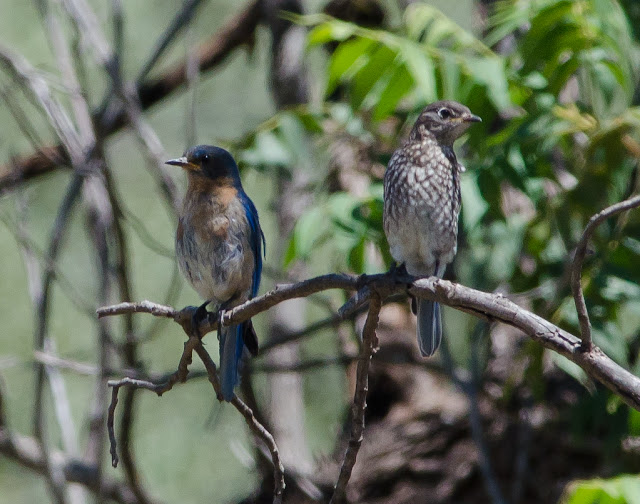
 Eastern Bluebirds, adult and juvenile

Eastern Bluebird, juvenile

Finally we reached the San Rafael Grasslands and with the monsoon rains that have been taking place this summer, the grasslands were plush with vegetation and the Grasshopper Sparrows were in full breeding mode. We saw more of these birds than I have ever seen before; they were lining the fences and were obviously feeding some young in nests that were well concealed in the grass.  One of the photos has more than its share of bugs in its beak!

 Grasshopper Sparrow

  Grasshopper Sparrow

 Grasshopper Sparrow, kind of a glutton if you ask me!

After leaving the grasslands, we headed back down Harshaw Canyon and once we reached the paved area of the road, I noticed a rattlesnake in our lane of the road and Muriel drive over it by straddling it with the car.  We turned around and went back to check it out and it was totally motionless and we thought it was dead or mortally injured by maybe another vehicle driving over it.  Tommy tossed some water on it and it flicked its tongue out, so then we knew it was not dead, but it sure was not disturbed or agitated in any way.  I gave it a very gentle nudge with the end of my monopod and it reared up into a striking pose, but still was not agitated and did not use its rattles.  After watching it and getting photos, I gave it one more gentle nudge and it took off and slithered quite rapidly into the grass on the side of the road.  I was concerned that if we left it on the road, the next vehicle to pass by might not have been quite so kind.  I prefer to let them live as they were inhabiting in this land long before we came along.  

 Western Diamond-backed Rattlesnake

 Western Diamond-backed Rattlesnake

Western Diamond-backed Rattlesnake, has a few rattles to the tail!

The photos below will show the lushness of the grasslands, plus we have photos of the the foursome.  The photos will show that Arizona is not all desert and sand dunes!    

 San Rafael Grasslands

 Muriel, Tommy, and Kelly

Muriel, Tommy, and myself

Have a lot more to share, but am going to create another post to cover some of the other great birds we saw.


Wednesday, July 10, 2013

Rancho El Aribabi, Sonora, Mexico - Part 2

Saturday morning I awoke before the sun had even risen and what woke me was the multitude of bird songs all around us outside the ranch house.  Of course I was excited and headed outside and heard the Buff-collared Nightjars calling their last calls before they went to rest for the day.  Those nocturnal birds are hard to get visuals, but once you learn their calls, you know they are out there.  We had already been told by Jim Rorabaugh that the hillside to the west of the ranch house would have Five-striped Sparrows singing in the morning, he was absolutely correct.  This is a bird that is very hard to find in the United States as it is only found in a couple of very remote canyons of southern Arizona, so it was one of my target birds on this little trip.  We found several singing all over the hillside and they were being especially cooperative and allowing several photo opportunities.  It is another one of those handsome sparrows.  So, Saturday started out fantastic as I got my first new life bird of the weekend!  (But things were going to get even better fairly quickly.)

 Five-striped Sparrow

Five-striped Sparrow

As we were standing there looking up a small draw at the Five-striped Sparrows, I heard a rattle call and saw a bird fly in and onto some dead branches just below some Saguaro Cactus.  That call immediately made me think of a kingfisher and low and behold, a Green Kingfisher had landed on those dead branches.  I was almost afraid to call out the ID on it because it really did not belong here; should have found this bird down in the stream bead and the trees and heavy shade.  This was a female and it sat there for several minutes allowing all of us to get some good looks and of course some photos.  This bird does show up occasionally in Arizona, but it is far from being common and not easy to find when it is present.  Another new life bird for me and one that I had secretly hoped to find, but thought it was going to be harder to find.


Green Kingfisher

What a way to start the day!  Also during all of this our resident pair of Barn Swallows took a rest in this area as well.  It is not often one gets photos of them on vegetation as they love to perch on power lines and fences.  This pair has a nest on the patio portion of the ranch house, so they were our constant companions along with a couple of Canyon Towhees that kept the patio free and clear of a lot of insects.  Even a Black Phoebe flew in to snack on a few flying insects once in a while.

 Barn Swallow

 Canyon Towhee

Black Phoebe

Other birds that were seen constantly in and around the ranch house were red and blue, such as the Blue Grosbeak and the Summer Tanagers and Northern Cardinals.  Yes, these birds can be seen in Arizona, but here they were constantly all around us.

Blue Grosbeak

 Summer Tanager

Summer Tanager- Male and Female

 Northern Cardinal

Northern Cardinal

During my wanderings on Saturday, I finally got around to photographing some of the many flycatchers located at this place.  Dusky-capped Flycatchers were abundant as were Brown-crested and Ash-throated Flycatchers.  We also had kingbirds, Cassin's Western, and Thick-billed Kingbirds.  I was really pleased to see the Thick-billed Kingbirds as it was a bird that I had only seen fleetingly in early June, but this time I was able to capture photos of this huge billed kingbird.  No doubt where it got its name.

 Thick-billed Kingbird

Thick-billed Kingbird

 Dusky-capped Flycatcher

Western Kingbird

Of course we also had both species of vultures.  The Black Vulture is one that is usually a bit harder to find and capture in a photo, so I took advantage of this one perched on an electrical pole.  Another bird that was seen in abundant numbers was the Common Ground Dove.  They are found in Arizona as well, especially in the south and occasionally they do stray as far north as the Phoenix area as I have seen them at a couple of places in the urban areas.  

 Black Vulture

Common Ground Dove

 A person never knew what to expect flying in the canopy of trees and even though we had heard them a few times, finally a Yellow-billed Cuckoo flew from right to left and actually landed on a branch for good viewing.  This is another one of those secretive birds that one hears a lot and gets an occasional glimpse.  Still not the best photos that I would like of this elusive bird, but much better than any I have captured before.

Yellow-billed Cuckoo

Anytime anyone wanted to take a break, we could sit around on the patio and watch the hummingbirds.  For the most part only 2 species were making regular visits; the Broad-billed Hummingbird and the Violet-crowned Hummingbird.  (A third species made an appearance on Sunday, but that will be on my next post.)

 Broad-billed Humingbird

 Violet-crowned Hummingbird

Violet-crowned Hummingbird

Must have been lunch time to find all of us together in the daylight.

This was the full crew, minus myself in this photo

Finding out how long this post turned into, I have decided to stop and continue on the 3rd and final post which will include a photo of the only snake we found.