Costa's Hummingbird

Costa's Hummingbird
Showing posts with label Neotropic Cormorant. Show all posts

Saturday, January 2, 2016

Birding Birthday Bash

In the early part of December, I just happened to celebrate a landmark birthday and I was fortunate to have it fall on a Saturday.  What better way to celebrate a birthday than getting out in nature to see what cool birds one can find!  One of my best birding buddies, Chris Rohrer ventured north from Tucson and joined me in our quest to find some birds in and around the eastern suburbs of Gilbert, Mesa, Scottsdale, and Tempe.  

First stop was the Gilbert Riparian Water Preserve in the search for some rare Purple Finches that had been seen there for a week or so.  We did not have any luck with that species, but the birding was was still excellent with the highlight being a White-throated Sparrow.  Of course several others were gracious enough to allow photos as well; Neotropic Cormorant and Wilson's Snipe.

 White-throated Sparrow

 Neotropic Cormorant

 Wilson's Snipe well camouflaged

Wilson's Snipe zoomed in and cropped

Our next stop was Coon Bluff on the Salt River northeast of Mesa to search for another rarity, a Reddish Egret which had not been reported for a few days, so our hopes were not very high and once again, we dipped on this bird as well. But once again, several other species made our visit very enjoyable such as Cedar Waxwing and Vermilion Flycatcher.  And a couple more passerine species graciously gave me a chance to get photos with their reflection in the water, which is not too common; Say's Phoebe and American Pipit.

 Cedar Waxwings

 Cedar Waxwing

Vermilion Flycatcher

 American Pipit

Say's Phoebe

From here we headed to Scottsdale Ranch Park to look for a Red-breasted Sapsucker which had been reported there.  It is an uncommon winter migrant in Arizona; its more common winter range is the Pacific Coast from Baja California northward to Washington state and into British Columbia in Canada.  It is always a treat to see this bird in Arizona.  We arrived and spent some time searching in the trees that it favored and was not finding it.  As we decided to maybe head to the next location on our agenda, we met a handful of other birders also looking for it, but to no avail.  I started scanning its favorite tree one last time and Bingo! there it was!  I quickly got everyone else on it and it was quite accommodating to us all.

 Red-breasted Sapsucker


One last point of interest on our list: Tempe Town Lake.  Sorry to say, but we came here to actually locate a drake Mandarin Duck that had been seen here for some time  Although, it is non-countable as an ABA bird, you have to admit it really is quite a handsome specimen.  

Mandarin Duck

A nice adult Bald Eagle is always a bonus, and it is nice to find one is such an urban setting such as Tempe Town Lake.

Adult Bald Eagle

I was a great way to spend a milestone bi(rd)thday!  


Tuesday, January 27, 2015

Birding With Jim - Day 1

Last weekend, birding friend, Jim Austin-Cole from New Jersey, was in Arizona for a week and together we spent two days searching for new life birds for Jim in Arizona. The first day we headed to the western side of the greater Phoenix area, specifically to the Buckeye/Arlington area.  Immediately after we turned off of Highway 85 and headed west on Baseline Road, the first bird to greet us was a very nice Ferruginous Hawk.  Our first real stop was the infamous 'Thasher Spot' at Baseline and Salome Hwy.  When we arrived we found another lost soul from Rhode Island there and he was also looking for the major prize, the Le Conte's Thrasher and he joined us.

The first thrasher we located was Bendire's Thrasher and as we made our way towards one of them we heard a thrasher call in the brush to the left of us that caught my attention and it was not long before we caught a glimpse of two Le Conte's scampering on the ground from one shrub to another. As we slowly tried to get closer for photos, one of them flew up into the branches of a tree and allowed good looks and some photos. This bird has never been easy to photograph but this pose was a dream come true.

Le Conte's Thrasher

As Jim and I departed the area we spied a few sparrows near the highway and mixed in just happened to be a few Brewer's Sparrows. We left this spot with 3 new life birds for Jim;  Bendire's Thrasher, Le Conte's Thrasher and Brewer's Sparrow.

Brewer's Sparrow
 
From the Thrasher Spot, we then headed out to cover the various spots along the many roads.  At one little stop along the road a Lincoln's Sparrow gave us an over-the-shoulder look before it took off for better cover and we did find a small flock of 55 Sandhill Cranes.  Not a common bird in Maricopa County, but there is a small flock that spends their winters in the Arlington area.  And we found huge numbers of Brewer's Blackbirds.
 
 Lincoln's Sparrow

 Sandhill Cranes

Sandhill Cranes
 
Brewer's Blackbird
 
After lunch in Buckeye, we headed to Friendship Park which is the place that I discover just two weeks before as a good place for the Lawrence's Goldfinch.  Since we were later in the day, we were only able to find one, but at least we got good looks at it and added another new life bird for Jim.  The only photos I took at this location was a bad one of a Common Yellowthroat (not an easy bird to photograph) and a Neotropic Cormorant that was busy preening its feathers.
 
 Common Yellowthroat

 Neotropic Cormorant

Neotropic Cormorant
 
Our last stop was Glendale Recharge Ponds which had large numbers of ducks and shorebirds.  Ducks were not so cooperative, but some of the shorebirds were a bit more accommodating, including Greater Yellowlegs and Lesser Yellowlegs feeding side by side which really made for a great comparison of the two species.  Had lots of Least Sandpipers and one of them was in the mood for taking a bath.
 
Greater Yellowlegs

Lesser Yellowlegs
 
 Least Sandpiper

Least Sandpiper
 
It was a great day of birding and I took off a day from work on Monday to take Jim to a totally different location and habitat.  That will be the focus of my next post.


Friday, August 8, 2014

Taking Advantage of a Cool Down

As mentioned many times in previous posts, the Arizona summers in and around the city of Phoenix can be quite brutal with the excessive heat.  When one gets up before the sun rises and the outside temperature is 94° F in the dark, then you know the daytime temperature will be very uncomfortable.  That's when it is time to head to higher elevations in the summer to go birding.  But every once in a while there is a slight break in the weather especially during monsoon season and the first weekend of August was one of those times.  Our day time highs did not quite reach the 100° range and the overnight lows were in the low 80's.  With this break, I decided it was time to get out early in the morning to see what I could find in an hour or two before the sun made it miserable.

Saturday, I decided to visit one of my regular spots, Pima Canyon Wash in South Mountain Park.  I arrived while it was still dark, and I began my hike in the dark, and was listening to the Common Poorwills calling higher up on the slopes of the canyon. I could vaguely see some movement in the sky as the sky started letting go of the pitch black darkness and I figure those were the Common Poorwills remaining activity before going to roost for the day.  All of a sudden I detected another bird movement, very close and right  across the path in front of me and it was very silent, reminiscent of an owl as they are very silent flyers. Sure enough I was able to pick out and count 3 Western Screech Owls with my flashlight.  Obviously as dark as it was, I was not going to get any photos, but it was great to find them and then I made a mental note of the tree they had flown into as I wanted to check it on my return hike.  Sure enough, on the return, I approached the tree with caution and one of them was perched on a branch in the tree.  The colors blended in quite well with the tree limbs and most people would walk right by and not notice this bird sitting there.  Approaching slowly and cautiously, I was trying to get some photos as this is one bird that has been difficult to photograph mostly due to their nocturnal habits.  First photos of it consisted of squinting eyes, then they opened a bit as I got closer and once it's eyes were open and I got a couple of photos, I quickly retreated to leave it rest in peace for the day.  I have always known these owls were in this location as I had heard them many times in the past.  Looking forward to a return visit to see if this particular tree is a common roost for them.

Western Screech Owl

Western Screech Owl

Western Screech Owl

What an elated feeling and glad I made the decision to get in a short hike that morning.  Then as I approached the parking lot I stopped in the wash as I had heard a different call from a nearby tree and just about that time, a Black-headed Grosbeak flew from the distant tree into the tree I was standing under and gave me a chance at a couple of photos.  I suspect that this bird is a first fall male with that bright yellow chest and belly stripe.

Black-headed Grosbeak

Black-headed Grosbeak

Sunday, I decided to check out Glendale Recharge Ponds in the western part of Phoenix.  Some nice shore birds were being seen and I wanted to check it out.  (Have to make a mental note to try and find a reasonable priced spotting scope to use in places like this.  Those ponds are fairly large and a scope will greatly assist the viewing of the birds on the opposite shores.)  There were lots of shore birds on the two ponds that held water, including 37 Wilson's Phalaropes.  These birds are a lot of fun to watch as they forage.  They swim in circles in a spinning motion like a top to stir up larvae, crustaceans, and insects to feed on.  They were so busy spinning in circles that I was able to at least approach them close enough to get a photo or two.  

Wilson's Phalarope

Wilson's Phalarope

Long-billed Dowitchers were quite numerous as well and some were still sporting the remnants of their summer breeding plumage as was a Neotropic Cormorant.

Long-billed Dowitcher

Neotropic Cormorant

After about an hour of scanning the ponds, and the sun staring to make its mark, I decided to calls it quits for this day except for the fact that I made one last stop at the southwest corner of this area.  There is a concrete bridge here that is at the dead end road and one can park and go exploring.  Glad I stopped for a few minutes as I was treated to a couple of very nice birds; Lazuli Buntings and a Sora.  Lazuli Bunting males are downright stunning in breeding plumage and usually we see them in and around Phoenix only in migration in the spring and in the fall.  Springtime sightings are a hit or miss on the breeding plumage, but early fall can be a great time to see them so colorful.

 Lazuli Bunting

 Lazuli Bunting

As I was observing these colorful birds from the bridge, I also caught glimpse of a Sora that flew into the area.  Always a great bird to see as they can be a bit secretive most of the time.  But of all the rails, this species is not as shy as the rest.

Sora

As an added bonus, a first year male Red-winged Blackbird also paid a visit.  Not a bird that I usually spend a lot of time observing, but that bright red patch on the wing really stood out, giving an indication of how handsome it would be next spring.

Red-winged Blackbird - first year male

So two short excursions turned into some nice birds when I was least expecting to find much in the heat of the summer.  Just shows that even with the heat, many birds are doing well.


Sunday, December 2, 2012

Tres Rios Wetlands - 1 Dec 2012

I noticed that I have fallen behind on updates, but in some instances I felt I was reporting on the same birds that I see quite frequently and that get to be a bore for some people reading this blog.  However many birders just like birds period and it does not matter if they are frequent or common birds or if they are rare birds.  Even in my adventures, I am discovering a lot about behavior and habits on even the most common birds and some of it is very entertaining. 
 
On Saturday, I ventured out to Tres Rios once again and this time with Bernie Howe who had not been there, but had just received his permit for access to this place and was anxious to check it out.  So off we went, arriving about 7:00 am and immediately we were amazed at all the birds around us everywhere; in the sky, in the trees, on the water and in the reeds growing in the water.  The prize of the day was a leucistic Cormorant that we happened to discover swimming in the small pond just before the spillway area.  I looked out into the water and saw a white bird that looked very unusual.  It was swimming with an upturned bill like a cormorant, but the cormorants in Arizona are not white.  We basically have 2 species of cormorants in Arizona, the Neotropic and the Double Crested and they can be very difficult to identify even as adults.  This was a Leucistic Cormorant and there is a lot of speculation on which species it is, seems everyone has a different opinion (even the experts).  And it really does not matter which it is, but one thing just about everyone can agree on, is that it is one unique and beautiful bird, especially since most cormorants are basically black in coloration.
 
 Leucistic Cormorant
 
Leucistic Cormorant
 
Leucistic Cormorant
 
Was also able to add a new bird to my life list; a Virginia Rail.  I knew this bird existed in this location as I had heard it several times in the past, but it is a secretive and elusive bird that likes to hide in the tall reeds.  It flew in about the same time that a Sora approached from the other direction and it was hard to determine where I should be pointing my camera.  So I attempted to get photos of each.  The Sora is not a new bird for me, but they are also secretive and elusive.
 
 Virginia Rail
 
Sora
 

Other birds that we found were a Spotted Sandpiper, Black-crowned Night Heron, Belted Kingfisher, and a Great Egret that was doing a balancing act on a high wire.
 
 Spotted Sandpiper
 
 Black-crowned Night Heron
 
 Belted Kingfisher
 
Great Egret
 
Some of the smaller birds included 2 phoebes; Black Phoebe and Say's Phoebe, an Orange-crowned Warbler, and the noisy little Marsh Wrens always playing Hide-n-Seek in the reeds.  The Song Sparrows were also quite numerous every step of the way. 


 Black Phoebe
 
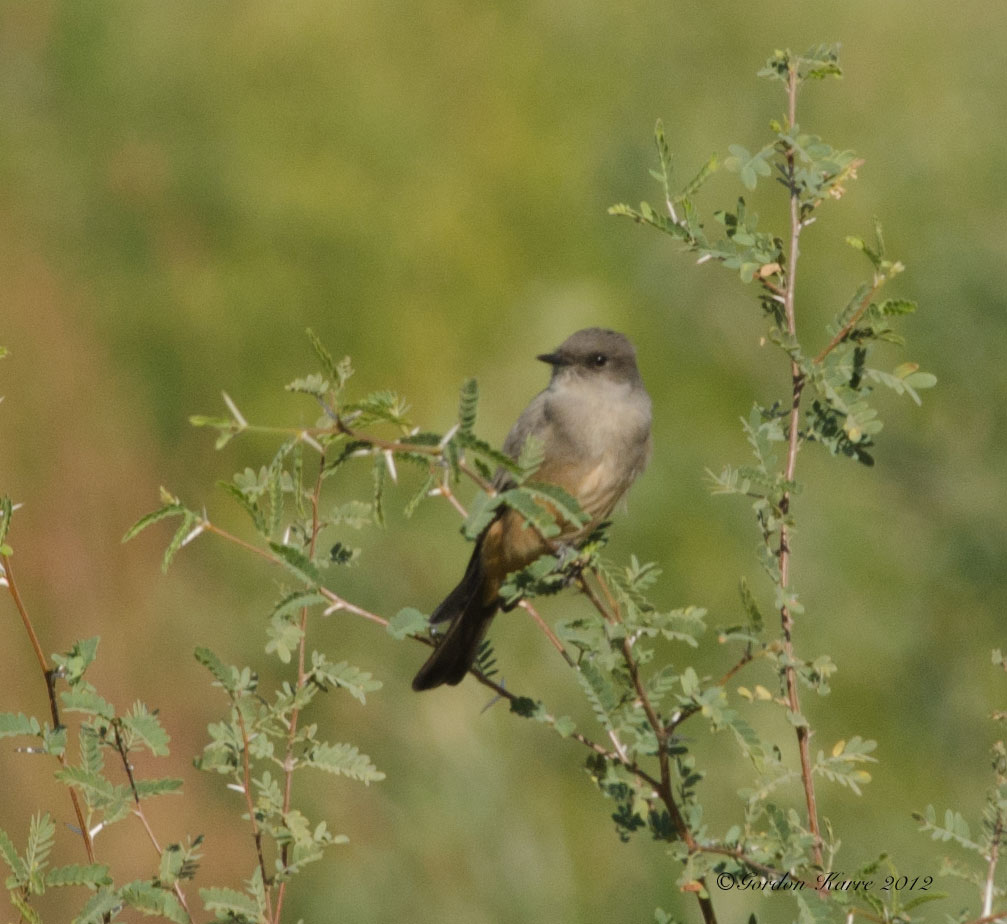
 Say's Phoebe
 
 Orange-crowned Warbler
 
Marsh Wren
 
Song Sparrow


As we were observing and shooting photos of the cormorant we had a fly-over by a couple of American White Pelicans and later when processing the photos we noticed one of them is carrying a wing tag.  So we are currently trying to find out where this pelican was tagged and where its travels may have taken it.
 
American White Pelicans