Costa's Hummingbird

Costa's Hummingbird
Showing posts with label Western Kingbird. Show all posts

Monday, October 13, 2014

Ringing a Bell

About a year ago the AOU (American Ornithologist' Union) split the Sage Sparrow into 2 different species; the Sagebrush Sparrow and the Bell's Sparrow. Having seen several of the former 'Sage' Sparrows, now the quest became to find both species and the thoughts were that both species could be found in Maricopa County in Arizona on their wintering grounds.  The problem lies in the fact that the 2 species can be a bit tricky to identify with any certainty and Sagebrush is probably the most common of the 2 species to be found in Arizona.  Bell's Sparrow was thought to have its eastern range in Maricopa County of Arizona.  Last year I did attempt to try to locate both species, but came away unsuccessful in definitively finding the Bell's Sparrow.  Found many of the Sagebrush Sparrow, but the Bell's had eluded me.  

This year is a bit different due to some extensive studies by a couple of great birders.  Chris McCreedy conducted a field study that included DNA testing on birds captured in mist nets. And good friend Tommy DeBardeleben, has spent countless hours finding and studying these birds at a couple places west of Phoenix.  I was lucky enough to get a call from Tommy asking if I want to explore Robbins Butte area on Saturday to look for Bell's Sparrow.  He did not have to ask twice; I jumped at the chance and some more good fortune that came with it was the opportunity to have Laurence Butler and a young man by the name of Caleb Strand joining us.  Laurence is a very experienced birder in his own right and Caleb is an amazing birder for only being a teen.  It was really quite an awesome team the 4 of us made for birding that day.  Our plan of attack was to visit Robbins Butte where Chris's testing revealed mostly Bell's in this location and Tommy had just been there 2 days before and had excellent looks at Bell's as well.  We did find Bell's Sparrows and was able to see the distinguishing field marks that separated them from Sagebrush Sparrows.  But we also found that the Bell's seem to be a bit more skittish and do not like to pose well for photos, so the only decent photo I got was of a Sagebrush Sparrow.  More trips are in order to study these birds closer and hopefully come away with a decent photo or two of the Bell's Sparrow.

Sagebrush Sparrow

Sharp-shinned Hawk - fly over while pursuing the Bell's

Sparrows were not the only stars that day.  Seems that reptiles played a role in our discoveries as well.  Laurence happened upon a pair of Western Diamond-backed Rattlesnakes mating and undulating under a mesquite tree.  These snakes will mate in Spring and then again in the Monsoon season in Arizona, and being live bearers, they will give birth to 2-12 babies.  They were well hidden under the tree, so photos were a bit tough, but still a cool thing to observe.

 Western Diamond-backed Rattlesnake - mating

 Western diamond-backed Rattlesnake - Mating

Western Diamond-backed Rattlesnake - 2 tails proving there are 2 snakes here

As we headed back to the car to head out to the Arlington area, I was following Caleb and right in front of me he quickly dropped to ground and picked up a medium sized Gopher Snake and held it for all of us to check it out up close and get some really nice shots.

 Gopher Snake

Gopher Snake

Just a word of caution to others head out to this location.  Keep an eye on where you are walking because we know there are at least 3 snakes out there!

The trip to the Arlington Pond area was very rewarding as well. On the road in, Caleb was quick to spot a Lewis's Woodpecker, which is a really cool bird to find at this low elevation as they are not very common to find in Maricopa County.  At the ponds we had a large group of Black-crowned Night Herons which all spooked once we approached.  
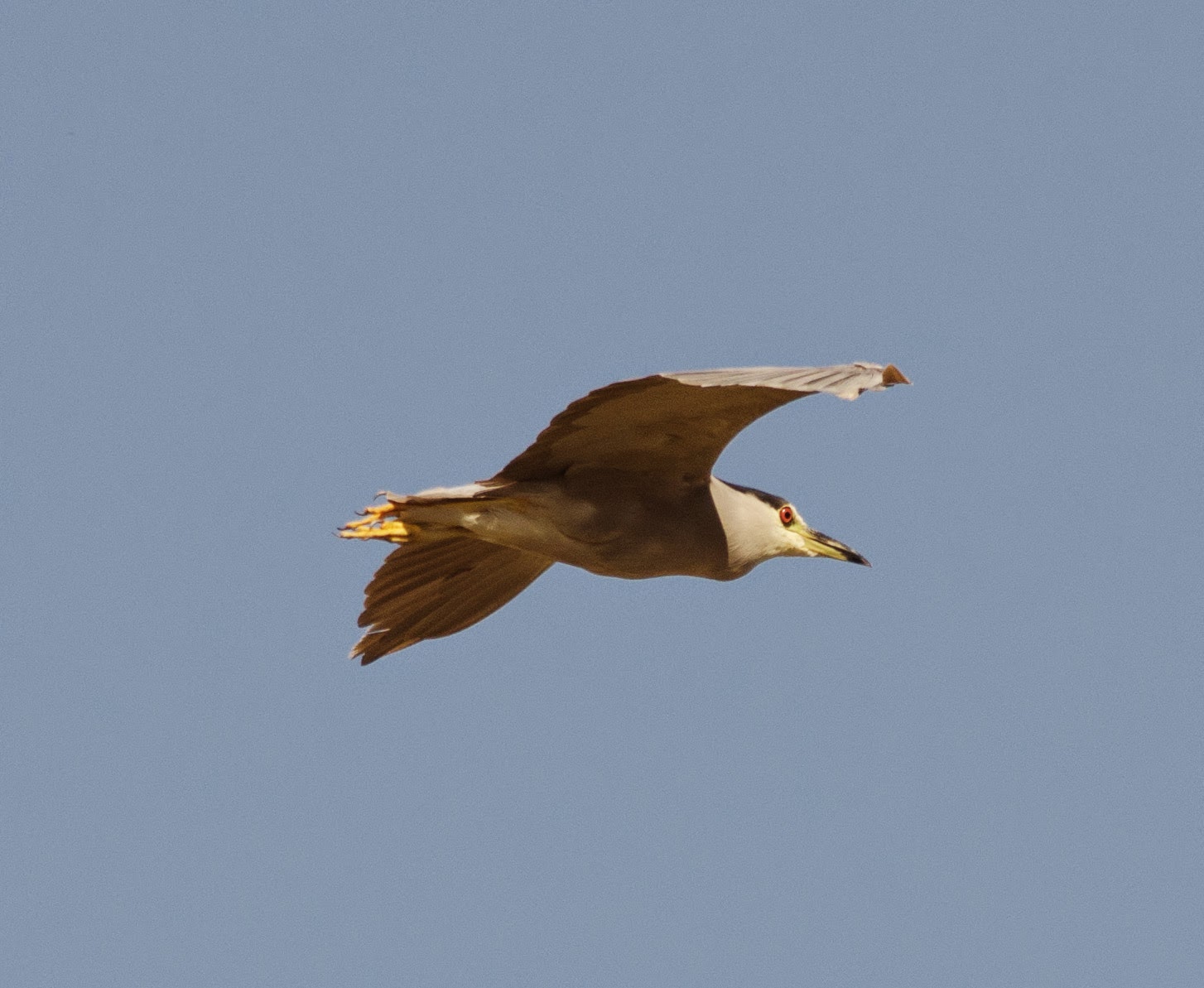
Black-crowned Night Heron

A Greater Roadrunner and a Loggerhead Shrike both posed on trees as we drove by.  Caleb was also quick to spot a Common Black Hawk high up in the sky as we were departing.  It was another fairly late migrant.

 Greater Roadrunner

Loggerhead Shrike

The last couple of photos for this post consist of 2 species of kingbirds; a Western Kingbird and a Cassin's Kingbird.  Both are migrants and are probably lingering behind on their migration.  We had the Western Kingbird at Robbins Butte and the Cassin's Kingbird at the Arlington ponds.  It is a good comparison of the field marks of the 2 species especially for new birders.  

 Cassin's Kingbird

Western Kingbird

This was a fantastic half day of birding with some awesome birders and I want to thank Tommy, Laurence, and Caleb for making this a remarkable and memorable outing.  And yes, I did 'Ring My Bell' by adding the Bell's Sparrow to my life list.


Tuesday, June 10, 2014

Bushnell Tanks Exploration

On May 26th, I decided to visit a spot that I had only explored once before and that was about 3 years ago, Bushnell Tanks, which is located on the opposite side of Sycamore Creek from Sunflower.  I don't recall much about my first visit, so maybe it was the time of the year that I visited that did not leave me with such a wonderful experience.  But this time it was much different and now I know that I need to visit this area more often.  I spent a total of almost 3 hours exploring this spot and hiked a total of 5.6 miles in the process.  (At least that is what my GPS app recorded on my phone; see last photos in this post.)  

The Brown-crested Flycatchers have returned for the summer.  This is a species that many new birders confuse with the more common Ash-throated Flycatcher.  They are very similar in appearance and have some minor visual differences, but those can sometimes be hard to tell when in the field.  Another aspect is to note the time of the year the bird is seen.  Brown-crested are migrants that return every year late April and into May and are usually gone by the end of September.  Ash-throated can be found throughout the year in Maricopa County.  But the best way to identify the differences is by learning their songs and calls.  And at this location in the spring and summer, both species occur making it so easy to listen to the different calls and songs.  And this trip presented this once again to me. 

Brown-crested Flycatcher

Ash-throated Flycatcher

The flycatchers were well represented as I also found both Western Kingbirds and Cassin's Kingbirds.  These 2 species can also confuse many new birders, but once again, the songs will set them apart and in the case of the 2 kingbirds, there are enough visual things to look for to tell the difference, such as the white outer tail feathers of the Western Kingbird.  No other kingbird has outer white tail feathers.

Cassin's Kingbird

Western Kingbird

During the entire time on this excursion, I was constantly under the watchful eyes of a pair of Zone-tailed Hawks.  If they had a nest in the area, it was out of my views and mostly likely very well concealed in one of the many sycamore trees.

Zone-tailed hawk

Zone-tailed hawk

A pair of Warbling Vireos were apparently having a warbling match to see which one could sing the loudest; but do not think a winner was declared this time around.

Warbling Vireos

One of the the day's most colorful birds happened to be the Summer Tanager.  This is a bird that I always love to see each and every spring.  The male and its bright red mantle of feathers is such an eye-opener, but the female is no slouch either in its covering of golden-yellow feathers.  At least this time she showed off a bit better than the male by perching in the sunlight.

Summer Tanager - Male

Summer Tanager - Female

Lucy's Warblers were probably one of the most numerous species of birds in this location as they were singing everywhere.  Oftentimes this bird just appears as a dull gray bird, but they do possess a couple of patches of a brick-red coloration; one on their rump and one on the top of head.  Many times those markings are not well seen.

Lucy's Warbler

Lucy's Warbler

The bird the won the award for the least well groomed was a very vocal and loudly singing Blue Grosbeak.  He was definitely trying to call in a female, but not sure what his luck was going to be this year as he had a lot of new blue feathers still missing for the breeding season.  I do not believe I have ever seen one of these beautiful birds in such a dull coat of feathers.  But maybe by now, it has shed all those dull feathers and it sporting a nice bright blue covering of feathers.

Blue Grosbeak - molting

Blue Grosbeak - molting

Other photos of note include a honeybee on a nice white thistle flower, an Ornate Tree Lizard on a rusty pipe. a Tiger Whiptail Lizard, and a beautiful purple flower that I believe is a species of spiderwort.

Honeybee

Ornate Tree Lizard

Tiger Whiptail


After spending 3 hours with all of this beauty and wonder, you know I will be returning to this place in the future.  After all, it is a great place to get in a good hike and some great solitude with some incredible wonders of nature.  And just to show the distance, here is the final reading on my GPS app showing distance, time and elevation irregularities.  

My hiking route - distance and path I took

Hiking route with time and elevation measurements

This is definitely one of those places that needs to be explored a bit more in the future.


Sunday, June 23, 2013

Globe and the Pinal Mountains - 22 June 2013

After spending last weekend at home and staying cool, I started having withdrawal symptoms on my birding habit!  It was time to venture out again, and with the summer heat in the valley likely to be around for about the next 3 months, I needed to find someplace cool to go birding.  Just a short drive east of Mesa and the heat of the valley, are the communities of Globe and Miami in Arizona.  And just south of these communities is a small range of mountains known as the Pinal Mountains.  The elevation of these mountains is around 7500', and maybe a bit higher at the highest point and they are surrounded by desert which makes this habitat almost a mini Sky Island.  Temperatures near the top can be 20° to 30° lower than in the lower elevations.  The communities of Globe and Miami, have all the amenities one could want for a casual vacation or getaway.  The area is often overlooked as a getaway from the big city heat and crowds.

When I visit this place, I usually head south out of Globe and follow Russell Road until it intersects with FR 651 which I follow the rest of the way to the top.  There is great birding all along the way with the variety of species constantly changing as one drives up higher in elevation. In the lower elevations I found several Western Kingbirds that were busy being what they are, 'flycatchers', meaning they catch and feed mostly on flying insects.  Occasionally, they will perch from a high spot looking for its next insect.

Western Kingbird

On this trip I also heard and then saw, several Black-chinned Sparrows, which is not an unusual species, but this time I found them at lower elevations than I had in the past.  

Black-chinned Sparrow

A bit higher up, I started finding the beautiful Spotted Towhee and due to their general behavior, many times they are heard and not seen as they tend to be a bird that favors foraging under the bushes and low to the ground.  However, at one stop, I heard one calling and the next thing I knew, it flew up into a tree along the road where I had parked and posed for some photos.  (It must have known that the first one I saw earlier caught me off guard and I was not able to get a decent photo!)

Spotted Towhee

Just as I was reaching the area where Pine trees start appearing, I found some Black-headed Grosbeaks.  The males were a bit far away for photos, but one female, did come in for a close landing, but she made sure that some leaves of a nearby branch partially covered her face.

Black-headed Grosbeak-female

During the trip to the top, I had two different flocks of Bushtits making their presence known.  These small birds (about 4½") usually travel in small flocks, flitting from bush or tree to the next, gleaning insects.  Although they are not real skittish around humans, they can be difficult to photograph as they are very active and constantly on the move.  

Bushtit

A short distance into the pines, and at my first stop on the road, a very vocal Cooper Hawk came flying in to my area flying from one tree to another, all the while calling, so it was not hard to find.  These raptors are simply amazing with their ability to navigate in the trees.  They can swiftly fly from within the thick branches and trees to capture their prey.

 Cooper's Hawk

Cooper's Hawk

Further up near the top, I rounded a curve in the road and discovered a couple of deer in the road, so I stopped my car and very quietly and slowly got out to capture a photo.  Once of them looked back very inquisitively. At the same time, a couple of Painted Redstart juveniles were flitting close by and I was have having a hard time focusing on what I should be shooting with the camera. Guess I settled for a little of both.   The Painted Redstarts are juveniles from this year's hatch as neither one has obtained its fully red belly coloration, although one of the them has started with a few red feathers on its side. 

 White-tailed Deer

 Painted Redstart

Painted Redstart

The next stop along the road was fascinating as well.  What got my attention was some Red-faced Warblers, but alas, I was not able to capture any photos.  But while I was concentrating on viewing them, several birds flew in and made their presence known.  Guess they did not want to be ignored and I was not going to let them down.  First was a White-breasted Nuthatch that actually landed on a branch not far from me and worked its way down to the end, not more that 10' from me making it too close for a photo.  Had to wait for it to move a bit further away.  A Western Tanager male also came in for a good close-up view.

 White-breasted Nuthatch

Western Tanager

A pair of Hepatic Tanagers also put in a brief appearance, but definitely did not want to pose for the camera.

Hepatic Tanager

Still in the same spot, I had probably my best view of a Virginia's Warbler ever.  Even though it was seen at the top of a tall pine a distance away, this time I actually was able to get an identifying photo of it.  It has not been an easy warbler to find and photos have been even tougher.  Another warbler that came in for a visit was a juvenile Grace's Warbler, or at least, that is what I think it is.  Definitely not as brightly colored or marked as the adults that I am used to seeing, but the color patterns look right.  And a Broad-tailed Hummingbird made an appearance feeding on nectar from the roadside flowers.

 Virginia's Warbler

 Grace's Warbler

Broad-tailed Hummingbird

Once I reached the top, I always enjoy spending time at Roy and his wife's cabin.  They have created a bird haven and the hummingbirds are the main attraction.  But along with the hummingbird feeders and the several species of hummingbirds that can be found there, they also have some other great features that attract many other species of birds.  On this trip, one of the highlights was a pair of House Wrens being kept very busy by feeding their very vocal babies in their nest.  They were making countless trips bringing back various insects for those voracious appetites. 

House Wren

The small pools of water they had set out were attracting many birds for a drink or for a chance at bathing.  A few of these birds consisted of Yellow-eyed Juncos, Western Tanagers, an Acorn Woodpecker and even a Red-breasted Nuthatch.

Yellow-eyed Junco

 Western Tanager

 Acorn Woodpecker

Red-breasted Nuthatch

What a great way to spend a day when the heat of the desert is creating a hot and not-so-enjoyable day for birding around the city.  It is wonderful to be able to venture out of the city a short distance to a spot that is cool and refreshing.  Anyone needing directions, please feel free to contact me.