Costa's Hummingbird

Costa's Hummingbird
Showing posts with label Green Heron. Show all posts

Wednesday, February 8, 2017

New Directions

Since finishing my 'Maricopa Big Year' in December, I have thought long and hard about the direction I was heading to continue my birding adventures.  I have definitely decided, no more big years for me.  It feels too much like a job and since I am now retired, a job is not what I want to begin again.  I want to enjoy the birds and revel in the beauty and behavior and learn more about them.  Along with that process, I have also started to admire and extend my interest into many more aspects of nature.  So expect to see a more diverse listing of other critters on this blog in the future.    One thing I have come to realize is the fact that many birding adventures are not the most physical and are lacking in exercise.  Granted, there are some chases that do require some good physical exertion such as a couple of trips to Slate Creek Divide last year.  But many hunts are more vehicle driving and then leisurely walking to easy spots.  

The past few weeks, I have been pushing myself to get some good physical exercise and much of it has been done on some hiking trails in South Mountain Park.  First and foremost, it is for the health aspect for me, but secondly, it will allow me to take trips out of state to chase some birds that cannot be found in Arizona.  Currently have a couple of upcoming trips on my slate.  Local birding has been fun and I would like to share some of the fun I have had enjoying local birds in the past few weeks.  Also know that long winded posts most times go unread, so I try to keep them short and add lots of photos.  After all, its the photos that most people enjoy seeing.  

A trip to Lost Dutchman State Park got me a nice Bendire's Thrasher and a Northern Mockingbird. 

 Bendire's Thrasher

 Northern Mockingbird feeding on Mistletoe berries


A visit to the Gilbert Water Ranch is always a great way to capture some great photos and is never a disappointment.

 Black-crowned Night Heron

Cinnamon Teal showing some of its colorful wings

 A very cooperative Green Heron

 Least Bittern

An elegant Northern Pintail drake

A handsome drake Redhead taken during the Greater Phoenix Waterbird Count.

Redhead

A trip out west to the White Tank Mountains Regional Park, was quite enjoyable.  Had never visited the place before and was taken in by its beauty and nature.  Besides having a lot of Canyon Towhees in the park, I came across something I never expected in a desert canyon; a snail!  I have always associated snails to be found in wet damp areas or water, but this one was found on a trail at an elevation of 2200' and no running water or pools of water anywhere close by.  Temperature was around 50° F.  It had rained about week prior to my visit and some areas of the trail were damp.  I was so intrigued that I posted this find on iNaturalist.org and also tried to do a little research on my own.  I discovered that there are an estimated 200 species of land snails in Arizona and most of them are fairly unknown and researched due to their limited ranges and hiding until enough rain or moisture brings them out from under rocks.  This one does not have a common name, but its scientific name is eremarionta rowelli.  Probably only found in the White Tank Mountains west of Phoenix.  

 eremarionta rowelli

Canyon Towhee

From the White Tank Mountains, I headed south to some ag fields near Buckeye where a Trumpeter Swan had been reported.  This was definitely not a common bird for Maricopa County, so it was nice to find it and add it to my county list.  

 Trumpter Swan

Cattle Egret

And a stop at the White-tailed Kite location not far from the ag fields and I was able to find the pari in one tree.

White-tailed Kites

One last stop that day took me to the Glendale Recharge Ponds to see if the Long-tailed Duck was still there.  It was and this time I was there by myself and it really let its personality shine for me.

 Long-tailed Duck


There were a few other stops during this time as well.  I also visited Pima Canyon Wash several times in the past few weeks and have had some really great experiences with some of the local birds.  Have enough to do a separate blog post to cover those instances.  So you can look forward to another post in the near future.  


Wednesday, December 17, 2014

To Tucson and a CBC

This year I took part in the Tucson CBC (Christmas Bird Count) for the first time.  The CBC was being held on Sunday and good friend, Chris Rohrer, invited me to come down on Saturday night so we could get an early start on Sunday.  I decided to try taking advantage of the Saturday road trip and do some birding on the way by detouring through the Santa Cruz Flats area.  The weather was definitely not in my favor as it had rained earlier in the day and when I reached the Flats, the rain had stopped, but the roads were a bit muddy, so I restricted myself to the paved and good gravel roads. Not too much to report, as I dipped on the Black-throated Blue Warbler that had been reported, but as I started heading to Tucson, some of the birds along the road were very interesting such as several Lark Sparrows, a Prairie Falcon, a pair of Harris's Hawks, and a juvenile Cooper's Hawk.
 
 Lark Sparrow
 
 Prairie Falcon
 
 Cooper's Hawk - Juvenile
 
Harris's Hawks
 
Once I left the Flats, I texted Chris to let him know I was on my way as we had made plans to meet at Sweetwater Wetlands.  Amazingly, as I turned the corner onto Sweetwater Road, Chris was coming in from the south.  Talk about perfect timing!  Sweetwater Wetlands is one of the premier birding spots in the Tucson area and I have never been disappointed with any of my visits to this spot.  Great place to find raptors and waterfowl together. 
 
 Cooper's Hawk - Adult
 
 Green Heron
 
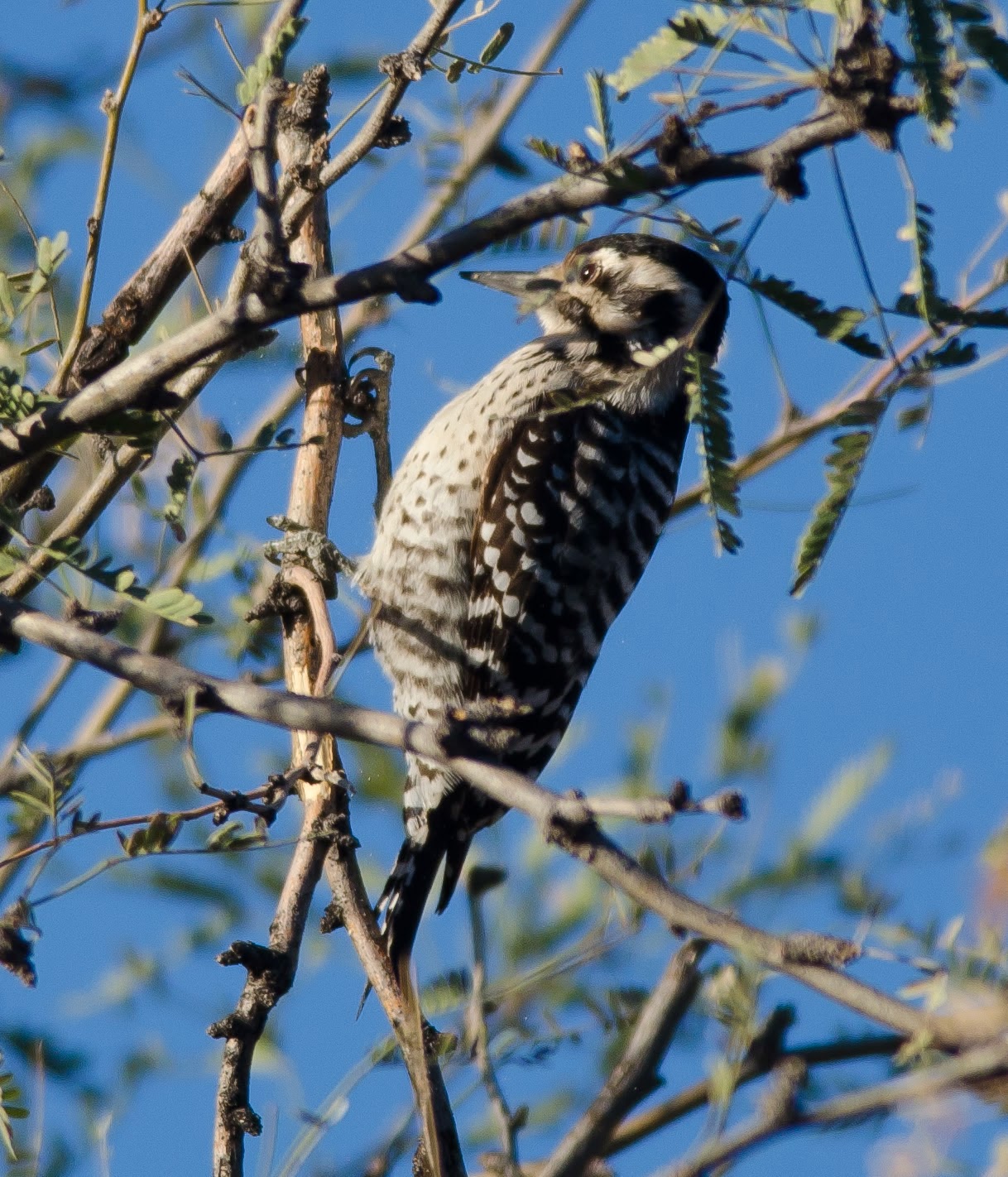
 Ladderback Woodpecker - Male
 
Pied-billed Grebe
 
From here we still had a bit of daylight left and we headed to Reid Park in Tucson.  Usually a crowded place with lots of people, but with the dark and overcast sky, the number of humans were quite low and it actually started raining while we were there and we had to take cover for a brief time in one of the ramadas.  The waterfowl here are so accustomed to people that they actually swim right up to the shore looking for handouts.
 
 Canvasback - Female
 
Canvasback - Male
 
Another Pied-billed Grebe - had to use a flash as it was very dark with cloud cover
 
 Results of the CBC and photos will have to be addressed in the next blog post. 


Sunday, November 9, 2014

Desert Meanderings

After so many birding trips to escape the heat of the desert and with fall finally settling in, the temperatures have subsided somewhat and now it is much more enjoyable to do some some local birding.  A large part of Arizona lies in the Sonoran Desert, including Phoenix and its surrounding suburbs.  Recent birding trips have been to familiar desert locations with some familiar birds.  Saturday, my original goal was a long hike in South Mountain Park, but changed my plans after seeing the reports for a Red-breasted Merganser at Glendale Recharge Ponds by birding friend, Tommy DeBardeleben earlier in the week and then reconfirmed by Steve Hosmer a couple of days later.  The last time I had visited this place, my camera was out of order and I tried birding it with binoculars only.  This is a tough place to go birding with just binoculars as the ponds are fairly large and the waterfowl are usually on the opposite side.  (Not too difficult to figure out why that is!)  I also recently purchased a modest spotting scope and this would be a great tool to have when visiting this place.  

I arrived there early and started scanning pond number 5, that had lots of waterfowl on it and during this time Babs Buck arrived and joined me.  We spent a lot of time scanning this pond without finding our target bird, so we moved over to pond number 4 to see if maybe it might be there and after about 45 minutes we moved back to pond 5 (those 2 ponds were the only ones with water).  Within about 5 minutes of returning I discovered our target bird out past some American Coots and a couple of Eared Grebes.  Mergansers are diving birds and easy to miss as one scans a pond if they are under water in one of their dives.  The distance to the bird was pretty far, but since this was a life bird for both of us, we took photos anyway for documentation purposes.  Of the 3 merganser species in North America, this is the species that is hardest to find in Arizona.

Red-breasted Merganser

Red-breasted Merganser

Red-breasted Merganser

Not the best place to try to get photos of birds, but a couple that did cooperate to a certain extent we an American Pipit and an adult Bald Eagle that flew over being harassed by an Osprey.  The pipits were abundant and could be heard flying overhead before we finally found them on the ground.

American Pipit

Bald Eagle

Bald Eagle

The title of this blog post is 'Desert Meanderings' simply because my most recent birding had been brief visits to some of my most familiar spots and along with some of those hikes, a few photos were taken from time to time of some of the birds that I find in almost every trip.  Since I never get tired of looking at birds, why not take more photos?

First off, Javalina Trail and Pima Canyon Trail in South Mountain Park.  From one of my hikes on Javalina Trail, I found a couple of cooperative Gilder Flickers and my first-of-fall 'Oregon' Dark-eyed Junco.

Gilded Flicker

Gilded Flicker

'Oregon' Dark-eyed Junco

Next from Pima Canyon Wash in South Mountain Park, an Ash-throated Flycatcher, a Northern Mockingbird, and a Rock Wren.

Ash-throated Flycatcher

Northern Mockingbird

Rock Wren

A quick stop at ASU Research Park presented me with a very nice Green Heron and a Ring-necked Duck.

Green Heron

Ring-necked Duck

And finally from a short stop at Fountain Hills Lake, a Killdeer and another first-of-fall Lesser Scaup.

Killdeer

Killdeer

Lesser Scaup

Lesser Scaup

Have some interesting birding trip planned in the future, so it should be interesting to see what I might see and photograph.  


Wednesday, January 8, 2014

Bringing in the New Year

Bringing in the New Year for me is a day to go birding to see what I can find to start off the year on the right foot.  This year, birding friend Jason Morgan and I headed off to some spots along the Lower Salt River near Mesa.  Finding and photographing Bald Eagles was kind of our objective, but we also knew that it is never a sure thing.  We did manage to see one adult fly over at the Granite Reef area early in the morning and later on a return stop, we also saw a fly by of an immature Bald Eagle as well.  Guess photos on this day were not going to happen.  Our first stop though at Granite Reef was rather special in the fact that we found 2 Mountain Chickadees in the pre-dawn darkness.  We actually heard them before we saw them.  This is the same place that I discovered 2 of these charmers back in October.  Were they the same 2 or a different 2?  Guess we will never know, but this is a bird that is not usually found in such low elevations, but apparently this must be a bit of a minor irruption year for this species as a few more have been found in other low elevations in Arizona.  At our next stop which was Phon D Sutton, with very little protection from the cold north wind, we did not linger, but continued up to Coon Bluff which is always a favorite for birding.  Finally the sun had rose up over the eastern low mountains allowing for some better chances for photos and the temps started improving.  On the road to the campground we had to pull over to check out the birds and a small flock of Western Bluebirds were forging on some berries and really gave us some great looks and some of the males were stunningly colorful. 
 
 Western Bluebird
 
Western Bluebird
 
Finally making our way to the campground we were greeted by a pair of Ladder-backed Woodpeckers.  This is a fairly common bird at this location and can often be heard by the 'peek' call which will assist in leading a person to locating them.
 
 Ladder-backed Woodpecker - Female
 
Ladder-backed Woodpecker - Male
 
And a male Vermilion Flycatcher made a brief appearance for us. 
 
Vermilion Flycatcher
 
Across the river we observed a Green Heron flying along the shore line and it landed then took off scampering along the water's edge, which we assumed it was chasing a fish in the water just out of reach.  This bird can get quite excited and when it does it will raise its crest and that is just what it was doing.  Considering the distance from us, I made an attempt at a few photos and now I have an idea of what a green Mohawk might look like if someone chose to get one from their local barber.
 
Green Heron
 
A couple of other birds that were not in short supply were the Ruddy Ducks and the Yellow-rumped Warblers.  We get both of these species in the winter time when they are at their least colorful time of the year.  But still worthy of photos all the same.
 
 Ruddy Duck
 
(Audubon's) Yellow-rumped Warbler
 
Finally we had to call is quits due to some previous commitments and we returned to our meeting place and Jason headed for home while I had one more stop to make in Scottsdale.  An odd trio of birds had been found in some Cottonwood trees by an urban lake that is full of bikers, walkers, and runners to name a few.  Reported a few days earlier by another excellent birder, Magill Weber, and re-confirmed by a couple more people I just had to make an effort to see if I could locate this Odd Trio.  The trio consisted of a Brown Creeper (fairly common in Arizona), a Northern Parula, and an American Redstart.  The later 2 species are very uncommon in the winter as migrants. I concentrated on the Cottonwood trees and it was not long that another couple of birders told me that they found the Brown Creeper, so I joined them at that tree and within 2 minutes I was able to locate the other 2 flitting around in the very same tree.  If one moves to a new tree, it appears the other two follow.  Guess there is safety in numbers for them.  While they did not present great photo opportunities, I managed to get identifiable photos and since the American Redstart was a new life bird for me, that is the one I was concentrating on most of all.  
 
 American Redstart
 
American Redstart
 
 Brown Creeper
 
Northern Parula
 
A new life bird on the first day of a new year?  Could not have asked for a better start.