Costa's Hummingbird

Costa's Hummingbird
Showing posts with label Bushtit. Show all posts

Saturday, February 25, 2017

California Specialties

The main target bird, the Island Scrub-Jay, was covered in my previous post, but I had a couple more to look for as well, but these birds are non-natives, and have established breeding populations in the United States and are ABA countable.  So I figured that I might as well put some time and effort in trying to locate these other 2 species.  

The first one is the Red-whiskered Bulbul, which is native to tropical Asia and was introduced to the United States.  With a little research, I discovered that the Los Angeles County Arboretum and Botanical Gardens might be the best place to find this bird.  It did not take long to find one either.  As soon as I got out of my vehicle in the parking lot, the first thing I heard was Indian Peafowl, which everyone is familiar with, and the 2nd one was an unusual song that I had not heard before and it did not take long to pinpoint the source; a Red-whiskered Bulbul near the top of a tree in the parking lot.  Once I got inside, I found out that they were quite numerous and they are very vocal, so it was not hard to locate many more.

Red-whiskered Bulbul


As mentioned in my previous post, I was captivated by all the Allen's Hummingbirds and the chance to get some respectable photos of them.  

Allen's Hummingbird


Indian Peafowl were introduced to this site in the late 1800's and they are thriving, breeding, and well established at this location.  Have always loved the colors of these large birds.

Indian Peafowl - Male


Female


From this spot, I then traveled to the Sepulveda Basin Wildlife area and Balboa Lake, which are fairly close together and just separated by a golf course.  And I got a nice assortment of birds there as well.  

A leucistic American Coot - rather attractive for a coot!
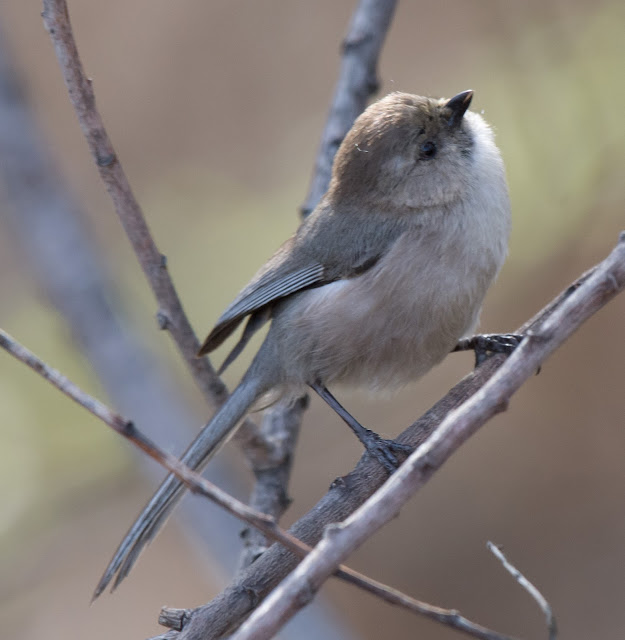

Bushtit - Sure looks different from those in Arizona


California Gull


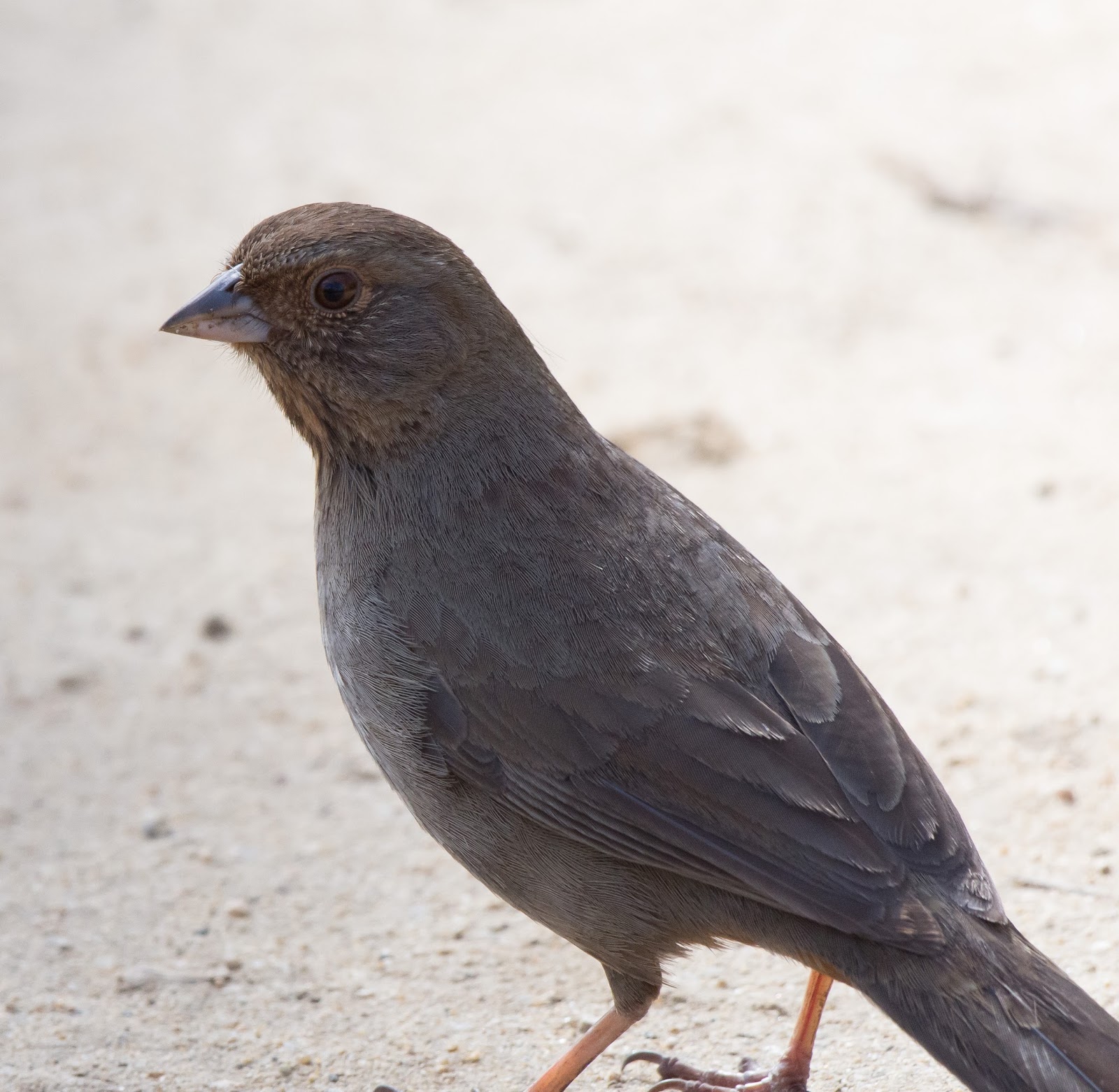
California Towhee


Egyptian Goose


A hybrid goose of some sort


Song Sparrow (ssp heermanni) - Much different than what we have in Arizona

Found a couple of lizards as well and not being real familiar with the species found in California, I had to rely on some of the experts on iNaturalist.org to supply an ID for them.  

Great Basin Fence Lizard


Western Fence Lizard

The Santa Cruz Island trip was wedged in between my arrival date and my departure date.  (See previous post.)  On my last day I had enough time to chase another countable non-native bird that is established in California; the Spotted Dove.  I had spent a lot of time researching in the weeks before my visit, to find out where it was being reported this year.  Incredibly, it was not being reported at any eBird Hotspots, so I had to make my way to the intersection of a couple of cross streets to begin my trek.  Who says you can't do any good birding at Home Depot or Target?  I had to walk up and down a street behind those two businesses that was lined with residences on one side.  Birding in and around a residence has to be done a bit judiciously.  Most people are not fond of people with binoculars and a camera probing their yards.  I walked this street from one end to the other and finally decided I was going to have to give up.  About a block from the car on my return, I saw a Mourning Dove fly up to an electrical line and shortly after, another dove-like bird fly to a line nearby.  Got my binoculars up and sure enough, there was a Spotted Dove.  Quickly took a couple of distant photos and then tried to get to an area with a closer view and by that time it was gone.  Talk about a last minute find!

Spotted Dove

I had time for one more stop before heading back to the airport in Burbank, so I headed to the San Gabriel River Parkway Nature Trail.  Nothing new, but got to view and photograph a couple of cool birds.

 Blue-gray Gnatcatcher


 Cassin's Kingbird


California Scrub-Jay

Yes, the time flew by very quickly, but being able to notch a few more life birds made the trip all worthwhile.  New adventures await me in the next few months of 2017.  Hope they are successful.  


Thursday, February 11, 2016

San Diego: The Quest For a Tattler

In preparing for this trip to San Diego, I had gone through a lot of lists and reports to see what new birds I could possibly find in San Diego.  Surprisingly, the list was relatively small.  Only 2 life birds stood out for me, without taking a pelagic trip for sea birds out on the ocean, the Wandering Tattler and the Scaly-breasted Munia.  Most of the other species in southern California were either birds that could also be found in Arizona, or birds that I had already found on a few previous trips to the area.  Prime target was Wandering Tattler.  After perusing the many eBird reports on this bird for the month of January, it appeared that it was most frequently encountered around the La Jolla Cove area on the coastline.  I decided that this would be my first stop to see if one might be hanging out in this area. Thanks to all the new smart technology and the use of my iPhone, I was able to locate this place in a reasonable amount of time.  What a view this was from the parking along the street high above the ocean waves crashing on the rocks below.  It was early morning and the cliffs were covered with cormorants; Brandt's, Pelagic, and a couple of Double-crested in the mix.  A few Brown Pelicans dotted the rocks as well.  But what quickly caught my attention was a Brown Booby on the cliffs with all the cormorants. Not a bird that I see that often and fairly close.

 Brown Booby

 Brandt's Cormorant


Brown Pelican

I decided to walk the entire coast road and along the way, I had the pleasure of seeing some California Sea Lions and at the far end, some Harbor Seals.  Both species had pups and they were pretty darned cute if you ask me.  And for those that are interested, sea lions have small visible ear flaps, whereas seals do not have visible ear flaps

 California Sea Lion & Pup

 Harbor Seal & Pup

Harbor Seal

Just as I reached the end of the walk, I noticed a different bird on a large boulder along the shore and once I got my binoculars on it, then I knew that I had struck gold; Wandering Tattler!  Sandpipers can sometimes be notoriously difficult to identify, but knowing behavior of many birds can most assuredly help in the ID process.  The Wandering Tattler has a behavior of bobbing and teetering as it walks or stand still.  This behavior is also seen in Spotted Sandpipers, but these 2 birds are vastly different in appearance, so it would be difficult to get them confused.

 Wandering Tattler


Also along this area I was able to find and photograph a Black Turnstone, a Royal Tern, and a Western Gull.

 Black Turnstone

Royal Tern

Western Gull

Mission accomplished for my number 1 target bird and I still had a lot of time left in the day.  My next plan was to visit Tijuana Slough, which is a place I had visited in May of last year and I liked it so well, I wanted to go again.  But along the way, I decided to make a slight detour off the freeway and visit Tecolote Canyon Natural Park.  Reports of the Scaly-breasted Munia had been sketchy on eBird up to this point, but this spot seemed to be the most likely possibility.  I pulled into the lot, parked my car and got out to hear an American Crow calling and then heard something unfamiliar to me on the north side of the parking lot, and lo and behold, there was the Scaly-breasted Munia!   That just seemed too easy, but then I remember so many of the times I have dipped on birds, so I guess I was due for a bit of good luck!

 Scaly-breasted Munia

Scaly-breasted Muni

But since I was there, I decided to hike a ways up the canyon to see what else I could find.  Got some decent looks at Bushtits, California Towhee, and California Thrasher.

 Bushtit

 California Towhee

California Thrasher

I then made my way to Tijuana Slough, and while there, my zoom lens on my camera quite working.  I was left without a workable zoom lens for the rest of Saturday and all day on Sunday, so photos became a bit tougher.  Nevertheless, on Sunday I headed out to the area of the San Diego Harbor area.  I was looking for another bird that I had only seen once before in Rocky Point, Mexico, and at quite a distance.  This time I was hoping to see a Brant a little closer and also add it to my USA list.  I not only saw it, but I saw over 100 of them!  Without a zoom lens, I still had an issue with photos, but did the best I could with my regular lens.

Brant

Also, quite plentiful, were Surf Scoters, which is a bird we see occasionally in Arizona in the winter, most generally females.  But this time, I got to see the males and they are outstanding!

 Surf Scoters


One last stop on Sunday, gave me a view of a new reptile for me; a San Diego Alligator Lizard.  What a cool looking reptile, very long at probably about 14" from snout to tail and such tiny legs.


The trip was most definitely worthwhile and I got my 2 new life birds that I had targeted plus so much more.  


Monday, March 9, 2015

The Olives on Mt Ord

The title of this post is a bit confusing, but makes sense once you read through the post.  The details come a little later.
 
This weekend, I decided to visit a couple of my favorite spots off the Beeline Highway north and east of Mesa; Sunflower and Mt Ord and time permitting a stop at Bushnell Tanks.  First stop was Sunflower, I figured Mt Ord would be quite chilly until the sun rose high enough to start warming the 1688 trail and Sunflower is right long the highway before reaching Mt Ord turnoff, plus it is a lower elevation and consequently a bit warmer in the wee hours of the morning.  Glad I made that decision as the birds were already active. 
 
Cassin's Finches were still being seen at this location.  This is an irruptive year for this species and they have ventured further south and into lower elevations than normal.  I had seen them a couple of weeks ago in this location, but at least this time, I did manage to capture a photo of a male and female getting a drink of water on the edge of the creek.
 
Cassin's Finch
 
Dark-eyed Juncos were everywhere, which is normal for the winter months in Arizona.  But this was the first time this winter that I was able to detect the 'Pink-sided' sub-species.
 
'Pink-sided' Dark-eyed Junco
 
Had wonderful views of Townsend's Solitaire, a seemingly drab gray bird, for most non-birder people.  But for a birder, they are rather cool with that bold eye-ring and when they fly, they show off their buffy wing patches and white outer tail feathers. This day they were very vocal and singing their wonderful song instead of the normal 1 note whistle that I normally hear.
 
Townsend's Solitaire
 
 Townsend's Solitaire
 
Townsend's Solitaire - Note the buff colored wing patches
 
After about only an hour at this location, I decided it was time to head up to Mt Ord, a short 3 miles further north on the highway.  Not far up the rough and rocky road, I found another vehicle parked at the first small pull off and was surprised to find Steve and Joan Hosmer already there and searching for birds.  As I pulled up and started visiting with them, I noticed a large flock of fairly good sized birds flying in the pines across a canyon and about midway up on the ridge.  Very unusual sight and we quickly got our binoculars on them and I discover that they were Band-tailed Pigeons!  Not a new life bird for me, but a first for me in Maricopa County.  Always exciting to add a new county bird even if I was not able to get photos.  It was fairly windy on the lower slopes, but Steve and Joan joined up with me and we then continued to head further up the mountain road to the 1688 trail.  At least when we arrived in that area, the wind seemed to be a bit less gusty as the pine trees gave us some shelter from the wind.   
 
The 1688 trail on Mt Ord is probably my most favorite spot to bird.  It starts out in tall pines and the leads to the west and south and skirts the edges of the mountain on the west side with openings out into the scrub oak habitat.  The trail meanders between these habitat zones and really creates the best of two areas and a wide variety and abundance of birds.  Today the birding was a bit sparse, so when we headed back, we took off through the forest instead and it was a wise decision as we were finding many more birds than in the windy exposed areas of the trail.  Among all these birds I discovered one of the great birds to be found on Mt Ord, the Olive Warbler.  (Now you can finally see the connection to the title of this post and the reference to olives!)  I ended up seeing 2 of this gorgeous birds.  This bird is grouped with all the warblers, but is placed in a separate family because its relationships are a bit uncertain.  Most field guides will show this bird as a summer resident in Arizona, but that is bound to change in the future as they are quite at home in the winter in higher elevations and I have even seen them foraging in snow covered trees.  As more sightings are reported, many of the field guide range maps will have to be rewritten. 

Olive Warbler (One of the olives on Mt Ord)
 
As we neared our parked vehicles, we also got to add Bushtit to our list for the day.  Guess it did not want to show my camera it's short little bill.  This is a male which can be identified by its dark eye.  Females have a light yellowish colored eye. 
 
Bushtit - Male
 
Yes, this was another great trip to Mt Ord and will be heading up there a few more times this spring and summer.  More migrants are poised to join in on the fabulous birding to be found at this spot.