Costa's Hummingbird

Costa's Hummingbird
Showing posts with label Savannah Sparrow. Show all posts

Saturday, December 7, 2013

Way Out West

On Friday November 29th, birding friend, Chris Rohrer ventured up from Tucson to the Phoenix area to spend a day of birding in the far western reaches of the 'West Valley' near Phoenix.  The area is a vast area that extends from the infamous 'Thrasher Spot' to the agricultural fields of Arlington and Buckeye.  In the winter this can be very productive for finding many migrant birds as well as some resident birds.  Our first stop was the Thrasher Spot which is famous for being probably the most reliable spot to find the fairly uncommon Le Conte's Thrasher.  We came to this spot in the hopes of finding both the 2 new sparrow species which were a result of the AOU making a split on the old 'Sage' Sparrow.  The 2 new birds from this split are the Sagebrush Sparrow and the Bell's Sparrow.  While we struck out on the Bell's Sparrow, we did find and observe several of the Sagebrush Sparrows which are most likely the most common of these 2 species to be found here.
 
Sagebrush Sparrow
 
We also dipped on the Le Conte's Thrasher this time, but will try again maybe when breeding season approaches.  As a consolation, we did see a few Bendire's Thrashers and one of 2 Crissal Thrashers put on a singing show for us and allowed us some great looks.  Most thrasher species can be quite secretive and elusive, so when one does land at the top of a tree and starts singing, it can be quite moving as most of their songs are quite melodic. 
 
Crissal Thrasher

Crissal Thrasher
 
From the Thrasher Spot, we hit the roads by first heading down towards Arlington.  Had intentions of taking Chris to the Arlington Ponds, but the road was very muddy and rutted, and we though better of that idea.  But we had many birds along the road including the American Kestrel.  We counted over 20 of these birds along the road.  This bird is our smallest and most common falcon in the United States and in the winter they can be found in high numbers in Arizona.
 
American Kestrel
 
We also had the great fortune of finding 2 Ferruginous Hawks along the roadways which is another winter visitor to our area and one that many birders love to find in Arizona.
 
Ferruginous Hawk
 
Other birds included a Greater Roadrunner, (no photos), a few Savannah Sparrows, a few Western Meadowlarks, and at one farms with a corral, a huge flock of Red-winged Blackbirds with some Brown-headed Cowbirds in the mix.
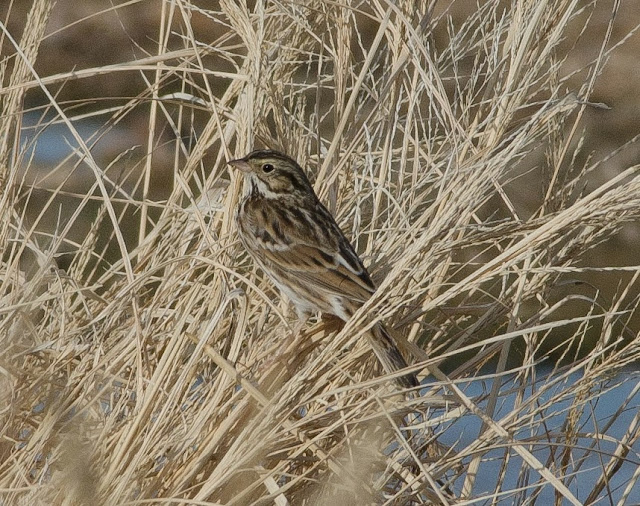
 
Savannah Sparrow

Western Meadowlark

Flock of Red-winged Blackbirds and Brown-headed Cowbirds
 
 Finally we arrived at the Lower River Ponds which Chris had never seen and we were amazed by the sheer number of American White Pelicans that were there.  We counted over 140 and a week later another person counted over 250.  This photo only shows a small portion of these magnificent birds that were located there and if one looks closely you will see 2 Snow Geese in the middle.  Looks like midgets among the giants!
 
American White Pelicans and Snow Geese
 
Snow Geese
 
 American White Pelican
 
American White Pelican
 
While we were astounded by the number of pelicans, we also noticed large numbers for Great Egrets and Great Blue Herons on the banks on the opposite sides and in the fields back behind and to the south of the ponds and mixed in with those Great Blue Herons was a sprinkling of Sandhill Cranes.  There is a small contingent of these magnificent birds that spend their winters in the vicinity of Maricopa County.  While they were quite a distance from us for photos, they eventually took flight and when seen flying, they do not even resemble the herons.  Very easy distinction.
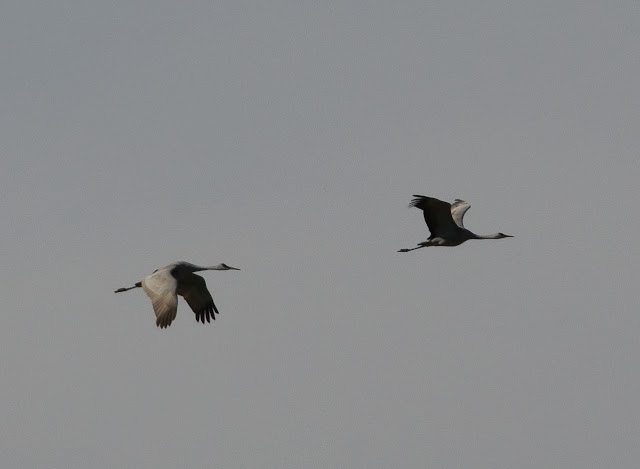
 
Sandhill Cranes
 
The ponds were also visited by a juvenile Bald Eagle flying over the ponds that made many of the waterfowl take flight.  While the sun was in the wrong place for photos, it was still quite interesting to see a Great Egret and the Bald Eagle in the same frame.  No, the eagle or the Egret were chasing each other; they just happened to be in the same frame at the same time.
 
 Bald Eagle and Great Egret
 
 Bald Eagle and Great Egret
 
Bald Eagle and Great Egret
 
What a wonderful place to visit for birds in especially in the wintertime in Arizona.  With the milder weather this state has to offer, we get the opportunity to see many wonderful birds that like to make their winter homes in Arizona.   


Monday, October 7, 2013

California: The Beginning

The old blog spot has been relatively quite for over a week now and it is all due to a week long vacation to California, specifically the Half Moon Bay area for 3 extensive days of birding with a group of about 50 others and then a few more days with relatives and friends and seeing some sites.  Now that I have returned and processed my photos (some good ones and some that are very bad), it is time to recount my adventures on my blog site.  I was able to add over 30 new species to my life list on this trip.  Unfortunately, not all of those sightings resulted in photos as many were difficult to capture for various reasons.  But not all were that bad as I also was able to capture some decent photos of new birds and some 'old' birds.

I arrived on a Friday afternoon and teamed up with Jim and Vince Austin-Cole and we managed to check out the beach area near our hotel for some quick birding before meeting many of the others.  It was pretty awesome to stand at the edge of the cliff and look down at the beach.  The wind was blowing in off the Pacific Ocean and the cliff created quite an updraft and many of the birds were riding the this updraft with gulls and pelicans flying just a few feet over our heads.  Some were so close that my lens could not focus in on them, but I did manage to capture one of the many Brown Pelicans.

Brown Pelican

And looking behind the pathway, a few Savannah Sparrows were making themselves visible even in the strong winds.

Savannah Sparrow

On Saturday the birding began in earnest.  I was with a group of about 30 birders that spent the day birding at spots along the coast.  One of our first stops was Pigeon Point Lighthouse and it did not take long before I got my first new life bird of the trip, the Tri-colored Blackbird.  A bird that is a bit similar to the Red-winged Blackbird, but having entirely different calls and they also show a buffy or white border on the red patch of the wing.

Tri-colored Blackbird

Several Brewer's Blackbirds were also mixed in and one of them gave me quite a stare down.  Maybe it thought it was auditioning for an Angry Birds photo.

Brewer's Blackbird

While we got to see many birds from this point, including one of the Blue-footed Boobies which have interrupted along on the California coast this season, many of the birds were very distant flying over and swimming in ocean.  Many of these distant birds became easier to see and photograph at other stops later on.  However, we did have one Harbor Seal make an appearance in the water by the rocky shoreline.

Harbor Seal

One of the birds that I had on my wish list from this trip was the Chestnut-backed Chickadee.  Little did I know how common this bird really is.  It was seen in many places, so it was an easy bird to add to my life list.  Getting good photos of one was another matter.  As with many small birds, they are very active and do not slow down, plus they spend a lot of their foraging in the deep shade.  Plus a group of 30 people tend to make it a bit harder to get photos.

Chestnut-backed Chickadee

Obviously we ventured a short distance from the beach to find this bird and near the entrance to the Pescadero Marsh habitat a Western Scrub-Jay came in and posed on a branch and spent some time preening.  This species is quite common in the right habitats in Arizona, so it was not a new bird for me.  However they can be a bit distant and hard to photograph.  

 Western Scrub-Jay

Western Scrub-Jay

One other stop we made was Pescadero Beach where some of the birds were quite accommodating and many photos were obtained.  That spot was where we enjoyed our lunch and that will be the focus of my next blog.


Tuesday, May 14, 2013

Glendale Recharge Ponds

I vowed I would always make posts in chronological order, but obviously that all went by the wayside.  Got busy in too many birding adventures that I have missed a couple of posts.  On April 28th I decided to find out if there was anything new to see in the category of wading birds by making a trip to the Glendale Recharge Ponds in the west valley  This is a place that attracts a lot of unusual migrants from time to time.  This is an unforgiving place on a hot day as there are no trees and depending on which ponds have water, viewing the birds is not too bad, but photography is most generally fairly difficult as most of the birds will fly to the other side of the pond you are viewing, or to another one of the ponds that might be holding water.  Despite the obstacles, I did manage to capture some photos of some water/shore birds and a few others as well. 

One of the most common 'peeps' (sandpipers) in and around Arizona throughout the winter months is the Least Sandpiper.  They can be confused with the Western Sandpiper when both are in their winter plumage. The leg color is the most distinguishing feature as the Least Sandpiper has yellowish-green legs and the Western Sandpiper has black legs.  But beware, the angle of the sun, and mud on legs can sometimes make a Least Sandpiper look like it has black legs.  This day, there was no doubt on them and part of that is the fact that the Westerns were also showing off their more colorful summer plumage.  Westerns are not nearly as numerous as the Least in the winter months..

 Least Sandpiper

Western Sandpiper

Then we had plenty of wading birds as well such as the American Avocet and the Black-necked Stilts.  Both birds were quite numerous in the shallow water and both are quite handsome; with the Avocets all decked out in their more colorful breeding plumage.  The photo of the Avocet is most likely a female as they tend to have a stronger more up-curved bill than the males.  

 American Avocet

 Black-necked Stilt

Black-necked Stilt

Another very common wading bird in AZ in the winter is the Long-billed Dowitcher, which is usually in its winter plumage of gray and white, but these were molting into their summer breeding plumage before heading north and they are quite handsome when they look so vibrant as this.

Long-billed Dowitcher

And of course we have probably the most common land bird that is not quite a sandpiper, but a close relative, the fanatical and yet sometimes inconspicuous Killdeer.  What was cool about this visit is that I also discovered some fledglings out in the mudflats and they were blending in quite well with the mud.  Even a couple of the adults were trying to play hide-n-seek with me.

 Killdeer

 Killdeer

 Killdeer chick

Killdeer chick

Some of the other birds that were present included a Savannah Sparrow, a Western Kingbird, a Red-winged Blackbird, and a colony of nesting Cliff Swallows that had already hatched and fledged several young ones this year.  The Savannah Sparrow is one of the sparrow species that is good to learn as it just might show up just about anywhere and there are some variances to this species throughout the US.  The Western Kingbird is always a welcomed sight as it heralds in the summer weather and it is a bird that was always a summer resident back in Nebraska on the farm.  The Red-winged Blackbird is a very familiar and common species to most people and this one was putting on a display for the females.  Hopefully they get turned on by mud encrusted feet!  

 Red-winged Blackbird

 Savannah Sparrow

Western Kingbird

 Cliff Swallow nesting colony

 Cliff Swallow fledgling

Cliff Swallow adult

For about a ½ hour while I was checking out the birds a Coyote was 2 ponds away from me and barking and howling up quite a storm.  While the distance was not going to make for a great photo, I still could not help trying to get a photo.

Wyle E. Coyote


Monday, March 25, 2013

'Thrasher Spot' and a bit more - 24 March 2013

On Sunday March 24th, I had the honor to take a couple of gentlemen from Ohio out to the 'Thrasher Spot' west of Buckeye.  Brian and Larry were interested in trying to find some thrashers, Sage and Le Conte's.  We did get a bit of a late start, but we also knew that they definitely would not see either if we did not go.  It was very quiet when we arrived and as we made out way further out in the desert scrub I was starting to think we may have been too late.  But then a male Black-tailed Gnatcatcher made his appearance and that was a new bird for them, so I know it would not be a total loss.  Finally we found some thrashers and 3 of them perched up in a leafless bush and allowed us some time to circle around them for better lighting to confirm that 2 of them were Sage Thrashers, one of the target birds, and the third was a Bendire's.  We knew that none of the 3 were the Le Conte's ase on bill shape and size.  Then as they flew to the ground, we started to follow them as they quickly ran from one desert bush to another, and soon discovered there were more than just 2 and during this time, we actually did catch sight of a Le Conte's Thrasher with its pale coloration and long and sharply down-curved bill.  Unfortunately, it was not going to allow any photos for us this day, so we had to settle for photos of the Sage Thrasher only.  

Sage Thrasher

Not the birdiest spot around, but during our short stay we got 2 of their target birds and a bonus 3rd bird, the gnatcatcher in the process.  From there we took a bit of a detour to the Lower River Road ponds and found a much larger variety of birds.  It was at this place that the Northern Rough-winged Swallows were just being downright passionate about having their photos taken.  So what was I to do?  I just could not ignore them.  It may not be the flashiest or most colorful swallow, but they are one that is very common in Arizona in just about all seasons and one species that a novice birder learns to identify very quickly in AZ.

Northern Rough-winged Swallow

Northern Rough-winged Swallows

 Northern Rough-winged Swallow
Northern Rough-winged Swallow, and we have lift-off!

One more thing that I did early on Sunday before meeting up with Brian and Larry was to scout the Scottsdale Community College for Burrowing Owls.  So I made trip to that location around sunrise and I found my Burrowing Owl and along with that a Gambel's Quail and a Savannah Sparrow in the early light of dawn.  The owl location is needed for a future guest that is arriving to see birds in Arizona.  I know of other locations, but was interested in some place a bit further north to we can hopefully save some driving time and cover more spots.  So here are my photos of these 3 birds in the warm early light of sunrise.

 Burrowing Owl (taken through a chain-linked fence)

 Savannah Sparrow

Gamble's Quail

Another awesome day of birding!


Thursday, February 14, 2013

Puerto Penasco, (Rocky Point), Mexico - Part 2

Sunday morning we bundled up and headed to Pelican Point and Tucson Beach near Cholla Bay.  It was very early in the morning and it was very cold; in fact I had to borrow an extra jacket/wind breaker at least until the sun came up and the air quickly warmed up enough to make birding a bit more enjoyable.  One of the most impressive birds for me was the American Oystercatcher.  We had seen 4 of them on Saturday far out in Cholla Bay at low tide, but on Saturday, while standing on the rocks at Pelican Point a small flock of them came flying by in the early morning light.  A little bit later, we got to observe several of them up close on the sand and some were even engaging in courtship displays.

American Oystercatcher

American Oystercatcher

American Oystercatcher

As with most environments around water, the Osprey is almost always present.  The early morning sunrise with an Osprey 'kiting' was nice and it created a nice warm effect on the photos of the bird.  The photo of the perched Osprey was taken later in the morning without the effects of early morning sun.

 Osprey

Osprey

Osprey

One of the biggest surprises was a Merlin that flew in with its catch of the day and landed on a rock a short distance from where we were.  It appears to have captured a shore bird.

Merlin  

Of course another photo of a Brown Pelican is always worth it, especially when they are displaying their breeding attire.

Brown Pelican

And more gulls, they were everywhere.  This time we found an adult Heerman's Gull, which is one of the easiest species to identify.  But we also found a Herring as well.

 Heerman's Gull-adult

Herring Gull

And since we spent most of the day in Cholla Bay, we obviously had more shore birds.  Lighting was a bit better and the birds were a bit more approachable on this day.  Captured photos of Black-bellied Plover and Willet, along with a couple of new birds, the Short-billed Dowitcher and Wilson's Plover.  

 Willet

Black-bellied Plover

 Short-billed Dowitcher

 Wilson's Plover

Wilson's Plover

The last bird photos are of a Sparrow, that almost looks a little out of place with all the water bird photos.  However, this is a special sparrow; it is a sub-species of the Savannah Sparrow, known as the 'Large-billed' Savannah Sparrow.  This bird has a fairly limited range and has the possibility of some day being split from the Savannah Sparrow species and becoming a separate species of its own in the near future.  The photos quite clearly show how large of a bill it has when compared to other sparrow species.

 'Large-billed' Savannah Sparrow

'Large-billed' Savannah Sparrow

Monday dawned with rain in Rocky Point which did not bode well for much birding, but it was nice to see as this area gets very little rain every year.  Will like to return again in the future, but have no idea when that might happen, but I really enjoy travelling to this small seaside community.