Costa's Hummingbird

Costa's Hummingbird
Showing posts with label Yellow-billed Cuckoo. Show all posts

Monday, May 5, 2014

Texas: The Real & Serious Begininng

Day 2, and I was up early as today was the day I had planned to spend in High Island, a small town about 19 miles south of Winnie.  It is called High Island as it is where a salt dome is located and it sits about 30 feet higher than the surrounding flat grasslands and marshes.  Due to this slightly elevated height, it is covered with many very tall trees which is one of the first places that many of the migrating smaller birds such as warblers will immediately touch down after their long flight over the Gulf of Mexico.  They are many times exhausted and are in search of food and water.  The Houston Audubon Society monitors and maintains about 4 stands of trees in this small town and during peak migration they offer 3 daily birding trips lead by well qualified guides.  I wanted to take advantage of these 3 trips so I could become more familiar with the area and maybe find birds that I could easily overlook.  The weather for this day started out a little bit worse than Sunday; still a strong southerly wind, overcast and rain showers in the morning, it cleared up later in the day with some sunshine.

The first tour was centered around Boy Scout Woods in High Island and one of the birds that I discovered early on, was another Common Nighthawk.  After seeing the one in flight the day before, this day I was blessed to find one perched on a wire allowing lots of views and photos for anyone that was there.  As it turns out, I ended up finding 4 more of these birds sitting still; 3 on the ground and 1 on a fence post all in different locations during my stay.

Common Nighthawk

Starting with birding in the woods, I quickly discovered the the Gray Catbird was quite common and if you could locate the mulberry trees, then you would most likely find one of these birds feasting on those berries.

Gray Catbird

At one spot, I stumbled upon a Yellow-billed Cuckoo feasting on tent caterpillars.  This have always been a bit of a shy and elusive bird for me as they are quick to dart into thick vegetation when they know you are near.  This one was quite content and allowed me some great photos of this bird; even with a worm in its beak.

Yellow-billed Cuckoo

The rest of the birds that I had the pleasure of seeing were the smaller passerines or song birds.  Some were difficult to photograph as they were most often in the deep shade of the trees, or a bit too far for good focusing.  They include a male American Redstart, a Black-throated Green Warbler (new life bird), Common Yellowthroat, Eastern Wood Pewee (new life bird), Indigo Bunting female, Painted Bunting, Rose-breasted Grosbeak (new life bird), Scarlet Tanager (new life bird), and a Tennessee Warbler (another new life bird).

 American Redstart

 Black-throated Green Warbler

 Common Yellowthroat
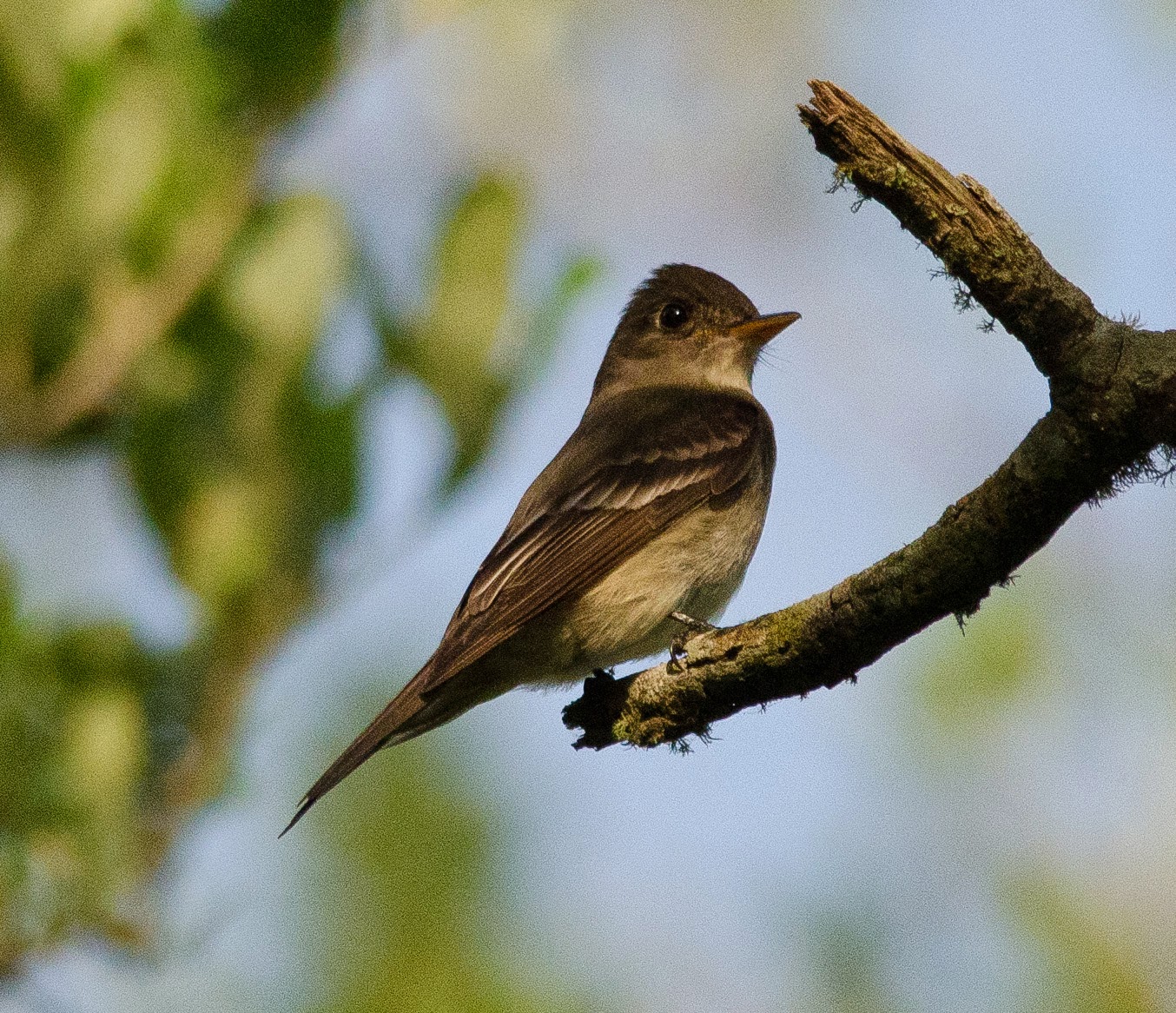
Eastern Wood Pewee

 Indigo Bunting - Female

 Painted Bunting - Male

 Rose-breasted Grosbeak - Male

 Scarlet Tanager - Male

Tennessee Warbler

This day of birding has to be split up into 2 different posts due to the sheer numbers of birds.  The next part will focus on water birds as one of our trips involved a coastal trip and some great birds near water and also my visit to the Smith Oaks Rookery on High Island later in the afternoon.  I ended up with 14 new species of birds for this day, so it was really quite awesome!


Wednesday, July 10, 2013

Rancho El Aribabi, Sonora, Mexico - Part 2

Saturday morning I awoke before the sun had even risen and what woke me was the multitude of bird songs all around us outside the ranch house.  Of course I was excited and headed outside and heard the Buff-collared Nightjars calling their last calls before they went to rest for the day.  Those nocturnal birds are hard to get visuals, but once you learn their calls, you know they are out there.  We had already been told by Jim Rorabaugh that the hillside to the west of the ranch house would have Five-striped Sparrows singing in the morning, he was absolutely correct.  This is a bird that is very hard to find in the United States as it is only found in a couple of very remote canyons of southern Arizona, so it was one of my target birds on this little trip.  We found several singing all over the hillside and they were being especially cooperative and allowing several photo opportunities.  It is another one of those handsome sparrows.  So, Saturday started out fantastic as I got my first new life bird of the weekend!  (But things were going to get even better fairly quickly.)

 Five-striped Sparrow

Five-striped Sparrow

As we were standing there looking up a small draw at the Five-striped Sparrows, I heard a rattle call and saw a bird fly in and onto some dead branches just below some Saguaro Cactus.  That call immediately made me think of a kingfisher and low and behold, a Green Kingfisher had landed on those dead branches.  I was almost afraid to call out the ID on it because it really did not belong here; should have found this bird down in the stream bead and the trees and heavy shade.  This was a female and it sat there for several minutes allowing all of us to get some good looks and of course some photos.  This bird does show up occasionally in Arizona, but it is far from being common and not easy to find when it is present.  Another new life bird for me and one that I had secretly hoped to find, but thought it was going to be harder to find.


Green Kingfisher

What a way to start the day!  Also during all of this our resident pair of Barn Swallows took a rest in this area as well.  It is not often one gets photos of them on vegetation as they love to perch on power lines and fences.  This pair has a nest on the patio portion of the ranch house, so they were our constant companions along with a couple of Canyon Towhees that kept the patio free and clear of a lot of insects.  Even a Black Phoebe flew in to snack on a few flying insects once in a while.

 Barn Swallow

 Canyon Towhee

Black Phoebe

Other birds that were seen constantly in and around the ranch house were red and blue, such as the Blue Grosbeak and the Summer Tanagers and Northern Cardinals.  Yes, these birds can be seen in Arizona, but here they were constantly all around us.

Blue Grosbeak

 Summer Tanager

Summer Tanager- Male and Female

 Northern Cardinal

Northern Cardinal

During my wanderings on Saturday, I finally got around to photographing some of the many flycatchers located at this place.  Dusky-capped Flycatchers were abundant as were Brown-crested and Ash-throated Flycatchers.  We also had kingbirds, Cassin's Western, and Thick-billed Kingbirds.  I was really pleased to see the Thick-billed Kingbirds as it was a bird that I had only seen fleetingly in early June, but this time I was able to capture photos of this huge billed kingbird.  No doubt where it got its name.

 Thick-billed Kingbird

Thick-billed Kingbird

 Dusky-capped Flycatcher

Western Kingbird

Of course we also had both species of vultures.  The Black Vulture is one that is usually a bit harder to find and capture in a photo, so I took advantage of this one perched on an electrical pole.  Another bird that was seen in abundant numbers was the Common Ground Dove.  They are found in Arizona as well, especially in the south and occasionally they do stray as far north as the Phoenix area as I have seen them at a couple of places in the urban areas.  

 Black Vulture

Common Ground Dove

 A person never knew what to expect flying in the canopy of trees and even though we had heard them a few times, finally a Yellow-billed Cuckoo flew from right to left and actually landed on a branch for good viewing.  This is another one of those secretive birds that one hears a lot and gets an occasional glimpse.  Still not the best photos that I would like of this elusive bird, but much better than any I have captured before.

Yellow-billed Cuckoo

Anytime anyone wanted to take a break, we could sit around on the patio and watch the hummingbirds.  For the most part only 2 species were making regular visits; the Broad-billed Hummingbird and the Violet-crowned Hummingbird.  (A third species made an appearance on Sunday, but that will be on my next post.)

 Broad-billed Humingbird

 Violet-crowned Hummingbird

Violet-crowned Hummingbird

Must have been lunch time to find all of us together in the daylight.

This was the full crew, minus myself in this photo

Finding out how long this post turned into, I have decided to stop and continue on the 3rd and final post which will include a photo of the only snake we found.


Sunday, July 22, 2012

Montezuma's Well---A new birding hotspot!

Last weekend, on my return to the valley of the sun, from Mund's Park, and with a birding friend, Wayne along, we made a short detour to Montezuma's Well.  We first stopped at the picnic spot and found it to be a very nice place with lots of shade trees and nice restrooms and we decided to check it out.  Within a few minutes we had discovered the trees and grasses were alive with birds.  The place is not a photographers friend as most of the birds were in heavy shade.  This weekend I travelled back to this spot mainly to try and get a glimpse of the one elusive bird that I had only heard the weekend before but was not able to see; the Yellow-billed Cuckoo.  More on that later in the post.  Both visits produced 3 red birds:  the Vermilion Flycatcher, the Summer Tanager, and the Northern Cardinal.  No photos of the Cardinals, but I did manage a couple of the Vermilion Flycatcher and the Summer Tanager.  Not outstanding photos, but the red is hard to miss in the canopy of trees.

Vermilion Flycatcher

Summer Tanager

Also seen in the picnic area were Lazuli Buntings, Blue Grosbeak, Yellow-breasted Chat, Anna's Hummingbird, Gila and Ladderback Woodpeckers, juvenile Yellow Warbler, Ash-throated Flycatcher, Black Phoebe, Western Kingbird, Western Wood Pewee, Bell's Vireo, White-breasted Nuthatch, and Bewick's Wren.

White-breasted Nuthatch

Bewick's Wren

And finally the Yellow-billed Cuckoo.  This is a very elusive bird; they tend to be very shy and definitely make it difficult to find.  Photos are even harder to come by, but today when I got out of the car, it was the first bird I saw and it took off and I followed a short distance trying to get a better view.  I finally got a couple of photos of it that are recognizable, but far from being what I would have liked to have gotten, so here is my very first salvageable photo of a Yellow-billed Cuckoo.  It is nice to know these birds are breeding in this location in Arizona.  They have a very short stay in the US for breeding in the summer. 

Yellow-billed Cuckoo

After spending a considerable amount of time in the picnic area, I ventured on to the actual sight of Montezuma's Well.  This is a natural up-welling of warm water into a large limestone sink and was utilized by ancient indigenous people for irrigation for crops in the Verde Valley.  It is a very interesting place to visit with no admission fees and you can follow the trail to the top looking down into the large pool of water.  After only being there twice in two weekends, I have decided this is the best place to view Canyon Wrens.  What show they put on both weekends.  Here are 3 photos that they were so eager to give for me and my camera.  (By the way this happens to be my favorite wren species!  Might have been a better state bird for AZ instead of the Cactus Wren!)

Canyon Wren


Canyon Wren

Also had a Rock Wren make an appearance today that was making quite a fuss about something, but not quite sure what it was.

Rock Wren

And to end this post I thought I would toss in a photo of a Empress Leilia Butterfly and a Katydid that I enjoyed during my short stay.  If someone reads this and notices that I have missed the identification on the insects, please let me know so I can correct it.