Costa's Hummingbird

Costa's Hummingbird
Showing posts with label Say's Phoebe. Show all posts

Saturday, January 2, 2016

Birding Birthday Bash

In the early part of December, I just happened to celebrate a landmark birthday and I was fortunate to have it fall on a Saturday.  What better way to celebrate a birthday than getting out in nature to see what cool birds one can find!  One of my best birding buddies, Chris Rohrer ventured north from Tucson and joined me in our quest to find some birds in and around the eastern suburbs of Gilbert, Mesa, Scottsdale, and Tempe.  

First stop was the Gilbert Riparian Water Preserve in the search for some rare Purple Finches that had been seen there for a week or so.  We did not have any luck with that species, but the birding was was still excellent with the highlight being a White-throated Sparrow.  Of course several others were gracious enough to allow photos as well; Neotropic Cormorant and Wilson's Snipe.

 White-throated Sparrow

 Neotropic Cormorant

 Wilson's Snipe well camouflaged

Wilson's Snipe zoomed in and cropped

Our next stop was Coon Bluff on the Salt River northeast of Mesa to search for another rarity, a Reddish Egret which had not been reported for a few days, so our hopes were not very high and once again, we dipped on this bird as well. But once again, several other species made our visit very enjoyable such as Cedar Waxwing and Vermilion Flycatcher.  And a couple more passerine species graciously gave me a chance to get photos with their reflection in the water, which is not too common; Say's Phoebe and American Pipit.

 Cedar Waxwings

 Cedar Waxwing

Vermilion Flycatcher

 American Pipit

Say's Phoebe

From here we headed to Scottsdale Ranch Park to look for a Red-breasted Sapsucker which had been reported there.  It is an uncommon winter migrant in Arizona; its more common winter range is the Pacific Coast from Baja California northward to Washington state and into British Columbia in Canada.  It is always a treat to see this bird in Arizona.  We arrived and spent some time searching in the trees that it favored and was not finding it.  As we decided to maybe head to the next location on our agenda, we met a handful of other birders also looking for it, but to no avail.  I started scanning its favorite tree one last time and Bingo! there it was!  I quickly got everyone else on it and it was quite accommodating to us all.

 Red-breasted Sapsucker


One last point of interest on our list: Tempe Town Lake.  Sorry to say, but we came here to actually locate a drake Mandarin Duck that had been seen here for some time  Although, it is non-countable as an ABA bird, you have to admit it really is quite a handsome specimen.  

Mandarin Duck

A nice adult Bald Eagle is always a bonus, and it is nice to find one is such an urban setting such as Tempe Town Lake.

Adult Bald Eagle

I was a great way to spend a milestone bi(rd)thday!  


Thursday, August 7, 2014

Exit From the White Mountains

Sunday was the day to return to the Phoenix metropolis, but before we were to depart, we took out time to enjoy a breakfast at the Rendezvous Restaurant.  If one elects to dine at one of the tables outside, they can be positioned next to a hummingbird feeder.  Of course we opted for one such table and we were constantly entertained with at least 3 species of hummers coming in to the feeders; Broad-tailed Hummingbirds, Calliope Hummingbirds, and the tyrants of the feeders, Rufous Hummingbirds.  I was most interested in the Calliope Hummingbirds, which are the smallest birds to be found in the United States at only 3¼ inches in length.  I have only seen this species a couple of times in the past and never got any decent photos of a male.  Seeing the males with their striped gorgets in the sunlight was really quite spectacular and special.  Once again, I had to resort to a photo with a feeder in it, but that is better than none at all.  Arizona is an awesome place to visit if one is interested in seeing a variety of hummingbirds!  One can see more species in Arizona than in any other state in the U.S.

 Calliope Hummingbird

Calliope Hummingbird

Although there were several Rufous Hummingbirds at these feeders, we also had one at our campsite that very aggressively defended the feeder that we hung from one of our trees.  

Rufous Hummingbird

And to add another bonus at breakfast, a Cordilleran Flycatcher was close by on the north side of the restaurant.  This is probably the closest I have been able observe one of these Empidonax flycatchers.  

Cordilleran Flycatcher

After breakfast, we headed back to the church camp area once again and it was very active this early in the morning.  We had visits from Mountain Chickadees, Olive-sided Flycatcher, Pine Siskin, and a Say's Phoebe that landed on a twig so close to me that I thought it would be too close to even focus on it for a photo.

 Mountain Chickadee

 Olive-sided Flycatcher

 Pine Siskin

Say's Phoebe

One more short trip to the Butler Trail head before heading out and we were blessed with more Cordilleran Flycatchers.  Once you get to know these birds, they quickly become very likable and always fun to see and observe.  They are part of a family of birds that can be tricky to identify, but the more one sees and hears the different species, then they become somewhat easier to identify.  

 Cordilleran Flycatcher

Cordilleran Flycatcher

Traveling west on Highway 260 we stopped off a small lake to see if we could find anything unusual.  Not much in the way of birds, but when we parked the car, we noticed some ground squirrels and we did happen to have a few peanuts with us.  They knew immediately what we had once we tossed a few their way.  They quickly ran out and grabbed a peanut and then ran under the shelter of a rock to start the feast.  A chipmunk also showed up and we made sure it got to take a peanut back to its burrow as well.  This is a good way to see the differences between ground squirrels and chipmunks.  Chipmunks have facial stripes, whereas ground squirrels do not.  Here is the Golden-mantled Ground Squirrel and the Cliff Chipmunk to compare.


 Cliff Chipmunk

Golden-mantled Ground Squirrel

Golden-mantled Ground Squirrel

And so our trip to the White Mountains came to an end, but none of us were disappointed in the whole trip.  Tommy stayed behind for another week with his family and had much more excitement during that time.  Such a great place that I think it deserves a visit every summer.


Monday, May 27, 2013

Tom's Thumb Trail - 25 May 2013

Saturday morning I made an early start to the day by arriving at 5:30 AM at the trail head of the Tom's Thumb Trail in the McDowell Sonoran Preserve near Scottsdale, AZ.  I wanted to do a bit of a scouting of this place due to the fact that I am going to be part of a birding survey for the upper elevations of this area in the very near future. I knew this was going to be a bit strenuous of a hike.  Elevation at the trail head is about 2760' and the elevation at the base of Tom's Thumb rock formation is 3840'.  So it is a gain of almost 1000' in elevation on this trail and the overall distance one-way is about 2½ miles.  Yes, it was slow going up the trail for me as this is a bit more than what I am used to, but it was really worth it.  Not only did I get some much needed exercise, the views were awesome from above.  

Birds were definitely out in full force with evidence of many species having already raised at least 1 brood of babies.  I found fledglings/juveniles of Say's Phoebes, Canyon Towhees, Black-throated Sparrows, and hummingbirds, most notably Anna's and Costa's Hummingbirds.  Most of the birds were not very cooperative for me an my camera, so bird photos were not meant to be.  But I did capture some photos of some other critters that made up for the bird photos.  Also on the hike to the top, I did spy a Gray Fox on the far side of a ravine, but it eluded me and had disappeared before I could get me camera on it.  Say's Phoebe's were at the beginning of the trail and the fledglings were still being partially fed by parent birds.
  
 Say's Phoebe at sunrise

Say's Phoebe, fledgling on the left with traces of its yellow gape.

All along the trail at higher elevations, hummingbirds were abundant and most were juveniles and/or females making it harder to identify each one when they flew by.  But many could be identified by voice and/or behavior.  The only male that I actually saw was a male Anna's Hummingbird feeding on little red flowers that were scattered all along the slopes.  Those flowers has to be one of the reason there are so many hummers along this trail.  

 Anna's Hummingbird

A hummingbird favorite

Near the top, I discovered some Black-chinned Sparrows and this is a species that the study would like to verify if they might be breeding in this location.  Even though none of them cooperated with me and my camera, it was a great find for me to find them this close to the Phoenix urban area.

Black-chinned Sparrow

At the base of the Tom's Thumb rock formation, I was able to photograph a California Patch Butterfly, which was a new species for me.  Another insect that caught my eye in the area of the saddle of the trail was a wasp, that appeared different to me as well.  I managed to capture a couple of photos of it and have since learned that it is a Female Sphex lucae which is a solitary wasp that hunts katydids as food for its offspring.  Thanks to Eric Eaton from Facebook with the ID on this wasp.

California Patch Butterfly

Female Sphex lucae Wasp

Lizards of various kinds were also in abundance all along the trail.  Here are 3 that I managed to capture photos:  Greater Earless Lizard, Zebras-tailed Lizard in the process of shedding its skin, and I think an Ornate Tree Lizard, but I am not 100% sure it this one as its tail appears much longer than this species should have.

 Greater Earless Lizard

 Zebra-tailed Lizard, shedding its skin

Ornate Tree Lizard

The red flowers that the hummingbirds were particularly fond of were not the only flowers I found.  A nice low spreading purple flower caught my eye as well as a Jojoba bush with nuts setting on quite nicely.

 Jojoba Nut


And to show off the beauty of this place, one scenic photo looking out over the valley to the north.


This was a bit of a strenuous hike and one that no one should attempt without ample water.  I logged in 5.24 miles with a elevation gain of about 1000', so the muscles were put to the test.  I could feel it the next day, but on the next blog you will see that I went out to another trail and did almost the same the very next day..


Sunday, March 3, 2013

Pima Canyon Wash - 1 Mar 2013

Now that I have completed 3 days of birding, guess it is time to catch up on some blog posts.  Going to do these chronological to prevent myself from getting mixed up.  Friday after work, I headed to Pima Canyon Wash in South Mountain Park once again mostly for the exercise but also wondering what kind of avian life would present itself to me.  Now that I have an iPhone, I have downloaded a nifty little app, that has a GPS in it that records my distance, time and elevation of my walks.  And it keeps a longitude and latitude map of my complete trail.  What was interesting was the distance.  I have been guessing my distance on this hike at about 3 to 4 miles in length, but in reality it is right at 5 miles in length.  

First bird that greeted me as I got out of the car was the Arizona State Bird, a Cactus Wren.  No other wren  can be confused with this one.  It is the largest wren in the United States and has very distinct markings.  And they can be quite noisy at times with their various clucking and calls.

Cactus Wren

Soon after, as I was walking up the wash, I caught a glimpse of movement; something small in a bush very close to me.  I discovered a male Black-tailed Gnatcatcher and it was collecting nesting material.  He was not at all disturbed by my presence and continued picking shredded material off of the bush.  Most normally I hear these little birds before I see them, but in this case with a beak full of nesting material, I thinking singing was out of the question.  Love to see the black cap on these birds in their summer breeding plumage.  

 Black-tailed Gnatcatcher

Black-tailed Gnatcatcher

Further up the wash, I found a Rock Wren foraging among the rocks.  It had found a fairly large insect, but managed to hide the morsel before I could capture a photo.  

Rock Wren

And almost at my turn around point I discovered a couple of Canyon Towhees.  I had not seen this bird in this area for several weeks, so it was great to see them back and as usual, they were foraging on the ground and definitely acted a bit camera shy.  Had to shoot through the brush.

Canyon Towhee

After I had reach my turn around point and was able to briefly view a Canyon Wren, I headed back down the wash and came upon a Loggerhead Shrike that was being very cooperative with me and my camera.  It just perched out in full view with a nice blue sky background.

 Loggerhead Shrike

Loggerhead Shrike

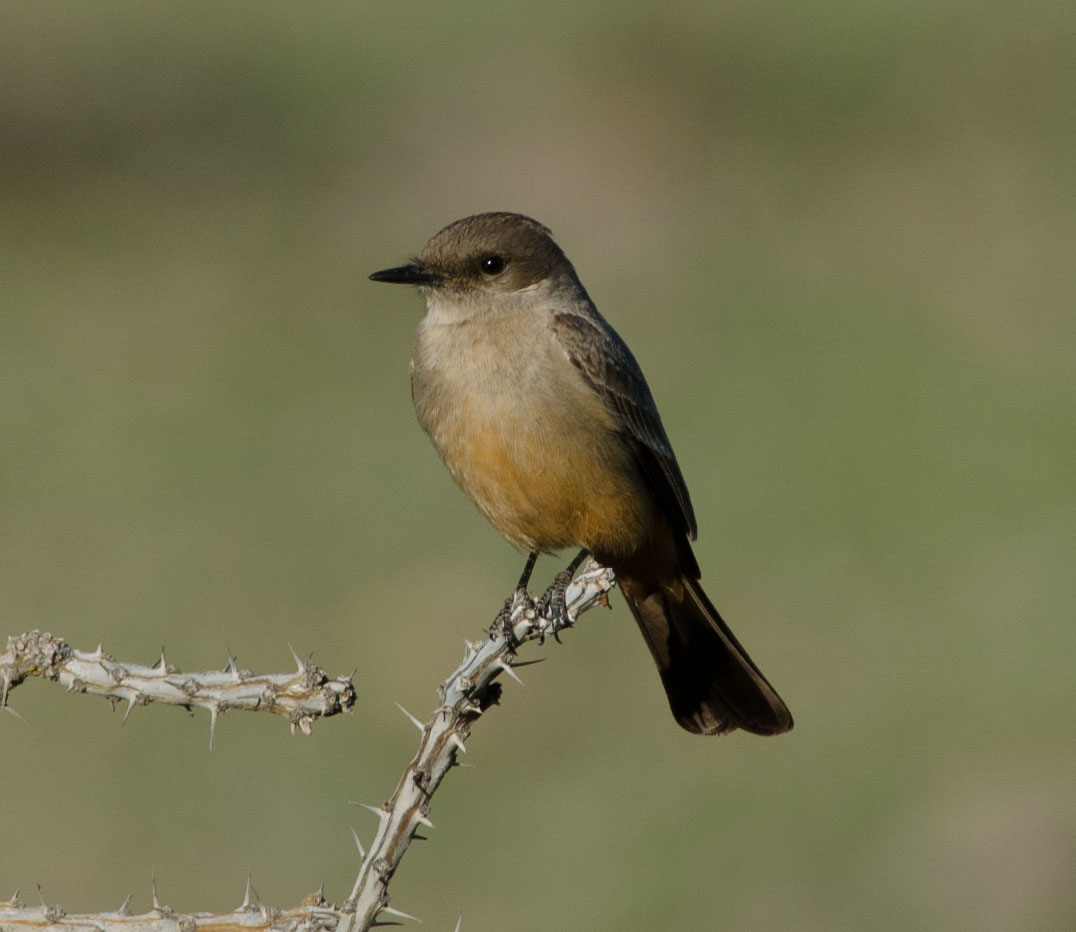
One of the last birds that I found when nearing the parking lot was a couple of Say's Phoebes.  A very common resident flycatcher in this part of Arizona.  While one of them was posing on an Ocotillo branch and I was firing away with the camera, this one must have had an itch on the back part of its neck.  Sure wish I could bend my leg back up over my back to scratch the itch!  And shortly thereafter, it took flight.

 Say's Phoebe

  Say's Phoebe

  Say's Phoebe

 Say's Phoebe

Yes, this is a lot of the same species I see quite frequently, but I never get tired of observing them.  It seems I am always learning a new behavior or trait about these frequently seen species.  The learning never ends.