Costa's Hummingbird

Costa's Hummingbird
Showing posts with label Belted Kingfisher. Show all posts

Sunday, April 2, 2017

The Water Birds of Oregon

I have saved all the water-related birds for the last blog post.  After all, my last lifer on this trip was a water bird, the Mew Gull.  And we got it on the last day before our flights carried us back to the sunshine of Arizona.  And, par for the course, Chris and I had to deal with the rain to find it.  They are fairly common, but trying to locate one in the rain with binoculars getting wet, proved to be a challenge.  So we just stood on the shoreline of the Columbia River at Broughton Beach and started taking photos of a lot of gulls that were traveling upstream in the rain.  

Mew Gull
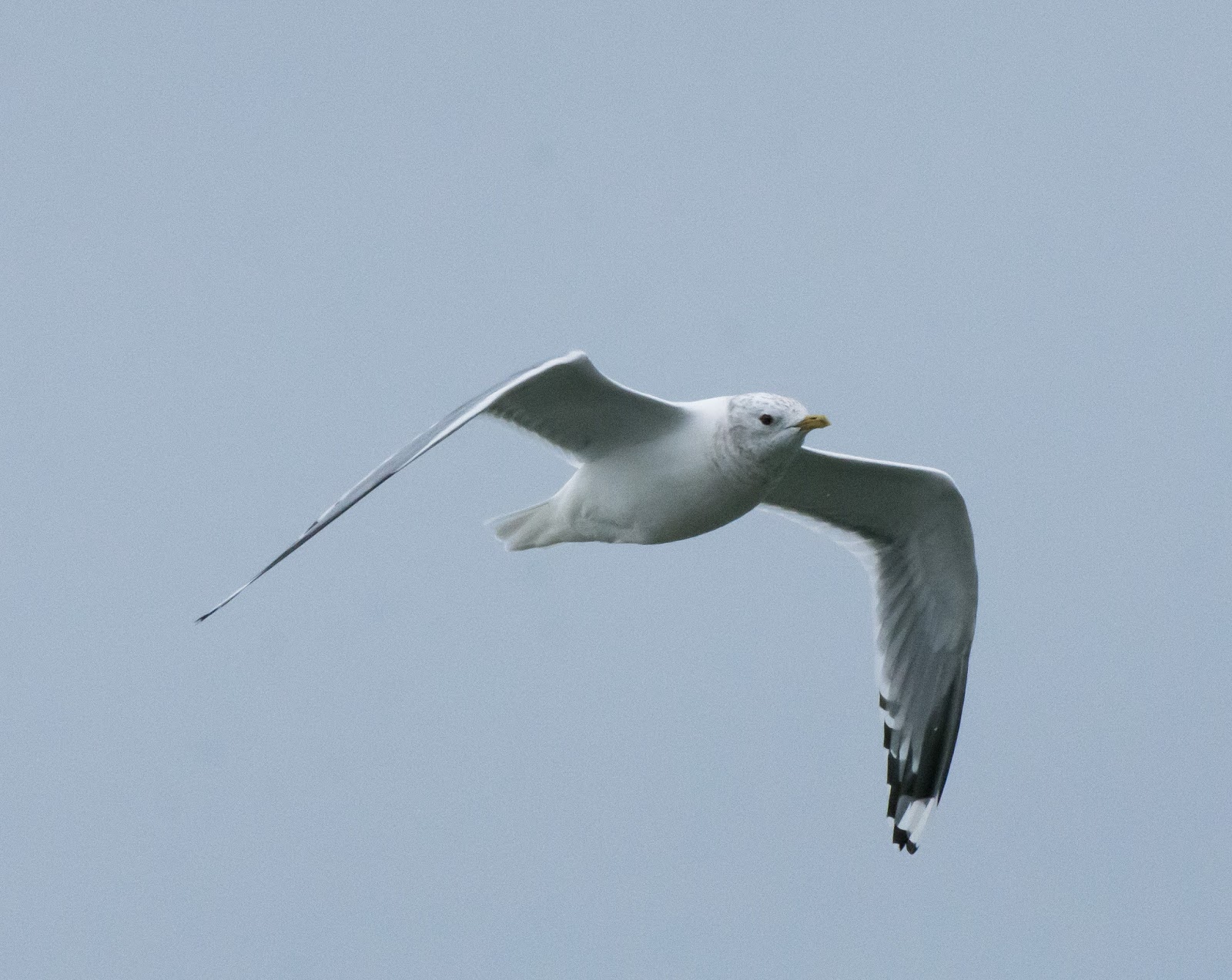


Gulls are not my forte in the birding world and not one that I would chase a lot.  There are a couple of species that would definitely get my interest to chase, but doubt if either will show up in Arizona.  We were challenged with the identification of the various gulls in Oregon.  Gulls are notorious for hybridizing and we quickly found out that some of the hybrids in this area are quite common.  So we had to approach the gull identification process with caution.  We did have other gulls that were not hybrids and one of them was the Glaucous-winged Gull.  This was not a lifer for me, but it was the first time I got to see one in adult plumage.  My previous sighting was a juvenile in Arizona several years ago.

Glaucous-winged Gull

Below are a few photos of some of the other water birds we observed during our stay.  Some I have seen in Arizona in the past, and some I have not.  But always fun to see and observe some of these species that I do not see as often.  

Horned Grebe

Common Murre

Common Murre

Surf Scoter - Male

White-winged Scoter

Black Oystercatcher

Black Turnstone

Belted Kingfisher

Belted Kingfisher

Golden-crowned Sparrow

Was also pleased to see a few other unusual flora and fauna.  My first ever sighting of a Vole.  I know they are a common rodent and are frequently seen as part of the diet of many raptors including owls. 

My first ever photo of a Vole

Western Skunk Cabbage was a new and interesting plant that we found.  Had heard of it before, but never knew much about it until now.  It is sightings like this that are fascinating as I read up on things like this and understand more about our natural world.

Western Skunk Cabbage

These last 2 photos are of a spider species that was fairly common clambering around on the snow in the vicinity of where we had the gorgeous male Spruce Grouse.  I have no idea what species it might be, but I had never seen a spider on snow before and seeing several of them leaves me in awe of what else is out there yet to be discovered.
  
Spider in the snow!


I returned to Arizona with 9 more new life birds so it was a great trip with some really awesome birds.  If anyone is planning a trip to the Pacific Northwest and have some of these birds on your wish list, I highly recommend contacting Khanh Tran.  He knows his birds well and not only knows where to find many of them, but also how to find them and what time of the year is best to observe them.  


Sunday, September 11, 2016

The Eye of the Hurricane

Living in Arizona, I figured I might not ever be affected in any kind of a dramatic way by a hurricane.  Yes, there have been hurricanes in the eastern Pacific off the western coast of Mexico at times, but most that form, usually tend to keep moving west and out into the Pacific Ocean.  A few had veered north and east, and usually lose their punch very quickly when making landfall.  And even fewer times, those that did, created some precipitation in Arizona, but the storms were seriously downgraded before they hit the state.  

Well, this last week, Hurricane Newton, decided to pay a visit to the state of Arizona.  Luckily, it had lost a lot of its punch before it hit the state, and had been downgraded to a tropical storm.  The eye of the storm, with all the rain, seemed to center near the city of Tucson.  A few experienced birders mentioned that this storm had potential to bring in some rare birds that get caught up in the winds and rain, and what really happened was totally incredible.  It brought in a host of pelagic birds, (birds that tend to live their lives at sea in the ocean).  About mid afternoon, some of the birders in southeastern Arizona started reporting storm-petrels, a shearwater, and another odd report from someone's back yard of an unusual petrel.  These birds live their lives at seas, except to come ashore on remote islands to breed.  They had no business being in Arizona, much less finding any kind of habitat that they are used to where they can find food to survive.  Most of these birds were weak and just trying to find any body of water as refuge, and unfortunately, some of the reports were coming in that some of these birds were perishing.  That is such a bittersweet feeling, knowing that many would not survive.  Those that were found alive, were taken in by rehabilitation groups that would nurse them back to health and then release them back on the Pacific Ocean.  

Good friend, Tommy Debardeleben, contacted me to see if I was interested in heading down the next day to see if we could locate any of these rarities, if there were any surviving birds still around.  Of course I said yes in a heartbeat and the next morning, we headed south at 4:00 am.  We arrived at Amado WTP and found other birders already there and so far, nothing had been found at this location.  We then decided to head to Patagonia Lake where more had been seen the day before.  When we arrived at Patagonia Lake we also found more birders that did not find anything here as well.  

It was fascinating to see all the awesome birders that we were meeting!  It was an impressive group, with names of the 'Who's Who' of birding in Arizona: Mark Stevenson, Molly Pollock, Laurens Halsey, Lauren Harter, David Vander Pluym, Shawn Fitzgerald, Jon Mann, and Tommy and myself.  We were all looking for any kind of a rarity we could find, and we then saw a new report of a storm-petrel in Benson which was another hour and 15 minutes away.  We all met up there as well, and by the time we got there, it could no longer be found.  While we were definitely enjoying the birding with all these great birders, we were also a bit disappointed as we had failed to find any of these pelagic birds, and the feeling of a wasted day was starting to sink in.  

Just as we were leaving Benson, a new report came across the list-serve, that James McKay had found a storm petrel in a man made lake in Mesa.  (Huh!?!?!?  That is the place we had departed from at 4:00 that morning!)  That was one of the longest 2½ hour drives that both of us had ever experienced.  Luckily, we had birding friends in the Phoenix area that were at the lake in Mesa and they were giving us frequent updates on its status.  As soon as we got to the park and I stopped the car, Tommy was out and sprinting to the lake.  Took me a bit longer to get my gear together and also run to the lake.  And there is was a small storm-petrel sitting in the water, almost like telling us 'Here I am.  I have been waiting for you to come and see me.  What took you so long?'  How ironic that Tommy and I traveled about 300 miles, just to come back to Mesa and then see this bird about 15 minutes from my home!

Storm-petrels can be difficult to identify with certainty, and the consensus so far was that it was a Wedge-rumped Storm-Petrel, that has 2 sub-species; one that breeds in the Galapagos Islands and another that breeds on some islands off the coast of Peru.  This bird has been reported before in the United States, off the coast of southern California, but no where else.  And we were looking at one sitting a lake in Mesa, Arizona, far from any sea.  This is a small bird at only 6 inches and to me it is hard to fathom something this tiny sitting and floating adrift out in the Pacific Ocean.  From here, I will let my photos tell the rest of the story.

 Wedge-rumped Storm-Petrel


 My attempt at a selfie with the WRSP.  Definitely not good at selfies!

So close to the edge that some did not even need binoculars.  This view also gives one a perspective on how small this bird really is.

This bird was a new bird for the state of Arizona, also Maricopa County, and of course a new life bird for me as well.  Besides this bird being a new bird for Arizona, there were several other new species that were a first for the state as well.  The most bizarre was a Juan Fernandez Petrel that breeds on a single island off the coast of Chile.  It had never been reported in the United States before and one person photographed it as it flew over his yard in Tucson!  Who would have thought that the state of Arizona would record the first ever record in the United States of a pelagic sea bird?  Laurens Halsey also had a Wedge-rumped Shearwater the day before, which was also a first.  

Here are a few other photos that were taken on this momentous day, but they are far less dramatic than Maricopa's first ever and own Wedge-rumped Storm-Petrel.

 Black-bellied Whistleing Ducks at Amado WTP

 Black-bellied Plover at a far distance

 Belted Kingfisher

Greater Roadrunner

Here are a couple of scenic photos that show the remnants of Hurricane Newton and the lingering storm clouds.


 Elephant Butte

Baboquiviri Peak from Patagonia Lake.


Friday, October 30, 2015

Saguaro Lake: A Huge Oasis in the Desert

Recently, I decided to head out to Saguaro Lake on the Salt River to take in a much needed hike for exercise and of course do some birding in the process.  Now that fall has arrived in the Sonoran Desert, the temperatures are so much more inviting for long hikes.  Saguaro Lake is a man-made lake on the Salt River and is surrounded by some incredible scenery.  On the north side of Saguaro Lake is a picnic/campsite known as Butcher Jones Beach and from this site is probably one of the most scenic hiking trails in Maricopa County, at least in my opinion, but then, I have not hiked every trail in the county, so I could be wrong.  This trail was the focus of my hike and it surely did not disappoint.  I started my hike early in the morning and apparently was the first person of the day to set out on this trail as I did not run into any other hikers until on my return. Here are some photos from various points along the trail.   


Birding was actually pretty good along with many of the expected species such as Black-tailed Gnatcatchers and Black-throated Sparrows.

 Black-tailed Gnatcatcher

Black-throated Sparrow

One bird that I was not expecting at this location was the Sagebrush Sparrow.  It is not a rarity by any means, but the habitat just did not seem quite right for this species.  It is a wintering bird in Maricopa County and I have observed this species in many other spots in the county.  But on the other hand, this habitat is not that too far off, so maybe they are around, but have just gone undetected in the past.  (Once I returned home, I checked eBird and found that they had not been reported there in the past, at least in eBird.  So I got to add a new species to eBird for this location.)

Sagebrush Sparrow

Near my turn-around point, I discovered a gorgeous female Belted Kingfisher.  They can be a very shy bird and this one was no different, quickly flying across a small inlet when I flushed it.  Considering the distance, I was kind of surprised I got a photo that was recognizable.

Belted Kingfisher - Female

By the time I returned to the beach area, the waterfowl were much more active than when I started, so I sat myself down on a rock along the shoreline and noticed that mixed in with the hundreds of American Coots was a Redhead duck.  This was my first of the fall sighting of this handsome drake and he looked a bit out of place with all those coots and a few Pied-billed Grebes.

 Redhead

Pied-billed Grebe

Not sure what was going on with the coots that morning, but many of them were flying high over the water.  Usually, when I see a coot in-flight, it is low and near the surface of the water and quickly sets down in the water at a different location.  With them flying over my head, I asked myself, 'Why not?' in reference to taking a photo of one in-flight.  Really gives a different perspective on this oh-so-common bird.  

 American Coot


One last walk through the picnic area before heading home, in the search for a Gray Flycatcher.  The past couple of winters have had one or two residing in this location.  And sure enough, I found it, or maybe I should say, it found me, as it flew into a tree right above me.

Gray Flycatcher

A great overall hike of about 4½ miles with some incredible scenery and some great birds along the way.  Even some of the flora along the trail is pretty amazing.  I am always amazed at how some of the cacti dispersed seeds can germinate and survive in and among the rocks.

 My hike, from my GPS app,

 Some type of a fishhook cactus.


 Cholla cactus