
As mentioned in my previous blog post, I have been spending a lot of time in Pima Canyon Wash in South Mountain Park. It is a place that I adopted as 'My Patch' in eBird, It was only natural that I did this becasue this spot is one of the closest locations for me to get some good exercise and over the years I have found some pretty good birds here. Many of the birds I see now are the more common desert species, but being able to document them and enjoy them on a personal level is really pretty cool. This post features some of the recent experiences that I have encountered in this location, including a couple of crushing scenes of hummingbirds. And hummingbirds will be my starting point for this blog post.
Probably my most favorite hummingbird that is a year-round resident of this part of Arizona is the Costa's Hummingbird. Of course there are others that really trip my trigger during the summer months, but don't tell that to any of the COHUs! This bird, with its stunning royal purple gorget is really hard to beat. I have discovered one in Pima Canyon Wash that is a fixture and he has his special favorite perch and he really defends the wolfberry bushes in his territory. And he is fairly approachable. Photographing hummingbirds in natural settings are so much more pleasing than those around feeders. Here are some photos of 'Mr. Reliable'.
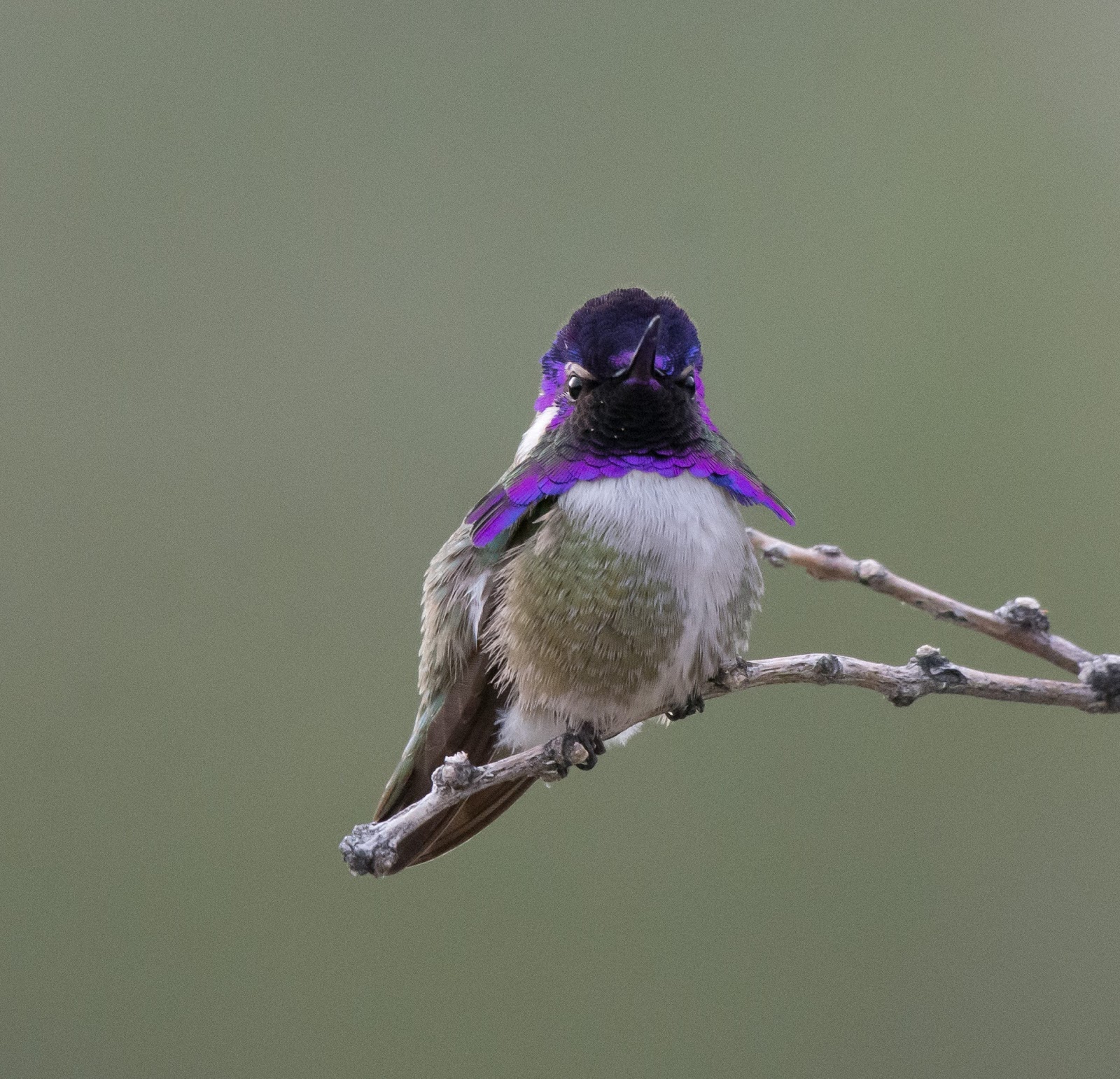
Costa's Hummingbird


The Anna's Hummingbird is also a year-round resident in this part of Arizona and it ain't no slouch either. It is by far the most numerous and probably outnumber the Costa's by 8 to 1. It is the most common and frequent hummingbird to show up at feeders in people's yards. And when a male is in just the right angle of sunlight, its brilliance is almost blinding.

Anna's Hummingbird


That just about covers all the hummingbird possibilities for this time of year, but we have other species that are enjoyable and fascinating as well. Case in point; the Black-tailed Gnatcatcher. This is another tiny passerine that is very vocal and also very common. They usually give up their location by their buzzy like notes. In winter, both sexes are a pretty boring overall gray on top and white underneath, reference the first photo. However, as spring approaches, and it is definitely approaching in Arizona right now, the male starts donning a spiffy black cap and subsequent photos show one such male beginning to get that dapper look.

Black-tailed Gnatcatcher


Of course there are many other regular birds in this part of South Mountain Park and when they properly present themselves and cooperate for photos, why not take advantage of it? Black-throated Sparrows are dapper LBJs (little brown jobs as many novice birders lump them).What's not to love with those very contrasting blacks, browns, whites, and grays on a sharp-dressed bird?

Black-throated Sparrow


Curve-billed Thrashers are one of the easiest birds to recognize with their sharply curved bill and bright orange eye. Now this bird has a proper name that describes it well.

Curve-billed Thrasher

This one was singing while on the rock, maybe trying to translate the petroglyphs. However, since I do not speak 'thrasherese' I could not understand it.
When it comes to woodpeckers in the desert, Gila Woodpeckers and Ladder-backed Woodpeckers are in order. Gila take advantage of the Saguaro Cactus for its nest cavities, creating a new cavity every year. The Ladder-backed uses the trees it finds for its nesting cavities.

Gila Woodpeckers

Ladder-backed Woodpecker and a possible new nest cavity in the making?

The never ending parade of the Verdin entertains an entire hike.

Verdin
As for the wren family, the 2 most common species found are the Cactus Wren and the Rock Wren. The Cactus Wren has the distinction of being Arizona's State Bird.

Cactus Wren

Rock Wren
On one of my recent trips, a Lesser Goldfinch had apparently taken a liking to the desert habitat as well. Not always assured to be found in the desert, but not rare by any means either.

Lesser Goldfinch
And finally a 'Gambel's' White-crowned Sparrow, which is a winter only resident. Come springtime, they will be headed north.

White-crowned Sparrow
Now that I have covered all the birds, lets move on to a butterfly and some mammals. The butterfly, a West Coast Lady, seemed a bit early this year, what a bright spot to enjoy in January!

West Coast Lady
The Coyotes seem to be thriving very well in this environment as they all look healthy and not malnourished. Thankfully, none of them were hungry enough to be viewing me as a possible meal! On one occasion a couple of them starting howling at me as I was walking down the wash. Really had some neat encounter with the Coyotes so far. They are very wary and try to stay far away from any humans.

A sequence of Coyote photos


Harris's Ground Squirrels


Black-tailed Jackrabbit

Desert Cottontail
For those that read my previous blog post, I also made comments that I was also branching out to more diverse groups of organisms. So with this post, you get to witness a couple of photos of some flora (or plants if you prefer).

Graham's Fishhook Cactus-love how it puts forth roots in a rock crevice and thrives!
This next one is a very tiny little plant. I have probably walked right by them countless times, but once a person 'stops and enjoys the roses', little things like catch my eye and the tiny whitish flowers were intriguing for sure. I was only able to identify this by posting it on a citizen science website, iNaturalist.org. Exact species is not known but at least someone suggested a 'probable' species.

Genus Pectocarya-most likely Pectocarya recurvata, note the tiny whitish colored flowers.

Same plant but with the corner of my cell phone next to it for size comparison.
It has been enjoyable following a lot of the regulars and learning new flora and fauna along the way. Hopefully my next post will be interesting as I am taking a short trip out of the state.


