Costa's Hummingbird

Costa's Hummingbird

Tuesday, May 14, 2013

Glendale Recharge Ponds

I vowed I would always make posts in chronological order, but obviously that all went by the wayside.  Got busy in too many birding adventures that I have missed a couple of posts.  On April 28th I decided to find out if there was anything new to see in the category of wading birds by making a trip to the Glendale Recharge Ponds in the west valley  This is a place that attracts a lot of unusual migrants from time to time.  This is an unforgiving place on a hot day as there are no trees and depending on which ponds have water, viewing the birds is not too bad, but photography is most generally fairly difficult as most of the birds will fly to the other side of the pond you are viewing, or to another one of the ponds that might be holding water.  Despite the obstacles, I did manage to capture some photos of some water/shore birds and a few others as well. 

One of the most common 'peeps' (sandpipers) in and around Arizona throughout the winter months is the Least Sandpiper.  They can be confused with the Western Sandpiper when both are in their winter plumage. The leg color is the most distinguishing feature as the Least Sandpiper has yellowish-green legs and the Western Sandpiper has black legs.  But beware, the angle of the sun, and mud on legs can sometimes make a Least Sandpiper look like it has black legs.  This day, there was no doubt on them and part of that is the fact that the Westerns were also showing off their more colorful summer plumage.  Westerns are not nearly as numerous as the Least in the winter months..

 Least Sandpiper

Western Sandpiper

Then we had plenty of wading birds as well such as the American Avocet and the Black-necked Stilts.  Both birds were quite numerous in the shallow water and both are quite handsome; with the Avocets all decked out in their more colorful breeding plumage.  The photo of the Avocet is most likely a female as they tend to have a stronger more up-curved bill than the males.  

 American Avocet

 Black-necked Stilt

Black-necked Stilt

Another very common wading bird in AZ in the winter is the Long-billed Dowitcher, which is usually in its winter plumage of gray and white, but these were molting into their summer breeding plumage before heading north and they are quite handsome when they look so vibrant as this.

Long-billed Dowitcher

And of course we have probably the most common land bird that is not quite a sandpiper, but a close relative, the fanatical and yet sometimes inconspicuous Killdeer.  What was cool about this visit is that I also discovered some fledglings out in the mudflats and they were blending in quite well with the mud.  Even a couple of the adults were trying to play hide-n-seek with me.

 Killdeer

 Killdeer

 Killdeer chick

Killdeer chick

Some of the other birds that were present included a Savannah Sparrow, a Western Kingbird, a Red-winged Blackbird, and a colony of nesting Cliff Swallows that had already hatched and fledged several young ones this year.  The Savannah Sparrow is one of the sparrow species that is good to learn as it just might show up just about anywhere and there are some variances to this species throughout the US.  The Western Kingbird is always a welcomed sight as it heralds in the summer weather and it is a bird that was always a summer resident back in Nebraska on the farm.  The Red-winged Blackbird is a very familiar and common species to most people and this one was putting on a display for the females.  Hopefully they get turned on by mud encrusted feet!  

 Red-winged Blackbird

 Savannah Sparrow

Western Kingbird

 Cliff Swallow nesting colony

 Cliff Swallow fledgling

Cliff Swallow adult

For about a ½ hour while I was checking out the birds a Coyote was 2 ponds away from me and barking and howling up quite a storm.  While the distance was not going to make for a great photo, I still could not help trying to get a photo.

Wyle E. Coyote


Monday, May 6, 2013

Mt Ord & Sunflower - 4 May 2013

Saturday May 4th, I was joined by a couple of FB birding blogger friends, Kathie Brown and Chris Rohrer, along with Mark Ochs and we went birding to Mt Ord with a stop at Sunflower on the way home.  Kathie got a bunch of new Maricopa County birds and Chris got a new life bird in the process as well.  By the time the day was over, it was dusty and windy and everything was covered in dust and everyone was exhausted! 

 It was cool and windy at our first stop on the road up to Mt Ord.  We made about 3 stops before we came to the 1688 trail head.  And along the way, we saw several Scott's Orioles, which are absolutely beautiful birds all decked out in bright yellow and black with a decorative trim of a white wing bar.  Had one land in a shrub right outside my window as I was driving and I couldn't get my camera up and turned on fast enough, but did manage to capture a photo.

Scott's Oriole

Also in about the same general area, we had Rufous-crowned Sparrows and Ash-throated Flycatchers.  However, they did not want to pose for us quite as nicely as the Scott's Oriole did.

 Ash-throated Flycatcher

Rufous-crowned Sparrow

Once we reached the pine forested slopes we started seeing lots of warblers, but most of them did not want to be photographed.  I did manage a few photos of some, but definitely not the best shots on these birds.  Photos include a Black-throated Gray Warbler, which was a very common species at this location where it breeds and resides in the summer months.  Also have a photo of a Painted Redstart, a dynamically colored bird all decked out in red, white, and black.  We also found Virginia's Warblers.  I had only seen this species  once before but did not get any photos.  This time I did manage to get a photo, but it leaves a lot to be desired.  Guess it is another one of those birds to come back for.

 Black-throated Gray Warbler

 Painted Redstart

Virginia's Warbler

Another group of birds, the vireos, were also well represented.  The Plumbeous Vireo was quite numerous just about every stop we made.  My photos came with a nice stick in front of the bird!  We also had Hutton's Vireos and in one case, one of them had found a nice green headed worm to snack on.  I did not even realize the worm had a green head until I saw my photos.

 Plumbeous Vireo

Hutton's Vireo with a green headed worm

Another group of birds that was well represented was the tanagers, as we found 3 species during the day. We found the Hepatic Tanager and the Western Tanager in the pines and upper elevations of Mt Ord, and we found several Summer Tanagers in the afternoon when we visited Sunflower.  

 Hepatic Tanager

 Western Tanager

Summer Tanager

One of the other birds that caught my eye was a female hummingbird that was flying around a dead log and some dried out pine needles and other litter. Looked strange to me as I saw nothing of interest for it, but once I got my photo, it appears it was gathering nesting material in this area.  Also of interest were a Chipping Sparrow and a Dusky Flycatcher.

 Anna's Hummingbird gathering nesting material

 Chipping Sparrow

Dusky Flycatcher

Among the non-avian photos, we have a couple of flower photos; one is of the lovely Desert Lupine, which was found near the top and a bright red Hedgehog Cactus that was also found at the very top of Mt Ord.

 Desert Lupine

Hedgehog Cactus

We had a great day together and hope to have many more.  Next gathering of us 3 bloggers might be the Tucson area if everything falls into place.  


Thursday, May 2, 2013

Pima Canyon Wash - 27 April 2013

Once again, back to one of my old standby hiking and birding spots, Pima Canyon Wash, in South Mountain Park.  With the warmer weather coming up in the future, I wanted to check out this spot once again befoire it got so hot that one cannot even enjoy hiking in this spot even at 5 or 6 in the morning.  Turned out to be quite an enjoyable day with a few unusual birds that made it interesting.  

The first interesting find was a pair of Costa's Hummingbirds in the process of courting and actually breeding.  This behavior was new to me and interesting to watch.  I have heard this hummingbird in this location many times, even in the cold of winter, but sometimes, the viewing leaves a bit to be desired.  This time a bright male was very cooperative and kept returning to a couple of favorite perches.  

 Costa's Hummingbird

Costa's Hummingbird

Breeding has been in full swing for a few species already as I discovered a pair of Loggerhead Shrikes attending to a couple of fledglings in the trees.  The young ones would squawk and cry to be fed as both parents would fly out and return with food for them.  

Loggerhead Shrike, adult below and fledgling above

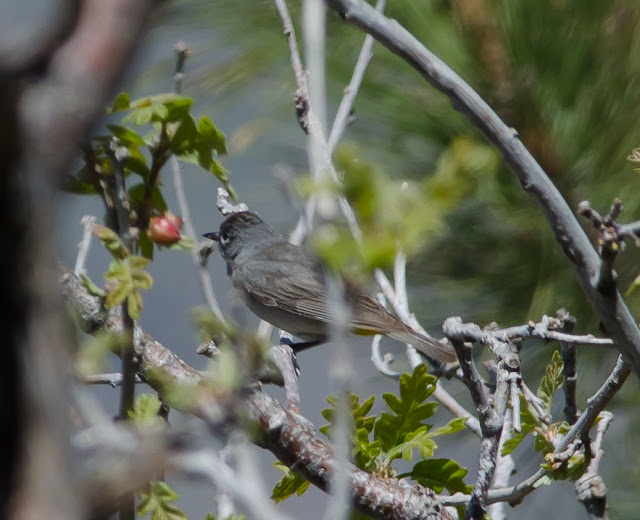
One of the unusual birds that I discovered was a Gray Vireo.  A different part of South Mountain Park has a few spots where this bird can be found in the winter months, but by now, most of them should have returned to their breeding grounds a bit further north and in higher elevations.  I heard this bird before I saw and knew I had a vireo in the area and once I finally laid eyes on it, I was happy to see this bird and hear its song.

Gray Vireo

A couple of migrating warblers were also seen; my first of the season, Wilson's Warbler and also a Townsend's Warbler.  I had also seen a Townsend's Warbler about a week before further south in Huachuca Canyon, but one of the 2 that I found here, gave me a couple of photo.  The Wilson's Warbler was a bit harder to get photos, but I managed to get a couple fairly decent.  Just goes to show that colorful birds do show up on occasions in this location.  

 Townsend's Warbler

Wilson's Warbler

To really make my day difficult, the Empidonax flycatchers, were quite numerous.  One of the most difficult group of birds to identify.  They all have unique calls, but when they are silent like all of these were, a few of them left me scratching my head.  I was able to identify 3 of them, with confidence, but a couple more left me  in the dark. Two of the 3 were Pacific-sloped Flycatchers, which is only a migrant in this part of Arizona as they migrate north and west to the Pacific northwest.  One of these had found a moth and was fueling up on energy before heading north.  It really make the photo a bit tough to shoot among the branches, but glad I caught it with prey in its beak.  Another one I was able to ID was a Gray Flycatcher, thanks to the downward phoebe like pump of its tail, which is a good indicator of this species.

 Pacific-sloped Flycatcher with prey

Pacific-sloped Flycatcher

Gray Flycatcher

Some lizards were starting to show themselves as well.  While I do not linger a lot on lizards, they are still intriguing and their presence provides food for many other animals including birds and other reptiles.
  
 Common Side-blotched Lizard

Ornate Tree Lizard

And a mammal that I see on almost every trip to this location, a Harris's Antelope Ground Squirrel, had to run to the top of a rock to check me out and posed quite well for.  

Harris's Antelope Ground Squirrel

After seeing the variety that this visit produced, now I know why I return to this spot frequently.  seems I always find something a bit unusual or unique.


Monday, April 29, 2013

Granite Reef & Sunflower - 21 April 2013

After all my travels from that week off from work, I was finally home on Saturday and a very good birder friend, Muriel, contacted me and asked me if I would like to go to Sunflower birding on Sunday since the last time we were there, we missed out on the Common Black Hawk.  I had already been thinking about going to Granite Reef on my own as I knew the Bullock's Orioles had returned.  So we decided to combine the 2 destinations and off we went early on Sunday morning.  The first stop at sunrise, was Granite Reef, and I was not disappointed as the Bullock's Orioles were easily found.  This is a bird that has always eluded me in photos (at least clear photos) and this time wasn't much better as they love the very tops of the trees and are often hidden by small twigs of foliage.  I did manage a much better photo this time around and am happy with the results.  But there is always room for improvement.


Bullock's Oriole

My goal was filled so off we headed to Sunflower and what a great idea this was.  The road in was particularly very birdy and we spent a long time walking along the road. We also found Muriel's target bird, the Common Black Hawk.  We first spied it on the east side of the road back among the trees and in poor lighting.  But then it decided to make our day and flew to the west side of the road on a clear open perch.  Yes, it was fairly high up in the tree, but still a great view of the magnificence of this bird.  We later also discovered its mate in another tree in a nest.

Common Black Hawk

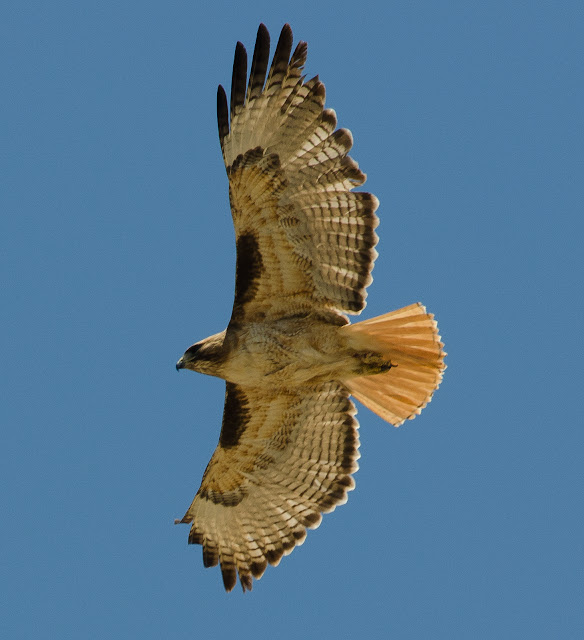
There were lot of other birds happening about the same time, including a fly-over by a Zone-tailed Hawk and a Red-tailed Hawk.  Summer Tanagers had returned and were singing from every direction.  Turkey Vultures were sunning themselves in the cool of the morning air.  One of the most unexpected finds was a Cedar Waxwing that Muriel spied, while I was concentrating on a Vermilion Flycatcher nest.  Almost too much happening at once.

 Zone-tailed Hawk

Red-tailed Hawk

 Summer Tanager

Turkey Vulture

 Cedar Waxwing

Cedar Waxwing

With all this activity, we had a hard time deciding to continue the walk on the other side of where the road is closed for vehicle travel, but so glad we decided to continue our walk further up the road.  And it was definitely worth the extra walking.  We discovered the Zone-tailed Hawk nest with presumably the female sitting on the nest.  

Zone-tailed Hawk nest--you can see a head and part of the tail

The trees were alive with singing Yellow Warblers and Yellow-rumped Warblers.  The Yellow Warblers are returning migrants and the Yellow-rumped Warblers (Audubon's), are migrants thinking about heading north, but a few of them were sporting their bright breeding plumage.  And to top it off, another oriole was seen; this one being a Hooded Oriole.  Really made my day to get 2 oriole species.  In addition to all that color a very handsome Violet-green Swallow thought we were safe enough to stay perched for good looks from us.

 Yellow Warbler

Yellow-rumped Warbler (Audubon's)

Hooded Oriole

Violet-green Swallow

While we were making our return walk to the car and the parking area we had a friendly encounter with a fairly large Gophersnake (at least that is what I think it is). Growing up I remember my father catching these reptiles back on the farm and then releasing them in places to control the rodent population.  This one was quite long, about 3½ feet long and very nonchalant.  It was not at all aggressive or agitated with us in any way.  If fact, it had pretty much disappeared by the time we regained our composure and was retreating into the grass before I could think about photos.  If you ever get to Sunflower and run across this beautiful reptile, just let it know that Gordon and Muriel said 'Hi'!

Gophersnake as it slithers away.

What a great day of birding and some wonderful birds.  And I can thank Muriel for suggesting the trip and she just happens to be the person that has taught me just enough about photography to help me get a few good photos once in awhile.