Costa's Hummingbird

Costa's Hummingbird

Monday, June 4, 2012

Mt Ord, Arizona

Little did we know what awaited me and my birding friend Ellen when we decided to explore Mt Ord this last Sunday.  Mt Ord is the highest point in Maricopa County in Arizona with an elevation of about 7100 feet.  Does not compare to the highest peaks in Arizona, but compared to the urban sprawl of the Phoenix area in the same county, it is so different and a great place to escape the valley heat.  The road to the top is dirt, rocks and gravel and is passable by a passenger car, but you won't break any speed records going up and down, nor would you want to as one missed curve and it might be a bit of a distance before your car stopped moving!  One can drive most of the way to the top, but the last ½ mile is walking only and nice and steep for a bit of a good workout.  The bird life on this mountain is very different than down in the valley.  We got to see a plethora of exciting birds and this post is going to be a long one as I have many photos to share. 

The first stop we made off the main highway at the lower reaches proved to be a good omen.  The first birds we found as we got out of the car was a flock of Bushtits.  Even though they are a very small (with a very tiny beak), and drab colored bird, (mostly gray), their antics make them fun to watch.  They move as a flock from one bush to another and are as busy as they can be.  Not a great photo of this one, but it will do for now.

Bushtit
What we really stopped for was to try and find a Black-chinned Sparrow which are known to breed in this area.  We heard them all around us and found that very few of them would make an appearance, so had to settle for just a mediocre photo.  These are not to be confused with Black-throated Sparrows.  Some day, I plan on doing a post on sparrows only.

Black-chinned Sparrow
The next stop was a cattle watering tank which is usually a great place to see birds because it is a water source in the dry foothills.  A pair of Canyon Towhees were visiting when we first got there, but departed before any photos were taken.  The next visitor was an Ash-throated Flycatcher, and it kept coming back instead of flying away.  Then we saw a second one and discovered they had a nest nearby and were bringing back food to their babies that were well hidden.  Got some nice photos of one of the adults with insects in its beak for the babies.

Ash-throated Flycatcher
One other bird stopped in for a short visit and that was a Western Scrub Jay and was able to get one photo before it took off down the hill.

Western Scrub Jay
We continued up the mountain road stopping at few places along the way and one of the first stops produced a Hepatic Tanager.  Not the most common bird around and seen mostly in the US in the southwest.  this was the first time I got an opportunity to actually photograph one.

Hepatic Tanager
The next stop provided us with an Acorn Woodpecker and a Spotted Towhee.  The towhee find was exciting for us, but little did we know that before the day was over we were going to see and hear many of them and even found the vicinity of a nesting pair.

Acorn Woodpecker
Spotted Towhee

We also found many White-breasted Nuthatches along the way including this one below.  One pair was even bringing in food for one of their recently fledged offspring.

White-breasted Nuthatch


As we walked the final ½ mile to the summit we found some Violet-green Swallows flying around overhead as most swallows do until we stopped to look at a flycatcher and that was the time that one of these swallows decided to land on a bare branch almost directly above us and really checked us out.  Of course we lost interest in the flycatcher and got some photos of this handsome swallow.

Violet-green Swallow


And just in case anyone was wondering how this bird got its name, the photo below makes it quite obvious as to why it is called a Violet-green Swallow.

 Violet-green Swallow

Another very common bird that we found near the summit were Black-throated Gray Warblers.  They were everywhere and as typical of most warblers, they do not make an easy subject to photograph, no matter how hard I tried.  But they are insect feeders like many bird species and this one had its meal.

Black-throated Gray Warbler


Another fairly common bird near the top were the Blue-gray Gnatcatchers.  This one posed for us and I do not recall seeing one so blue, but I suppose that the breeding season brings out the best in all.

 Blue-gray Gnatcatcher

As we descended from the summit we also discovered an Arizona Sister Butterfly.  In my opinion, they have to rank high up there as one of the most beautiful butterflies around.

Arizona Sister Butterfly


As we drove down the mountain, we met another vehicle that was stopped on the narrow road with people with binoculars out of the vehicle and staring up in the pine trees.  (Obviously birding is a big hobby in Arizona!)  So of course we stopped and asked what they were looking at and found out they had discovered a pair of Grace's Warblers.  What a beautiful bird and they were kind enough to point them out to us.  Typical of most warblers, they do not sit still and photos were hard to come by, but got one that shows off their beauty.

Grace's Warbler


Mt Ord is a mountain oasis in the desert.  I would have loved to write more about each bird and their photo, but I fear that might have gotten boring to some, so we will end this post with a point that this is someplace that I need to explore more thoroughly and Ellen agrees.  Looks like a bit of a cool respite from the heat of the summer desert in the Phoenix metropolis.


Sunday, June 3, 2012

Granite Reef Recreation Area

Granite Reef Rec Area is one of many on the Salt River that flows from the northeast mountains and down into the valley of the sun.  Many of these recreational places are great birding stops.  The Salt River is also a very popular place for many people in the Phoenix area to escape the city and go camping, hiking, tubing, and kayaking in the Salt River, so at times, especially holidays in can get very crowded and congested.  Granite Reef is known as hotbed for many varieties of birds and it almost never disappoints.  Saturday morning, this was my destination and while nothing rare presented itself it was very enjoyable for the couple of hours that I spent there before the heat got unbearable. 

The most entertainment I found was a pair of Western Kingbirds that had 3 recently fledged young in the trees.  The fledglings had not yet learned how to capture bugs in flight by themselves so they were still very much dependent on the parents.  This first photo show one of the young that had just received a morsel from one of the parent birds.

 Western Kingbirds

And just as soon as that morsel was gone, it was begging for more!

Western Kingbirds


I spent several minutes watching these birds and during that time an Ash-throated Flycatcher flew in and landed almost on the same branch of one of the fledglings. 

Ash-throated Flycatcher and Western Kingbird in the rear


It is always interesting to see 2 different species of the same family together as it is great to compare them and understand how much in common they are and in this case, it helps to understand whey they both belong in the flycatcher family.

Another visitor that was quite active in the same area were Lucy's Warblers and it was very nice and generous of one of them to land on a bare branch for my photo op!  This is a female and you can see a hint of red patch on its rump.

Lucy's Warbler


The last birds that I attempted to photograph were some Lesser Nighthawks.  They belong to the family of night jars and are most generally a nocturnal bird flying through the air catching insect in the large gaping beaks.  They are a migratory bird and this was my first observation of them so far this year.  They were at least 15 of them flying over the lake water but at quite a distance from me.  Since they sleep most of the day, they are usually very hard to find in a tree or on the ground as they blend in so well with their surroundings.  I decided to try and capture some shots on them in flight and found out it is not an easy thing to do as they zigzag all over the sky.  Here is one of the photos I got that at least shows the field markings of one of them.

Lesser Nighthawk


And as was making my way to my car, one of them flew overhead on the road and I had just enough time to lift the camera and fire off a shot and came away with this photo.

Lesser Nighthawk


 A very challenging task, and even though the photos are not as crisp as I would like, I can live with these photo until a better opportunity comes along.

Tuesday, May 29, 2012

Boyce Thompson Arboretum

Neatly tucked into a small valley along Highway 60 about an hour east of Phoenix is a wonderful place known as Boyce Thompson Arboretum.  It is located right on the highway and has Picketpost Mountain looming up on the south side of this marvelous place.  The first time I visited this place I fell in love with it and immediately purchased a membership.  The place is first and foremost a mecca for horticulturists with its many different areas of plant life.  One really should take a look at the BTA web site for a much more comprehensive list of what can be found there.

http://arboretum.ag.arizona.edu/

Obviously when they created all these different habitats it also created a haven for a lot of wildlife, including birds.  Anyone who is passing through this part of Arizona should make it a point to stop and check it out.  You never know what you might find there as you walk the trails.  It is a frequent place to visit for me and to round out my 3 day weekend, I travelled out to BTA with Ellen Hairston, one of my regular birding friends.  One of the first birds we discovered was a juvenile Zone-tailed Hawk sitting in one of the pine trees.  These birds are most often seen soaring the thermals and look very similar to a Turkey Vulture.  Since Turkey Vultures do not attack live animals and only feed on carrion, the Zone-tailed Hawk can soar with the vultures, and their prey think they are safe as they appear to be vultures and of course the Zone-tailed Hawk can sometime find easy prey.  This was the best close-up view that I have ever had with a Zonie and it seemed to have very little fear of us.

Zone-tailed Hawk

As we traveled the higher elevation path with Ayer Lake as our next destination, a Northern Cardinal put in an appearance singing from an Ocotillo limb.  Most generally, these birds are found down in the foliage near the stream, so it seemed just a little out of place on the high desert trail.

Northern Cardinal


As we ventured around the main path, which is about 1 ½ miles in length, we worked out way to Ayer Lake.  While it is a small lake, it sometimes has a surprise or two in it.  This time was the first time I found a Great Blue Heron at this lake.  I am sure they have been there before, but it seemed a bit out of place.  Also had a Green Heron in this small lake, but alas, it kept to the other side of the lake and I had to settle for photos of the Great Blue Heron only, which is still nice bird to find.

 Great Blue Heron


Working our way downhill from Ayer Lake, we found a Broad-billed Hummingbird actively sipping nectar from some spent Agave blossoms.  This is one of the most attractive hummingbirds and their red bill is an easy way to identify them from other hummers.

Broad-billed Hummingbird


And a short distance from this we found a Hooded Oriole singing from the top of a palm leaf.

Hooded Oriole


The prize of the day was found in the Demonstration Garden, a Varied Bunting.  This is a bird more commonly seen in Mexico, but with a few reports in Arizona, New Mexico and Texas.  This is a bird I had never seen before, so it was a welcome addition to my lifetime list.  Even though it is not a great photo, it is clear enough to see the beautiful colors this male has and a photo that I can live with since it is a fairly rare find in Arizona.  With luck, maybe there is a pair of them at BTA and nesting would and rearing some young at this location would be a really big plus.

Varied Bunting


While waiting for the Varied Bunting to appear, I had a few opportunities to shoot a couple of photos of some Lesser Goldfinches that were very busy feasting on some flower heads in this area.

Lesser Goldfinch


Boyce Thompson Arboretum is a place that will return to very frequently as it is beautiful with flowers, abundant bird life and some amazing wildlife when one is alert and looking.

Monday, May 28, 2012

Tres Rios Wetlands-Again, 27 May 2012

What to do with a 3 day weekend?  Take advantage of the 3 days and go birding every day to a different location.  Weather was very nice with cool nights and warm days so after the Saturday trip to Sycamore Creek, decided it was time again to check out Tres Rios once more before the summer heat arrives.  Started off the day with a visit with the Burrowing Owls on Burrower's Row, (see previous post) which was done mostly from inside the vehicle.  Then it was time to get out and do some walking.  The west side of Tres Rios is birding by permission only and one has to get prior approval for parking near the gate and then venturing to the west area behind the closed gate.  So with one copy of my permission slip on the dash of my car and one copy in my pocket I headed out once again to explore the area. 

One of the first birds that I photographed was a Peregrine Falcon.  While these raptors are fairly common in the winter in Arizona, it was a bit of a surprise to find one still here at this time of the year.  Many, but not all, migrate to far northern climates for the summer.  And for the first time, I found one that was fairly approachable and allowed me to snap a couple of shots of it.  Their facial pattern is quite remarkable and they look so regal perched up high.

 Peregrine Falcon

Killdeer are so common and seen just about everywhere and really like to be heard.  Many times it is easy to ignore them, but they do some strange things at times maybe to just get attention.  This one was calling to make sure I heard it and then it would run a bit and stop to see if I was watching.  Then it would run a bit more, but this time it decided to try and hide behind a rock, thinking that I was not going to see it, but it did not fool me.  They can be so entertaining to watch their antics.

Killdeer


For those that think we do not have waders in Arizona, I just had to capture a photo of a Great Blue Heron.  These are really very common in Arizona, even though Arizona is part of the Sonoran Desert.  They can be found just about anywhere where there is water with fish.  This area in Tres Rios has a large population of these birds and in fact they even have a tree with a rookery of several nests that raise several young every year.  As this one shows, they quite frequently perch in trees.

Great Blue Heron


Also near this area I found several White-faced Ibis.  Most were easily spooked, but this one was hanging out with some Black-necked Stilts and allowed a bit more time for some photos.  It is a bird that can easily be confused with the Glossy Ibis, but the red eye is a sure sign of a White-faced Ibis.  The white face is evident on breeding adults.

White-faced Ibis


Just a bit past the spillway area is a small area going down near the river and the vegetation is very thick, so I just stood there watching the activity in the trees and during this time I was able to capture a photo of a Song Sparrow and also a Lazuli Bunting.  The bunting is a bird that is so colorful that they just try to make it difficult to those that want to take photos of them.  This photo is not bad, but would have loved to capture a front view with the cinnamon breast band.

Lazuli Bunting


Song Sparrow


Two more photos to round out this outing; one of an Ash-throated Flycatcher and the other of a Common Gallinule.  The flycatcher is a common bird in the summer in Arizona and have a subtle beauty to them even though they are not strong on bold colors.  The Common Gallinule was formally know as the Common Moorhen.  The name change took place just one year ago.  While they look a bit like the American Coot, they definitely have a bit more color to them.  They have already bred here in Arizona as I did see several chicks, but the ever-attentive parents quickly got the chicks to take cover when I approached too closely.

 Ash-throated Flycatcher

Common Gallinule


Will need to make some future trips out there again in the future, but with the heat starting to built for the summer, the trips will become less numerous until the fall night time temps start falling.

Burrower's Row

Thanks to Laurence Butler and his post about the small community of Burrower's Row, I was able to locate this small village and document some of the inhabitants as well.  Recommended reading before reading this column would be to visit his original post

http://butlersbirdsandthings.blogspot.com/2012/05/burrowers-row.html

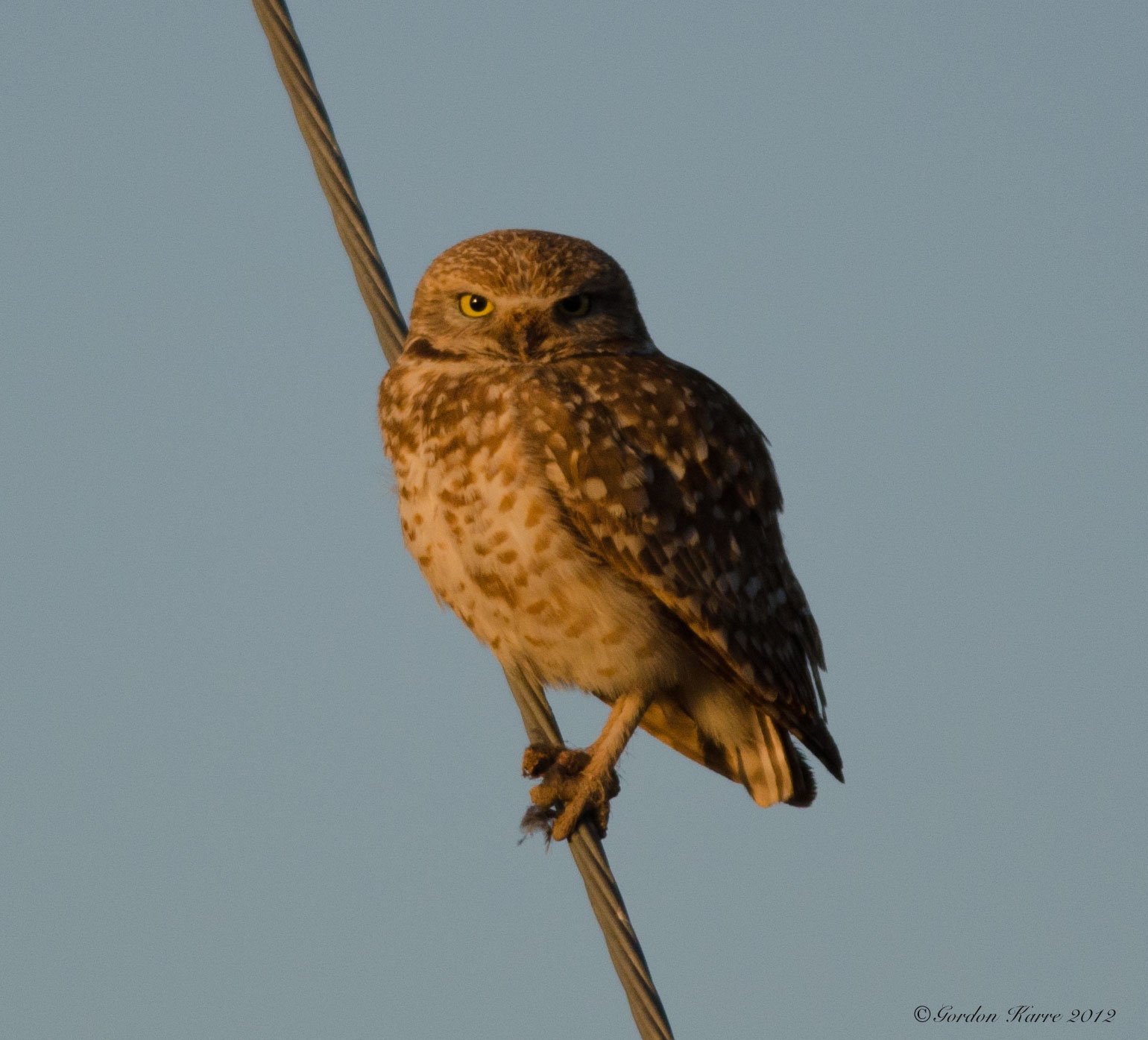
When I visited the community very early on Sunday morning, sure enough the eastern edge of the village had its sentinel as a lookout to warn the rest of any unwelcoming intruders.  After staring at me intently for some time, he must have decided that I could enter their territory.


Of course I was closely scrutinized by every inhabitant, and a couple of them apparently were a bit skeptical and flew far enough away and continued their observations for afar.  But one of the inhabitants must have decided that I look safe as long as I stayed in my vehicle.  Getting out the the vehicle was a sure sign of caution for them as they would take for cover. 

And it appears their offspring are starting to come out for exposure to the new world about them.  But this youngster seemed less than impressed with his new surroundings in the outside world.  I am sure it will eventually come to like becoming an adult and like most juveniles, won't be able to resist the urge to leave the nest.  Won't be too long and there will be no more room at the Inn for this youngster.

Saturday, May 26, 2012

Sycamore Creek

Never wanting to waste a weekend day off and missing out on a new adventure, today was a day that I ventured to a relatively new birding spot for me.  Sycamore Creek is an amazing stream bed that flows to the south and west basically along the same directions of the Beeline Highway, Highway 87.  The place I took on today is not well marked, but it proved to be a great choice when all was said and done.  Got some photos on some great birds that I did not have before.  The best experience was a Canon Wren that landed on a dead tree snag just a short distance from me and sang like there was no tomorrow.  Stayed there for the longest time and allowed plenty of photo ops.  This bird is my favorite Wren.  I think it is one of the most attractive and also has the most distinguished song that is unmistakable and not one too easily forgotten.  As someone else mentioned to me a few months back, this bird maybe should have been chosen as the Arizona State Bird instead of the Cactus Wren.  Nothing wrong with the Cactus Wren, but at least the Canyon Wren is found throughout the state where the Cactus Wren is not.  Some might agree and some might not.

  Canyon Wren

Actually the first critter that I found was not a bird, but a beautiful doe deer and she struck a nice pose for me that I found attractive.  Can't argue with wildlife beauty in any form.


Early on in the hike down Sycamore Creek I ran across many of the common species of birds that I see quite frequently on my birding adventures and today I found this Anna's Hummingbird sipping nectar from flowers that did not even look big enough to have nectar.

Anna's Hummingbird

Shortly after the Hummingbird a Western Tanager flew in from the left and actually landed on a branch in full sun to show off its handsome colors.  This is probably the best photo to date that I have taken of this species.  Love it when they return for the summer.

Western Tanager

The Brown-crested Flycatcher is very similar to the Ash-throated Flycatcher, but not quite as common.  Sometimes they are best identified by their songs.  Today I was able to capture my first photo of this species.  This photo is not perfect, but it does help to define some of the subtle differences in the two species.  The Brown-crested is about an inch larger than the Ash-throated, but if you are only seeing one bird in the field, sometimes size comparisons are a mute point.  In this photo it is easy to notice the more extensive yellow below that is not as extensive and bright on the Ash-throated Flycatcher. 

Brown-crested Flycatcher

One of the most common birds today was the Lucy's Warbler.  They were everywhere and could be heard singing their songs long before I could spot them.  Like most warblers, they are very active and spend a lot of their time in the trees without making themselves too visible.  One male decided to show himself  to me briefly in the open but a bit of a distance away so I took a chance on a photo and got one that is good enough to show off the reddish cap that is found on males.

Lucy's Warbler

Other birds I found but did not get great photos are listed below, including the always colorful Lazuli Bunting.

Lazuli Bunting

Curve-billed thrasher

Cliff Swallows on a Cliff!

An added benefit to all these birding excursion is that sometimes the scenery is also incredible.  This last photo just happens to have a Turkey Vulture soaring the thermals nearby.

Turkey Vulture and Mountain

Thursday, May 24, 2012

Mesquite Wash-Revisited

After my first spring visit to Mesquite Wash, I just knew I had to return for more.  This time fortune was not on my side.  Seems a group of young people had decided to use this place as a campsite on Saturday night and here I was on a Sunday morning attempting to have a quiet and peaceful bird outing.  When I arrived very early on Sunday morning, the music was blasting from a camp site quite a distance from the the parking area and several of the young people were milling about and appeared to have slept very little.  So I worked my way down to the bridges and then along the south side of the wash.  Still found many birds and it always surprises me how resilient they can sometimes be to human interference and commotion.  As I got further down stream, the music faded away and I was finally enjoying the solitude of the area and the stream of running water.  Found an Ash-throated Flycatcher that was feeding on insects it could spot from where ever it decided to perch.  Another bird that was playing hide-n-seek with me and my camera, but I still enjoy these birds immensely.

Ash-throated Flycatcher

As I continued further down the stream bed, I had noticed a few Warbling Vireos and decided it was time to attempt capturing a photo of one of them.  The only one that actually gave me a chance did not want to face me, so I had to settle for a shot from behind.

Warbling Vireo
It was this same time that a juvenile Anna's Hummingbird decided to try taking a bath in the stream water and I found it quite remarkable and even did an earlier post on this little dynamo earlier in the week. 

Anna's Hummingbird Juvenile

A bit further on down the stream I found several Black-headed Grosbeaks and like the Blue Grosbeak in an earlier post, I enjoy seeing these birds and will almost always try to capture a photo.

Black-headed Grosbeak
And finally at the point where I decided to turn around and return, I finally got a fairly good look at a Yellow Warbler.  I had been hearing them and seeing fleeting glances of them in the upper limbs of many trees, which is quite normal for them, but this one appeared in a shorter tree and gave me just enough time to get my camera up for a couple of shots before he was gone.  This is a bird that is fairly common, but like most warblers, they can be very diffcult to photograph.  Not a great photo, but knowing their nature, I am not embarassed by the photo either.  As one can see, with its outstretched legs, a fraction of a second later and I would have had a photo of twigs and leaves.

Yellow Warbler
As I returned to my car in the parking area, I heard a Yellow-breasted Chat.  These birds have a bold and boisterous call in the breeding season.  I had heard and seen them at Boyce Thompson Arboretum earlier in the month, but this was the first one of the season that I had found in Maricopa County for the year.  Considered our largest warbler, but there is some question as whether or not is should be classified as a warbler at all.  Handsome birds never-the-less.

Yellow-breasted Chat

In my meanderings around the Mesquite Wash area I also found a couple of intriguing insects.  I think my butterfly friends have helped me identify the butterfly as a Marine Blue and the red insect as a Bloody Net-winged Beetle. 

Marine Blue Butterfly

Bloody Net-winged Beetle
As always, Mesquite Wash is an intriguing place and is one of the best birding spots in Maricopa County.  Thanks to Tommy D. for posting this on his website and opening up my eyes to this spot.