Costa's Hummingbird

Costa's Hummingbird

Tuesday, May 6, 2014

Texas: 2nd Day, Part 2

Too many birds in one day to include all in one post, so this second part is going to focus more on waterbirds and another previously mentioned bird.  At noon, the Houston Audubon Society had another field trip and this one took us to the actual Gulf Coast and some great water birds.  First stop was Rollover Pass and the first birds we found up close and personal, were some Ruddy Turnstones.  This is one gorgeous shorebird and can really stand out in a crowd of other shorebirds.  We were so close we could see the awesome coloration of the legs and feet.  Love the black lines on the feet and the black 'knees'.

Ruddy Turnstone

Additional shorebirds included Black-bellied Plover and Wilson's Plover.    

Black-bellied Plover

Wilson's Plover

We had a total of 7 species of terns at this location, plus a Black Skimmer and of course some gulls and a few other shorebirds.  All of them were resting quite comfortably on the sand bar until an unexpected Broad-winged Hawk decided to make a brief appearance in the sky and that created pandemonium with all the birds taking flight but to return very shortly after the hawk disappeared.  

 Various terns

 Royal Tern

Broad-winged Hawk

At one brief stop near the shore, we had another 'Common' Nighthawk sitting on the ground.  Having never seen this species before this trip, now I had seen one the day before in flight, one in the morning at High Island on a wire, and now a third one resting on the ground in broad daylight.  (Be prepared to see more on a couple future posts as this was not the end of seeing this very unique bird.)

Common Nighthawk

So now back to High Island and this time my focus was to check out the rookery in Smith Oaks Woods in the afternoon.  This spot is a photographer's dream in late afternoon in spring with all the nesting and breeding birds.  They have built some great platforms that gives photographers great viewing with an abundance of subjects for your photography skills.  Here is a sampling of what I was able to capture.

 Cattle Egret

 Great Egret with chicks

Neotropic Cormorant with chicks

 Purple Gallinule

 Tricolored Heron

Tricolored Heron

 Roseate Spoonbill

 Roseate Spoonbill on nest with egg

Roseate Spoonbill

By the time this day had come to a close for me and my birding I had added a total of 15 new life birds.  Some were not photograph-able, but I did get some good looks at some.  When birding with a group, photos are always not going to happen as it is quite enjoyable to let others see these birds as well.  List for the day includes; Dickcissel, Tri-colored heron, Yellow-crowned Night Heron, Broad-winged Hawk, Tennessee Warbler, Ruby-throated Hummingbird, Rose-breasted Grosbeak, Scarlet Tanager, Red-eyed Vireo, Ovenbird, Golden-winged Warbler, Common Tern, Sandwich Tern, Hooded Warbler, and Black-throated Green Warbler.  Not a bad day at all.  


Monday, May 5, 2014

Texas: The Real & Serious Begininng

Day 2, and I was up early as today was the day I had planned to spend in High Island, a small town about 19 miles south of Winnie.  It is called High Island as it is where a salt dome is located and it sits about 30 feet higher than the surrounding flat grasslands and marshes.  Due to this slightly elevated height, it is covered with many very tall trees which is one of the first places that many of the migrating smaller birds such as warblers will immediately touch down after their long flight over the Gulf of Mexico.  They are many times exhausted and are in search of food and water.  The Houston Audubon Society monitors and maintains about 4 stands of trees in this small town and during peak migration they offer 3 daily birding trips lead by well qualified guides.  I wanted to take advantage of these 3 trips so I could become more familiar with the area and maybe find birds that I could easily overlook.  The weather for this day started out a little bit worse than Sunday; still a strong southerly wind, overcast and rain showers in the morning, it cleared up later in the day with some sunshine.

The first tour was centered around Boy Scout Woods in High Island and one of the birds that I discovered early on, was another Common Nighthawk.  After seeing the one in flight the day before, this day I was blessed to find one perched on a wire allowing lots of views and photos for anyone that was there.  As it turns out, I ended up finding 4 more of these birds sitting still; 3 on the ground and 1 on a fence post all in different locations during my stay.

Common Nighthawk

Starting with birding in the woods, I quickly discovered the the Gray Catbird was quite common and if you could locate the mulberry trees, then you would most likely find one of these birds feasting on those berries.

Gray Catbird

At one spot, I stumbled upon a Yellow-billed Cuckoo feasting on tent caterpillars.  This have always been a bit of a shy and elusive bird for me as they are quick to dart into thick vegetation when they know you are near.  This one was quite content and allowed me some great photos of this bird; even with a worm in its beak.

Yellow-billed Cuckoo

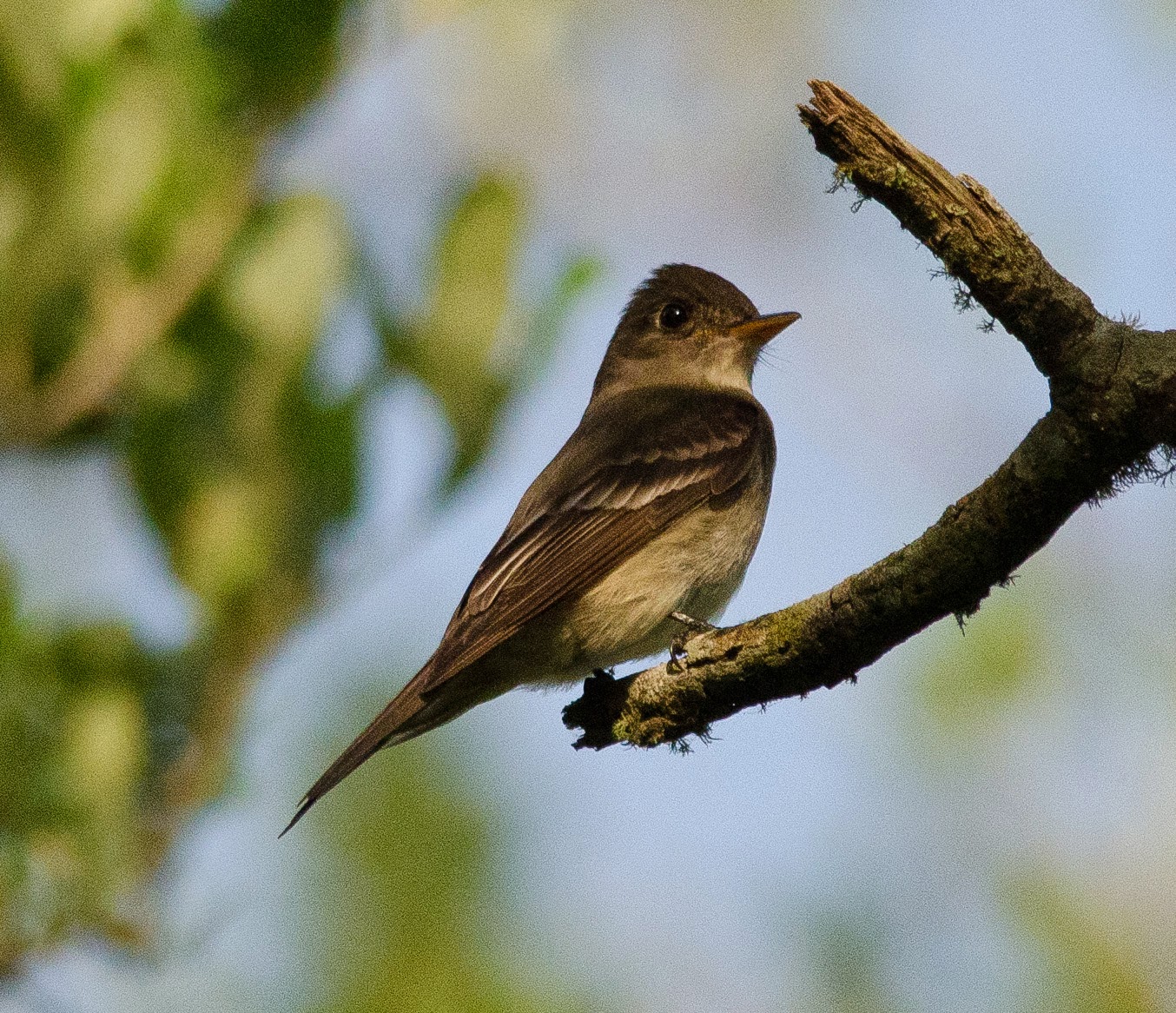
The rest of the birds that I had the pleasure of seeing were the smaller passerines or song birds.  Some were difficult to photograph as they were most often in the deep shade of the trees, or a bit too far for good focusing.  They include a male American Redstart, a Black-throated Green Warbler (new life bird), Common Yellowthroat, Eastern Wood Pewee (new life bird), Indigo Bunting female, Painted Bunting, Rose-breasted Grosbeak (new life bird), Scarlet Tanager (new life bird), and a Tennessee Warbler (another new life bird).

 American Redstart

 Black-throated Green Warbler

 Common Yellowthroat

Eastern Wood Pewee

 Indigo Bunting - Female

 Painted Bunting - Male

 Rose-breasted Grosbeak - Male

 Scarlet Tanager - Male

Tennessee Warbler

This day of birding has to be split up into 2 different posts due to the sheer numbers of birds.  The next part will focus on water birds as one of our trips involved a coastal trip and some great birds near water and also my visit to the Smith Oaks Rookery on High Island later in the afternoon.  I ended up with 14 new species of birds for this day, so it was really quite awesome!


Saturday, May 3, 2014

Texas: The Beginning

About a year ago, a great birding friend, Muriel Neddermeyer, returned from a birding trip to the coastal areas near Houston, Texas and brought back some incredible photos of some very different and unique birds.  I was so impressed that I decided to make the same trek myself this year.  The area is highlighted by High Island, the Bolivar Peninsula, and Anahuac National Wildlife Refuge. Timing is crucial for the most birds.  April and early May are the best times for migrating birds especially warblers.  Many of these migrants are flying straight from the Yucatan Peninsula in Mexico over the Gulf of Mexico and the first land fall is around High Island.  Of course birding is great there throughout the year, so any time is great.  

I arrived on Sunday shortly after noon and was greeted by humidity and very strong winds blowing out of the south.  These winds prevailed for all of Sunday and Monday which does affect the birding prospects a bit as a strong southerly wind helps to push those migrants further inland before making landfall.  So the weather plays a big part in a person's birding chances.  Sunday afternoon I spent driving some roads hoping to maybe find some Swallow-tailed Kites, but the wind made those chances pretty slim, but I did settle for a nice Red-shouldered Hawk on Highway 90.  This is a bird I have seen in Arizona, but it is not common there, so being able to get a fairly decent photo was a good start on a bad weather day.  Even the hawk was having trouble balancing itself against those strong southerly winds.

 Red-shouldered Hawk

Red-shouldered Hawk

I was staying in the town of Winnie, TX, so I checked in and then ventured out to drive some of the roads near there.  I came across a few parked cars of other birders that were scoping a flooded field and thankfully a couple of them were gracious enough to allow me to view through their scopes, where I picked up life birds #1, Buff-breasted Sandpiper and #2 American Golden-Plover.  Number one was too far out to get photos and number 2 was not much better, but at least good enough for ID purposes.

American Golden-Plover on the right; Semipalmated Plover on the left

After I left the group, I continued driving the roads and in doing so I found a couple of birds that I recollect from my youth on the farm in southwestern Nebraska; the Eastern Kingbird and the Scissor-tailed Flycatcher.  It was very exciting to see both again after such a long time.  The Scissor-tailed Flycatcher I had only seen once on the farm and it left a very vivid memory imprinted in my brain.  As it turned out I saw several of these magnificent birds during my stay in Texas.  

 Eastern Kingbird

Scissor-tailed Flycatcher

At other places along the road I discovered life birds 3, 4, and 5.  Number 3 was the Orchard Oriole and number 4 was the Boat-tailed Grackle.  Although I did not get photos at the time, before my trip was over I was able to photograph both of these birds in other locations.  Number 5 was the Common Nighhawk and this sighting really got me excited as it was a bird that I finally wanted to add to my list with full confidence that is was a Common Nighhawk and not a Lesser Nighhawk, which is very similar but also much more common in Arizona.  This bird was in-flight and calling its single note call that is unmistakable.  

Common Nighthawk

One last photo for this half day of birding was one of a Cattle Egret.  Another bird that is not new to me, but not overly common in Arizona, but this one is showing off some of its breeding plumage which makes it much more colorful.

Cattle Egret

So the beginning which really only consisted of about ½ day came to a close and knowing that the next day would be a full day of birding was very exciting.  Getting 5 life birds on the first ½ day was definitely a good start even if the weather did not cooperate so well.  Much more to come!


Monday, April 21, 2014

Fire & Ice

Title of this post is probably a bit melodramatic, but after reflecting on this adventure, it did seem a bit apropos.  On Saturday April 19th, I had the pleasure of birding the Pinal Mountains with a couple of  friends that just happen to be excellent birders as well; Marceline VandeWater and Muriel Neddermeyer.  The Pinal Mountains are located just south of Globe, Arizona which is about 1½ hours from Mesa.  This is another great spot to visit in the middle of the summer when the heat of the lower elevations is stifling.  Temperatures can be 30 to 40 degrees cooler around the summit.  Before the day was over we would see and drive in falling snow and at least one of us ended the day in shorts sipping a beer on a patio in sunshine and heat.  It made for an interesting day.

We starting listing birds on the south edge of Globe en-route to the summit and back.  For the day we ended up with a total of 75 species of birds, so we were not disappointed.  Warblers were part of our main objective and we managed to see 10 species of warblers, but with overcast skies and the typical frenetic feeding habits of warblers, photos were a bit tough to capture.  But at least one warbler must have felt a bit sorry for me and offered some photos and this was the Olive Warbler.  This is a bird I have seen briefly about 4 times, but have never been able to acquire a decent photo and on this day a very stunning male was fairly cooperative even with the bad lighting.  When I get a decent photo of a bird like this, it is almost like seeing it again for the first time.

 Olive Warbler

Olive Warbler

At the very same spot, we had a couple of Red-faced Warblers also make a showing and these birds are also stunning.  What is interesting is that both of these warblers have ranges pretty much restricted to Arizona and New Mexico in the United States.  The Olive is a resident bird and I have seen them in snow, but the Red-faced is a summer resident only, spending its winters is southwestern Mexico.

 Red-faced Warbler

Red-faced Warbler

We also observed 4 species of vireos on this trip; Plumbeous, Cassin's, Gray, and Warbling Vireos.  Of these birds, I was only able to capture photos of 2 of them, the Cassin's Vireo and the Warbling Vireo.  

 Cassin's Vireo

Warbling Vireo

Photos are not always a given, never are and never will be, but it just adds to the chase when finding birds.  Just getting out and enjoying the birds, their songs and their wonderful and refreshing habitats is what it is all about.  Even with snow falling on our road with thunder and lightening being seen and heard, we definitely had a lot of fun and are already planning another trip in the near future.  Oh yes, did not want anyone to think the snow was a fabrication to embellish the post, so I have to add a couple of photos of the vehicle and the road.  Photos courtesy of Marceline VandeWater.  Have to thank her for offering them for use in my blog post and for thinking ahead and jumping out to capture a couple of shots.  (Aren't the pine trees along the road gorgeous?)

 Yep, this is snow!


An Early Spring Visit to Mr Ord

On April 12th, I ventured out to visit Mt Ord for an early spring bird outing and hike.  This is a spot that I have come to love to visit as it is the highest elevation in Maricopa County and much of it lies within Maricopa County while part of it also lies in Gila County.  I discovered this place only because of a great website designed by a good friend and great birder, Tommy DeBardeleben.  His website was my primary tool for birding Maricopa County when I first became very active in birding in Arizona.  First couple of visits to this place by myself and I will admit that I was a bit timid about wandering around up there by myself, but now, I feel quite at home and very comfortable.  A great place to get away and enjoy some solitude and some great birds.  The elevation of this wonderful spot creates a whole new habitat not found elsewhere in Maricopa County.  The pine forests are a breath of fresh air.  On this trip I devoted most of my time to the 1688 trail which is totally in Maricopa County.  

Warblers were my main objective and they did not disappoint.  By far the most numerous species was the Black-throated Gray Warbler and was basically what I expected.  Par for the course, warblers are one of the trickiest group of birds to photograph as they are usually quite energetic and many species can be only found high in the trees.  With all the pine needles around this bird, I was quite surprised to actually capture a couple of view-able photos.

 Black-throated Gray Warbler

Black-throated Gray Warbler

I also had Grace's Warblers and Painted Redstarts, but they proved to be much more difficult and did not allow any photos.  A Virginia's Warbler did allow some photos but made it a bit trickier.

 Virginia's Warbler

Virginia's Warbler

It seems that I am always learning something new about birds on just about every outing, even on places I have visited frequently and this day was no exception.  The 1688 trail is rather unique in that it passes through tall Ponderosa pines, but is also on the upper reaches of the desert scrub oak, so it is kind of on the fringe of 2 different habitat zones.  Along this road I had several Black-chinned Sparrows and a few Gray Vireos.  Normally I stop at points lower on the mountain to observe these birds, but this time I was finding them in this higher elevation.  At least 2 Gray Vireos made themselves seen, not necessarily providing the best pose for photos, but just seeing them is very positive.

 Gray Vireo

Gray Vireo

A couple of other very numerous species were the Spotted Towhee and the Blue-gray Gnatcatcher.  Both species do breed in these habitats, so seeing them and hearing them throughout the hike was very much welcomed.  

 Blue-gray Gnatcatcher

Spotted Towhee

One last photo to share is my FOS (first of the season) Broad-tailed Hummingbird, which is a hummer usually found in higher elevations in Arizona.

Broad-tailed Hummingbird

This place is always a fresh new place to visit after spending so many birding excursions in and around the Phoenix desert spots as the variety of bird life is very different and such a great change.


Wednesday, April 9, 2014

Sunflower, AZ

A few weeks ago, I was contacted by a birder, Dwight Molotsky, from Pennyslvania about birding in and around the Phoenix area.  He had contacted me through the Birdingpal website:  http://birdingpal.org/  as he was going to be visiting the Phoenix area for a couple of day in early April and was wanting to discover some new birds in Arizona during his short visit.  First few days were spent in the Tucson area and when he arrived in the Phoenix area, I decided that maybe the spot on the map know as Sunflower might be the best bet to get the most birds for his one day adventure.  This place is about an hour northeast of the Phoenix metro area off the Beeline Highway.  Since this was the beginning of the migration season I had high hopes in finding some good birds for him and at the same time give good enough looks for a few photos and also allowed for a little bit of behavior observation as well.  

Shortly after we pulled off the highway we saw a fairly large flock of birds and discovered they were Cedar Waxwings. They had landed in a leafless tree and were taking turns about 2 or 3 at a time flying to a nearby Juniper and feeding on berries.  I have seen these most handsome birds many times and always get a big thrill every time I see them, but this flock was the largest I have ever seen.  I counted 43 of them and think I could only capture about 35 of them in one photo frame.

Cedar Waxwings

Slowly we made our way to the dead end where we parked the vehicle and then started walking on the paved barricaded road.  All along the way we were adding new life birds to Dwight's life list.  We had a fly over Common Black Hawk, many singing  Bell's Vireos, a lone Eurasian-collared Dove and a lone Inca Dove, Cassin's Kingbird, several Violet-green Swallows, several Lucy's Warblers, a couple of Canyon Wrens, and a bright red male Vermilion Flycatcher.  Further up the road we found the 2 resident Zone-tailed Hawks that were soaring the thermals and have not yet started the nest building process yet for the year.  

Zone-tailed Hawk

A couple of Red-tailed Hawks were in the area as well but at a higher elevation in the sky.

Red-tailed Hawk

The bird that gave us some of the best views was a stunning male Hooded Oriole.  He did not want to face the camera for us, but at least continued to forage in the same tree giving us a lot of time to enjoy him.

 Hooded Oriole

 Hooded Oriole

Hooded Oriole

With our time running short, I decided to make a short trip about 3 miles further north to the Mt Ord turnoff.  Great place for Black-chinned Sparrows and Gray Vireos in breeding season.  While we did hear one Gray Vireo calling down one of the canyons, it would not show itself, but one of the Black-chinned Sparrows gave us some great looks.

Black-chinned Sparrow

If I remember correctly, Dwight was able to add 11 new life birds to his list.  It is a lot of fun to show out of state birders some new life birds to add to their lists.  I know that I have been in reversed roles and I am always happy when I am in a new place and some of the locals help to show me around.