Costa's Hummingbird

Costa's Hummingbird

Tuesday, December 24, 2013

Santa Cruz Flats

About midway between the cities of Phoenix and Tucson lies an agricultural area in the flat open desert.  The Santa Cruz River that originates in extreme southern Arizona flows south for a ways into Mexico and then turns northward and flows back into Arizona and eventually makes its ways to this flat expanse of desert.  This river is dry in most places, but water does flow when there is adequate rainfall, but by the time it reaches the 'Santa Cruz Flats', it quickly dries up.  This area is well known for the abundance of birdlife and most of this can be contributed to the agricultural development in this area.  If not for this development, this would be a very dry desert area and not very hospital to most avian life.  In the winter, many specialty migrants show up to spend their winters here. 
 
About a week ago another birding friend, Jason Morgan contacted me to see if I would like to travel to this area to look for some specialty birds.  I was more than happy to take him down there.  For a person to travel there on their own for the first time, it can be a bit daunting as the network of roads can be a bit confusing and knowing where to look for certain birds does take a bit of getting to know the place.  Even after several trips to this area, I still find more roads to explore.  One of the first birds we discovered was a nice Ferruginous Hawk in the early morning light.  This one seemed unbothered with us and let us take photos from the vehicle, in fact we were almost too close.  This bird was a great start for the day.
 
Ferruginous Hawk
 
We also had a Prairie Falcon in the early morning, but it definitely did not want its photo taken, but the second one we found later in the morning was a little more accommodating.  But even then, it did not allow us to get too close.  Prairie Falcons seem to be one of the most wary of all the raptors.
 
Prairie Falcon
 
By far, the most numerous of all the raptors we found was the Red-tailed Hawk.  Here is just a sampling of a few of them.
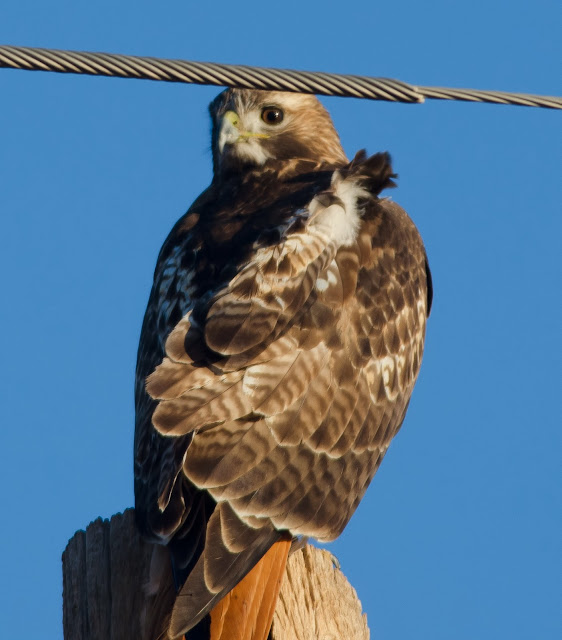
 
 Red-tailed Hawk
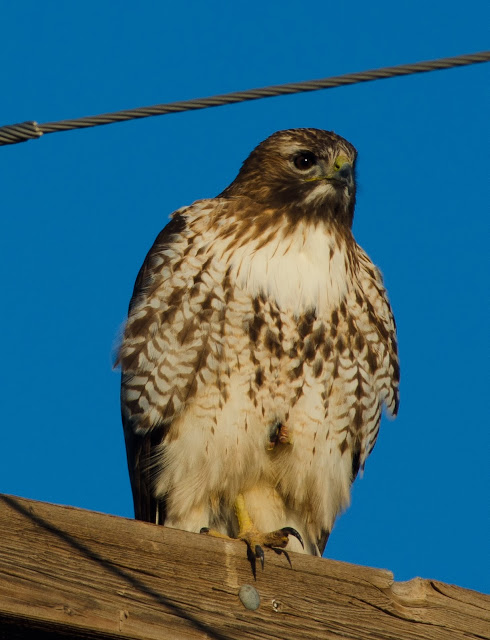
 
 Red-tailed Hawk
 
 Red-tailed Hawk
 
Red-tailed Hawk
 
Our target bird for Jason, was the Crested Caracara.  This is an area that they can be found with regularity and after driving to the places where I normally found them in the past and coming up empty, I was starting to think I had failed to find them.  I had known that it was common for them to hang out with Common Ravens and had advised Jason of that fact.  Finally we came to an intersection and got out of the vehicle to scan the fields and sure enough, Jason was quick to spot some far off in the distance.  Most of the farm land in this area is posted and this presents a bit of a problem in getting close to these awesome birds.  We traveled around to the far side that got us a bit closer and was able to at least get better views, but even then they were probably still ¼ mile away.  Photos were not meant to be this time, so I made a feeble attempt to at least try,
 
Crested Caracara
 
We then worked our way up to the sod farms where wintertime can bring Mountain Plovers to the state of Arizona.  These are birds that most people would think love to be near water and most plovers are found near water.  Quite contrary, the Mountain Plover likes to nest on short grass prairies, especially near Prairie Dog towns.  They breed on the high plains of North America from southern Alberta and Saskatchewan south to northern New Mexico and Texas.  They are not a common bird and their numbers are being monitored due to loss of habitat on their breeding grounds.  It is a bird that many birders love to find as they can be difficult to locate.  Jason and I were fortunate to find 6 of these, but they were even further away from us than the Caracara.  Once again, I still took some photos just for documentation purposes.
 
 3 Mountain Plovers
 
Mountain Plover
 
As we were leaving the field where the Mountain Plovers were located, Jason and his sharp eyes noticed a Burrowing Owl along the side of the road on his side of the vehicle.  We parked right there in the road and watched and photographed this character for some time.  It was probably the most cooperative of all the birds we saw on this day.  By the looks of the pellets outside his 'burrow', it appears to be finding plenty to feed on in this area.
 
 Burrowing Owl
 
Burrowing Owl
 
Our last stop was at Arizona City Lake just to check out the waterfowl that might be there.  Here we found some Eared Grebe and it was nice to compare them to the Horned Grebe that I had seen recently in Chandler.  Very good comparison which helps to make future identifications much easier. 
 
Eared Grebe
 
Another great day of birding and sometimes the fun is in the hunt for those special birds that you know are there and then when you find them, it is quite gratifying.


Wednesday, December 18, 2013

Boyce Thompson Arboretum - Another Rarity

After such a great day on Saturday and chasing some rarities, I figured that my odds of anything special on Sunday were just about nil.  But there had been a few reports of a Varied Thrush at one of my most favorite spots, Boyce Thompson Arboretum which is only about 45 minutes from my house.  So it was not hard for me to decide to check it out, because of my love for this place.  I arrived about 15 minutes early before they had opened the gates, so I parked my vehicle on the opposite side of the highway near the gate and of course got out of the car and started enjoying the birds that were found just along the road.  The star of the road side was a male Pyrrhuloxia that paid a visit to me.  Often nicknamed the 'Desert Cardinal', it is a bird that I do not see as often as I would like.  What a great way to start my Sunday adventure!
 
Pyrrhuloxia
 
While wandering around and looking for the Varied Thrush, I realized that this location had become a hotbed for another species of thrush, the Hermit Thrush.  They were everywhere and even though they are not the most colorful of birds, they are always a delight to see.  Not as flighty as the warblers, but can be sitting on a branch watching you and you could look right past them.  They do blend in with their surroundings quite well but they are so stately sitting on a perch. 
 
 Hermit Thrush
 
 Hermit Thrush
 
Hermit Thrush
 
Of course there were other birds to entertain me while searching for my target bird.  There were many Spotted Towhees, but they did not want to show themselves so I settled for some photos of a female Northern Cardinal and a Curve-billed Thrasher.
 
 Curve-billed Thrasher
 
Northern Cardinal-Female
 
With the help of some others, we knew the vicinity where the Varied Thrush was hanging out and with the help of Bernie Howe, I finally camped out where he had seen it earlier and we waited.  Patience and silence really paid off as it came into view foraging in the fallen leaves from the colorful deciduous trees in the area.  The colors of this bird blended in so well with the leaves.  Success on this find as well.  This is a bird that breeds in the far northwest of the United States and extending all the way to Alaska.  But in the winter some of these birds can wander far and wide, and this one definitely wandered quite a distance.
 
 Varied Thrush
 
 Varied Thrush
 
Varied Thrush
 
I figured my day was now complete and I could start making my way back to the visitor center, but along the way, I met a couple of other birders and they mentioned that they had seen a male Williamson's Sapsucker earlier in the picnic area. Well that peaked my interest as well as that is not a common bird to be found.  So Bernie and I headed to the picnic area to try to find it and a couple of other birders from Idaho arrived just before us and had already found it in one of the pines in the picnic area.  Last spring a female had made BTA its home for a couple of weeks and it drew many birders in to take a look.  This time it was a male and was about 35 feet up in the tree. 
 
 Williamson's Sapsucker
 
Williamson's Sapsucker
 
Another successful trip to Boyce Thompson Arboretum.  I love this place and will go back often.  Its a membership that is a worthy investment.


Tuesday, December 17, 2013

Headin' South to Chase Rarities Again

Late last week, I was contacted by the 2 other 'Phoenician Kingbirds' about heading south to the Tucson area on Saturday to chase some rarity warblers. Yes, we kind of come up with a nickname for the 3 of us, Tommy DeBardeleben, Mark Ochs and myself.  Tommy and I met Mark at Picacho Peak and we headed straight to Reid Park and our first stop was the pond behind the Hardesty Building where a female Black Scoter has been residing for over 2 weeks.  I had seen it once before with another birder friend, Chris Rohrer, but it was not very cooperative with us, staying in the far shadows of the back part of this fenced in pond.  This time we had a bit of better luck as it swam out into the central part of the pond and we got some really good looks at this rather odd duck.  Scoters are diving sea ducks that have short necks and breed in the far north.  There are 3 species of scoters, the Black Scoter, the Surf Scoter and the White-winged Scoter and they are uncommon in Arizona as migrants.  Strangely, I have seen all 3 species in this desert landlocked state of Arizona.  Who knew?
 
 Black Scoter
 
Black Scoter
 
Next we ventured to another part of Reid Park to try our luck at finding another rarity, the Pine Warbler.  All I can say is that I am really lucky to have had some expert birders with me along with another couple that was there also searching for it.  We knew it was not going to be in its bright breeding coloration, but this turned out to be one of the dullest and drabbest warblers I have ever seen.  It was hanging out with a large flock of Yellow-rumped Warblers, and it was pretty difficult to pick it out amongst the Yellow-rumps.  Someone had left remnants of a cake on one of the benches by the playground equipment and all the warblers (and a Gila Woodpecker) were very busy pigging out on the cake.  This was probably one of the most disappointing new life birds that I can recall.  Now I am going to have to head to the eastern part of the US to see one in breeding plumage.
 
 Pine Warbler
 
 Pine Warbler
 
Gila Woodpecker, pigging out on some cake
 
Had a couple of Vermilion Flycatcher females entertain us in the park, plus I had to take a side trip to one of the ponds to check out water birds such as a Snowy Egret and an American Wigeon. 
 
 American Wigeon-Male
 
 American Wigeon-Female
 
 Snowy Egret
 
Vermilion Flycatcher-Female
 
From there we headed to the Tanque Verde Wash in Tucson to try and locate another warbler that is rare for Arizona, the Magnolia Warbler.  This is a bird that breeds in the far north, especially Canada and into northeastern United States.  Well this one turned out to be fairly easy to find as it was still hanging out right where several others birders had seen it and reported it.  And for all the drabness that the Pine Warbler provided, this one made up for it quite quickly.  A very stunning bird and this one showed off its flashy tail several times for us. 
 
 Magnolia Warbler
 
Magnolia Warbler
 
So far we were doing quite well, so on the road to our last target bird, we made a brief stop at Evergreen Cemetery in Tucson to maybe find the Greater Pewee that has been living there for the past few weeks.  This is a bird that should be spending its winter much further south down in Mexico.  This time we were not so lucky, but we know it was still there as it had been reported earlier in the day by others, but since we were short on time we needed to move on, but before we left we had a nice Merlin pay us a visit right above us along with several Northern Flickers.  What was cool to discover was that one of the Northern Flickers was a 'Yellow-shafted' form.  The yellow-shafted is the form most generally found in the eastern part of the US while the most common form we get in Arizona is the red-shafted.  While it is not considered a separate species, it is always nice to see and document an unusual bird for the state.
 
 Merlin
 
'Yellow-shafrf' Northern Flicker
 
Our last target bird was a Louisiana Waterthrush which has been spending it's time on the Santa Cruz River near the Ina Street bridge.  Yes, we found it by is distinct chip note and caught some brief glimpses of if as it flew from one area of dense vegetation to another.  Alas, no photo opportunities were going to happen on this day.  But that just gives me another new goal, get a photo of one!
 
After dropping Mark off at his vehicle, Tommy and I head north and made a brief stop at the Veteran's Oasis Park in Chandler to check out the Horned Grebe that was found a couple days earlier.  It was not hard to find this handsome small bird on the fishing lake and I was surprised at the distance it would travel under water when it would make a dive.  You never knew where it was going to surface.  This spotting helped me reach a milestone of viewing all 7 species of United States grebes in Maricopa County in Arizona.  This was considered almost impossible until last January when a Least Grebe was found in a small pond in Chandler Heights.  That bird was way far north of its range and allowed several birders to hit that milestone back in January.  I had seen the Horned Grebe in Lake Havasu before, but this was my first viewing in Maricopa County.
 
 Horned Grebe
 
Horned Grebe
 
Once again a very successful trip and I have to give thanks to Tommy and Mark for helping me to achieve more birds to my lifetime list.


Saturday, December 7, 2013

Way Out West

On Friday November 29th, birding friend, Chris Rohrer ventured up from Tucson to the Phoenix area to spend a day of birding in the far western reaches of the 'West Valley' near Phoenix.  The area is a vast area that extends from the infamous 'Thrasher Spot' to the agricultural fields of Arlington and Buckeye.  In the winter this can be very productive for finding many migrant birds as well as some resident birds.  Our first stop was the Thrasher Spot which is famous for being probably the most reliable spot to find the fairly uncommon Le Conte's Thrasher.  We came to this spot in the hopes of finding both the 2 new sparrow species which were a result of the AOU making a split on the old 'Sage' Sparrow.  The 2 new birds from this split are the Sagebrush Sparrow and the Bell's Sparrow.  While we struck out on the Bell's Sparrow, we did find and observe several of the Sagebrush Sparrows which are most likely the most common of these 2 species to be found here.
 
Sagebrush Sparrow
 
We also dipped on the Le Conte's Thrasher this time, but will try again maybe when breeding season approaches.  As a consolation, we did see a few Bendire's Thrashers and one of 2 Crissal Thrashers put on a singing show for us and allowed us some great looks.  Most thrasher species can be quite secretive and elusive, so when one does land at the top of a tree and starts singing, it can be quite moving as most of their songs are quite melodic. 
 
Crissal Thrasher

Crissal Thrasher
 
From the Thrasher Spot, we hit the roads by first heading down towards Arlington.  Had intentions of taking Chris to the Arlington Ponds, but the road was very muddy and rutted, and we though better of that idea.  But we had many birds along the road including the American Kestrel.  We counted over 20 of these birds along the road.  This bird is our smallest and most common falcon in the United States and in the winter they can be found in high numbers in Arizona.
 
American Kestrel
 
We also had the great fortune of finding 2 Ferruginous Hawks along the roadways which is another winter visitor to our area and one that many birders love to find in Arizona.
 
Ferruginous Hawk
 
Other birds included a Greater Roadrunner, (no photos), a few Savannah Sparrows, a few Western Meadowlarks, and at one farms with a corral, a huge flock of Red-winged Blackbirds with some Brown-headed Cowbirds in the mix.
 
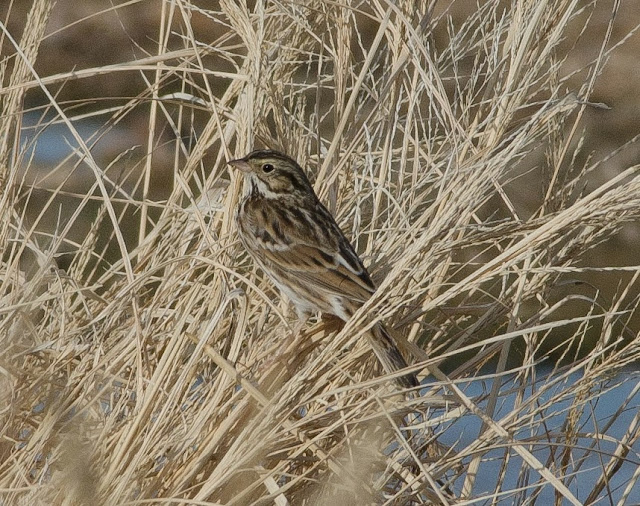
Savannah Sparrow

Western Meadowlark

Flock of Red-winged Blackbirds and Brown-headed Cowbirds
 
 Finally we arrived at the Lower River Ponds which Chris had never seen and we were amazed by the sheer number of American White Pelicans that were there.  We counted over 140 and a week later another person counted over 250.  This photo only shows a small portion of these magnificent birds that were located there and if one looks closely you will see 2 Snow Geese in the middle.  Looks like midgets among the giants!
 
American White Pelicans and Snow Geese
 
Snow Geese
 
 American White Pelican
 
American White Pelican
 
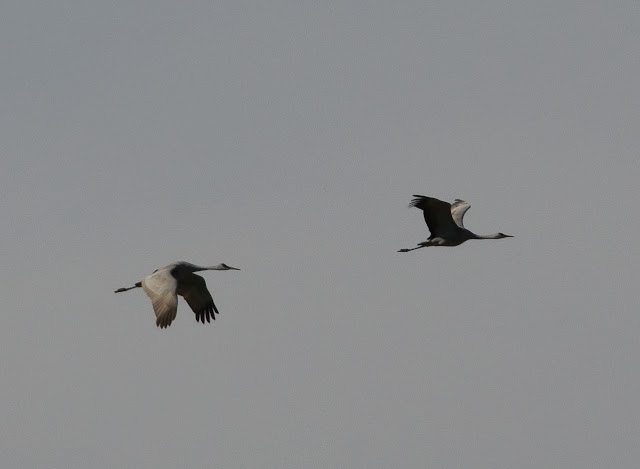
While we were astounded by the number of pelicans, we also noticed large numbers for Great Egrets and Great Blue Herons on the banks on the opposite sides and in the fields back behind and to the south of the ponds and mixed in with those Great Blue Herons was a sprinkling of Sandhill Cranes.  There is a small contingent of these magnificent birds that spend their winters in the vicinity of Maricopa County.  While they were quite a distance from us for photos, they eventually took flight and when seen flying, they do not even resemble the herons.  Very easy distinction.
 
Sandhill Cranes
 
The ponds were also visited by a juvenile Bald Eagle flying over the ponds that made many of the waterfowl take flight.  While the sun was in the wrong place for photos, it was still quite interesting to see a Great Egret and the Bald Eagle in the same frame.  No, the eagle or the Egret were chasing each other; they just happened to be in the same frame at the same time.
 
 Bald Eagle and Great Egret
 
 Bald Eagle and Great Egret
 
Bald Eagle and Great Egret
 
What a wonderful place to visit for birds in especially in the wintertime in Arizona.  With the milder weather this state has to offer, we get the opportunity to see many wonderful birds that like to make their winter homes in Arizona.