Costa's Hummingbird

Costa's Hummingbird

Sunday, September 15, 2013

Not Again! (Yes, another post on Pima Canyon Wash)

This will be the last post from this location for awhile.  Been hitting this trail kind of hot and heavy recently for a couple reasons.  1. I need to get myself in shape for an upcoming hike to Tom's Thumb which is a bit more strenuous as it has an altitude gain of almost 1100 feet which can be a bit of a challenge.  2. I have recently found some new and incredible birds at Pima Canyon Wash that make me want to go back to check them out a bit closer.  One of those birds is the Common Poorwill which is one of those nocturnal birds belonging to the family of Goatsuckers.  A week ago I arrived very early, before the sun was up and I heard a bird calling from up on the banks of the canyon that I was unfamiliar with.  I narrowed it down to one of the species in this family since it was nocturnal and calling while it was pitch black out and after listening to the Common Poorwill's call, I knew immediately what it was.  I had never encountered this bird there before, but then I have never went birding out there in the dark.  There is a good chance that this species has been there all this time and perhaps even breeds in this location.  Since then I have gone out while it was dark in hopes of actually finding one.  That is going to be a tough mission to accomplish as they sit on the ground or rocks in the daytime, completely motionless and they blend in so well you would never see them unless you stepped on it.  

This morning my mission was early again to try finding the Common Poorwill and sure enough I heard them calling again, but no sightings.  Then I also heard two Western Screech Owls calling their soft hooting calls.  I actually saw one of these in the dark fly to a nearby tree, but I was never able to get my flashlight on it for viewing or a photo.  So these two species has rekindled my interest once again for this area.  On this day, I deviated off onto another drainage wash that I had never hiked before and found out that it led to some incredible new areas that is definitely worth exploring more in the future.  Another positive note to this hike today, is that when I checked the Great Horned Owl roost, we now have two owls, not one.  Maybe it is the same pair that raised young for 2 years in row in 2010 and 2011.  I don't think most hikers are even aware that these magnificent birds are perched in the rocks every day.

Great Horned Owls

One of the most common birds in this habitat is the Black-throated Sparrow.  It is so common that I have gotten pretty good at identifying it by its single note chip call.  I hear them constantly, but do not always see them as they have a tendency to forage on the ground and they blend in well with the rocks, gravel and vegetation fairly easy.  Today, very in early in the morning, one of them presented itself on a rock for me.  One has to agree that this is one dapper looking sparrow with that black bib and contrasting facial markings.

Black-throated Sparrow

A Gilded Flicker flew into my area just long enough to snap off a photo.  This is another bird that most of the time I will heard off in the distance and not see it.  To have one come in close enough for a photo is always a plus.  In this photo, the yellow coloring on the underside of it primaries can be seen along the edge of the wing.  This is one of the key identification marks on this bird.

Gilded Flicker

Another bird that I have noticed more frequently in the past few weeks is the Phainopepla (otherwise known as one of those 'P' birds in Arizona that is hard to pronounce, the other being the Pyrrhuloxia!).  I have seen Phainopepla in this canyon before, but they are not very common, and I am not totally sure why as there seems to be an abundant supply of mistletoe, which is one of their foods sources.  Maybe they are starting to expand their range into this area.  Always a great bird to see.

Phainopepla

Found two species of raptors today; a Red-tailed Hawk and a pair of American Kestrels.  The Red-tail was a fly over and while the photo is not a great one, it does point out a couple of the key identification marks.  Notice the belly band of dark feather across the middle of its belly, and also note the dark patagial bars on the front edge of the underside of its wings.  Key marks in most of these birds, however there are a few color morphs where these markings cannot be seen.
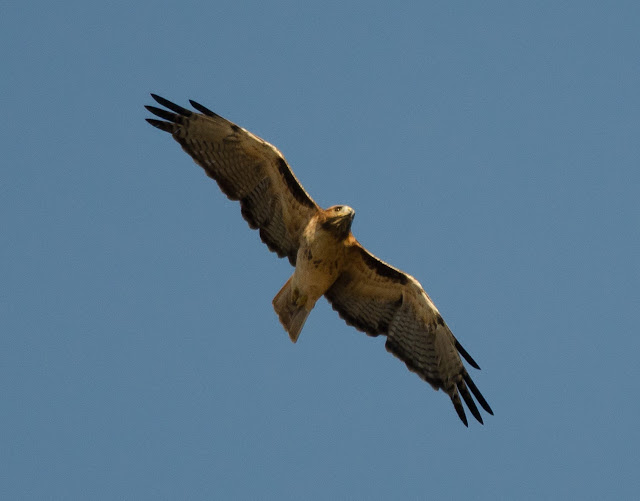
 Red-tailed Hawk

American Kestrel

On my return, I discovered a Black-headed Grosbeak and for once it wasn't quite so skittish and came out into the open for some photos.  Yes, it still preferred to stay in the shade, but with this bird I will take any photo I can get.  You can definitely see how this group of birds got their names 'grosbeak'.  That is one massive beak on a bird this size.

 Black-headed Grosbeak

Black-headed Grosbeak

But the day probably belonged to the Rock Wrens.  They were quite common and calling from the hillsides and deep in the wash, I found a pair that I think might be preparing to breed once more as they were favoring a rock crevice and watching me with interest.  The recent monsoon rains will often set in motion another breeding cycle for many birds.  In one of my photos I discovered an Ornate Tree Lizard trying to get in on the act.  Funny part was that I had no idea it was there until I started processing my photos at home.

 Rock Wren

 Rock Wren
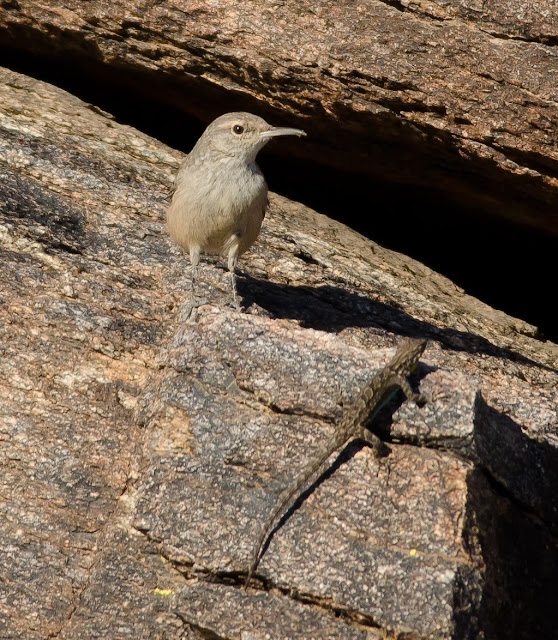
Rock Wren with Ornate Tree Lizard

One bird photo then a couple more of non-avian critters.  Of course there is always Black-tailed Gnatcatchers and of course I am always taking photos of them, so anyone can skip over this photo if they are tired of seeing photos of this bird.

Black-tailed Gnatcatcher

Saw lots of lizards during the hike, but this time I caught one in the action of feeding on a bee.  It is not often I see a lizard with prey.  This is a Common Side-blotched Lizard that caught a bee and I think the bee lost.

Common Side-blotched Lizard with prey

And finally I found a Coyote that did not even pay attention to me.  Not sure if it knew I was around or not, but it was slowly working its way up a secluded wash very leisurely, but never once turned around to even stare at me.

Coyote

Tomorrow is a different destination and next weekend who knows where I will venture.  


Thursday, September 12, 2013

Boyce Thompson Arboretum

It has been a while since I visited this wonderful place and when I received an email announcing an impromptu bird walk with some wonderful and excellent birders with AZFO, of course I was going to check it out and see what was new.  The first thing to greet me was the redesigned parking area.  Much more parking spaces and much better defined.  I do miss some of the older trees that were in the original parking lot, but in a couple of years some of the new plantings will make up for the loss.  Since this was a short notice bird walk, most of the people that showed up were members of AZFO and very good and knowledgeable about birds, so I was in very good company.  While the day was cloudy and overcast, the opportunities for photos was not as good as they could have been, so will have to share the few photos that did turn out ok.

I arrived a little earlier than most and I went in and down to the first hummingbird feeder area and I could hear two Yellow-breasted Chats calling but they were not being very active and as usual were hiding in the trees.  Finally caught a glimpse of some yellow and located one.  Of course it was not going to expose itself and make the photo any easier, so I had to be content with what I got.

Yellow-breasted Chat

When walking near the herb garden area a Rock Squirrel carried a fruit from one of the nearby trees up onto a rock and was proceeding to chow down.  Caught it with its mouth open!

Rock Squirrel

Another interesting critter just happens to be an insect, the Tarantula Hawk Wasp.  Only the females sting and their sting is rated as the second most painful sting on the Schmidt sting rating.  Only the Bullet Ant is worse.  I have no desire to test the sting rating, but thankfully, this is not an aggressive insect towards humans.  Females will find a Tarantula and sting it and paralyze it then drag it back to a burrow and lay an egg on the spider.  When the egg hatches it feeds on the tarantula before it pupates. You have to admit, they are rather attractive to look at though.

 Tarantula Hawk

Tarantula Hawk

About 30 minutes before AZFO was to hold their meeting, I took a quick hike up and around the higher trail and found an Ash-throated Flycatcher.  Did not have much more time for birding so headed to the Smith Center to attend the meeting.

Ash-throated Flycatcher

I did take a slight detour off the highway just outside of BTA and traveled to the Picketpost Trailhead.  I always like to stop here when I have a little free time and in my 20 minutes of walking around, I discovered a Cactus Wren gathering grasses.  Not sure if it was going to attempt nesting and breeding again, but it is highly possible as the monsoon rains can do this to many species of birds.  

 Cactus Wren

 Cactus Wren

 This place never disappoints.  We had lots of birds and a large variety of birds, but with the overcast skies and large number of people around, getting photos was a bit more difficult.  But it is not always about the photos, seeing and observing the birds is a enough of a reward in itself. 


Thursday, September 5, 2013

Pima Canyon Wash - Aug 31 & Sept 1, 2013

Last weekend was a long 3 day holiday weekend and not wanting to lose out on any birding opportunities but still stay close to home, I headed out to one of my regular spots, Pima Canyon Wash in South Mountain Park.  I needed a good hike instead of the treadmill at home and the nights have been cooling off ever so slightly and hiking at dawn before the sun rises is definitely doable.  

One of the first birds that I heard and then spied was a Loggerhead Shrike and this was right at sun rise with the full yellow morning glow shining on it.  The photo definitely does not show off its normal colors of black, white and gray, but that black mask is unmistakable.  At one time these birds were nicknamed 'butcher birds', which I think is a bit harsh of a name for them.  True, they can be quite aggressive in searching for and capturing their prey, but lots of other birds do the same thing.  These birds, in spite of their smaller size will take on small rodents and small birds and lizards if they can capture them.  However, their mainstay diet is insects, large and small.

Loggerhead Shrike

Anna's Hummingbirds seemed to be more abundant than ever on this trip.  Trying to capture them in a photo with their full gorget in bright iridescent color is usually quite tough, so I settled for just partial color in this photo.  This bird is quite common at my feeders in my yard, but I usually avoid taking their photos near feeders if I can.  I really prefer to capture them in a more natural setting like this.

Anna's Hummingbird, male

Another little bird that made a very brief appearance was a Pacific-sloped Flycatcher.  It landed on a branch with its back to me and I was able to only snap a couple of shots and then it was gone and I could not relocate it.  It is one of those birds that belong to a family of nearly identical looking birds, the Empidonax Flycatchers, and can be very difficult to identify.  Many times they can only be identified by their call, but when they are silent, (which is quite frequently) then it gets tougher.  This one was a little easier once I could look at the photo.  It has an eye ring, (which most have), but this eye ring is slightly elongated in the rear, which is usually indicative of one of the western flycatchers, the Pacific-sloped or the Cordilleran.  It also has an all orangish colored lower mandible which sets it apart from the others  Both of these birds are almost identical in appearance, but the key to help with the ID on these two is habitat.  Pacific-sloped are found in Arizona only during migration as they breed on the west coast, plus they inhabit lower elevations.  The Cordilleran actually breeds in higher elevations in Arizona and when they migrate they are very rarely found in lower elevations.  So with the lower elevation of this bird, it is a Pacific-sloped Flycatcher.

Pacific-sloped Flycatcher

The stars this day though, were the warblers.  Warblers are not usually found in this location, except during migration as this is not normal warbler breeding habitat.  I was lucky enough to find a pair of Black-throated Gray Warblers on this trip.  I have seen a single bird twice before but at quite a distance.  This time I had to scramble up a couple of rocks and was able to come away with a couple of photos even though I had to try to focus between some sticks and twigs in the foreground and even found it feasting on an insect.

 Black-throated Gray Warbler, with insect

 Black-throated Gray Warbler, with insect

The next warbler that I happened to find was a Hermit Warbler.  This is is a bird I would not normally expect to see at this low elevation and I have only seen this species in Maricopa County on Mt Ord.  I have also seen it in the Pinal Mountains and the Huachuca Mountains.  But this is the first time I have seen one in Pima Canyon Wash, so it was a very pleasant surprise.

 Hermit Warbler

Hermit Warbler

All of these photos so far were taken on Saturday August 31st.  Felt so good to see these cool birds, I decided to return on Sunday morning, September 1st.  And it is quite amazing how different the two days turn out.  

On Sunday, I arrived before the sun even rose and was hiking with a flashlight (have to take heed as those rattlesnakes are a bit harder to see when it is dark).  Shortly into the wash area, I heard a Great Horned Owl calling.  It was too dark to try to locate so decided to check the old owl roosting area in the rock when I returned.  In the meantime, I continued up the wash and this time, I saw no warblers, but much of the regulars, including a couple of juveniles.  Couple of the photos that I liked best were the Black-tailed Gnatcatcher juvenile and a Black-throated Sparrow juvenile.

 Black-tailed Gnatcatcher

Black-throated Sparrow, juvenile

On the return, I did find a Lesser Nighthawk, but alas it did not land for me to capture photos, but it was another nice find as I had not seen this bird in this location before.  Also was able to capture a photo of a Zebra-tailed Lizard and a couple of Rock Squirrels that were climbing in the rocky areas.

Zebra-tailed Lizard

 Rock Squirrel

Rock Squirrel

Finally on my return, I made a special point to search for the Great Horned Owl that I had heard when I started my hike.  Sure enough it was perched where I had seen them about a year ago.  It was great to see one has returned.  Not sure if it was one of the originals or maybe one of the offspring that they successfully raised one of those years, but I hope it finds enough prey so that it stays around.

Great Horned Owl

This just goes to show how exciting it is to go bird watching.  Birds, with their ability to fly, can move around a lot and consequently can show up in different places from time to time.  Already looking forward to the places I will visit this next weekend. 


Monday, September 2, 2013

Mid-week Birding Splurge

Just to be different for a change, I decided to fight rush hour traffic and head on out to the Glendale Recharge Ponds in the middle of the week one day after I left work.  When I left work on a Thursday afternoon, the heavy traffic was just getting started, but I had made up my mind to get out there and see what I could find.  Of course one of my birding friends, Tommy D., had already posted that he had found a Snowy Plover a few days earlier.  Thanks to Tommy, I had seen this bird 2 years earlier for the very first time, so it was not going to be a life bird, but a great bird to find anytime as they are rare in Arizona except during migration, when a few are found at various places.  It was hot and humid, but cloudy and a thunderstorm was quickly building up to the south and appeared to he headed right for the ponds.  Only two of the ponds had water and only one of the two had the right amount of water for this bird.  In the process of searching for this very small plover, I had a group of Western Sandpipers come in close up while I was standing there and of course the camera was in action.

Western Sandpiper

Western Sandpiper

A White-faced Ibis flew in as well and allowed some photos of it as well.  This is a very oddly colored bird and the iridescent feathering can really present a wide array of colors depending on how the sunlight falls on it.  This one even showed a bit of pink in its feathers.

Whitefaced Ibis

Another bird that was quite numerous was the Horned Lark.  Their unique coloring can make them difficult to spot on the soil where they like to reside and many times the best views of one is when it is flying away.  Found a couple that allowed me to approach close enough to capture a couple of photos.

Horned Lark

Horned Lark

Since I was not having much luck finding my target bird, I eventually headed to the other pond and along the way I saw an Osprey take flight on the road and head to the area of the canal.  Since I had decided to pursue the Osprey, I noticed a Red-tailed Hawk at the top of a power pole.  I approached the pole slowly and quietly taking photos along the way.  Finally at the last stop for photos, I could sense it was going to take flight, and it did as I was shooting multiple frames.  I call this sequence:  Ready,   Set,   Go!!!!!

Red-tailed Hawk

Red-tailed Hawk

Red-tailed Hawk

Finally started spending some time at the second pond to try and locate that Snowy Plover, and once again I was striking out.  But I did have a bit of a consolation prize, a Spotted Sandpiper, and for once it was mixed in with some of the other shore birds.  Usually they are relatively rather solitary and keep to themselves.  While my photos were really focused on this bird I found it interesting to share one photo that also includes a Killdeer and a Least Sandpiper.

 Least Sandpiper in front, Killdeer in back, Spotted Sandpiper on the right

Spotted Sandpiper

Also spotted on the edge of this second pond was a Red Saddlebags Dragonfly.  Another new one to me and I had to look it up to identify it.

Red Saddlebags

After scanning this second pond and still not finding my target bird the Snowy Plover and watching the thunderstorm rolling my way from the south, I decided I better start heading for the car which meant I had to walk right past the first pond once again.  As I did this, I heard a Sora calling and decided to see if it might make an appearance by sticking its head out of the grasses.  Naturally that wasn't going to happen, but I scanned the pond one more time and lo and behold, my target bird the Snowy Plover showed itself.  It was a bit of a distance away, and as small as they are they are easily overlooked and I knew immediately when I found it my day was now complete.

And finally I give you the Snowy Plover!!!!

Storm rapidly approaching, I quickly made it to my car and head home in the late afternoon rush hour traffic, but the journey was worth all the traffic frustration.


Sunday, September 1, 2013

Day 2 with Muriel & Tommy

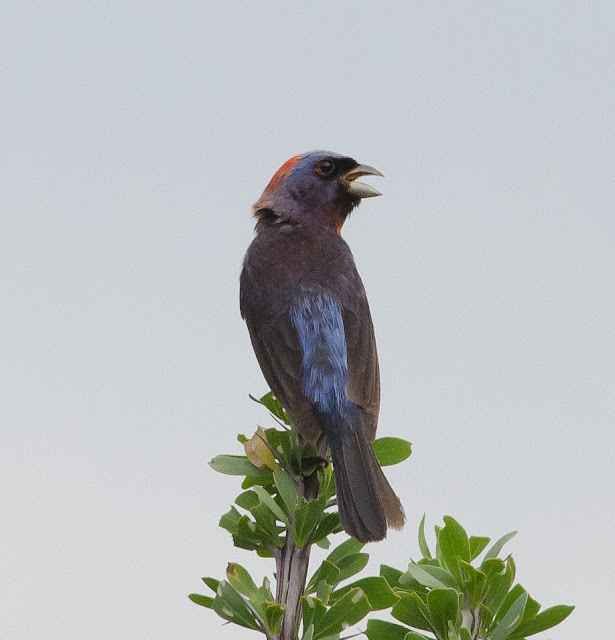
After having such a successful first day of birding in SE Arizona, day 2 started early with a drive to Montosa Canyon which is on the west side of the Santa Rita Mountains.  Our goal at this location was to try and locate another rare bird that a few had seen for a couple of days, a specialty of Mexico, the Yellow-green Vireo.  From the sketchy reports, we knew it would not be an easy find and alas, it is one of the birds we missed.  There were probably another dozen birders also there looking for it and one gentleman had seen it briefly, but we were not so lucky.  We did catch a fleeting glimpse of another rare bird, the Black-capped Gnatcatcher which breeds in this canyon and a couple of other places in Arizona and no where else in the US.  The best bird that we found and photographed was one that we had all seen numerous times before, but it is not one that is easily photographed, the Varied Bunting.  It likes to hide in dense thickets most of the time, but we had some males at this location that were perching high and singing loudly. It unique coloration is also a bit difficult to capture the true colors without the right light.

 Varied Bunting

 Varied Bunting

Varied Bunting

From Montosa Canyon, we then headed to Florida Canyon which is a well known location to find the Rufous-capped Warbler.  Once again we missed this bird, but someone else had been there about 2 hours earlier and got good looks at it.  This is a spiffy little warbler with really good looks and one that I will have to return for in the future.  A great consolation prize, was a beautiful Gray Hawk along the road on the way to Florida Canyon.

Gray Hawk

We wanted to finish the day in Madera Canyon with some of its specialties.  Along the road to Madera Canyon, Muriel knew of a nice little side road to check out and so we checked it out and once again we had Botteri's Sparrows, but I also discovered an adult with a juvenile Rufous-winged Sparrow in the low part of the wash.  Was able to get photos of each and it is always nice to compare the differences between adults and juveniles.

 Rufuos-winged Sparrow, adult

Rufous-winged Sparrow, juvenile

At this same place a Spiny Lizard stuck its head out to check me out and with my zoom lens the photo kind of reminds me of something from Jurassic Park!

Spiny Lizard

One of the keys birds we wanted to find in Madera Canyon was the Sulphur-bellied Flycatcher which is probably the most colorful and interesting flycatcher to be found in Arizona.  It was not a new bird to any of us, but I have never gotten a very good photo of one.  Amazingly, we found a whole family of them; 2 adults and 3 fledglings and even witnessed one of the adults feeding one of the fledglings.  For once I got some decent photos of this wonderful bird.  Their call sounds like a squeaky dog toy, so they are very unique.

 Sulphur-bellied Flycatchers

 Sulphur-bellied Flycatcher, adult

Sulphur-bellied Flycatcher, fledgling

The flycatchers were found just a short distance from Santa Rita Lodge, so it was almost certain that we would spend some time viewing their hummingbird feeders as a Lucifer Hummingbird had recently been reported visiting this place.  Sure enough, it did not take long for this stunning male to show up and make an appearance at the feeders.  We also observed several Rufous Hummingbirds at the feeders.

 Lucifer Hummingbird

Lucifer Hummingbird

Rufous Hummingbird

This last photo of the Rufous Hummingbird also shows that the rain had started to fall, notice the couple of white lines in the background.  With that we bid adieu to Madera Canyon and headed for home.  We had all had a great weekend of birding and the trip home was quite enjoyable.  One last photo to share was a cactus within the shady trees at Montosa Canyon that was covered in blossoms ready to open.  The color was a nice stark contrast to the surrounding shady trees and the beads of dew gave it a cool and inviting look.