Costa's Hummingbird

Costa's Hummingbird

Monday, April 1, 2013

Mt Ord, Number 1 - 30 Mar 2013

Call me crazy, but this last weekend with only 2 days for birding, I went to the same place twice.  Not something that I would normally do, but there were reasons for it this time.  On Saturday, I had made plans to take Scott and Fonda Christopher to Mt Ord to show them around and in the process we also had the honor of being joined by Ellen Hairston and Muriel Neddermeyer.  Thankfully Scott volunteered to drive and I am glad he did as his vehicle has a higher clearance than my car and without his vehicle, we might not have been able to make it all the way to the top.  After we left Mt Ord, we made a stop at Sunflower as well.  The 5 of us had an awesome day of birding!

The day started off very overcast and cloudy and a bit chilly at first, but as the day progressed, we found sunny skies and warmer temperatures.  The first birds in the morning were the Black-chinned Sparrows.  This is perhaps one of the best places to find this species in Arizona, or at least in Maricopa County.  These birds were singing throughout the hills; their song is unmistakable, sounding a bit like a bouncing ball.  Once you hear it, it is easy to remember.  It is also a bird that does not always shows off very well, tending to stay low in shrubbery.  With the overcast sky, photos were a bit tricky, but some got some great photos and my best of the lot is pictured below.  And the Rufous-crowned Sparrows were another of our target birds.  My photo below was taken further on up the mountain, but we also found them at the top of the Mountain.

 Black-chinned Sparrow

Rufous-crowned Sparrow

In the same area where I photographed the Rufous-crowned Sparrow, a pair of Blue-gray Gnatcatchers were actively foraging.  This bird was found and heard at several spots on the mountain.  At only about 4¼ inches in length, they can be difficult to photograph.  Always a challenge, but in this case I think the photos paid off.

Blue-gray Gnatcatcher

Blue-gray Gnatcatcher

We encountered several warblers including the Painted Redstart and Grace's Warbler.  Warblers can also be a challenge to photograph, and my photo of a Grace's Warbler leaves a lot to be desired.  But when they land right above you and it is shady and overcast, sometimes you take what you can get.  The Painted Redstarts for most of the day showed off in the shade on the higher reaches of the trees without much chance for photos.  But I started lagging behind when we were descending from the top and one flew into some dry grasses on the trail right beside me giving me a chance to snap off a couple of shots.

 Grace's Warbler

Painted Redstart

The Spotted Towhees were seen and at this elevation, they also breed here.  Quite a handsome bird even though they also prefer to skulk in the low vegetation.  Even caught one in the act of launching itself into flight.  The Violet-green Swallows were checking out nesting cavities in the trees near the top.  The overcast sky really does not do them justice as they are much more brilliant than the photo suggests.

Spotted Towhee

 Spotted Towhee

Violet-green Swallow

At the very top we found a pair of Hairy Woodpeckers, and par for the course, a twig just had to spring up in front of my camera's field of view.

Hairy Woodpecker


Finally down on the road at Sunflower, we were hoping to find the common Black Hawk along with Zone-tailed Hawk.  We found the latter, but the Black Hawk eluded us.  The Zone-tailed Hawk look a lot like a Turkey Vulture as it soars over the land riding the thermals.

Zone-tailed Hawk

Other birds we found in this area included a Bewick's Wren that presented itself high in a tree for us.  And then 2 'First of the Season' birds made their debut; the Yellow Warbler and the Cassin's Kingbird.  This tells us that migration is in full swing.

 Bewick's Wren


Yellow Warbler

Cassin's Kingbird


Springtime is Arizona is wonderful as the birds return, many of them in their bright breeding plumages. 


Monday, March 25, 2013

'Thrasher Spot' and a bit more - 24 March 2013

On Sunday March 24th, I had the honor to take a couple of gentlemen from Ohio out to the 'Thrasher Spot' west of Buckeye.  Brian and Larry were interested in trying to find some thrashers, Sage and Le Conte's.  We did get a bit of a late start, but we also knew that they definitely would not see either if we did not go.  It was very quiet when we arrived and as we made out way further out in the desert scrub I was starting to think we may have been too late.  But then a male Black-tailed Gnatcatcher made his appearance and that was a new bird for them, so I know it would not be a total loss.  Finally we found some thrashers and 3 of them perched up in a leafless bush and allowed us some time to circle around them for better lighting to confirm that 2 of them were Sage Thrashers, one of the target birds, and the third was a Bendire's.  We knew that none of the 3 were the Le Conte's ase on bill shape and size.  Then as they flew to the ground, we started to follow them as they quickly ran from one desert bush to another, and soon discovered there were more than just 2 and during this time, we actually did catch sight of a Le Conte's Thrasher with its pale coloration and long and sharply down-curved bill.  Unfortunately, it was not going to allow any photos for us this day, so we had to settle for photos of the Sage Thrasher only.  

Sage Thrasher

Not the birdiest spot around, but during our short stay we got 2 of their target birds and a bonus 3rd bird, the gnatcatcher in the process.  From there we took a bit of a detour to the Lower River Road ponds and found a much larger variety of birds.  It was at this place that the Northern Rough-winged Swallows were just being downright passionate about having their photos taken.  So what was I to do?  I just could not ignore them.  It may not be the flashiest or most colorful swallow, but they are one that is very common in Arizona in just about all seasons and one species that a novice birder learns to identify very quickly in AZ.

Northern Rough-winged Swallow

Northern Rough-winged Swallows

 Northern Rough-winged Swallow
Northern Rough-winged Swallow, and we have lift-off!

One more thing that I did early on Sunday before meeting up with Brian and Larry was to scout the Scottsdale Community College for Burrowing Owls.  So I made trip to that location around sunrise and I found my Burrowing Owl and along with that a Gambel's Quail and a Savannah Sparrow in the early light of dawn.  The owl location is needed for a future guest that is arriving to see birds in Arizona.  I know of other locations, but was interested in some place a bit further north to we can hopefully save some driving time and cover more spots.  So here are my photos of these 3 birds in the warm early light of sunrise.

 Burrowing Owl (taken through a chain-linked fence)

 Savannah Sparrow

Gamble's Quail

Another awesome day of birding!


Sunday, March 24, 2013

Santa Cruz Flats - 23 Mar 2013

On Saturday, I was privileged to take part in the AZFO (Arizona Field Ornithologists) Survey in the Santa Cruz Flats area to try and obtain evidence of any possible breeding attempts of the Crested Caracara is this vicinity.  This bird does have a confirmed breeding area in far south central Arizona in the Tohono O'odham tribal lands, so they are considered a resident of the state.  However there numbers seem to be increasing in the Santa Cruz Flats area and are being seen in small numbers in every month of the year in recent years.  The goal of this survey was to divide in to several small teams to research the various habitat areas and try to locate any evidence of breeding in this area.  While no one found any definite proof a lot of data was gathered and several spots were determined to be spots of interest for further observation.  My team consisted of Marceline and Norma and we kind of stumbled upon the jackpot fairly early in the morning, shortly after 8:00 am.  We found a flock of 12 of these interesting birds and as we watched them from a distance, they slowly dispersed a few at a time until they had all left.  Throughout the day, we saw more of these birds, but we cannot be sure if they were part of the original flock or different birds.  Normally they do not allow close approaches to them, so we had to settle for some distance shots.

4 Crested Caracara

 Crested Caracara

Crested Caracara

While the day was focused on the Crested Caracara's, it is hard to ignore the rest of the birds one finds on such outings.  We found several American Kestrels, which is a fairly common bird and our smallest falcon in the US.  I was able to capture photos of both a male and a female of these beautiful raptors.

 American Kestrel - Female

American Kestrel - Male

One more bird that I was able to photograph, but not easily, was a Pyrrhuloxia (aka the 'western cardinal').  This male did not want to make the photography easy on me.  He definitely wanted to stay fairly well hidden and that really makes focusing a tad bit difficult.  But since I had not seen on of these birds in about a year, I was happy to at least see one and ecstatic to actually see 3 of them on this day!

 Pyrrhuloxia

Pyrrhuloxia
 
This was a day well spent with others that are avian enthusiasts and maybe I might have contributed just a tiny bit of information to the avian scientific community.


Monday, March 18, 2013

Sunflower, AZ - 16 Mar 2013

After leaving Mt Ord, we wanted to stop and check out Sunflower, AZ which is not much more than a dot on the map, but yearly the Common Black Hawk has been nesting here along with Zone-tailed Hawks which nest a bit further up the stream.  First bird we saw soaring high above was a Zone-tailed Hawk, so that answered the question about whether or not this species had returned.  We had read a report the day before from one of the residents of Sunflower that mentioned that one of the Common Black Hawks had returned.  They also mentioned that the 2nd bird normally arrived a few days to a week later.  As we walked down the road we quickly found the one that had returned, perched in a tree, unfortunately on the back side of the tree not giving us the best photo ops.  Soon it started calling and we looked up in the sky and found a 2nd one circling and riding the thermals.  We thought maybe the mate had returned, but as they called back and forth to each other and the 2nd bird never came in for a landing and eventually kept going north, we decided that maybe this might have been 2 males and the one the trees was defending its claimed territory.  We will never know for sure, but it was quite wonderful to observe.

 Common Black Hawk

 Common Black Hawk

Common Black Hawk

While we were watching this spectacle, we also noticed a pair of Red-tailed Hawks riding the thermals above us in the sky.  I had never witnessed 2 of them flying so close to each other and after looking at my photos at home, I noticed that one of them had it legs and talons extended while in flight.  This is not a normal soaring behavior, so I decided to read up on the their breeding and courtship behavior and it seems the male of this species will often do this in courtship display.  Learn something new every day!  (Obviously it is not hard to see where this bird got its name!)

 Red-tailed Hawk

 Red-tailed Hawk

Red-tailed Hawk

Since we found our 2 target birds, we did not spend much more time there, so photos were concentrated on the hawks. We did discover an unusual and rare bird along the road.  A very skittish Eastern Phoebe was found and would not let us approach it very closely to get good photos.  It is not unheard of in Arizona, but this state is usually not where most of them migrate to.  Every year, maybe about a dozen or so show up in the state in the winter months.  So when they are found, it is highly recommended to try and get documentation.  While my photo leaves a lot to be desired, it is still good enough for a positive ID as it was also dipping its tail in the classical phoebe style.

Eastern Phoebe

And last but not least, a nice male Phainopepla made himself look very attractive in the afternoon sun.

Phainopepla

What a way to finish off the day with these 3 incredible and beautiful hawks and an Eastern Phoebe as well.


Sunday, March 17, 2013

Mt Ord - 16 March 2013

All I can say about this trip 'What an awesome day of birding!'  Mt Ord is in the far northeastern part of Maricopa County and rises to an elevation of about 7100' making it the highest spot in Maricopa County.  I had not been to this location for some time and was wanting to go, so I was joined by Tommy DeBardeleben and Dominic Sherony and away we went.  Tommy is very familiar to this area and thanks to him and his website:  http://www.birderfrommaricopa.com/ this area is a bit easier to locate.  We chose to hike the 1688 trail, which can be a bit strenuous if one is not in pretty good physical condition.  The trail follows the west side of the mountain for about 2 miles in and then one has to return.  If you discover an uncommon bird and you have to deviate from the trail, be prepared to do some bushwhacking and climbing as it will get much more strenuous.  And that is exactly what happened to our party of 3.

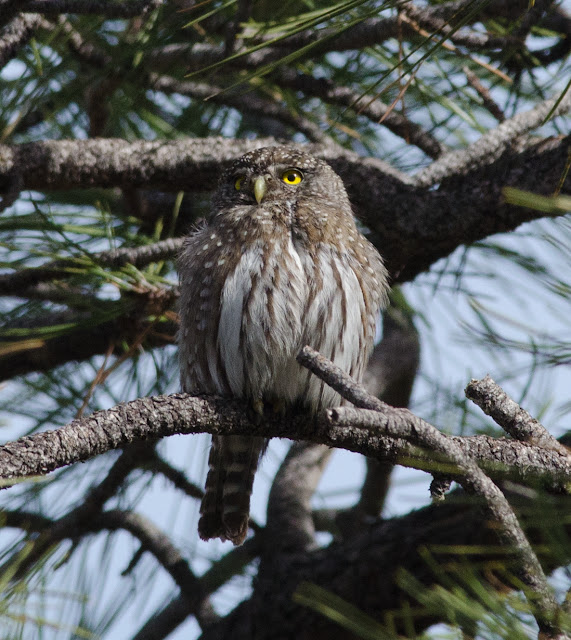
Near the far end of the trail, we heard a Northern Pygmy-Owl and chose to locate it by climbing and bushwhacking and the prize was well worth it.  These tiny, but ferocious, owls (about 6.75 inches) seem to not have much of a fear of humans and once found, this one gave us lots of great views while perched in a pine and at one point even turned around so we could capture photos of the back of its head which shows off the distinct black marks on the nape, which is a key field mark, and give the appearance of 'false eyes'.

 Northern Pygmy-Owl

Northern Pygmy-Owl---back view with false eyes

Northern Pygmy-Owl

This owl was definitely the highlight of the day, but it was far from being the only great bird we saw. We found evidence that the spring migration has begun in earnest.  Black-chinned Sparrows and Rufous-crowned Sparrows were in abundance on the first mile of the road leading to the 1688 trail.  The Black-chinned has a song that reminds one of a bouncing ball and they were singing from the hillsides, but most did not want to make themselves visible, until one of them finally flew in and circled us all the while foraging and singing and giving us fantastic views.  

 Black-chinned Sparrow

 Black-chinned Sparrow---Note the long tail


Black-chinned Sparrow

Rufous-crowned Sparrow

A very welcome find was the Painted Redstart, a warbler of the southwestern US and probably a bit earlier than normal for migrating into this area.  We found about 5 or 6 of these birds singing and foraging high in the trees, constantly flicking their tails and wings, which is a normal behavior of these birds.

 Painted Redstart

Painted Redstart

We also found 3 species of nuthatches, the Pygmy, Red-breasted, and the White-breasted.  Unfortunately the only species I was able to capture with a photo was the White-breasted, which is probably the most common species found throughout the US.  We also heard Spotted Towhees all along the trail and finally one of them popped up out of the dense vegetation and gave us great views and some wonderful photos.

 White-breasted Nuthatch

White-breasted Nuthatch

 Spotted Towhee

Spotted Towhee

Awesome birds, awesome scenery, and awesome company for the day.  We also made a stop at Sunflower on our way back, but have decided to do a separate post on that as we got some new migrants there as well.