Costa's Hummingbird

Costa's Hummingbird

Thursday, February 14, 2013

Puerto Penasco, (Rocky Point), Mexico - Part 2

Sunday morning we bundled up and headed to Pelican Point and Tucson Beach near Cholla Bay.  It was very early in the morning and it was very cold; in fact I had to borrow an extra jacket/wind breaker at least until the sun came up and the air quickly warmed up enough to make birding a bit more enjoyable.  One of the most impressive birds for me was the American Oystercatcher.  We had seen 4 of them on Saturday far out in Cholla Bay at low tide, but on Saturday, while standing on the rocks at Pelican Point a small flock of them came flying by in the early morning light.  A little bit later, we got to observe several of them up close on the sand and some were even engaging in courtship displays.

American Oystercatcher

American Oystercatcher

American Oystercatcher

As with most environments around water, the Osprey is almost always present.  The early morning sunrise with an Osprey 'kiting' was nice and it created a nice warm effect on the photos of the bird.  The photo of the perched Osprey was taken later in the morning without the effects of early morning sun.

 Osprey

Osprey

Osprey

One of the biggest surprises was a Merlin that flew in with its catch of the day and landed on a rock a short distance from where we were.  It appears to have captured a shore bird.

Merlin  

Of course another photo of a Brown Pelican is always worth it, especially when they are displaying their breeding attire.

Brown Pelican

And more gulls, they were everywhere.  This time we found an adult Heerman's Gull, which is one of the easiest species to identify.  But we also found a Herring as well.

 Heerman's Gull-adult

Herring Gull

And since we spent most of the day in Cholla Bay, we obviously had more shore birds.  Lighting was a bit better and the birds were a bit more approachable on this day.  Captured photos of Black-bellied Plover and Willet, along with a couple of new birds, the Short-billed Dowitcher and Wilson's Plover.  

 Willet

Black-bellied Plover

 Short-billed Dowitcher

 Wilson's Plover

Wilson's Plover

The last bird photos are of a Sparrow, that almost looks a little out of place with all the water bird photos.  However, this is a special sparrow; it is a sub-species of the Savannah Sparrow, known as the 'Large-billed' Savannah Sparrow.  This bird has a fairly limited range and has the possibility of some day being split from the Savannah Sparrow species and becoming a separate species of its own in the near future.  The photos quite clearly show how large of a bill it has when compared to other sparrow species.

 'Large-billed' Savannah Sparrow

'Large-billed' Savannah Sparrow

Monday dawned with rain in Rocky Point which did not bode well for much birding, but it was nice to see as this area gets very little rain every year.  Will like to return again in the future, but have no idea when that might happen, but I really enjoy travelling to this small seaside community.


Tuesday, February 12, 2013

Puerto Penasco, (Rocky Point), Mexico - Part 1

I was privileged to have the opportunity to travel to Puerto Penasco, Mexico this past weekend with some dedicated birders.  This small resort town of about 50,000 lies about 1 hour south of the Arizona border with Mexico on the Sea of Cortez, also known as the Gulf of California.  The Sea of Cortez is a long extension of the Pacific Ocean that is enclosed by Baja California on the west and mainland Mexico on the east.  My traveling companions were Claudia, Susie, Pat, Jeanne, Sue, and Marilyn and together we got to see and observe many birds and ourselves dined on some great cuisine.  Personally, I came away with 7 new life birds and I know a couple others that scored more than that.

The first day we concentrated our search near downtown and the fishing docks.  For me one of the most exciting finds were the Brown and Blue-footed Boobies.  These birds are known for following the fishing boats into the harbor and the distance out in the water was a bit of a challenge for my camera, however I managed to at least capture photos of the 2 species for identification purposes.

Blue-footed Booby

Brown Booby

Brown Booby

One of the most numerous birds, other than gulls, were the Brown Pelicans and some were even showing their very colorful breeding plumage.  One of my photos captured a Brown Pelican, a Blue Footed Booby and an unknown gull taking part in a feeding frenzy.

Unknown gull, Blue-footed Booby, & Brown Pelican

Brown Pelican - adult

As mentioned earlier, the gulls out numbered all other birds and the most common gull was the Ring-billed Gull, which is shown below.  Also along the docks we were able to locate a Yellow-footed Gull, and a juvenile Heerman's Gull, most likely a 2nd year bird.  Gulls can be extremely difficult to identify for various reasons, which I don't have space for on this post.  But they sparked many a lively discussions among us.

Ring-billed Gull

 Yellow-footed Gull


Heerman's Gull

In the afternoon we found our rental house which was situated on Cholla Bay and immediately started seeing shore birds.  Some of those that we found before dusk were Long-billed Curlews, Marbled Godwits, Whimbrels, Black-bellied Plovers and a lot of Willets.  The tide schedule greatly influences where birds may gather.  Notice the extreme differences of the bill shape of the first 3 species below.

 Long-billed Curlew


Marbled Godwit

Whimbrel

Willet


Black-bellied Plover

Part 2 will consist of more incredible discoveries that were made on Sunday.


Tuesday, February 5, 2013

Birding with Jim - Part 2

Sunday had a change in the weather with overcast skies and a few sprinkles from time to time.  This time Jim and I visited the agricultural farm grounds in the west valley in and around the communities of Buckeye and Arlington in Arizona.  A different habitat which leads to a different diversity of bird life.  Much of the birding in this place is completed by driving around in a car.  With an overcast sky, the photography was quite a bit more challenging but I was able to capture a few worthwhile photos.  Jim will have a lot of photos to process when he returns to New Jersey!

The first bird we encountered once we pulled off the highway was a Ferruginous Hawk which was on Jim's side of the car and I know he got many photos, but that in itself was a very good omen to start off the day.  It was not much further down the road and we discovered a Merlin.  I know others have reported this species off and on in this location, but it was my first sighting of one in Maricopa County, so that was good omen number 2.  Not a great photo by any means but I was happy to get what I could.

Merlin

Driving down one of the dirt roads that was very rutted from previous rains, we came upon a small flock of American Pipits and with our windows down we were able to capture a few photos as we sat in the car.

American Pipit

A couple of other birds that we found and photographed from inside the car were Savannah Sparrows and Western Meadowlarks.  Both birds were quite numerous along the roadsides and out in the fields.  

 Savannah Sparrow

Western Meadowlark

One thing to look for when birding in this area is farmers flooding their fields with water.  When that happens and you find such a spot, you will find a plethora of birds.  We found one of these flooded alfalfa fields and although the birds were some distance from the road and of course, a long distance from our car, we got some good looks at them thanks to Jim's scope that he had brought along.  This one field contained Great Egrets, a couple of Cattle Egrets, a huge flock of White-faced Ibis mixed in with a fairly large flock of Long-billed Curlew and some Greater Yellowlegs.  Also perched on the earth berms that were on the edges of the field were Red-tailed Hawks and a juvenile Bald Eagle.  Birds were a bit far away for my lens, but when one of the Long-billed Curlews took flight and flew our way, I did manage to get a photo that really shows off its long curved bill.

Long-billed Curlew

A bit further down the road and near our destination, we found one of our target birds, the Sandhill Crane.  There is usually a small flock that over winters in this area every year.  We counted a total of 27 of them in the field and one group of 9 tended to hang out together.

 Sandhill Cranes

Sandhill Cranes

Also near this spot we drove up to the canal and found a female Belted Kingfisher observing us from a concrete perch.

Belted Kingfisher

One other avian find was a bit unexpected.  We discovered a small flock of domestic turkeys.  They were running free range and we really never did figure out which farm they might belong to.  But they did create some different color patterns for us to observe.

 Domestic Turkey

Domestic Turkey

Agricultural farm grounds can really bring in a lot of surprise birds and a great variety.  We ended up with over 60 species of birds on this outing.


Monday, February 4, 2013

Salt River birding & more.

On Saturday and Sunday, I had the privilege of showing a Facebook friend some birding spots in and around Phoenix.  Jim Austin-Cole was in the area visiting and wanted to see some Arizona birds.  We found several new life birds for him and some he found on his own before we met up.  It was a pleasure in assisting him and one of his target birds was the Burrowing Owl.  That one was an easy one as I know of 3 places that one can surely find these remarkable birds, so my first stop was Zanjero Park where Desert Rivers Audubon Society has successfully set up habitat for them and introduced some of these birds.  I am sure he must have taken a couple dozen photos, so I will submit only one of my photos of one that really had its eye on us and was really to scramble down its burrow if it felt threatened.

Burrowing Owl

While we were at the park, we were also entertained by 2 American Kestrels.  This one could have picked a bit more attractive landing post for photos, but obviously this must be a favorite perch of hers.

American Kestrel

From there we headed to the Salt River and our first stop was the Pebble Beach Recreation Area to catch a glimpse of the beautiful Red-breasted Sapsucker. (I will have a post on that bird a bit later with my photos).  But while there, Jim not only got the sapsucker as a new life bird but the Phainopepla as well.

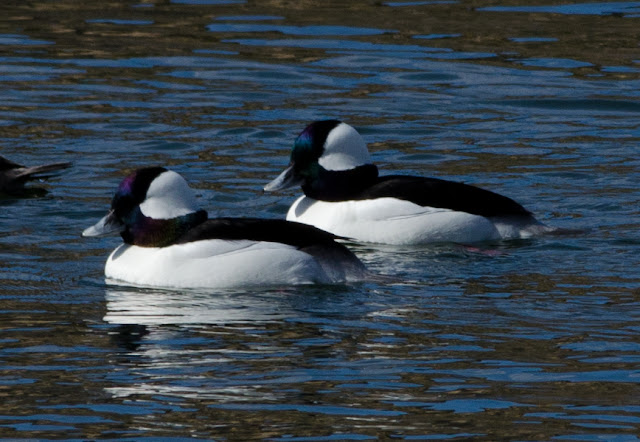
Next we ventured further north to Saguaro Lake and the Butcher Jones Beach area.  While we were there, the Bufflehead were quite numerous and actually got close enough to capture some decent photos of them.  This is our smallest duck in the United States and I think the males are quite handsome, especially when the sunlight reflects the various colors on the black part of their heads.  One of the males even got into a wing exercising moment and guess I was lucky enough to have my camera firing away at the time.

 Bufflehead-2 males and 6 females


 Bufflehead-male

  Bufflehead


 Bufflehead

 Bufflehead

We also witnessed a Pied-billed Grebe surfacing from a dive and had what seemed to be a fairly large fish in its beak.  We watched it several moments struggling to swallow this fish and it finally went down the hatch.  For awhile I was not so sure it was going to get it down without choking.

Pied-billed Grebe

Finally we headed back towards town with a short stop at Granite Reef Recreation Area and I managed to capture a photo of a Northern Cardinal tucked in behind some twigs and also a Ruddy Duck that seemed to hug the shore up close to us.  Also had the honor to meet fellow birder/blogger Lawrence Butler during our short time there.

Ruddy Duck

Northern Cardinal

To finish off the day, (we had run out of time), we made a very short stop at the Gilbert Riparian Water Ranch and with the sun dipping very low in the western sky, we managed to find a Loggerhead Shrike that was not the least bit afraid of us.  The sunset glow gives this bird a different but warmer look than normal.

Loggerhead Shrike

Lest some people think it is only about the birds, just had to add a photo of one of the small groups of Salt River Horses that frequent the area.  Always nice to find them and enjoy them when we can.


This was the first day of birding with Jim.  The Sunday trip will be in my next post.