Costa's Hummingbird

Costa's Hummingbird

Tuesday, July 8, 2014

Summer Birding in the Desert

Most people are aware of how hot it can be in and around the Phoenix vicinity in the summer.  Daytime temperatures are consistently over 100° F every day and can range upwards to 119° F on the most extreme side.  Needless to say, that kind of heat creates more challenges for birders as it gets to be unbearable to be outdoors and in the sun for any length of time.  Even in the shade it is downright HOT.  The only logical thing to do is to try getting an hour of birding in the very early morning before the sun starts beating down.  Personally, I prefer to get out of the Phoenix valley area and head to upper elevations where the temperatures moderate quite a bit and the night time lows make a big difference in morning birding.  Near the Phoenix area, even the night time lows might only fall to about 90° F, which is not much relief.  

There are birds to be seen in this heat and it amazes me that some survive these 2 to 3 months of extreme heat, but they do.  This heat makes for proper planning for any kind of a birding trip.  But even locally, one has the chance to see some wonderful and awesome birds in the heat of the summer.  One recent warm Sunday morning I ventured out with a mission to try and get a photograph of a Barn Owl and I met up with a couple of other birders, Pam Barnhart and Louis Hoeniger at about 5:30 in the morning..  I have seen Barn Owls several times, but most generally they are rather skittish and spook quite easily and all I get to see is the view of it flying away.  This time, we had much better luck and one was sitting tight and not too concerned with my presence.  Yes, the eyes appear to be closed, but I think it was only squinting and was keenly watching us.  After all, daytime is usually their roosting time and one should avoid stressing them by getting too close.

Barn Owl

Barn Owl

Also in the same area a Great Horned Owl was trying to find a roost for an undisturbed day of resting.  And only a mile a way, a pair of Burrowing Owls were seen along the road side near their burrow and perched on the power lines above.
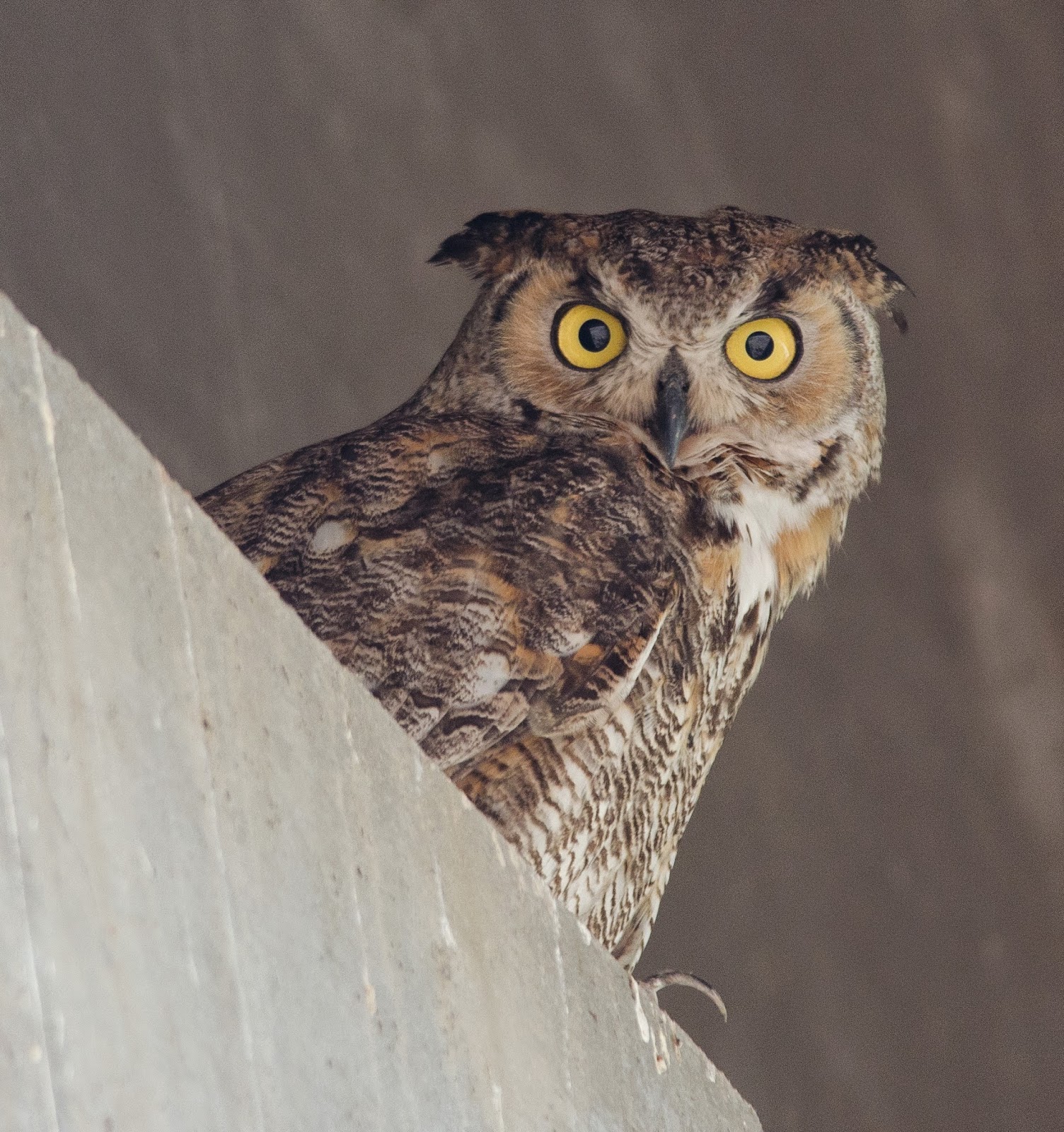
Great Horned Owl

Burrowing Owl

Burrowing Owl

Burrowing Owl

Always nice to find 3 species of owls in one day, but there were other birds as well.  Had the opportunity to see a couple Least Bitterns in flight which did not present any photos, but a female Black-chinned Hummingbird, a Gambel's Quail, and an oddly colored singing Blue Grosbeak all allowed a couple of photos.

Black-chinned Hummingbird - Female

Gambel's Quail

Blue Grosbeak

Once 8:00 AM rolls around, you quickly realize that summer is here and it is high time to seek cooler environments, such as air conditioned homes or vehicles.  It made for a short time for birding, but it was a trip that was necessary for me and my urgent need to see and observe more birds.  Have some cooler trips planned for later on this summer to escape the heat of the desert, and when fall rolls around, then it is a free for all and some great birding.   

Sunday, June 29, 2014

The Kaibab Plateau, the Final Day

Saturday night the winds had calmed down, but that also brought lower temperatures (down into the 30's) that night.  But with the proper equipment, camping in the cold is not all that bad and sleep was fairly easy on this second night.  This was going to be our last day of the expedition, but with a long 6 hour return drive looming on the horizon, many of us decided to make it a short day.  The entire group stopped near the entrance of our turn off to our camp site to check for a few birds in the area where we had seen the Downy Woodpeckers the night before.  This morning they were there to greet us again along with some Williamson's Sapsuckers and some Evening Grosbeaks, which was a new bird for me.  Although my photos left a lot to be desired, at least I got to see and hear them for the first time.  (Guess that means I will have to back again for better photos!)

Williamson's Sapsucker - Male


Williamson's Sapsucker - Male

Evening Grosbeak

The entire group decided to head into the Grand Canyon National Park on this morning and visiting the North Rim is much different than the South Rim.  Due to the remoteness of the North Rim, it only gets about one tenth the number of visitors on a yearly basis, but the road is also closed to the North Rim in the winter months due to snow.  The views from the the North Rim were just as awesome.


At the lodge at the North Rim, we found some cool birds as well, including a pair of Western Bluebirds that were feeding young.  We also had a Virginia's Warbler, Black-throated Gray Warblers, and 'Audubon's' Yellow-rumper Warblers.

  Western Bluebird - Male

Virginia's Warbler

Black-throated Gray Warbler


'Audubon's' Yellow-rumped Warbler

We also found Steller's Jays which are gorgeous birds, but we got to see a different side of them as one had stolen a newly hatched junco chick from a nest and was feeding on it.  Probably not a photo that many want to see, but it also shows nature in the raw.

Steller's Jay

Had some great mammals as well along the road.  There is a herd of bison found inside the park.  The park calls them bison, but truth be told they should probably be called 'beefalo' as they are remnants of a ranching operation from years back of a rancher that was crossing bison with cattle as an experimental ranching idea.  They animals do look quite a bit like bison, but not sure how purebred bison they really are.  


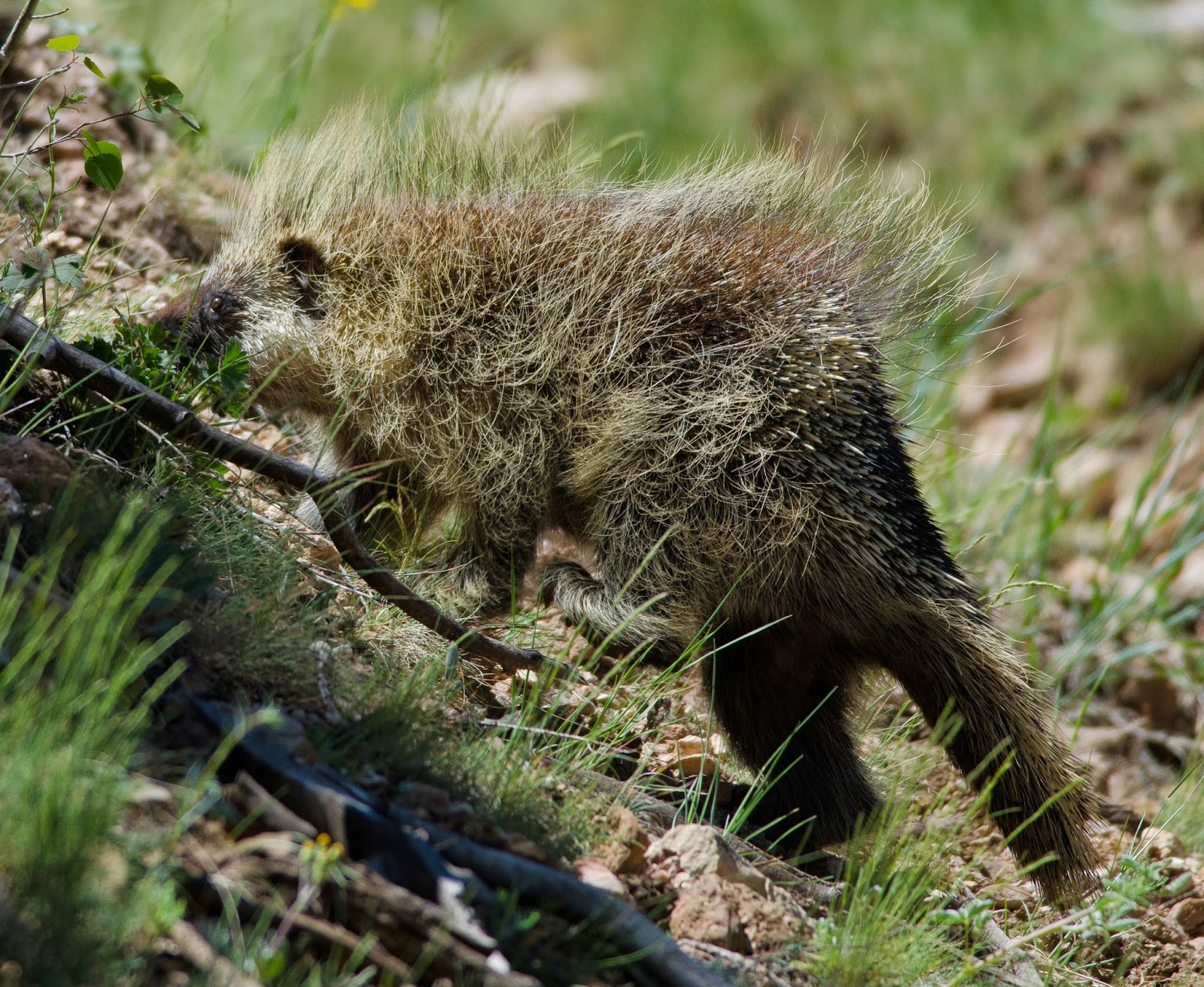
Probably the most interesting mammal that we discovered was a Porcupine along side of the road as we were leaving.  Got to see 2 of these animals when we were in New Mexico in February of this year, but both were sleeping in trees; this one was actively grazing along side of the highway.

Porcupine


Porcupine

What a way to end an exhilarating field expedition!  And I have to add a group photo of the 9 campers that journeyed to the North Rim.  Want to thank a great group of people that made this an exciting and enjoyable experience;  Eric Hough, Magill Weber, Chris Rohrer, Lauren Harter, Nathan Williams, Brian Ison, Michael Lester, and Jarrod Swackhamer. 


Friday, June 27, 2014

The Kaibab Plateau

Friday night was my first night camping out in a tent after a one night stay in the far southern fringes of Arizona in the ghost town of Ruby.  This time I was a bit better prepared with better camping equipment and supplies (and an air mattress!).  The winds were blowing all night long which did put a damper on our owling prospects; however we did hear a single Great Horned Owl, a Northern Saw-whet Owl, a Flammulated Owl, and at dawn a Northern Pygmy Owl.  We had picked out a very remote camp site just for this reason; owling is best done at night without a lot of other campers nearby.  

On Staurday, we were divided up into 3 teams and Chris and I took off and headed up to Jacob Lake to meet up with the 2 members that were not camping out; Mary Williams and Ann Hilliard.  Our team was to head west from Jacobs Lake and cover the areas from there to the Big Springs area.  We covered several miles with various stops along the way.  We got to see and count many different species of birds including a small flock of Bushtits, Cordilleran Flycatcher, Hermit Thrush, Lesser Goldfinch, MacGillivray's Warbler, Mountain Chickadee, and a lot of Broad-tailed Hummingbirds at the feeders at a cabin at Big Springs Lookout Tower.

 Bushtit - Female
Cordilleran Flycatcher

 Hermit Thrush


 Hermit Thrush on horse back - odd behavior for this bird


Lesser Goldfinch

 MacGillivray's Warbler


Mountain Chickadee

Broad-tailed Hummingbird

One of the saddest things that was found was a deceased Common Poorwill, which was found by Mary and Ann along one of the roads.  We can only speculate that it may have gotten hit by a vehicle at night.  They are a nocturnal bird and sometimes love to land on gravel roads at night.  Since they are nocturnal, it is not a bird that is often seen by the naked eye and even though this was an unfortunate find, we all got to get good looks of this awesome bird up close and really admire its dynamic plumage pattern and the whiskers around its beak.

Common Poorwill - deceased

Common Poorwill - deceased

Birds were not the only things that grabbed my attention.  Found several species of butterflies and some of them were new to me.  (Finally broke down and purchased a butterfly guide book after this trip!)

 Arizona Sister


 Pacuvius Duskywing


Rocky Mountain Duskywing - (not 100% certain of this ID)

 Silver-spotted Skipper


Weidemeyer's Admiral Butterfly

Once we returned to our base camp that evening, we were able to locate a couple of Downy Woodpeckers before nightfall.  This was a new Arizona bird for me.  They were quite common in Nebraska in my youth and I also found one in New Mexico earlier this year, so finding them in Arizona is just icing on the cake.

 Downy Woodpecker

What incredible 2nd day spent on the Kaibab Plateau.  The 3rd and final day was a short one since many of had a long trip home, but it was equally wonderful and a 3rd post is forthcoming on that last day.


Friday, June 20, 2014

The Flight of the Condor

This past weekend was a pretty special birding weekend in Arizona.  Being a member of the Arizona Field Ornithologists group, I had the honor of taking part in a field expedition to the Kaibab Plateau in the far northern part of the state which is located on the north rim of the Grand Canyon at an elevation of about 8000'.  This was going to be 2 nights of camping out in a remote part of the forest, (with no facilities, I might add), but a chance to escape crowds of people and enjoy nature.  There were a total of 11 people taking part in this expedition with 2 members staying in the inn at Jacob Lake and other 9 camping out.

Birding bud, Chris Rohrer traveled with me and of course we did some birding on the way.  And the prime spot that I had on my list was he Navajo Bridge at Marble Canyon, which is known as one of the best spots to find the majestic and rare California Condor.  In 1987 the remaining 22 condors living in the wild were captured and a very extensive captive breeding program was started.  Today the total population has increased to less then 500 with less than 300 in the wild.  The captive breeding program has led to releases of these birds at 3 different sites; 1 in California, 1 in Baja California, and 1 at the Grand Canyon area in Arizona.  They only breed once every 2 years and only lay one egg, which results in a very slow reproductive rate.  They have a lifespan of up to 60 years.  Their numbers will always be low as they require huge areas of land to subsist and live.  The biggest threat to those in the wild today is lead poisoning and every bird is tested every year for lead toxicity, with some having to be taken into rehabilitation.  The lead poisoning is due to the use of lead ammunition used in hunting and left in the carcasses left in the wild.

As we pulled up the Navajo Bridge, I immediately saw one soaring near the bridge and could not hardly get parked quickly enough so I could get out and gaze at it in awe.  As it was, there were 2 of them there on Friday, numbers 11 and 83.  (All of the birds are tagged, numbered and monitored closely every year.)  With a wingspan of about 9½ feet, they are the largest land bird in North America.  What a thrill to see such a rare bird soaring and riding the thermals in the wild!

 California Condor - # 11


 California Condor - #83, hatched 2005, released in the wild 2008


California Condors - # 11 and 83

When we returned home on Sunday we stopped by the bridge one more time and this time we found 4 of them in the area.  Number 11 was still there but numbers 53, L3, and H3 had joined 11 and 83 was absent.

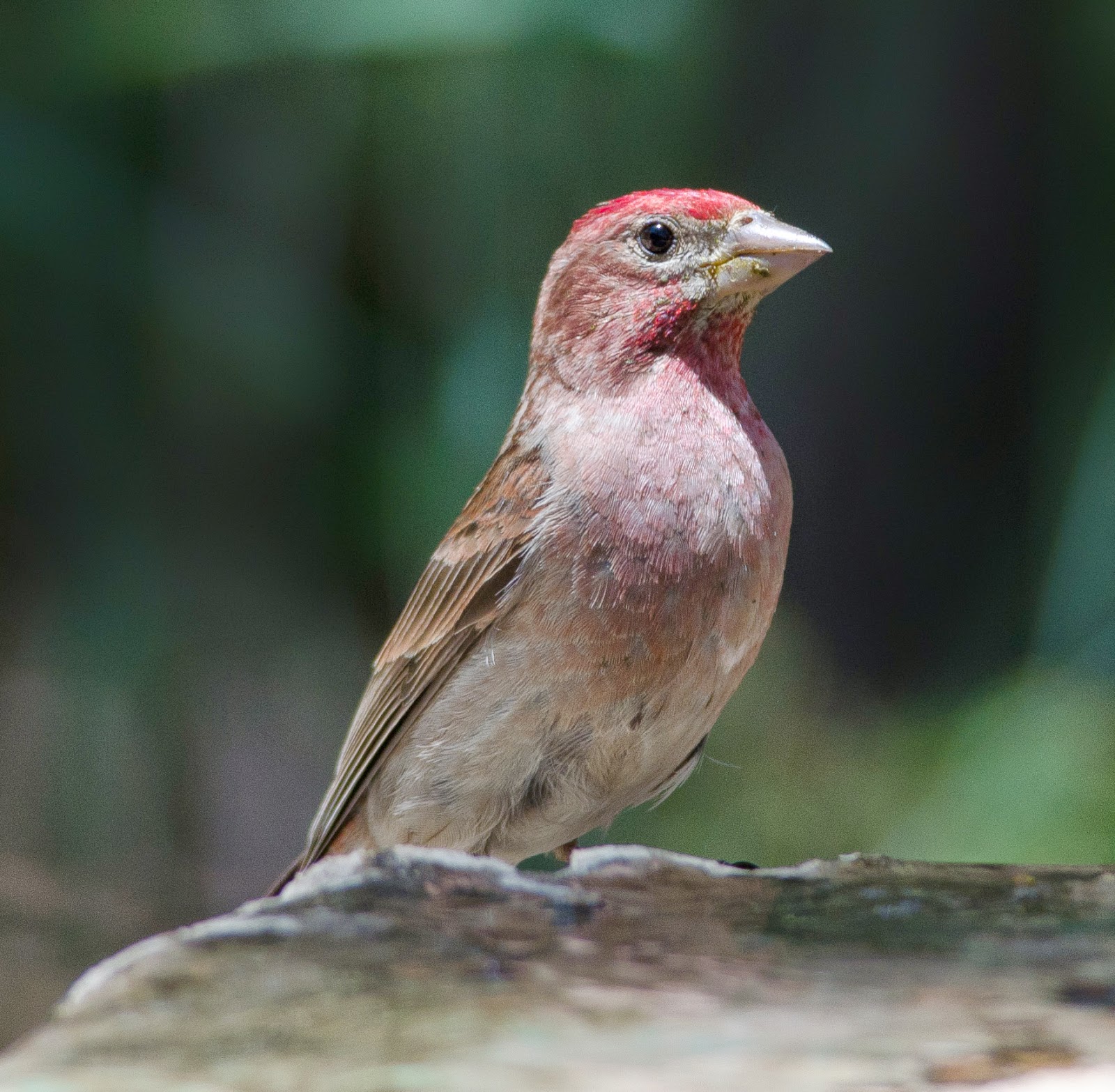
We finally had to tear ourselves away from this grandeur and continue our trip to the Kaibab Plateau.  Once we reached the community of Jacob Lake, we took a lunch break and enjoyed the birds in and around their water fountain.  The Cassin's Finches were the most notable in the fountain.  This is a bird that Chris and I had the pleasure of observing for the first time back in February, but this time they were much closer to observe and photograph, both males and females.

Cassin's Finch - Male

 Cassin's Finch - Female


  Cassin's Finches

A male Western Tanager also paid a visit to partake in a sip or two of water.  This is one of Arizona's most colorful birds in the summer, especially in the higher elevations.

Western Tanager

We had made an appointment to meet another vehicle of participants in mid afternoon near the DeMotte Campground, so after lunch we headed to the spot and along the way, we stopped at few spots along the road and one was a pond that was being used by Brewer's Blackbirds for nesting and some of them were busy collecting insects to feed their young.  Kind of look like gluttons, but those babies get hungry!
 Brewer's Blackbird


Brewer's Blackbird

After meeting some of the other members, we set out to find a remote campsite to set up our tents and prepare for the night and the possibility of hearing some owls.  With daytime temps in the 70's and nighttime temps in the low 40's and upper 30's we knew it was going to be a pretty chilly night.  But just being in a remote spot with no other campers around made this an enjoyable start to this expedition.