Costa's Hummingbird

Costa's Hummingbird
Showing posts with label Yellow-rumped Warbler. Show all posts

Thursday, January 14, 2016

Salt River - Post CBCs

Finally after completing my 5th and final CBC, (Christmas Bird Count), for the year I should now have more free time to go birding on my own.  But what I am finding is that it is easier said than done.  Seems I have this guilt complex of not getting anything done around the house like I think I should.  But then it dawned on me that the chores around the house are not on a time schedule, so there is no rush on getting them completed.  So on Saturday, I met up with Joe Chernek to do some birding on the Salt River.  We only made it to 3 of the locations, but those 3 locations are my favorite spots for casual birding.  

I arrived at our meeting spot a little early and got to witness a Yellow-rumped Warbler that had discovered its reflection on the passenger side mirror of a parked car.  It would fly down and land on the door frame of the car and then see its reflection and fly up to the mirror as if to attack it and then land on the top of the mirror.  By the string of photos and the droppings on the side of the car frame, this bird has been at it for awhile.  It would take breaks from this activity and go forage for insects for awhile and then return.

 Yellow-rumped Warbler


Our first stop on the Salt River was Coon Bluff, which is one of my favorite spots. We made attempt to see if the Rusty Blackbirds might still be around that had been reported in December.  But due to the recent week of on and off rain, the river was quite full and the sand bars in the river were completely submerged.  They had been associating with some Great-tailed Grackles on these sand bars, but we could not even find any of the grackles, so it was a miss on the Rusty Blackbird.  However, we did take advantage of a couple of photo ops of a Song Sparrow and a Ladder-backed Woodpecker.

 Song Sparrow

Ladder-backed Woodpecker

Next stop was Butcher Jones Beach at Saguaro Lake.  It was here that I got my most favorite photo of the day of a White-throated Swift.  This is a bird that never perches except on its nest in the crevices in rock cliffs, so they are constantly in motion when out feeding on flying insects.  Their fast and erratic flight makes photos tough to come by.  Most of the time when I attempt photos of them in flight, I just get a photo of blue sky.  But on this day, I captured a very lucky shot of one, and was quite surprised.

White-throated Swift

A few other birds that we enjoyed were Ruby-crowned Kinglets, a Ring-billed Gull, a Redhead, and a tailless empid, that I suspect is a Gray Flycatcher, due to the color of the lower bill.  

Ruby-crowned Kinglet

 Ring-billed Gull

Redhead

Epidonax Flycatcher - Most likely a Gray Flycatcher

On the road out of Butcher Jones, we stopped to marvel at the snow cover on Four Peaks.  The rains that feel in the lower elevations, fell as snow in the higher elevations.  Really enjoyed this view of the Sonoran Desert with snow-clad peaks in the distance and clouds enshrouding the peaks.  


At our feet while taking our scenic photos, we had Cholla cactus plants at our feet, which can be very nasty if one brushes up against one or even steps on one of the heads lying on the ground. This is one method of how this plant reproduces, as these spiny pieces can take root fairly easy.  These broken off pieces can be relocated to new areas by wildlife or humans.  They are hard to remove from clothing and shoes and those spines can be very painful if they break skin. 

 Cholla Cactus


Monday, February 2, 2015

You Win Some & You Lose Some

This hobby of birding is not always what it seems.  Once a person gets addicted to birding and listing, then every week and every day, one is always thinking what should I chase on my next day off?  Currently for me, that is pretty much weekends only, but if everything falls into place, next year at this time I will be able to head out any day I feel like it.  So it was, when the fourth weekend in January rolled around.  I wanted to add some of the rarer birds being reported to my Arizona list and my Maricopa County list for the new year.  So I headed for Lake Pleasant to see if I could locate some of the rarer birds being seen at that location.  What I did not plan on, was the wind.  It was brisk, and cold coming in off the water of the lake.  White caps in the water were not conducive to finding birds as they were most likely hiding in some sheltered coves on the opposite side.  Next time I decide to go to this place, I am going to check on the weather first. 
 
Since I was that far north, I figured I might as well hit a couple of other spots on the way home where I might have better luck.  Next closest spot to Lake Pleasant was Dos Lagos Park in Glendale to locate the continuing Eurasian Wigeon.  This is the second year in a row that this bird has wintered in this park and one of the easiest birds to add to one's list for the year at this location.  But from where I live it is quite a drive just for this one species, so being in the neighborhood gave it more credence.
 
 Eurasian Wigeon
 
Eurasian Wigeon
 
Next stop on the list?  Tempe Town Lake to add the Brown Pelican to my list.  This spot has been a consistent place for a small population of these birds to reside.  Most generally it consists of juveniles, but this time I found one in adult plumage.  Even though it was not easy to get close enough for killer photos, it was fun to watch it glide in from the west with a flock of cormorants and see the noticeable size difference between these two species.  Here is the Brown Pelican with its entourage of cormorants. 
 
Brown Pelican & Cormorants
 
Final destination for the day was the Gilbert Water Ranch.  Arriving late in the morning, took a little excitement out of the hunt as this place is so popular with joggers, dog-walkers, human strollers, and of course families with kids!  Oh yes, there is also always a plethora of photographers taking photos of some of the great birds that are there and are usually easier to photograph here than at most locations.  On this day, one could say that I must have joined ranks with the photographers because I started photographing ducks.  A drake Green-winged Teal and a drake Northern Pintail are always nice; the teal with its blaze green on the head and the pintail showing off its elegance and it is quite easy to see how it got the name pintail. 
 
 Green-winged Teal
 
Northern Pintail
 
Then I visited the fishing pond that has quite a flotilla of Ring-necked Ducks.  Most non-birders do not understand why they are called ring-necked instead of ring-billed ducks.  And to be quite honest it would seem that ring-billed is more apropos with that ring around the bill.  However, they do have a ring around the neck which is most generally not visible, but on this day, the drakes were stretching their necks and the rufous/cinnamon colored ring around the neck was visible.  Always nice to get photos of this duck with the visible rings.
 
 Ring-necked Ducks
 
 Ring-necked Ducks
 
Ring-necked Ducks
 
And as an added bonus, I wanted to add a photo of a Yellow-rumped Warbler just to let everyone know that I was checking out other birds, not just ducks.  This the Audubon's Yellow-rumped Warbler subspecies, and this photo leaves no doubt on how it got its name with that bright yellow patch on its rump.
 
Yellow-rumped Warbler
 
Although my original goal was a bust in the beginning, it ended up still being a good day of birding.
 
And if one is interested in mammals, this location has an abundant population of Cotton Rats.  They were great food for the Coyotes when they were there and are still a draw for several raptors that tend to visit this location.
 
  Cotton Rat


Sunday, June 29, 2014

The Kaibab Plateau, the Final Day

Saturday night the winds had calmed down, but that also brought lower temperatures (down into the 30's) that night.  But with the proper equipment, camping in the cold is not all that bad and sleep was fairly easy on this second night.  This was going to be our last day of the expedition, but with a long 6 hour return drive looming on the horizon, many of us decided to make it a short day.  The entire group stopped near the entrance of our turn off to our camp site to check for a few birds in the area where we had seen the Downy Woodpeckers the night before.  This morning they were there to greet us again along with some Williamson's Sapsuckers and some Evening Grosbeaks, which was a new bird for me.  Although my photos left a lot to be desired, at least I got to see and hear them for the first time.  (Guess that means I will have to back again for better photos!)

Williamson's Sapsucker - Male


Williamson's Sapsucker - Male

Evening Grosbeak

The entire group decided to head into the Grand Canyon National Park on this morning and visiting the North Rim is much different than the South Rim.  Due to the remoteness of the North Rim, it only gets about one tenth the number of visitors on a yearly basis, but the road is also closed to the North Rim in the winter months due to snow.  The views from the the North Rim were just as awesome.


At the lodge at the North Rim, we found some cool birds as well, including a pair of Western Bluebirds that were feeding young.  We also had a Virginia's Warbler, Black-throated Gray Warblers, and 'Audubon's' Yellow-rumper Warblers.

  Western Bluebird - Male

Virginia's Warbler

Black-throated Gray Warbler


'Audubon's' Yellow-rumped Warbler

We also found Steller's Jays which are gorgeous birds, but we got to see a different side of them as one had stolen a newly hatched junco chick from a nest and was feeding on it.  Probably not a photo that many want to see, but it also shows nature in the raw.

Steller's Jay

Had some great mammals as well along the road.  There is a herd of bison found inside the park.  The park calls them bison, but truth be told they should probably be called 'beefalo' as they are remnants of a ranching operation from years back of a rancher that was crossing bison with cattle as an experimental ranching idea.  They animals do look quite a bit like bison, but not sure how purebred bison they really are.  


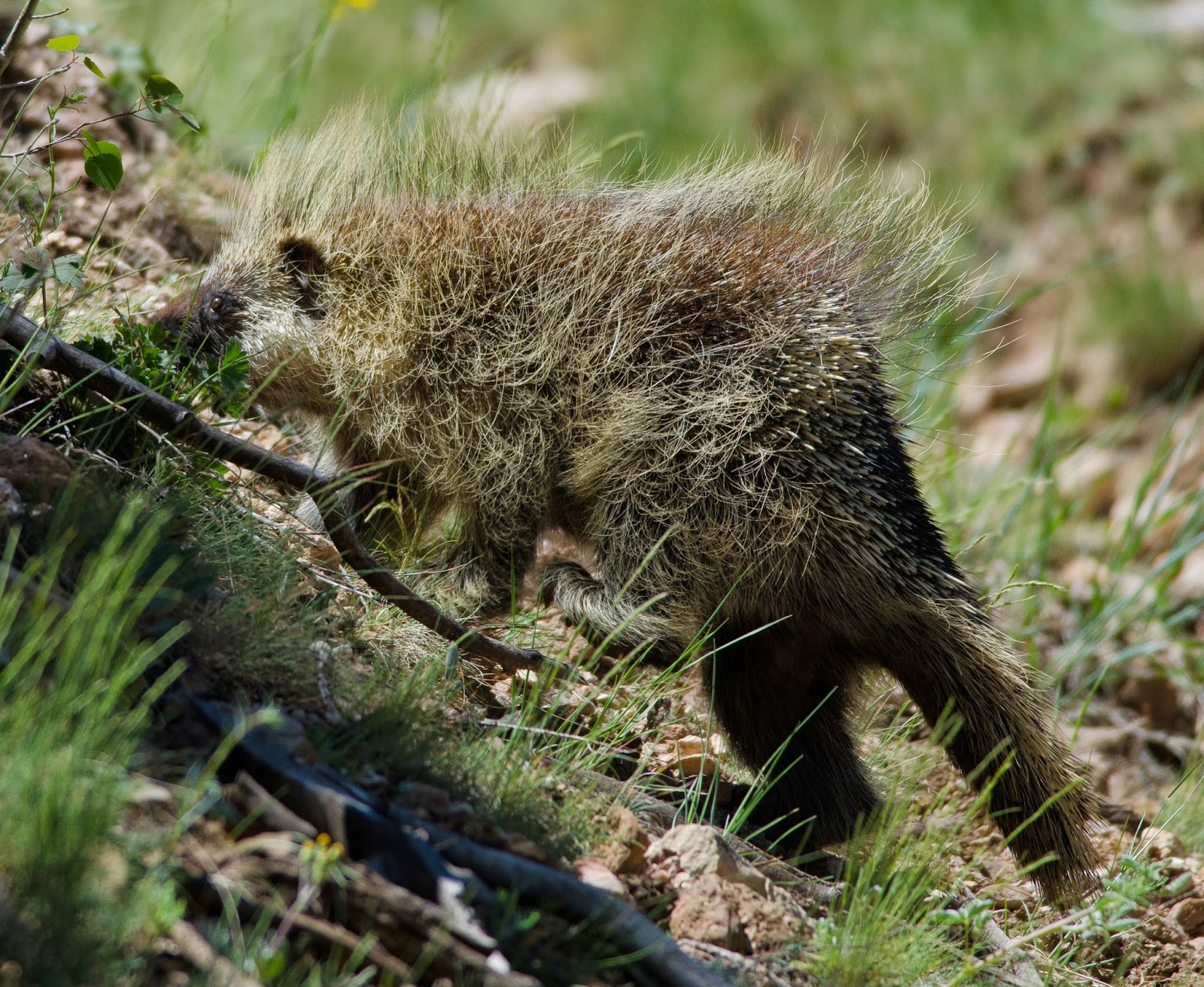
Probably the most interesting mammal that we discovered was a Porcupine along side of the road as we were leaving.  Got to see 2 of these animals when we were in New Mexico in February of this year, but both were sleeping in trees; this one was actively grazing along side of the highway.

Porcupine


Porcupine

What a way to end an exhilarating field expedition!  And I have to add a group photo of the 9 campers that journeyed to the North Rim.  Want to thank a great group of people that made this an exciting and enjoyable experience;  Eric Hough, Magill Weber, Chris Rohrer, Lauren Harter, Nathan Williams, Brian Ison, Michael Lester, and Jarrod Swackhamer. 


Sunday, May 25, 2014

Preparing for NAMBC

In 2013, I took part in the Navajo County North American Migratory Bird Count and was assigned some designated areas in and around the Heber/Overgaard area in Navajo County which I covered by myself.  This year I got lucky and had a couple of birding friends ask to join me which is great to have when taking part in one of these exercises.  This year Barb Meding and Wayne Manske asked to come along, for which I was thankful to have the assistance.  We departed early on Friday to get in some extra birding before the big day which was Saturday.  We stopped at several places along the way including the Tonto Fish Hatchery Road, which is a beautiful drive and at one spot a House Wren was very vocal and allowed us some up close views.

House Wren

Next stop was Willow Springs Lake, which is a bit new for me as I now know how to access the main part of the lake.  At one of the parking areas we found some male 'Audobon's' Yellow-rumped Warblers.  This species is one that is so common in the winter in and around the Phoenix area and is the first warbler that I learned the single note chip call since they are so common.  But there is a big difference in what we see in winter in the Phoenix area compared to what we see on their breeding grounds.  We found males in full breeding plumage and what a stunning bird they are.  

 'Audubon's' Yellow-rumped Warbler - showing its yellow rump
'Audubon's' Yellow-rumped Warbler

From there we ventured on to Black Canyon Lake, which is a spot I always visit every time I take a trip up to the Heber Area.  The parking lot has a population of Golden-mantled Squirrels that thrive on human handouts.  I have started carrying peanuts in the shell with me and it is always fun to watch them approach hoping for a hand out and of course I obliged.  It scampered down a tunnel, but shortly returned to feed on one that it had extracted from the shell and pose for me.  Guess this was my reward.

Golden-mantled Squirrel

Of course there were birds to be seen as well.  Brewer's Blackbirds are almost a given at this location as well as American Robins and 'Red-shafted' Northern Flickers.  And on this day the water bird specialty was an Eared Grebe.

 Brewer's Blackbird

 American Robin

'Red-shafted Northern Flicker

 Eared Grebe - Now you see it

Eared Grebe - Now you don't

Other interesting creatures were a Common Buckeye Butterfly and across the lake was a small herd of horses including a mare and her foal.

 Common Buckeye

Mare and foal

We had a great time birding on our way to Heber and that night we met up with 4 more volunteers, including the leader for some fine dining in Heber on Friday night the day before the big day of counting.  Great way to start the weekend!