Costa's Hummingbird

Costa's Hummingbird
Showing posts with label Western Meadowlark. Show all posts

Tuesday, February 26, 2019

A Numbers Game

Birding for many people, is a numbers game.  Keeping track of the birds that one can tick off in a county, a state, or the ABA Area, various countries, and finally life birds, is what many of us do while we are observing birds.  The game is sort of like a scavenger hunt with moving targets.  Some birders can recite how many species they have in every county, every state, ABA, and life birds.  For me, I do good remembering my life list number.  I can easily look up my county, state, and life list numbers, but I don't focus on memorizing them as those numbers are constantly changing. 

Since my trip to Ecuador last July, my birding has been relatively curtailed to Arizona.  Yes, I have been making plans for some future trips, but in the meantime, I have been exploring Arizona a bit more and learning more about the birds of Arizona and their distribution.  In the process I have picked up one new life bird, which was last August in the Chiricahua Mountains of southeast Arizona.  Alas, no photos, but I was quite stoked and pleased to see my first Black Swift.  I have also added 8 new species of birds to my Arizona list, of which one of them was the Black Swift.  Adding birds to my Arizona list gets harder every year.  Most are rarities, and require a chase of one kind or another.  And some of these new Arizona birds are birds that I have seen in other US states and 3 of them were birds that I have seen outside of the United States.  New Arizona birds that I have added include Fulvous Whistling Duck (Texas), Ringed Kingfisher (Costa Rica), Short-eared Owl (Washington), Black Rosy-Finch (New Mexico), Gray-crowned Rosy-Finch (Oregon), White-throated Thrush (Mexico and Costa Rica), and Ferruginous Pygmy-Owl (Mexico).  {The places in parenthesis, are the locations where I have seen them before seeing them in the United States or Arizona.} 

The only species that I was able to photograph in Arizona during my recent chases, are displayed below and even some of these photos are less than stellar. Lots of reasons for the mediocre photos and for some, why photos are absent. I could probably write a whole blog post on why photography can be so fickle.  But for me, the nature of birding does not always allow for great photos.  It is more about observing the bird and enjoying the moment.  Sometimes we get lucky and sometimes we fail.

Black Rosy-Finch

Black Rosy-Finch
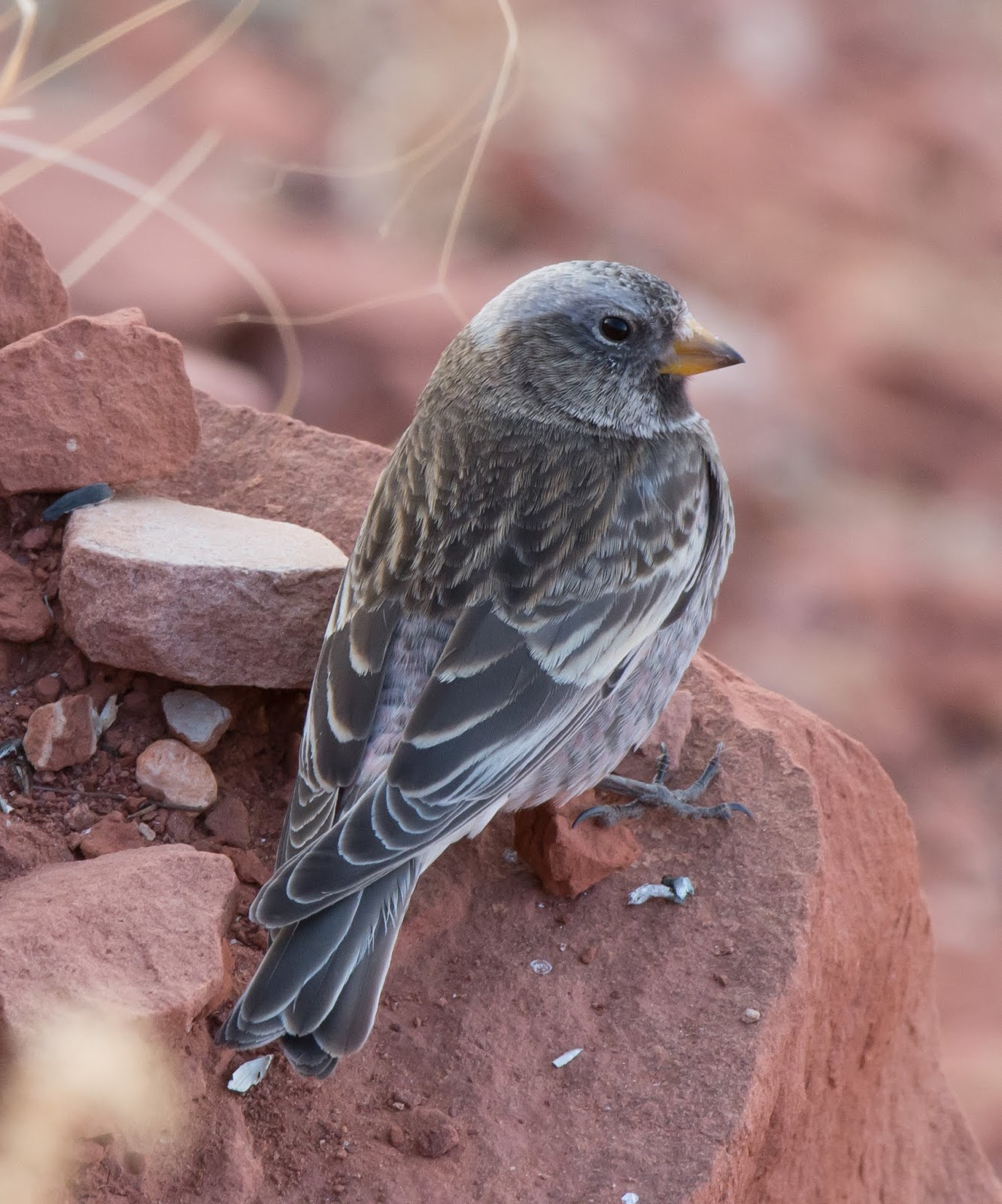
Black Rosy-Finch

White-throated Thrush

Ferruginous Pygmy-Owl

Obviously, when chasing some of the rarities, other birds are seen as well.  When one is birding in a location that is not your normal spot, you also take time to enjoy the new habitat and what might be waiting in the trees, grasses, or water.  For instance, the White-throated Thrush was being seen in Madera Canyon, and when I get to Madera Canyon, I never fail to stop at the Santa Rita Lodge to enjoy their birds.  For the second year in a row, a male Elegant Trogon has taken up its winter residence in the lower areas of the canyon.  I never get tired of this bird.  At one time this was called the Coppery-tailed Trogon and the second photo definitely puts credence to that name.  

 Elegant Trogon

Elegant Trogon

That trip also took in some of Patagonia and Santa Cruz Flats as well.  Always great to visit southeastern Arizona.  

 Acorn Woodpecker - Female

 Broad-billed Hummingbird - Male

 'Red' Fox Sparrow

 Western Meadowlark

White-nosed Coati - Santa Rita Lodge

When the trip for the Ferruginous Pygmy-Owl took place, I was lucky enough to be accompanied by birding friends, Tommy DeBardeleben, Josh Wallestad, and Caleb Strand.  And true to form, we explored more areas, including another trip to Madera Canyon.  Once again that male Elegant Trogon was just irresistible.  

 Elegant Trogon

 Whiskered Screech-Owl - Can you see it?  (See next photo)
Now this is great camouflage!

Whiskered Screech-Owl - Cropped close of preceding photo.  

2019 will a bit different for birding.  I am currently not planning any international trips for this year, but do have some trips within the United States in the plans.  I hope to increase my numbers of life birds and also ABA birds in the process.  


Thursday, March 13, 2014

New Mexico Adventure - Part 3

Our third and final day was spent at Bosque del Apache which is located about an hour south of Albuquerque and Linda was able to join us on this final day.  This place is a very well known birding hotspot for its huge flocks of Sandhill Cranes and Snow Geese in the winter.  It is also known for having some very unusual and rare bird appearances, the most recent being the Rufous-necked Wood Rail.  Our arrival was fairly late in the season and the Sandhill Cranes and many of the Snow Geese had already departed for nesting grounds much further north.  A few lingering Snow Geese did give us some great views in the sky along with a loner that was foraging by itself near one of the ponds.
 
Snow Goose

Snow Geese Flock
 
A pair of Bald Eagles on a tree far out into one of the ponds presented a rather nice perspective with the distance mountains in the background. 
 
 Bald Eagles
 
The grassy areas along the roads and pond were full of Western Meadowlarks and when they land in the dry grass they almost disappear.  But when they expose that bright yellow breast, then they really stand out.
 
Western Meadowlark

 
Western Meadowlark
 

 Western Meadowlark
 
A visit to the Visitor's Center here was quite the bonanza.  They also had an indoor seating area with glass windows with feeders right out side and the birds were easily feasting on the bountiful food supply.  We had American Goldfinch, White-throated Sparrow, Harris's Sparrow, Spotted Towhee, and a fairly rare Golden-crowned Sparrow. 
 
American Goldfinch

Golden-crowned Sparrow

 Harris's Sparrow
 
Spotted Towhee

 White-throated Sparrow

 
We were also fortunate to see some Mule Deer while driving the roads around the ponds at Bosque.  Almost drove right past them as they were walking away.
 
Mule Deer
 
Finally after a full day of birding we called it a night and after a restful night in a local motel, Chris and I headed back to Arizona the next morning and birding at several odd spots along the way in this remote area of western New Mexico.  Just outside of the town of Magdalena, NM, we came across 3 Pronghorns of which 2 of them were sparring when we first saw them.  But once we stopped the car, they stopped their sparring and headed out across the dry grassland.
 
 Pronghorn
 
Pronghorn
 
I think that each of us came away with 4 new life birds on this trip which made it all worth while.  It is getting harder to find new life birds for both of us in this part of the United States, so future different trips are in store for both of us outside of this area this year and it will be amazing to see what all we find.  Chris will probably get more as he has more trips planned than I do for different areas of the country. 


Tuesday, February 4, 2014

Santa Cruz Flats - Life Birds for a Non-Resident

On January 25, 2014, I had the honor and privilege to show Frances Raskin around the Santa Cruz Flats area in Arizona.  Frances is an avid and very good birder in her own right.  Currently she resides near the east coast of the United States with a new job lined up in another state.  What brings her to Arizona is the fact that her parents currently reside here which really give her the best of a lot of birding opportunities.  I think the Mountain Plover was probably her main target bird and some years this bird can be found fairly regularly in and around the sod farms in this area of ag lands south of Eloy, AZ.  This year had been a fairly reliable year for them but having not read any reports of them for about 10 days, I was thinking maybe we had lost our window of opportunity.  So we met and headed out together to explore this vast area of roads to see what we could find.
 
In the early morning light we happened upon a Merlin perched in a tree along the road and really enjoyed the good looks this one provided for us.  Merlin is always a great bird to find, so that started us off on a good note.  This is a very fast falcon and they come in 3 color forms and this one was the darker or'Taiga' form which is the most common form seen in AZ.  About 3 miles further down the road, near the corner of Baumgartner and Wheeler we discovered another Merlin and it looked so different than the first one, that I had to get out my bird guides to confirm what I thought it was; another Merlin, however this one was the lighter of 'Prairie' form.  I have only seen one of the Prairie forms once before and that was a quite a distance and in flight, so this one was a real treat to find and see for the sake of comparison. 


As we were driving the roads we came upon a Ferruginous Hawk that flew from a pole in front of our car.  Unfortunately, it kept on flying until it flew out of sight, but that was the first new life bird that we found for Frances.  We had an abundance of birds in many different habitats including a Western Meadowlark and of all the Red-tailed Hawks we found, one of them included this gorgeous 'dark-morph' Red-tailed Hawk.


As we continued driving the roads, we finally came upon a very nice Prairie Falcon and since was life bird number 2 for Frances, we stayed in the car and approached as close as we could without disturbing this bird.  I angled the car sideways so that she could get good looks at this bird out of the passenger window and study it well.  Prairie Falcons are very skittish especially when a car door opens.  We finally made it to the sod farms and tried as we might by scanning every field multiple times, we never came up with any Mountain Plovers.  Our consolation prize was the resident Burrowing Owl and some Brewer's Sparrows.


After a quick drive to grab some lunch, we headed back to the roads and this time we were on the west side of this vast area and as soon as we got to Pretzer Road I decided to head east to the sod farms once again and about a mile west of where we were looking before, I found a good friend Claudia Kirscher with a group of birders and they had found some Mountain Plovers and were gracious enough to point them out to us in their scopes.  Finally, we had succeeded in finding this bird for Frances giving her 3 new life birds for the day.  (Incidentally, Claudia was the person that helped me find my first Mountain Plover a few years back!)
 
As we worked our way back to our meeting point, we passed through an area with water and fields on both sides and the number of American Pipits were staggering, flying in huge swarms over the road and the fields.


At several places along the roads Frances had spotted some of the resident ground squirrels, so finally at one point I was able to capture a photo of one of these adorable little rodents.
 
 
We had a great day of birding and hope to do more in the future when she makes another visit to AZ.


Saturday, December 7, 2013

Way Out West

On Friday November 29th, birding friend, Chris Rohrer ventured up from Tucson to the Phoenix area to spend a day of birding in the far western reaches of the 'West Valley' near Phoenix.  The area is a vast area that extends from the infamous 'Thrasher Spot' to the agricultural fields of Arlington and Buckeye.  In the winter this can be very productive for finding many migrant birds as well as some resident birds.  Our first stop was the Thrasher Spot which is famous for being probably the most reliable spot to find the fairly uncommon Le Conte's Thrasher.  We came to this spot in the hopes of finding both the 2 new sparrow species which were a result of the AOU making a split on the old 'Sage' Sparrow.  The 2 new birds from this split are the Sagebrush Sparrow and the Bell's Sparrow.  While we struck out on the Bell's Sparrow, we did find and observe several of the Sagebrush Sparrows which are most likely the most common of these 2 species to be found here.
 
Sagebrush Sparrow
 
We also dipped on the Le Conte's Thrasher this time, but will try again maybe when breeding season approaches.  As a consolation, we did see a few Bendire's Thrashers and one of 2 Crissal Thrashers put on a singing show for us and allowed us some great looks.  Most thrasher species can be quite secretive and elusive, so when one does land at the top of a tree and starts singing, it can be quite moving as most of their songs are quite melodic. 
 
Crissal Thrasher

Crissal Thrasher
 
From the Thrasher Spot, we hit the roads by first heading down towards Arlington.  Had intentions of taking Chris to the Arlington Ponds, but the road was very muddy and rutted, and we though better of that idea.  But we had many birds along the road including the American Kestrel.  We counted over 20 of these birds along the road.  This bird is our smallest and most common falcon in the United States and in the winter they can be found in high numbers in Arizona.
 
American Kestrel
 
We also had the great fortune of finding 2 Ferruginous Hawks along the roadways which is another winter visitor to our area and one that many birders love to find in Arizona.
 
Ferruginous Hawk
 
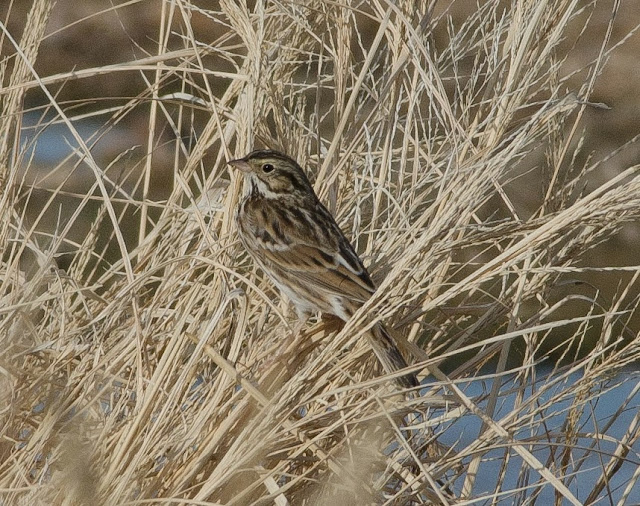
Other birds included a Greater Roadrunner, (no photos), a few Savannah Sparrows, a few Western Meadowlarks, and at one farms with a corral, a huge flock of Red-winged Blackbirds with some Brown-headed Cowbirds in the mix.
 
Savannah Sparrow

Western Meadowlark

Flock of Red-winged Blackbirds and Brown-headed Cowbirds
 
 Finally we arrived at the Lower River Ponds which Chris had never seen and we were amazed by the sheer number of American White Pelicans that were there.  We counted over 140 and a week later another person counted over 250.  This photo only shows a small portion of these magnificent birds that were located there and if one looks closely you will see 2 Snow Geese in the middle.  Looks like midgets among the giants!
 
American White Pelicans and Snow Geese
 
Snow Geese
 
 American White Pelican
 
American White Pelican
 
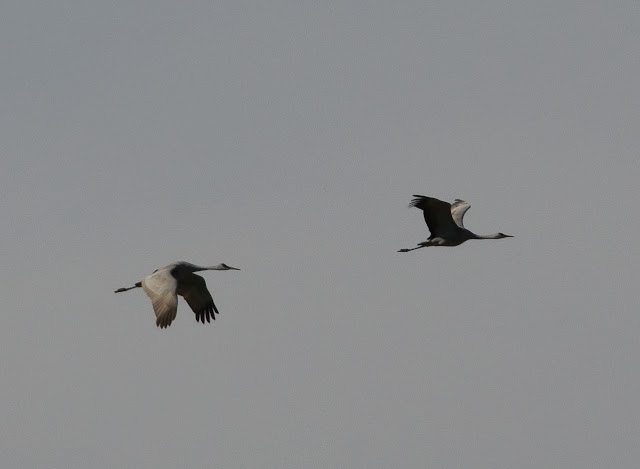
While we were astounded by the number of pelicans, we also noticed large numbers for Great Egrets and Great Blue Herons on the banks on the opposite sides and in the fields back behind and to the south of the ponds and mixed in with those Great Blue Herons was a sprinkling of Sandhill Cranes.  There is a small contingent of these magnificent birds that spend their winters in the vicinity of Maricopa County.  While they were quite a distance from us for photos, they eventually took flight and when seen flying, they do not even resemble the herons.  Very easy distinction.
 
Sandhill Cranes
 
The ponds were also visited by a juvenile Bald Eagle flying over the ponds that made many of the waterfowl take flight.  While the sun was in the wrong place for photos, it was still quite interesting to see a Great Egret and the Bald Eagle in the same frame.  No, the eagle or the Egret were chasing each other; they just happened to be in the same frame at the same time.
 
 Bald Eagle and Great Egret
 
 Bald Eagle and Great Egret
 
Bald Eagle and Great Egret
 
What a wonderful place to visit for birds in especially in the wintertime in Arizona.  With the milder weather this state has to offer, we get the opportunity to see many wonderful birds that like to make their winter homes in Arizona.