Costa's Hummingbird

Costa's Hummingbird
Showing posts with label Hutton's Vireo. Show all posts

Monday, January 15, 2018

Maricopa County Has Awesome Birds!

Southeast Arizona most generally gets all the attention for the best birding in Arizona and rightfully so.  After all, that area is located near to the border with Mexico, and it is expected that some of these Mexican specialties wander north over the border and into Arizona.  But at the other end of the spectrum, Maricopa County which is further north, has its share of some pretty awesome birds. It does get its share of northward wandering Mexican birds as well, just not as regular as southeastern Arizona.  The county also gets some pretty amazing northern and eastern migrants that can whet the appetite of many birders.

Recently, I was invited to join Barb Meding and Jeanne Burns to head a little ways north of town of Carefree and look for Grasshopper Sparrows which had recently been reported by a team of birders participating in a CBC (Christmas Bird Count). We had decided to make a day of it and explore various other locations in the vicinity as well.   First was the search for Grasshopper Sparrow in the desert grasslands and we found them (at least 4).  This is a bird that is not too commonly found in Maricopa County, and we had to endure looking at a lot of White-crowned Sparrows to find these rather cool and interesting sparrows.

 Grasshopper Sparrow


Grasshopper Sparrow - backside

2 Grasshopper Sparrows

Rufous-crowned Sparrows and a Sage Thrasher also rounded out this area along the recently paved road.

 Rufous-crowned Sparrow

Sage Thrasher

Next stop was the Seven Springs Campground area.  We arrived to find a wedding had been scheduled for the campground, so we did not have a lot of time to explore, but we were able to find Cassin's Finches feeding on the many Juniper berries.  

 Cassin's Finch - Male, munching on juniper berries


Cassin's Finch - Female, also feeding on juniper berries

Our final stop on the way back to civilization was Lower Camp Creek.  We had seen reports of a Louisiana Waterthrush and a Golden-crowned Kinglet from that location, so those were our target birds.  The kinglet was actually quite easy to hear and it showed itself well.  It is rare for this species in these lower elevations, but this year seems to be a bit of an irruption year for it.  It can be notoriously hard to get photos of this bird, and this one offered me the best views ever for this species.  

 Golden-crowned Kinglet


Took a bit longer to locate the Louisiana Waterthrush.  We could hear it giving its single note 'chick' call, but getting on it was a bit tough.  And it got tougher as I happened to spy a Pacific Wren down near the water, which had not been reported and it too, is a hard bird to find in Arizona due to their secretive habits.  It is always fun to find an uncommon bird to add to the list for others to locate. 

 Pacific WrenWren


After getting over the distraction of finding the Pacific Wren, we were able to finally get some views of the Louisiana Waterthrush. They can often be confused with the Northern Waterthrush, but one of the key identifications is the white supercillium, or eye-brow.  These photos show how wide it is all the way back behind the eye towards the nape of the neck.  Northern Waterthrush has a similar marking, but it tapers to a very thin line in the rear.  This is a species I had only had seen very well once before.  This sighting is great as it provides a learning experience for me. 

 Lousiana Waterthrush


 A couple more birds we saw at this location was a Hutton's Vireo and another Sage Thrasher.  Both species are always great to see.  

 Hutton's Vireo

Another Sage Thrasher

What a great day of birding with a couple of really good friends, so I was in good company.  Finding the Pacific Wren was really great so we could add to the list of uncommon birds at this location.  Several other birders have chased the Pacific Wren since our report and found it, so you know it is a desirable bird.  Maricopa County really has some great birding of its own and birders need to take note that not all special birds are found in southeastern Arizona.


Thursday, June 18, 2015

The Start of a Long, Hot Summer

Blog posts have been a little sparse recently for me, but there is a reasoning behind all of this.  With a major epic out-of-country birding trip planned in the month of July, I have been focusing on more local birding rather than many 2 to 3 day trips around the state of Arizona as I had done last year.  But at the same time, I just cannot stay home and ignore all those marvelous avian creatures we have in the great state of Arizona.  It is becoming hard for me to find too many more life birds in Arizona, but there are still a few on my wish list and with luck I will be able to pursue those goals in 2016 and beyond.  But rather than staying at home while planning this epic trip in July, I like to return to visit some of my favorite haunts in Maricopa County and the surrounding area.  So with that in mind, I made a couple of trips on consecutive weekends and both ended up being the same destination, although the first was meant to be a little bit different.  

On Saturday June 6th, another birding acquaintance, Rob Bowker, and I planned to make a trip to Slate Creek Divide and we gave it the good old All-American try, but due to some really freakish weather, we were not able to make it up the road.  Seems Mother Nature decided to bless many areas of the state with rainfall in June.  June is traditionally one of the driest months of the year in AZ, but this year we have been blessed with rainfall in most areas of the state.  Since we were not able to access the muddy road to Slate Creek Divide, we opted to go across the highway to Mt Ord and see how the roads were and what we could find.  

It was still cloudy from the rain the day and night before, but the road was fine to navigate and we ended up enjoying the hiking in and around the 1688 trail.  While I have had Acorn Woodpeckers near this area in the past, they have always been a bit distant, but on this trip at least one of them perched within a decent distance to allow a photograph.  It is a bird I have photographed many times in many other locations in the state, but I believe this is my first photo of one in Maricopa County.

Acorn Woodpecker

At one point as we were bushwhacking through some of the pines, I heard a squawking noise fairly close by and low to the ground and it did not take long to discover the source of the noise; a newly fledged chick, but a bird at that age can be difficult to identify at first glance.  This is a case though of having patience, because a youngster making that much racket will most likely have a parent nearby fetching morsels of food for them and they will return.  Sure enough, in less than a minute, one of the parents dropped in with some food and it became clear this youngster was a Plumbeous Vireo fledgling.  And here is a sequence of photos of this youngster and his parent.

Plumbeous Vireo - Fledgling


It is always a treat to witness something new like this and obtain a few photos knowing that is a moment in time that only 2 of us witnessed and captured some documentation by our photos.  

As we finally headed back towards the vehicle, rounded a corner on the trail and found this Painted Redstart singing up a storm for us.  Lighting left a little to be desired, but one can never have enough photos of this smartly dressed bird.

Painted Redstart


While we were not able to access our target location, we still had a great time birding at one of my favorite locations in Maricopa County.  

A week later and the summer heat had arrived, but I thought I could maybe get in a couple of hours of birding early on a Saturday morning before the heat kicked in and once again I chose to go to Mt Ord, but this time by myself.  Wanted to do a little more practicing with my new camera and this time around, different species of birds made themselves available to my camera.  There are going to be some challenges for photography on my upcoming adventure in July.

Rufous-crowned Sparrow

Spotted Towhee

Blue-gray Gnatcatcher
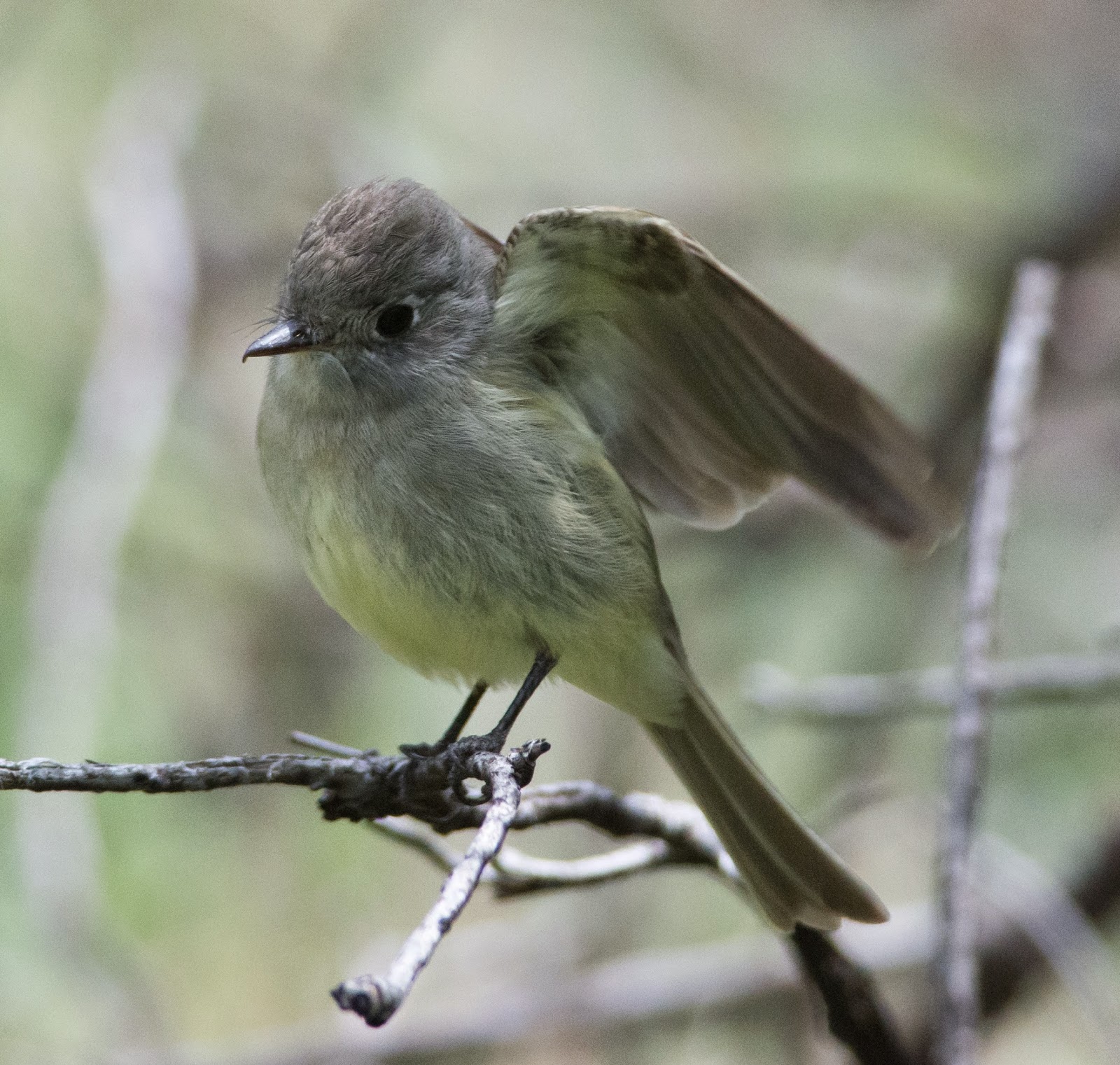
Hutton's Vireo

Hepatic Tanager

Hepatic Tanager

Woodhouse's Scrub-Jay

And to round out the trip, the agave plants on Mt Ord were sending up their tall flower spikes which really added to the color of the spring day.


Monday, May 11, 2015

Criss-Crossing the Great Divide

OK, that heading is quite an exaggeration from reality.  With a heading like that, one would think I was birding the Great Divide in the Rocky Mountains.  Truth be told, the divide I am referring to is far less important and generally not even considered a 'divide'.  This divide, is the division line of Maricopa and Gila Counties on Mt Ord and the Slate Creek Divide in the far northeastern reaches of Maricopa County.  Probably not considered very important unless one is a birder and especially an eBirder where entering reports with accuracy really do count.  I volunteered to cover the Gila County portion of these 2 locations for the NAMBC (North American Migratory Bird Count) and I was fortunate to have Jason Morgan offer to assist me this year.  Since I love the Mt Ord area so much, all we had to do was concentrate on the Gila County portion only this time.  The county line between these 2 counties comes close to following the forest roads that lead to the tops of both locations with Gila County predominately to the north and east of the county roads.  However there are some spots where the county line crosses over the road and then back again and knowing where those spots were located was key to our success. 
 
We arrived at Mt Ord at 5:40 am and our starting temperature was a nice and balmy 36° F!  And to top it off, we had a bit of snow on the ground in sheltered areas as it had snowed the day and night before our arrival.  So we got off to a very chilly start, but that did not seem to bother most of the birds. 
 
 
By far, our most numerous bird was the Blue-gray Gnatcatcher which were found predominately in the higher elevations and were heard and seen at every stop we made. 
 
Blue-gray Gnatcatcher


Another very common bird in this location and the most numerous of all the warblers we found was the Black-throated Gray Warbler.  I have not yet found any warbler species that was easy to photograph, so one has to have a bit of patience and once in a while they at least will show themselves on a perch in an a bit more visible place.  That does not mean the lighting will be great for photos when they do this, but one has to take what is presented at times.
 
 Black-throated Gray Warbler
 

Black-throated Gray Warbler and its departure
 
Finally was able to get a good visual on a Hutton's Vireo on this trip.  A few weeks ago when I visited this area with a couple of out-of-state birders, all I got of these birds were them singing.  They did not want to show themselves at all.
 
Hutton's Vireo
 
Next photo is one of 2 empidonax flycatchers that I could not safely identify.  This is a very tough family of birds to ID with 100% certainty.  Vocal calls notes are very helpful, but most of them that I encounter are silent so I have to rely on behavior and other small details.  Unfortunately, this is the only photo that I captured of this one, but based on the long primary projection, my best guess on this one is a Hammond's Flycatcher. 
 
Empidonax flycatcher species
 
Of course we had many Black-chinned Sparrows as well, with most of them being in the lower elevations.  Kind of surprised to have some a little higher up than I have seen them before and actually using a pine tree for its singing. 
 
Black-chinned Sparrow


Other warblers that we had on Mt Ord included Hermit Warbler and Grace's Warbler and both are always a delight to see.  Hermit is a passing migrant while Grace's breeding range includes many of the high elevation locations in Arizona including Mt Ord.
 
 Grace's Warbler
 
Hermit Warbler
 
Rounding out some of the many birds we found on Mt Ord, were Chipping Sparrows, a pair of Lazuli Buntings, and a first year male Scott's Oriole.
 
 Chipping Sparrow
 
 Lazuli Bunting-female on left and male on the right
 
Scott's Oriole
 
After spending most of the morning on Mt Ord, we then travelled to the west side of Hwy 87 and worked our way up to the Slate Creek Divide area.  Just before we decided to stop for a lunch break on one of the ridges on the road up, we happened to find an Olive-sided Flycatcher.  As we got out to observe it in more detail another vehicle full of barking dogs came up from behind us and needless to say, once they had passed, the bird had disappeared. 
 
Olive -sided Flycatcher
 
Acorn Woodpeckers were plentiful, but most were not approachable for photos.  This is also the only place in Maricopa County where one can find Mexican Jays.  Today they were located on the Gila County side of the road, so we were able to add them to our list for the NAMBC.
 
 Acorn Woodpecker
 
Mexican Jay
 
We also had several Broad-tailed Hummingbirds fly by and males can be identified in flight with the loud whistling produced by their wings in flight.  We did have a female take time to pose for us and I found after the fact she was photo bombed by a colorful blue and black tent caterpillar on the right in the background.
 
Broad-tailed Hummingbird - female
 
Slate Creek Divide was much slower in the bird department, but part of that might have been the fact that we were birding there in the usually slowest part of the day for birding.  A very nice and cooperative Hammond's Flycatcher displayed and performed for me before we called it a day.
 
 Hammond's Flycatcher


We concluded the day about mid afternoon, but we got to see some incredible scenery along with some really cool birds and hopefully contributed a small bit to the NAMBC for 2015.