Costa's Hummingbird

Costa's Hummingbird
Showing posts with label Yellow-headed Blackbird. Show all posts

Saturday, September 26, 2015

White Mountains: The Final Field Trip

Sunday morning arrived and we had signed up to join the field trip to Wenima Wildlife area and also Becker Lake.  Kurt Radamaker along with his wife Cindy took the lead on this field trip and we started out at Wenima hoping to find a nice rarity or two but we had no luck on rarities but had lots of great birds.  My best photo from Wenima turned out to be a Common Buckeye butterfly.  (Yes, I am guilty of photographing butterflies and slowly, but surely, I am starting to learn the common names of some of them.)  In this post, you will see that birds are my number 1 target, but I also have a passion for all types of wildlife including butterflies, insects, amphibians, reptiles, and mammals.  For those that have read many of my previous posts, you probably already know that, but for those that might be new to my blog site, you will see a sprinkling of other creatures in my posts from time to time and this one has a good blend of several creatures.


Becker Lake proved to be a bit better for some bird photography.  We no sooner parked our vehicles in the parking lot and was scanning the area and we were blessed by a couple of Yellow-headed Blackbirds that came in to feed very close to the parking lot.  They seemed unperturbed by us and allowed us great looks and some nice photos as well. Stunning birds with their bright yellow on black bodies and when they fly they show off a nice white wing patch as well.  


Along the shore of the lake near the boat ramp, we happened upon a Woodhouse's Toad, which I believe is a new species of toad for me as I do not recall seeing one in the past.  


As we made our way along the dike on the northeast side of the lake, we had a couple Virginia Rails come to check us out.  This is a fairly secretive rail and most times I hear them in the marshes without seeing them.  They are one of the most elusive and secretive rails, so when they do show themselves, you know you are in for a real treat.

This photo is a sighting of what I would consider normal and then they would disappear just as quickly as you saw it.


But this one mush have been unfazed by us as it put on quite a show with the photos below.


We also discovered a new lizard for most of us including our leader.  We found a couple of very young Lesser Earless Lizards.  This one was only about 2½ inches in length, including the tail.


And a Praying Mantis is always a cool insect to see.


The tree that normally holds a pair of Bald Eagles proved to be just the place that 3 Great Blue Herons decided to stop in for a rest.


I had not been in the White Mountains for almost a year, so it was great to return to some old stomping grounds.  Maybe next summer I can spend a bit more time in this remarkable place and explore some more spots as it is truly a magical spot in the state of Arizona.


Wednesday, January 14, 2015

The Diversity of Maricopa County - Part 1

Finally, a full weekend of birding where I felt good and I had some awesome company to go birding with me.  Saturday, Muriel Neddermeyer joined me by heading out to some spots west of the Phoenix metro area.  We ended up having an incredible day of birding with some very nice birds.
 
We started out by heading to Friendship Park in Avondale; a very unlikely spot for birds, but I had read a couple of eBird reports that Lawrence's Goldfinches had been reported there recently.  Definitely want to get there early to avoid the crowds of soccer teams playing.  After getting a feel for the park, we quickly decided that the southwest corner of this park would be the mostly likely habitat.  After a few minutes we caught a glimpse of a few in a small cottonwood tree and they quickly took off. So we meandered down to the dry stream bed and found a tree full of Lesser Goldfinches, but upon closer inspection, we found some of the elusive Lawrence's Goldfinches also a bit lower in the tree and of course harder to photograph.  No matter, because finding this bird is rather special as they are definitely not as common as the other finches.
 
Lawrence's Goldfinch
 
From there we traveled a little bit further south to Baseline and Meridian a place that Muriel had not yet been to.  A great place with lot of different habitat, including running water in the river and desert scrub on the hill sides nearby.  At one time we came across a group of very active warblers and we were checking out several Yellow-rumped Warblers and Orange-crowned Warblers and we both zeroed in on a bird that was different.  Luckily Muriel had just seen one of these birds about a week before at Granite Reef and she knew immediately that it was a female American Redstart.  As soon as she said that, I immediately knew she was right.  It is not a bird that I have seen very often as they are rare to uncommon in Arizona, but it seems like about a dozen or so get reported every winter.  It is really cool to find a rare or unusual bird without chasing someone else's find. Wish I could have gotten a bit better focus on it, but at least the photos are good enough for an ID.
 
American Redstart - Female
 

American Redstart - Female
 
We also had the privilege of watching a Peregrine Falcon fly over and take a dive at some Eurasian-collared Doves, but it missed this time.  Also had a small flock of 4 American White Pelicans fly over.  This day was overcast all day and photos leave a lot to be desired when the sun is not shining as all my photos from that day are definitely not the best.
 
American White Pelican
 
From here we headed further west to the Buckeye/Arlington area where we were treated to a vary wide array of raptors.  We had 5 Ferruginous Hawks, including a rare 'dark-morph' of this species.  Lots of Red-tailed Hawks, which included a 'light-morph' "Harlan's" Red-tailed Hawk.  Also had a Prairie Falcon that was very wary of humans and did not allow any close approaches for photos.
 
American Kestrel
 

 American Kestrel
 
The next two birds are both Ferruginous Hawks.  The first one is the normal Ferruginous Hawk and by far the most common one.  The second one is the much scarcer 'dark-morph' Ferruginous Hawk.  I had not seen this color morph of this species before, so this was a real treat.  While the birds do look very different from each other, one thing they do have in common is the extended yellow gape which gives one the impressions of a yellow 'grin'.
 
Ferruginous Hawk
 

Ferruginous Hawk
 

Ferruginous Hawk - Dark morph
 

Ferruginous Hawk - Dark morph
 

 Ferruginous Hawk - Dark morph
 
The next couple of photos is  light-morph 'Harlan's' Red-tailed Hawk which is another rare color morph.  I have actually seen one of these once before in a fly over in my neighborhood in Mesa a couple of years ago.  This bird also comes in a dark-morph phase and it is a bit more common than the light-morph.
 
'Harlan's Red-tailed Hawk - light morph
 

 'Harlan's Red-tailed Hawk - light morph
 
We also had a field with over 70 Black Vultures in it; another field with over 300 Yellow-headed Blackbirds mixed in with a few Red-winged and Brewer's Blackbirds.
 
 Black Vultures

Black Vultures
 

Yellow-headed Blackbirds
 
And in one of the freshly flooded fields we found a couple of Long-billed Curlews, an extraordinary bird with a very long curved bill.
 
Long-billed Curlew
 
Before we knew it, this day was drawing to a close.  It is amazing at how time flies when one is having a great day of birding.  I want to thank Muriel for joining me on this trek, just wish the weather would not have been quite so overcast and cloudy.  Photos might have been a bit better, but just seeing these remarkable birds made the day a great day.


Tuesday, May 27, 2014

Navajo County NAMBC 2014

Saturday morning arrived and we were up and on the road early as we had a lot of ground to cover.  This year, we were assigned some different areas; Twin Springs near Heber, Zeniff agricultural area, and then several spots in the Pintop/Lakeside area.  This is the second year for me taking part in the Navajo County NAMBC (North American Migratory Bird Count).  This is a day where the main focus is to count every bird one sees or hears at your designated spots within the county.  So photography and photos were secondary on this day.  Since we were birding in places at over 7000' elevation and there was a stiff wind out of the southwest, in spots it was quite chilly.  The winds also kept many birds low and hiding and made the counting a bit more difficult. 

At Twin Springs, a small spot off Highway 260 and FR122, we found a couple of Olive Warblers. Before this year I had only seen 3 Olive Warblers, but now this year I have seen 4 of them.  This is a bird that is not found on a regular basis in the United States outside of the states of Arizona and New Mexico.  Always a treat to find and see and I call it the warbler with a Zorro mask.

Olive Warbler

Olive Warbler

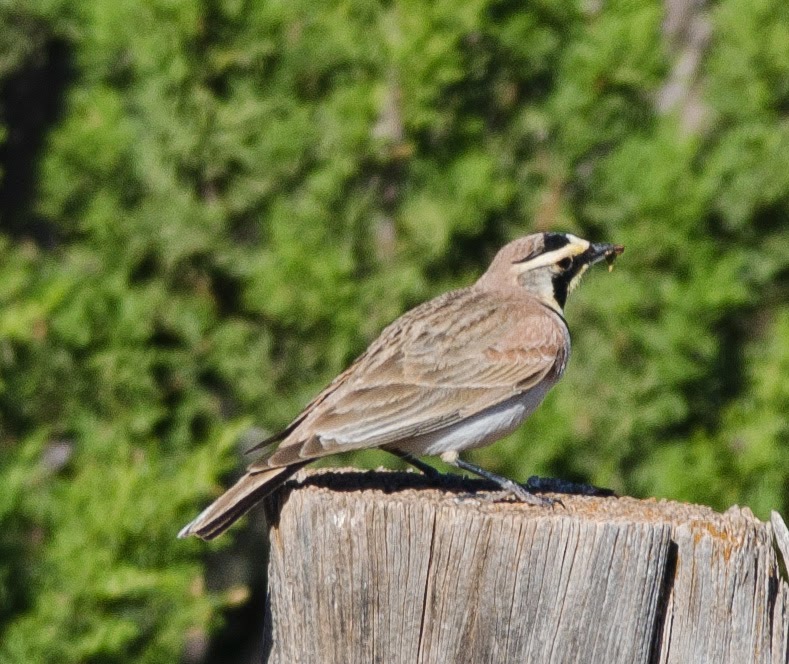
In the Zeniff area, the only photo that I able to get was one of a Horned Lark.  They were quite plentiful in the area along with both Eastern and Western Meadowlarks, a Bullock Oriole and several others.

Horned Lark

From there we headed east and south to the Pinetop/Lakeside community where we have several spots to visit.  The first was Jacques Marsh, which was a new spot for me.  Rather tricky finding the way into this area but quite the spot for birds associated with water.  On this day, the wind made the birding a little more difficult as the wind gusts were quite strong, up to 35 mph.  It is quite an extensive area with several ponds of water and lots of marshy areas.  I discovered a small flock of Canada Goose that included a leusictic one (a genetic mutation that occurs resulting in partial absence of melanin).  It occurs with some regularity in birds, but unfortunately many of the bird born with this fail to live to adulthood.  An odd colored one in a flock is an easier target for predators to focus on.  

Canada Geese - one leucistic

Canada Geese - one leucistic

We also had several Cinnamon Teal in this area and they are pretty darned close to being one of the best looking ducks around.  I have always found them a bit skittish and not always easy to capture in photos but at least one of them cooperated to some degree for me.

Cinnamon Teal

And Yellow-headed Blackbirds were in abundant numbers at this location.

Yellow-headed Blackbird

At Woodland Lake Park, we expected to see Lewis's Woodpeckers and were not disappointed. This is one of the most reliable spots to find this oddly colored woodpecker with its pinkish belly and its red facial patch.

 Lewis's Woodpecker

Lewis's Woodpecker

A Northern Rough-winged Swallow took some time out for a rest from the normal incessant flying like most swallows.  

Northern Rough-winged Swallow

At Billy Creek Trailhead we had several smaller birds including a Acorn Woodpecker and a Mountain Chickadee.  This is a spot that will need more attention in next year's count.

 Acorn Woodpecker

Mountain Chickadee

Also near the trail head and the residential area, an Abert's Squirrel attempted to hide from us by blending in with the branch of a tree.  Those ear tufts are quite an eye catching look.

Abert's Squirrel

We had a totally enjoyable day of birding and counting, even with the strong winds, so it was back to Heber for the night and a glass of wine for the evening.  The next day we were to head home, so we got up early to go to breakfast at one of the best little cafes around and found out they were not yet open, so with about 10 to 15 minutes to kill, we headed to the Navajo County Park in Overgaard and it was lucky that we did as we got to witness a fairly large flock of Pinyon Jays moving through.  Must have been 40 to 50 of them and I was finally able to get a photo of one of them to add to my photo gallery.

Pinyon Jay

Anytime one ends a birding trip with a Pinyon Jay is ending with a great bird!


Tuesday, December 4, 2012

Santa Cruz Flats & Sweetwater Wetlands - 24 Nov 2012

Mentioned earlier this week that I had gotten behind in my blog postings!  This time I have to go all the way back to the 24th of November and try to remember how the day went.  Mark Ochs contacted me on Friday night and wanted to know if I was interested in heading south to try and find the Groove-billed Ani that had been reported at Sweetwater Wetlands.  Of course I did!  So I met him in Gold Canyon and we took the back roads to Tucson and glad I went as we saw a lot of raptors on the way down and on the way back.  But more about the raptors later in the post.  Our first goal was Sweetwater and the search for the Groove-billed Ani.  When we arrived, many other vehicles were arriving and I think just about all of them were there for the same thing, 'Find the Ani'!  We joined up with John Higgins and headed to the west area and ponds 9 and 10 and John was the first one to spot it far away at the top of a tree with some Salt Cedar in front of us.  Mark got his scope on it and I got a really good look at it and could even see the grooves in the bill.  Attempted to take a photo, but too much clutter in front of the bird did not make for a good photo.  So without a good photo of the Ani, I will start off this post with my first photographed bird of the day, a Yellow-headed Blackbird.  This is one sharp looking bird!
 
Yellow-headed Blackbird
 
Other birds I had the pleasure of photographing at Sweetwater Wetlands included a juvenile Cooper's Hawk that had apparently taken a bath and found itself a perch in the sun and was really relaxed in spreading its wings and tail to allow the sun to assist in drying out.
 
Cooper's Hawk
 
The rest of the photos from this place are all water birds of one kind or another; an American Wigeon, a Green Heron, a Northern Shoveler, a Pied-billed Grebe, and a Ruddy Duck.
 
 American Wigeon
 
 Green Heron
 
 Northern Shoveler
 
 Pied-billed Grebe
 
Ruddy Duck
 
Once we left Tucson and headed back home, Mark suggested that we check out the Santa Cruz Flats area for raptors and sure glad we did.  This area is a great place to see and observe many species of raptors. Our little side trip did not disappoint.  We observed numerous Red-tailed Hawks, but probably the most stunning one was a 'Dark-morph' Red Tail.  
 
Dark-morph-Red-tailed Hawk
 
Other hawks included a nice Ferruginous Hawk, a couple of Prairie Falcons and about 8 Crested Caracaras.  The hawks posed nicely on poles for us as long as we stayed in the car.  The Crested Caracaras were a distance away in a farmers corral that did not allow us to get close up views.
 
Ferruginous Hawk
 
 Prairie Falcon
 
Crested Caracara
 
And just to make sure you read the entire post, here is my only photo of the target bird, a Groove-billed Ani.  (Kind of looks like a black blob, doesn't it?)   That is part of bird watching; sometimes even a short glimpse and a really bad photo makes for a wonderful day when you spot a really rare bird and a new life bird! 
 
Groove-billed Ani