Costa's Hummingbird

Costa's Hummingbird
Showing posts with label Broad-billed Hummingbird. Show all posts

Tuesday, February 26, 2019

A Numbers Game

Birding for many people, is a numbers game.  Keeping track of the birds that one can tick off in a county, a state, or the ABA Area, various countries, and finally life birds, is what many of us do while we are observing birds.  The game is sort of like a scavenger hunt with moving targets.  Some birders can recite how many species they have in every county, every state, ABA, and life birds.  For me, I do good remembering my life list number.  I can easily look up my county, state, and life list numbers, but I don't focus on memorizing them as those numbers are constantly changing. 

Since my trip to Ecuador last July, my birding has been relatively curtailed to Arizona.  Yes, I have been making plans for some future trips, but in the meantime, I have been exploring Arizona a bit more and learning more about the birds of Arizona and their distribution.  In the process I have picked up one new life bird, which was last August in the Chiricahua Mountains of southeast Arizona.  Alas, no photos, but I was quite stoked and pleased to see my first Black Swift.  I have also added 8 new species of birds to my Arizona list, of which one of them was the Black Swift.  Adding birds to my Arizona list gets harder every year.  Most are rarities, and require a chase of one kind or another.  And some of these new Arizona birds are birds that I have seen in other US states and 3 of them were birds that I have seen outside of the United States.  New Arizona birds that I have added include Fulvous Whistling Duck (Texas), Ringed Kingfisher (Costa Rica), Short-eared Owl (Washington), Black Rosy-Finch (New Mexico), Gray-crowned Rosy-Finch (Oregon), White-throated Thrush (Mexico and Costa Rica), and Ferruginous Pygmy-Owl (Mexico).  {The places in parenthesis, are the locations where I have seen them before seeing them in the United States or Arizona.} 

The only species that I was able to photograph in Arizona during my recent chases, are displayed below and even some of these photos are less than stellar. Lots of reasons for the mediocre photos and for some, why photos are absent. I could probably write a whole blog post on why photography can be so fickle.  But for me, the nature of birding does not always allow for great photos.  It is more about observing the bird and enjoying the moment.  Sometimes we get lucky and sometimes we fail.

Black Rosy-Finch

Black Rosy-Finch
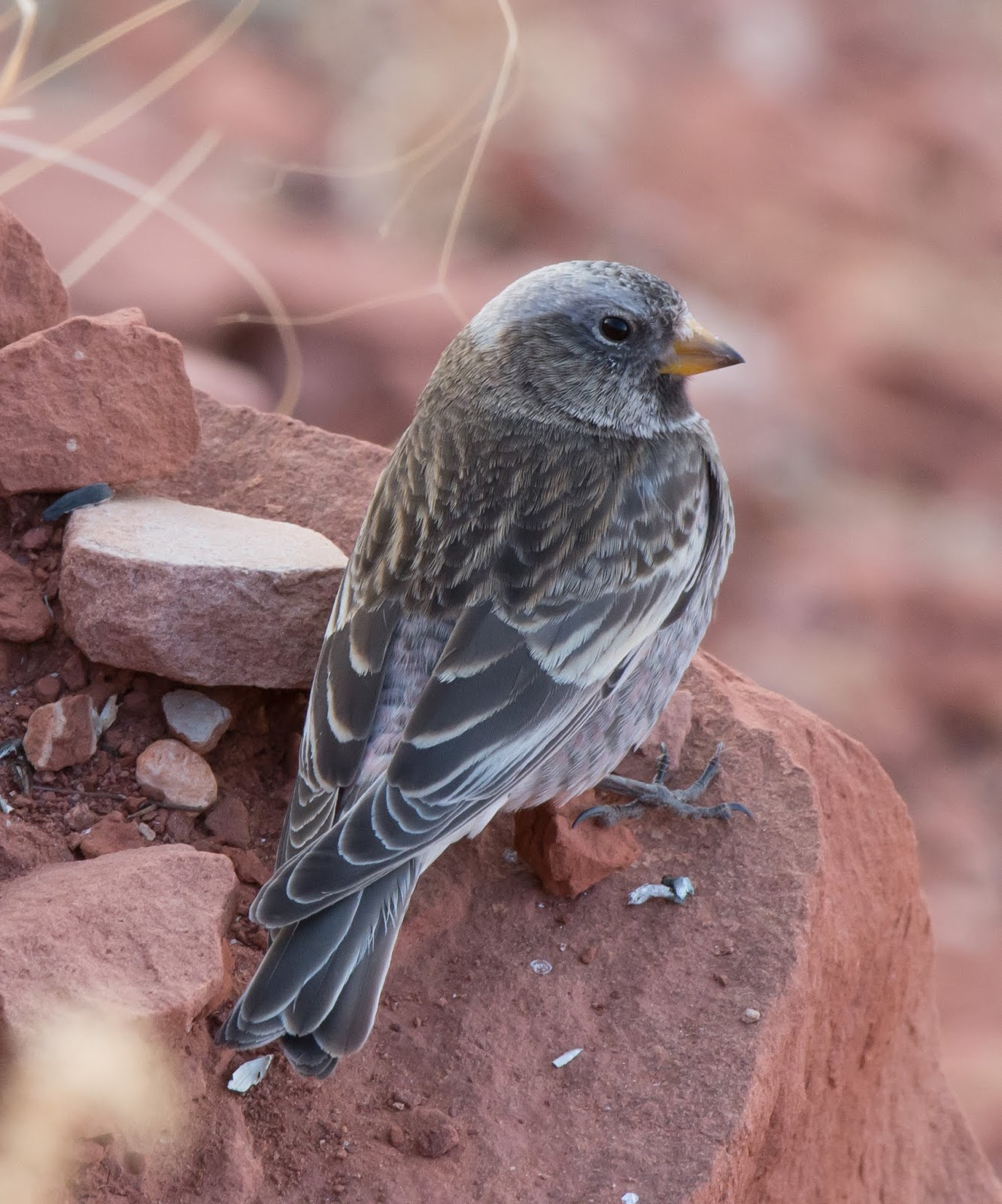
Black Rosy-Finch

White-throated Thrush

Ferruginous Pygmy-Owl

Obviously, when chasing some of the rarities, other birds are seen as well.  When one is birding in a location that is not your normal spot, you also take time to enjoy the new habitat and what might be waiting in the trees, grasses, or water.  For instance, the White-throated Thrush was being seen in Madera Canyon, and when I get to Madera Canyon, I never fail to stop at the Santa Rita Lodge to enjoy their birds.  For the second year in a row, a male Elegant Trogon has taken up its winter residence in the lower areas of the canyon.  I never get tired of this bird.  At one time this was called the Coppery-tailed Trogon and the second photo definitely puts credence to that name.  

 Elegant Trogon

Elegant Trogon

That trip also took in some of Patagonia and Santa Cruz Flats as well.  Always great to visit southeastern Arizona.  

 Acorn Woodpecker - Female

 Broad-billed Hummingbird - Male

 'Red' Fox Sparrow

 Western Meadowlark

White-nosed Coati - Santa Rita Lodge

When the trip for the Ferruginous Pygmy-Owl took place, I was lucky enough to be accompanied by birding friends, Tommy DeBardeleben, Josh Wallestad, and Caleb Strand.  And true to form, we explored more areas, including another trip to Madera Canyon.  Once again that male Elegant Trogon was just irresistible.  

 Elegant Trogon

 Whiskered Screech-Owl - Can you see it?  (See next photo)
Now this is great camouflage!

Whiskered Screech-Owl - Cropped close of preceding photo.  

2019 will a bit different for birding.  I am currently not planning any international trips for this year, but do have some trips within the United States in the plans.  I hope to increase my numbers of life birds and also ABA birds in the process.  


Tuesday, June 12, 2018

The Merry Month of May

May brings even warmer temperatures and more migrants.  But it also signals that summer is soon to arrive with its blistering triple digit temperatures in Arizona.  One has to take advantage of the nice weather whilst one can!  And these blog posts need to continue as it won't be long and I will be embarking on a new adventure outside of the Unites States.  More details will be provided at the end of this post.  

One of my trips in May involved a journey into northern Arizona and an oasis in the desert east of Flagstaff.  This jewel of a birding spot, Meteor Crater RV Park, was new to me, but I had heard of it in the past as it seemed to bring in some really special migrants every year.  This spring was no exception, as an Ovenbird made its appearance, and an invite from Barb Meding to join her on quest to see if we could locate this bird.  Ovenbird is not a life bird for me as it is fairly common in eastern US, but I had never been able to add it to my Arizona state list.  What a great place to bird and the hosts are very welcoming to birders.  Go inside and ask to go birding and they point you to the doors in the back and into the great little oasis they have created.

 Ovenbird


A Bendire's Thrasher was also a bit of a surprise at this location.  I was not aware that their breeding range extended that far north. 

Bendire's Thrasher

On the way home, we spent a short time looking for the Gray Catbird that had been reported in the Flagstaff area.

Gray Catbird

In addition to this trip up north, I also made a couple of 3 day trips.  The first trip was to Rancho El Aribabi in Sonora, Mexico, to assist in leading the Tucson Audubon Society's field trip to this magical place.  The location is only about 35 miles south of the US/Mexico border and many of the bird species are common with Arizona, but a couple of species are a bit more prevalent and easier to see and hear, namely, the Sinaloa Wren.  Was able to get a photo and also made a video on my cell phone just to capture its rich melodic song.  Not much to see on the attached video, but you can hear it clearly.

Sinaloa Wren

Click on this link:

Video and audio file of a Sinaloa Wren.

Other birds and arthropods are shown below.

 American Rubyspot

 Broad-billed Hummingbird

Painted Damsel - Beautiful and a first for me!

 Bullock's Oriole-Hate feeder shots, but sometimes you have to take advantage.

 Olive-sided Flycatcher

Sonoran Spotted Whiptail

The second trip in May, was a trip to Greenlee County, Arizona, that I led for the Maricopa Audubon Society.  We spent 3 days exploring some of the birding spots in Greenlee County, which is the most under-birded county in Arizona, mostly due to its location along the far eastern border with New Mexico.  

 Cedar Waxwing

 Olive Warbler

Vermilion Flycatcher - Female

This is the third year in a row that a Yellow-throated Vireo has returned to the same location in Arizona in Yavapai County.  It really does not belong here in the summer, as their normal range in the eastern half of the US.  Of course I had to chase it to add it to my Arizona list.

Yellow-throated Vireo - Rare for Arizona

The rest of my exploration time in May focused on local places, including my 'patch' area (South Mountain Park), where I go hiking to get some exercise and see what all kinds of natural flora and fauna I can find.  

 Black-tailed Gnatcatcher

Black-tailed Gnatcatcher

 Adult Verdin with fledgling

 Loggerhead Shrike fledgling

White-winged Dove

Cordilleran Flycatcher

 Coyote

Antelope Ground Squirrel


Black-tailed Jackrabbit

 Springwater Dancer

Zela Metalmark

The month of May was a very busy, but a very rewarding month for getting out and exploring what nature has to offer in Arizona and Sonora.  

In July, I will be traveling to yet another international destination.  Obviously the focus of my destinations are centered around our wonderful avian friends in this world.  Ernie Welch and I decided on a trip to Ecuador this summer.  Ecuador is a country that is situated on the Equator and in size is about the size of the state of Nevada.  But it ranks high in bird species density; over 1600 species has been reported in this beautiful country.  Currently, my free time is spent in preparation for this exciting trip.  I hope to add a lot of new life birds to my list.    


Tuesday, March 29, 2016

Santa Rita Mountains Visit

One thing that I really enjoy since I retired and think I have a bit more free time on my hands, is to assist out-of-state avian enthusiasts find some of the wonderful and special birds that Arizona has to offer.  Recently, I was put into contact with one of these birders, through a mutual friend, Jennifer Rycenga.

Michael Gertz and his family was moving from San Francisco to Ohio, and Mike was going to drive to Ohio via Arizona, while his family was flying to Ohio.  We made arrangements to meet in Madera Canyon as I thought that would be the easiest place to use as a base camp for the day and a half that I had to spare and the place he might see the biggest diversity of our avian wonders.  What I quickly discovered is that Mike is an excellent birder.  He has a very good ear and a very quick eye.  He does not miss much when it comes to birding and he has studied his birds well and needed very little assistance from someone like me.  It is always fun to watch birders new to Arizona react to some of these new birds they get to witness.

After spending some time at the feeders at Santa Rita Lodge, and racking up some birds for Mike, we headed to Florida Canyon.  This past winter, several reports with photographs indicated that a male Elegant Trogon had been seen fairly frequently near the parking area.  I knew there were possibilities for other birds in this location as well and even though it was already afternoon, we decided to check it out.  We did not find the Elegant Trogon when we arrived and when we returned from the hike, so that was a miss.  However, we did have some success on the trail.  At one point, we had stopped on the trail and while we were talking, we noticed something move in the dry grass about 3 feet in front of us.  Did not get a good look so was not sure what it might be, but just a few seconds after the first movement, a second and a third critter moved and that was when we caught a good glimpse of them:  3 Montezuma Quail, rustling away in the undercover of the dried grass!  This is not always an easy bird to detect, so every viewing of one is pretty exciting.  Obviously, we were not able to get photos, but the next bird along the trail was a different story.

We had detected a gnatcatcher, and knowing that this location is a good spot for Black-capped Gnatcatcher, I had a hunch this was our bird.  (Although, we did have a Blue-gray Gnatcatcher calling earlier on along the trail.)  Arizona is about the only reliable spot in the United States to see Black-capped Gnatcatcher, and we not only got to see it and photograph a nice male, we also got to witness it in the construction of a new nest.

Black-capped Gnatcatcher


Black-capped Gnatcatcher - Nest Construction

With daylight waning, we decided to call it a day, but as dusk arrived in Madera Canyon, the calls of the Whiskered Screech Owls kept us entertained.  We even hiked up one of the trails in the dark, but they did not cooperate with us by showing themselves.

The next morning, our target was the Madera Picnic area as regular reports were coming in daily of a pair of Hepatic Tanagers were visiting the spot.  It was just a short drive to the spot, but what greeted us on the road was really quite amazing.  A Hog-nosed Skunk had apparently laid claim to the road was was sauntering down the road and pretty much staying in the middle on the double yellow lines.

 Hog-nosed Skunk


(Follow the yellow brick road.)

Once we reached the picnic area, it was just a matter of waiting for the sun to rise up over the mountains in the east.  Once that happened, then the female Hepatic Tanager flew in and followed shortly thereafter by the male.

 Hepatic Tanager - Female


 Hepatic Tanager - Male


From here I had decided to go the Patagonia Lake State Park; another spot where the Elegant Trogon has been known to spend the winter.  This place was very birdy and we had a hard time keeping to our schedule to look for the trogon, as witnessed by these next 2 photos of a Vesper Sparrow and a Broad-billed Hummingbird that we found as we headed towards the trail.  

 Broad-billed Hummingbird


Vesper Sparrow

Along the trail as we headed down, we met a few birders that were headed back up and they had informed us that they had seen the trogon and they gave us an idea as to where they had seen it.  One of the birders mentioned that there were still more birders down there watching it so it would be easy to find.  We arrived in the general area that they had mentioned and all we found was an older couple sitting on a bench looking out at the lake, so I asked them if they had seen the trogon and they said yes, they had and that it took off into a ravine back behind them and were the last to see it.  So much for getting it easy and handed to us on a silver platter.  

So the two of us headed back into the drainage area where this couple advised it had flown.  We split up a bit and were checking out any and all trees.  A Northern Cardinal male had flown into an evergreen green and was incessantly calling and singing.   I tried to ignore it, but it finally got the best of me and I went to take a look at it.  Boy did that bright red bird stand out in the shade in that evergreen.  But wait, off to the left, I noticed another splotch of red in the tree and its sure was not another cardinal.  I quickly called out to Mike to let him know that I had found it and he did not waste any time in getting there.  It was rather deep in the trees, but we found an angle that provided us some good views and photos.  We did not want to approach it any closer and cause it to fly.  Not sure that it would have as it was busily preening itself and seemed unconcerned with us.  By that time we had attracted another birder that also came in to watch and get photos.  This bird is probably one of the most sought after birds in the United States and Arizona is one of the best places to find it.

Elegant Trogon


Success in finding such a special bird is always an exciting thing and I knew this just made my day.  Even I enjoy seeing this bird anytime I can.  We had one more stop to make and that was at Paton's in Patagonia where we were going to try locating a Violet-crowned Hummingbird.  This spot is probably the most reliable spot for this hummingbird from Mexico, that just barely makes its range into the United States.  When we arrived, the other birders that were there advised us that it had been coming in and had a favorite feeder so we tried keeping our eyes on that feeder while also watching all the other birds come and go.  It did not take long for Mike to spy its arrival on its preferred feeder.
  
Violet-crowned Hummingbird

We then returned to Madera Canyon and Santa Rita Lodge as we planned to both depart early the next morning.  I was heading home to Mesa and Mike was headed to some other spots in Arizona before heading out to Ohio.  In the short time that I spent with Mike, he had accumulated 16 new lifers, but he got many more on his own at other spots.  On our return to Madera Canyon, the Wild Turkeys were still present including one Tom that was putting on a display.  Later as dusk settled in, the Whiskered Screech Owls began calling again and on this second night Elf Owls started calling as they had returned as well.  Mike caught a brief look at one of the Elf Owls, so it was a fitting end to our adventure.

 Wild Turkey - Hen


Wild Turkey - Tom

Mike is an exceptional birder and with his new residence in Ohio, he is going to have a very interesting spring and summer with all the new eastern birds that he will be exposed to this year.  Who knows, maybe someday in the future our paths will cross and I will have an opportunity to go birding with him again.