Costa's Hummingbird

Costa's Hummingbird
Showing posts with label Stripe-headed Sparrow. Show all posts

Saturday, August 19, 2017

Costa Rica: Parque Nacional Carara, the Finale.

Nearing the end of our stay and with only one more full day left to go birding near San Jose, I had decided the Carara National Park would be the best place to go for the more unusual birds that I had not yet seen.  This park is located on the Pacific Coast about 2 hours out of San Jose and was going to be hot, humid, and most likely mosquito infested.  Chris and Michael had decided to spend the day exploring the city of San Jose, so I was on my own.  Thankfully, Serge Arias, was able to assist me in finding a guide that would take me to this location.  He arranged for a great young man and an awesome birder by the name of Abelardo to take me there and help me do some birding.

This park has a wonderful array of birds and the conditions were pretty much what I expected - humid and wet with plenty of mosquitoes that we had to share space with.  We were well prepared as we carried repellent with us and for the most part it worked, but had to re-apply it from time to time.  It is a tropical rain forest with all kind of vegetation which created a lot of low light conditions.  The conditions, plus my camera a bit off on its ISO settings, created a lot of photography challenges.  I just rolled with the flow and tried to make the best of it.  Even resorted to trying to use a flash in a couple instances. 

I added a total of 18 new life birds in that awesome place that pushed me over the 800 mark easily.  My list of lifers at this incredible spot include:  Gray-cowled Wood-Rail, Long-billed Hermit, Slaty-tailed Trogon, Black-throated Trogon, Lesson's Motmot, White-whiskered Puffbird, Rufous-tailed Jacamar, Scarlet Macaw, Black-hooded Antshrike, Bare-crowned Antbird, Chestnut-backed Antbird, Cocoa Woodcreeper, Ochre-bellied Flycatcher, Royal Flycatcher, Bright-rumped Attila, Orange-collared Manakin, Red-capped Manakin, and Rufous-breasted Wren. Below are some of those that I was able to photograph and many of the photos leave lot to be desired.  But just seeing these birds was a thrill and so glad I explored this park with a great guide.  Thanks to Abelardo for helping me find these birds and thanks to Serge for making arrangements for Abelardo to be my guide.  I highly recommend both as future guides for anyone that plans a trip to Costa Rica.

Black-hooded Antshrike

Black-throated Trogon

Chestnut-backed Antbird
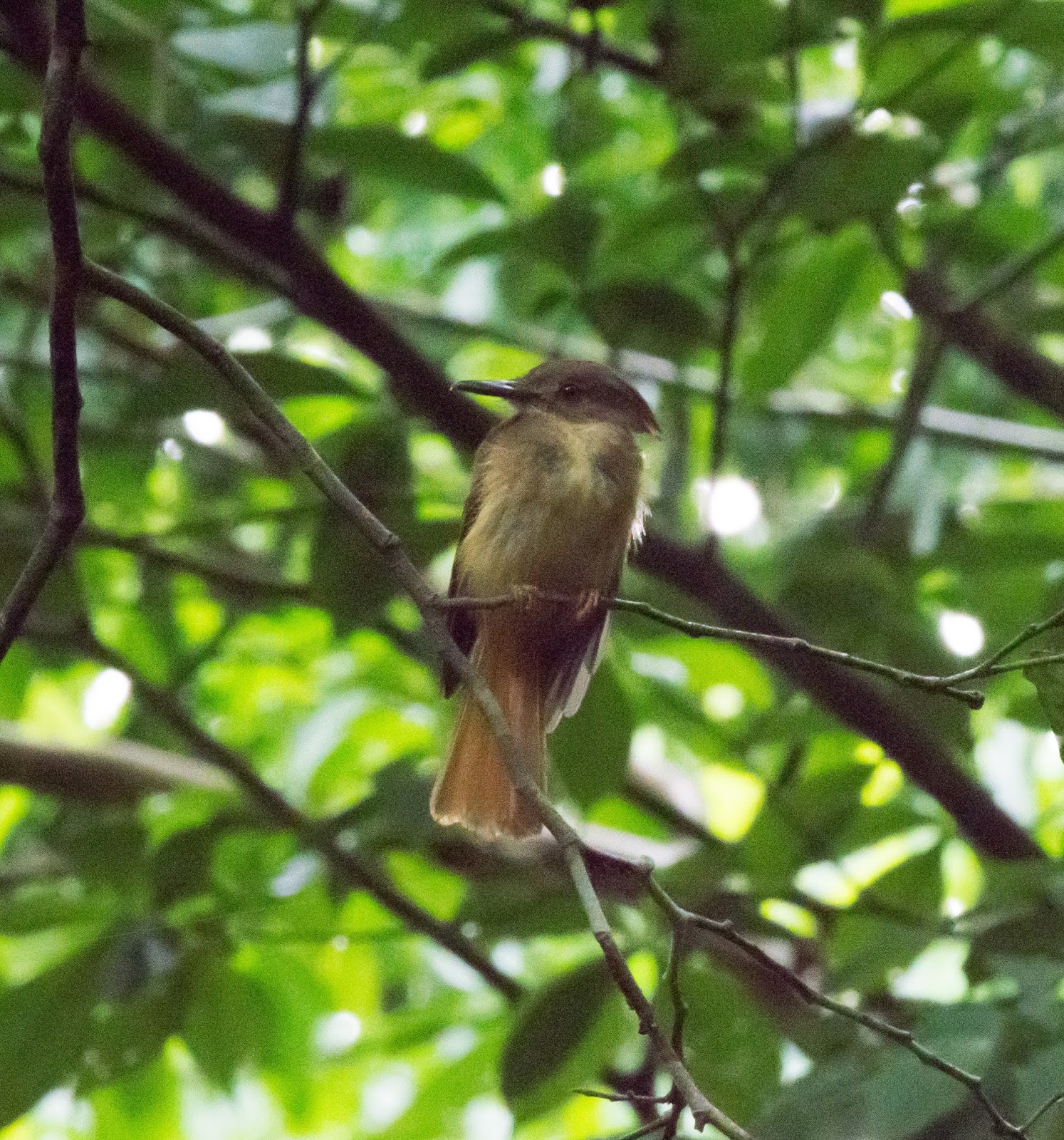
Royal Flycatcher

Rufous-tailed Jacamar

Slaty-tailed Trogon

White-whiskered Puffbird - Female

White-whiskered Puffbird - Male

Orange-collared Manakin (About all one can see is the orange collar!)

Within the park, I was also able to photograph an Agouti and an Owl Butterfly.

 Agouti

Owl Butterfly

Just outside the park and down the road from our entrance to the park, Abelardo, took time out to stop at the river so I could view the resident American Crocodiles.  One of them was quite large!

 American Crocodile


So glad I made the decision to visit this spot and add so many new birds, with the assistance of a really great guide!  A bit THANK YOU to Abelardo and also to Serge Arias for working out the details for me.  Even with all the mosquitoes, it was definitely a day to remember.

The next day we headed back to Liberia since we were flying out from there.  We did have a bit of free time in Liberia and of course we did some birding, when it wasn't raining.  While I did miss out on the Yellow-naped Parrot that Chris and Michael saw in San Jose, I got lucky and was able to add that species to my life list in Liberia. Got some photos of a very cooperative Stripe-headed Sparrow as well.

 Yellow-naped Parrot


 Stripe-headed Sparrow


I started this trip with 689 life birds and finished with 814.  An increase of 125 species was an incredible number of new life birds.  Yes, there is a lot more to explore in Costa Rica, and would love to go back.  Also have several other destinations in mind as well.  These trips are not always inexpensive, so budgeting must be thought out well in advance.  


Friday, August 7, 2015

Chiapas: La Sepultura, The Finale

As a reader, many of you are thinking I should be done with blog posts on this one day field trip!  Well, it was so special that if I tried to make it all one post, most would have gotten bored very quickly when reading it due to the shear length.  So this will be my third and final blog post on this remarkable day.

We left the pond and traveled just a short distance up the road where we stopped to try for another bird that had been located during scouting trips.  But along the way, I had the opportunity to view some Blue-black Grassquits.  This is a bird I had seen on the El Ocote trip, but since that day was probably my worst day of birding, this time I got to see them and enjoy them and actually get some photos of them.  They are definitely blue/black!!!

 Blue-black Grassquit

 Blue-black Grassquit

Blue-black Grassquit

Now back to the bird we were going to try finding, a Ferruginous Pygmy-Owl.  It was found before our gathering and was found on most of the other trips.  I think it was missed on one trip.  It took a while but it finally called from a distance and it eventually moved close to the road.  This is one of the rarest owls to find in Arizona, but they are fairly common in Chiapas.  A very limited range in Arizona, usually near the Organ Pipe National Monument and access to that area has been sketchy in the past.  I still want to try locating one in Arizona, but that will have to wait until my retirement becomes effective and when I have more time to devote to bird trips.  These owls are small at a little under 7" in length and can go undetected very easily.

 Ferruginous Pygmy-Owl

Ferruginous Pygmy-Owl

From there, we moved up the road a few miles and then traveled down a dirt road that was lined with small ponds of water and trees that were covered in heavy vegetation.  We had to be near some open water as the sky was filled with many water birds including Magnificent Frigatebirds.  This is an unmistakable bird in flight with its long forked tail and long, thin wings.  They are sometimes known as pirates of the sea as they will often harass other birds in flight hoping the other birds will disgorge anything they have eaten, then the frigatebirds will swoop down and catch the regurgitated spoils in flight.  

 Magnificent Frigatebird - Male

 Magnificent Frigatebird - Female

Magnificent Frigatebird - most likely a juvenile male

At one point we actually witnessed one harassing a Great Egret.  Don't think it had any luck in its quest to get a meal, but it was really a neat experience to watch.  Unfortunately, it was a bit too far for great photos, but I had to try and capture some of the action.

 Magnificent Frigatebird & Great Egret


Another life bird that I got to add to my list was the Wood Stork as one was flying over.  I really want to see this bird better than a fly-over and will probably have to make trip to the Gulf Coast to do so.  We also had a fly over Anhinga but it was a bit further away and I had trouble getting it into focus on my camera.

Wood Stork

Finally our day was drawing to an end and as we walked up the dirt road to our van, I heard a chip note in the roadside bushes that sounded a lot like the single chip note of the Verdin that is so common in Arizona, but I knew it was not.  Kind of an unexpected last minute new life bird for us was the Stripe-headed Sparrow.  A rather large sparrow with a large bill and quite attractive at that.

Stripe-headed Sparrow

With this last planned trip, our tours had come to an end, but Chris and I had extended our stay for 2 additional days while most of the crowd headed home.  And I am very glad we did (it was Chris's idea in the first place) as we got more photos and a few more birds on our own.  I have a couple more blog posts planned and they will have some more cool birds included.