Costa's Hummingbird

Costa's Hummingbird
Showing posts with label Williamson's Sapsucker. Show all posts

Sunday, June 29, 2014

The Kaibab Plateau, the Final Day

Saturday night the winds had calmed down, but that also brought lower temperatures (down into the 30's) that night.  But with the proper equipment, camping in the cold is not all that bad and sleep was fairly easy on this second night.  This was going to be our last day of the expedition, but with a long 6 hour return drive looming on the horizon, many of us decided to make it a short day.  The entire group stopped near the entrance of our turn off to our camp site to check for a few birds in the area where we had seen the Downy Woodpeckers the night before.  This morning they were there to greet us again along with some Williamson's Sapsuckers and some Evening Grosbeaks, which was a new bird for me.  Although my photos left a lot to be desired, at least I got to see and hear them for the first time.  (Guess that means I will have to back again for better photos!)

Williamson's Sapsucker - Male


Williamson's Sapsucker - Male

Evening Grosbeak

The entire group decided to head into the Grand Canyon National Park on this morning and visiting the North Rim is much different than the South Rim.  Due to the remoteness of the North Rim, it only gets about one tenth the number of visitors on a yearly basis, but the road is also closed to the North Rim in the winter months due to snow.  The views from the the North Rim were just as awesome.


At the lodge at the North Rim, we found some cool birds as well, including a pair of Western Bluebirds that were feeding young.  We also had a Virginia's Warbler, Black-throated Gray Warblers, and 'Audubon's' Yellow-rumper Warblers.

  Western Bluebird - Male

Virginia's Warbler

Black-throated Gray Warbler


'Audubon's' Yellow-rumped Warbler

We also found Steller's Jays which are gorgeous birds, but we got to see a different side of them as one had stolen a newly hatched junco chick from a nest and was feeding on it.  Probably not a photo that many want to see, but it also shows nature in the raw.

Steller's Jay

Had some great mammals as well along the road.  There is a herd of bison found inside the park.  The park calls them bison, but truth be told they should probably be called 'beefalo' as they are remnants of a ranching operation from years back of a rancher that was crossing bison with cattle as an experimental ranching idea.  They animals do look quite a bit like bison, but not sure how purebred bison they really are.  


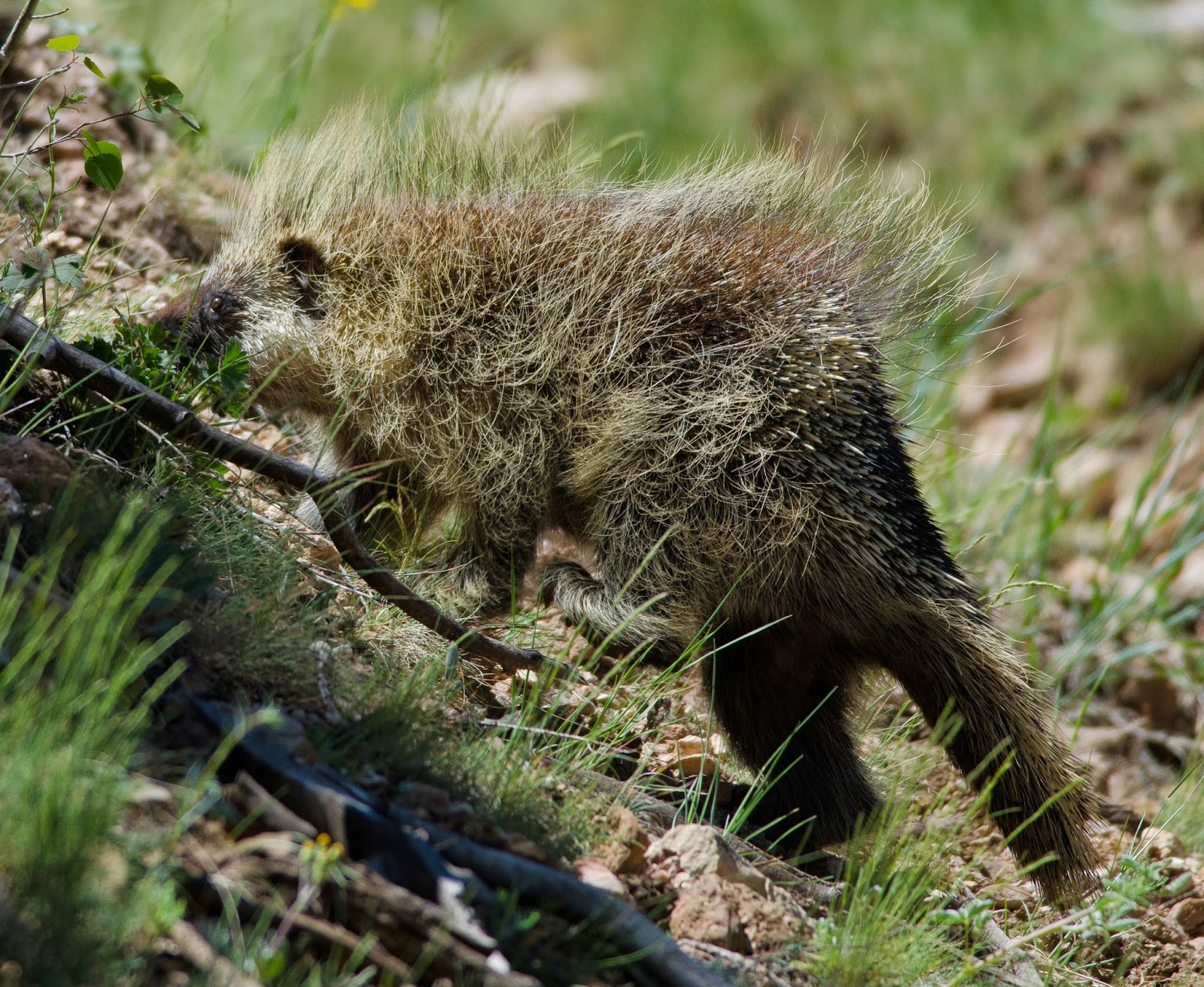
Probably the most interesting mammal that we discovered was a Porcupine along side of the road as we were leaving.  Got to see 2 of these animals when we were in New Mexico in February of this year, but both were sleeping in trees; this one was actively grazing along side of the highway.

Porcupine


Porcupine

What a way to end an exhilarating field expedition!  And I have to add a group photo of the 9 campers that journeyed to the North Rim.  Want to thank a great group of people that made this an exciting and enjoyable experience;  Eric Hough, Magill Weber, Chris Rohrer, Lauren Harter, Nathan Williams, Brian Ison, Michael Lester, and Jarrod Swackhamer. 


Wednesday, December 18, 2013

Boyce Thompson Arboretum - Another Rarity

After such a great day on Saturday and chasing some rarities, I figured that my odds of anything special on Sunday were just about nil.  But there had been a few reports of a Varied Thrush at one of my most favorite spots, Boyce Thompson Arboretum which is only about 45 minutes from my house.  So it was not hard for me to decide to check it out, because of my love for this place.  I arrived about 15 minutes early before they had opened the gates, so I parked my vehicle on the opposite side of the highway near the gate and of course got out of the car and started enjoying the birds that were found just along the road.  The star of the road side was a male Pyrrhuloxia that paid a visit to me.  Often nicknamed the 'Desert Cardinal', it is a bird that I do not see as often as I would like.  What a great way to start my Sunday adventure!
 
Pyrrhuloxia
 
While wandering around and looking for the Varied Thrush, I realized that this location had become a hotbed for another species of thrush, the Hermit Thrush.  They were everywhere and even though they are not the most colorful of birds, they are always a delight to see.  Not as flighty as the warblers, but can be sitting on a branch watching you and you could look right past them.  They do blend in with their surroundings quite well but they are so stately sitting on a perch. 
 
 Hermit Thrush
 
 Hermit Thrush
 
Hermit Thrush
 
Of course there were other birds to entertain me while searching for my target bird.  There were many Spotted Towhees, but they did not want to show themselves so I settled for some photos of a female Northern Cardinal and a Curve-billed Thrasher.
 
 Curve-billed Thrasher
 
Northern Cardinal-Female
 
With the help of some others, we knew the vicinity where the Varied Thrush was hanging out and with the help of Bernie Howe, I finally camped out where he had seen it earlier and we waited.  Patience and silence really paid off as it came into view foraging in the fallen leaves from the colorful deciduous trees in the area.  The colors of this bird blended in so well with the leaves.  Success on this find as well.  This is a bird that breeds in the far northwest of the United States and extending all the way to Alaska.  But in the winter some of these birds can wander far and wide, and this one definitely wandered quite a distance.
 
 Varied Thrush
 
 Varied Thrush
 
Varied Thrush
 
I figured my day was now complete and I could start making my way back to the visitor center, but along the way, I met a couple of other birders and they mentioned that they had seen a male Williamson's Sapsucker earlier in the picnic area. Well that peaked my interest as well as that is not a common bird to be found.  So Bernie and I headed to the picnic area to try to find it and a couple of other birders from Idaho arrived just before us and had already found it in one of the pines in the picnic area.  Last spring a female had made BTA its home for a couple of weeks and it drew many birders in to take a look.  This time it was a male and was about 35 feet up in the tree. 
 
 Williamson's Sapsucker
 
Williamson's Sapsucker
 
Another successful trip to Boyce Thompson Arboretum.  I love this place and will go back often.  Its a membership that is a worthy investment.


Sunday, July 28, 2013

Above the Rim - Day 1

Since my fantastic trip to Sonora, Mexico at the first of the month, and with the suppressing heat of the Arizona summer in full force, I decided to take it easy for at least one weekend in the month of July.  But the last 2 weekends have been covering a lot of miles all across the state and the extremes of Arizona weather and habitats.  On July 20th and 21st, I spent 2 days of birding with some great birding partners above the Mogollon Rim and in the cool pine forests in and around Heber, AZ.  I was joined by Barb Meding, Ellen Hairston, and Chris Rohrer and we made quite a team searching for birds and any other critters that caught our attention.

We departed Mesa early on Saturday morning and headed straight to Woods Canyon Lake, which is in Coconino County and just above the rim.  Gorgeous lake surrounded in pines and with an elevation over 7000' the temperatures were very refreshing.  And naturally this place is extremely popular with campers and many people fishing, so it was very crowded.  It also has its resident Bald Eagles which we had the honor to view across the lake.  The first bird that cooperated with us and allowed great viewing and photos was that of a female Western Tanager that did not appear to be very concerned with our presence as it was actively feeding nearby.  At bit later we also found a male that was also feeding in a tree.  The male of this species is an awesome and beautiful bird to behold.

 Western Tanager, female

  Western Tanager, female

Western Tanager, male

Virtually in the same area, we had several Golden-mantled Squirrels foraging in the rocks and when one posed nearby with the remains of a peanut shell, of course it wanted its photo taken so I obliged.  It was not until I got home and started processing the photos that I noticed the reflection of 4 humans in the eye.  Kind of puts a bit of perspective on what it is seeing as we ogle these creatures.

 Golden-mantled Squirrel

Look at those humans staring at me!!

Another small rodent was active in this area as well, a Gray-collared Chipmunk was delicately balanced on a small limb, also feasting on what appears to be a peanut.  Chipmunks can be identified by stripes on their faces, whereas squirrels do not have have facial stripes.

Gray-collared Chipmunk

As we started walking the trails around the lake, we started encountering Townsend's Solitaires, both adults and juveniles.  The juveniles have a very different look as they appear very speckled.  The adult in the photo below is in the process of swallowing a berry that it had plucked.  Note the buffy colored wing patch on both birds which helps to clearly identify this bird.

 Townsend's Solitaire, adult

Townsend's Solitaire, juvenile

Shortly thereafter a male Williamson's Sapsucker flew in and was intently probing in the trunk of a nearby pine.  This was the first time I had actually seen a male of this species, so it was quite a treat.  Got to see a female earlier in the year at Boyce Thompson Arboretum.  Unfortunately, this male did not cooperate by turning its head for photos, but just being that close to one was good enough for me.  Maybe the next time I will have a better chance at a better photo.

Williamson's Sapsucker

Also making brief appearances were a Red-breasted Nuthatch, a Brown Creeper and a Mountain Chickadee.

 Red-breasted Nuthatch

 Brown Creeper doing what they do best, probing for insects.

Mountain Chickadee

I think that everyone in our group will agree that the highlight of the day were the Red-faced Warblers.  The trees were full of them and with obvious juveniles mixed in, it was a pretty good indication that they had a very successful breeding season this year.  This is a bird that is highly sought after by many birders and is usually only reliable in the summer breeding season in Arizona and New Mexico.  They have been seen in parts of California and Texas but not on a consistent basis.  Most people agree that this is a unique and stunning bird.

 Red-faced Warbler

Red-faced Warbler

Our next stop was Twin Springs area, which was in Navajo County, luckily we had Ellen along and with her sharp eye she discovered this Greater Short-horned Lizard on the ground.  It would have been easy to step on it had she not seen it.  Always a cool find and adds to the enjoyment of a day of birding and enjoying nature.

 Greater Short-horned Lizard

Greater Short-horned Lizard

We spent the night in Heber in a quaint little motel and we discovered a bat in the yard of the motel.  We knew it was not well as this was not typical bat behavior, so we kept our distance.  I was able to capture a couple of photos of this little one, but alas when we returned from dining, it had expired.  Always sad to see a creature of nature perish, but in the natural world life is harsh.  Since I am not any kind of an expert on bats, I have yet to determine what species of bat this might be.  If anyone is reading this and can give a positive ID on it, I would appreciate it.

*************** Update on the bat *****************
Not 100% positive, but this might be a Mexican Free-tailed Bat, one of the most common in the US.
****************************************************************************

Unknown Bat

Thus our first day came to a close with the four of us enjoying a little wine in the motel courtyard in the evening.  Day two would dawn bright and early with another day of adventures.  


Monday, March 11, 2013

Boyce Thompson Arboretum - 10 March 2013

OK, I finally got away from South Mountain Park and this time I ventured east to Boyce Thompson Arboretum, one of my favorite places.  And all I can say is WOW!  What a great day to go.  This place was a birders haven on this day as the AZFO was holding a meeting there and it attracted birders from all of the state and I got to meet a lot of people that I knew by name only.  And of course, the icing on the cake was a couple of special birds that have been seen at this location and past couple of weeks.  Both species happen to be Sapsuckers; one was a male Yellow-bellied Sapsucker and the other was a female Williamson's Sapsucker.  Just a couple of months ago, I saw my first Yellow-bellied Sapsucker and then saw a 2nd one on one of my CBC's.  I had never seen the Williamson's Sapsucker, so this one was a new life bird for me.  The Yellow-bellied is a very handsome bird and with the assistance of others, it was found and I lingered behind to try to get some photos and it finally obliged. The Williamson's female was much easier to find as she has a special territory that she seems to favor.  The male of this species is much different in appearance and someday I hope to see one of those handsome birds as well.

 Yellow-bellied Sapsucker-male

Williamson's Sapsucker-female

While the Sapsuckers were the main draw with many birders coming and going to get a look, the rest of this place did not disappoint!  Since we are on the subject of woodpeckers (Sapsuckers belong to the woodpecker family), I had a nice male Ladderback Woodpecker pose for me on top of a Prickly Pear Cactus.

Ladderback Woodpecker-male

 You really know springtime has arrived in Arizona with the birds putting on quite a display and even found a pair of Curve-billed Thrashers feeding young chicks already.  The thrashers nest was in the confines of a Cholla Cactus, which is one of their favorite nesting habitats.  Will definitely keep a lot of the predators out!  Also had a nice looking Verdin land on another cactus to pose for me with its nice yellow head and its dark red shoulder patch.  It is amazing that they can land on a thorn of a cactus and be delicately balanced and not be harmed by any of the spines of the cactus.

 Curve-billed Thrasher, with babies

Verdin

Down in the picnic area, the Northern Cardinals were putting on quite a display, there were 2 males and 2 females flitting from tree to tree with one of the males dropping to the ground allowing a photo without all the twigs in front of them.  A Lincoln's Sparrow stopped by for a visit in the same area shortly after the cardinals dispersed.

 Northern Cardinal

Lincoln's Sparrow

Probably the most vocal and gregarious of all the birds that day were the Cactus Wrens.  They were everywhere, singing and chortling and croaking, I think trying to entice a mate.  Had one land on the dried parts of a palm tree and then dug in and went up inside the dry area and soon emerged with a morsel, a bee.  Great for the Cactus Wren, but not so good for the bee.   

Cactus Wren

Cactus Wren

What a wonderful day of birding!