Costa's Hummingbird

Costa's Hummingbird
Showing posts with label Juniper Titmouse. Show all posts

Tuesday, March 3, 2020

February: A Costa's Kind of Month

The month of February this year is not only a Leap Year month with 29 days, but it has proven to be a great month for me in observing one of the my favorite hummingbirds; the Costa's Hummingbird.  When the desert receives some proper rainfall, the Wolfberry (Lycium andersonii) bushes come to life and start blooming. This shrub in bloom is a favorite of hummingbirds with the small lavender blossoms and when they set fruit and it ripens, many other species of birds feed on the berries when they ripen.  This winter has been fairly decent in the rainfall department, so it has been fun observing the Anna's and Costa's Hummingbirds fight over feeding rights and defending their territories.  These mornings have allowed me to get some fun photos of the Costa's Hummingbirds and a few of the Anna's as well. Below are 3 photos of Costa's males and 3 photos of Costa's females, followed by 2 photos each of Anna's males and females.

Costa's Hummingbird - Male


Sipping nectar from Wolfberry blossoms.

Costa's Hummingbird - Female


Anna's Hummingbird - Male


Anna's Hummingbird - Female


Hummingbirds have kind of been the stars of the show for the month, but they are most definitely the only interesting and great birds that were observed.  The one regular Western Screech-Owl that I had been monitoring, turned into two after discovering a second one in a second cavity.  

Western Screech-Owl - Number 1

Number 2

One of the biggest highlights for me in February was getting a new yard bird.  Glanced up in my neighbor's tree to see a small falcon and at first glance, thought it was just an American Kestrel, which I see almost yearly in the neighborhood.  But its posture looked a little odd, so I hurried into the house to grab my binoculars and took a second look and WOW!  It was a Merlin!  This is a male and it is the 'Prairie' subspecies (richardsonii).  What a great bird to add to my yard list.

Merlin - Male


A trip out west of the Phoenix metro area with 3 birding friends allowed me to get some photos of some really good birds that presented themselves well enough to capture a few photos.  Bell's Sparrow can sometimes be a bit difficult to to find and identify in the winter due to the fact that we have many more Sagebrush Sparrows and the 2 are not always easy to distinguish one from the other.  Plus, I have never really gotten very good photos of Bell's Sparrow.  LeConte's Thrasher.  What can I say about this bird, except that it is one of the most sought after birds in Maricopa County?  And who doesn't like Long-billed Curlews?  When a flock flies over, you start clicking away. 

 Bell's Sparrow


 LeConte's Thrasher

 Long-billed Curlew


A trip to southeastern Arizona gave me a chance to photograph a Mexican Duck and this post is the first time that I have included it in one of of blog posts since it is now considered a separate species according to Clements list of birds of the world.  Hepatic Tanagers and two species of titmouse are nice additions for the month.

 Mexican Duck

Hepatic Tanager

 Bridled Titmouse 

Juniper Titmouse

And finally a few of the desert regulars that I have had the pleasure of seeing in February.

 Gambel's Quail - Female

 Cactus Wren

Verdin

Black-tailed Gnatcatcher - Male in breeding plumage

Greater Roadrunner

With the milder weather in February a few butterflies are starting to make an appearance.  Got to see my first Painted Lady on the first of the month and some lovely Lupine Blues on the fifteenth.  

Painted lady

 Lupine Blue

 Lupine Blue


The month of February was a month of enjoying our fine feathered friends in the Sonoran Desert.  Spring migration is just around the corner.


Monday, March 30, 2015

The Beauty of Mt Ord

This past Saturday, I was free to go birding by myself and decided that Mt Ord in Maricopa County was a prime spot for FOS (first of the season) migrants.  As I have mentioned in past posts, this is probably my favorite place to go birding in Maricopa County and once again it did not disappoint.
 
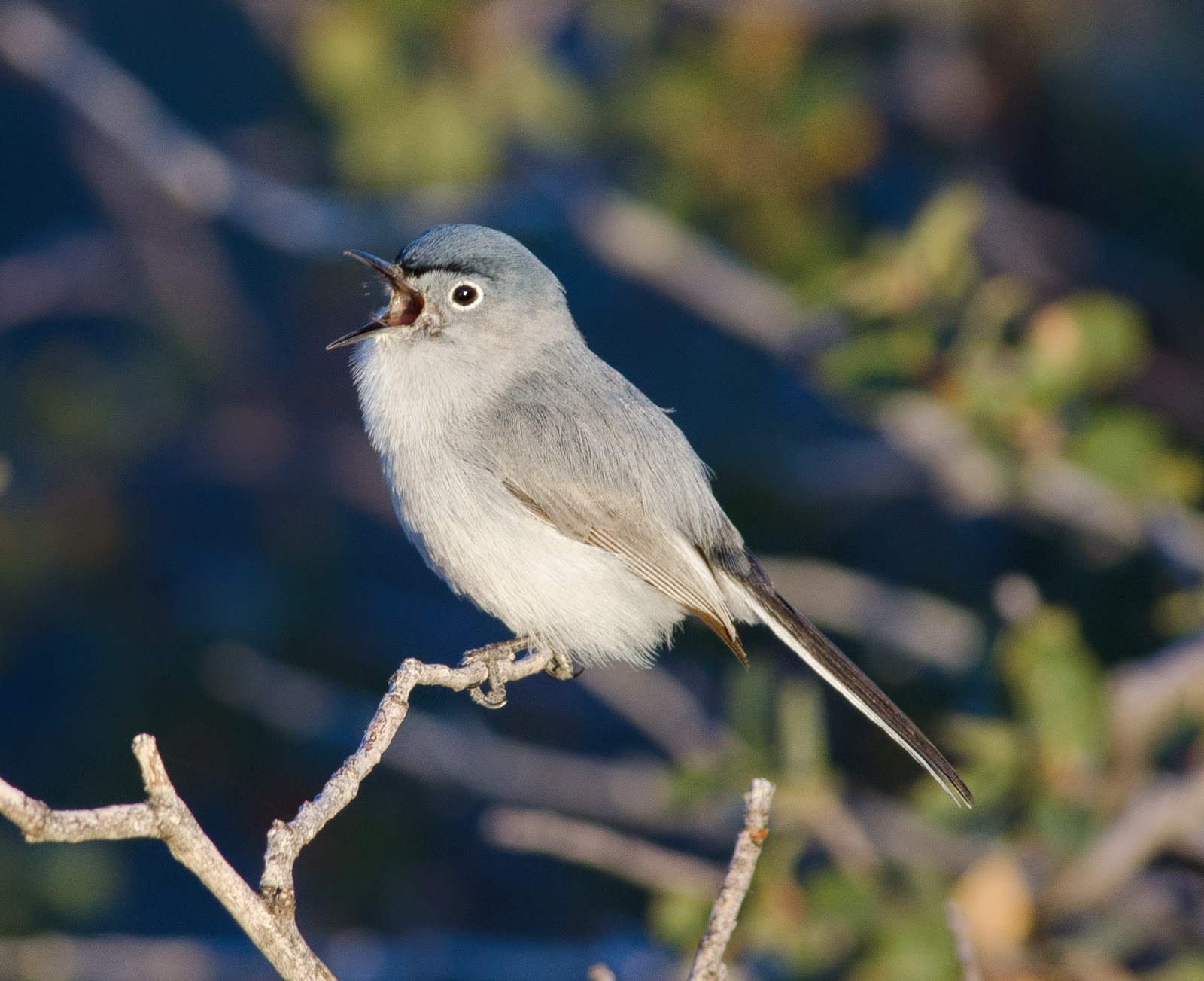
I set my sights on the top of the mountain first and headed directly to the top.  I quickly discovered that Blue-gray Gnatcatchers had returned with a vengeance and was probably the most numerous species of bird that I found over the entire mountain.  They were very vocal and singing and at one time I had 5 of them in the same area, out-dueling each other for territory rights. 
 
 Blue-gray Gnatcatcher
 
 Blue-gray Gnatcatcher
 
Blue-gray Gnatcatcher
 
The second most numerous bird was the Bewick's Wren, however they were a bit less photogenic that the gnatcatchers, but I have to include at least one photo of one for comparison with a House Wren that was also located along the way.
 
Bewick's Wren
 
House Wren
 
The irruption of the Cassin's Finch this year was still evident in the upper elevations including this male and female.
 
Cassin's Finch - Male and Female
 
At the top, I had a female Hairy Woodpecker pose long enough in the sunlight for a photo or two.  It is always strange to have this bird show up as a 'rare' bird in eBird when I complete my list.  But eBird has factors built in to prevent rarities being added without some kind of backup and this bird is definitely rare in the rest of the county.  This is the only area in the county where they are regularly seen. 
 
Hairy Woodpecker - Female
 
Violet-green Swallows had also returned which is always nice to see and since I had a nice blue sky background to work with, I attempted to photograph one in flight.  Not easy to do if you are aware of the erratic flight pattern of these birds.  But the photo does help to show how this species got its name with its violet rum patch and green head and back.
 
 Violet-green Swallow
 
Violet-green Swallow
 
The highlight at the top of the mountain was my FOS Painted Redstart.  Such a colorful bird and a regular summer breeder in Arizona and New Mexico.
 
 Painted Redstart
 
Painted Redstart
 
One final bird at the top as I reached my vehicle and was getting ready to head back down the mountain, was the Juniper Titmouse and this one appeared to be feasting on some tree buds.
 
 Juniper Titmouse
 
 Juniper Titmouse
 
I descended back down from the top to the 1688 Trailhead and headed out along this trail that runs along the west side of the Mt Ord but at an elevation that is considerably lower than the summit.  I covers quite the convergence zone of pine forests and the lower scrub oak habitat lower down.  Spotted Towhees and Black-chinned Sparrows were in abundance along this road.  One of the Black-chinned Sparrows gave me probably my best ever photos of this species.  And one can never get enough photos of the vibrant Spotted Towhee.
 
 Black-chinned Sparrow
 
 Black-chinned Sparrow
 
 Black-chinned Sparrow
 
 Spotted Towhee
 
Spotted Towhee
 
Want some scenery photos of this magnificent place?  Then here are some various photos of the surrounding areas.
 
 Mazatzal Mountains to the west with Beeline Hwy in the lower foreground.
 
 Bartlett Lake to the west.
 
 Roosevelt Lake to the south and east.
 
 Four Peaks to the south
 
 Mazatzal Mountains to the west.
 
 Mogollon Rim in the distance on the horizon to the north.
 
 Manzanita flower buds
 
 More Manzanita flower buds
 
 Looking west again, with the bridge and Beeline Hwy to the lower left.  The smaller yellowish road on the closest ridge is the rock and dirt road one has to traverse to get up the mountain.
 
Mazatzal Mountains to the north and west.