Costa's Hummingbird

Costa's Hummingbird
Showing posts with label Eastern Meadowlark. Show all posts

Tuesday, January 9, 2018

Arizona's Grasslands and More

This past week, I had the privilege of searching for Arizona birds for a person that has been birding for more than 50 years and has a life list of of over 6400 species.  Peter Bono and his wife Elaine, made a stop in Arizona on their way to Mexico and had contacted me through Birding Pal.  Believe it or not, he was missing 3 species on his life list and was hoping I could assist him on these 3 species.  It is a bit intimidating to be trying to help find life birds for a person that already has almost 5000 species more than myself.  His life list targets were Baird's Sparrow, a species that I had only seen once before and that was almost 7 years ago, Cackling Goose and Sagebrush Sparrow.  The latter 2 species, I felt would be a bit easier than the sparrow as they usually winter in Maricopa County and there had been solid reports of them in the recent weeks.

Our first full day, we headed out early to southeastern Arizona to search for the Baird's Sparrow.  We arrived at our destination right around sunrise and we stationed ourselves in one spot to let the birds get acclimated to seeing us in their habitat.  After checking out many sparrows, we finally zeroed in on a Baird's Sparrow, which is a good looking sparrow!  A couple of them were kind enough to pose for photos. 

 Baird's Sparrow
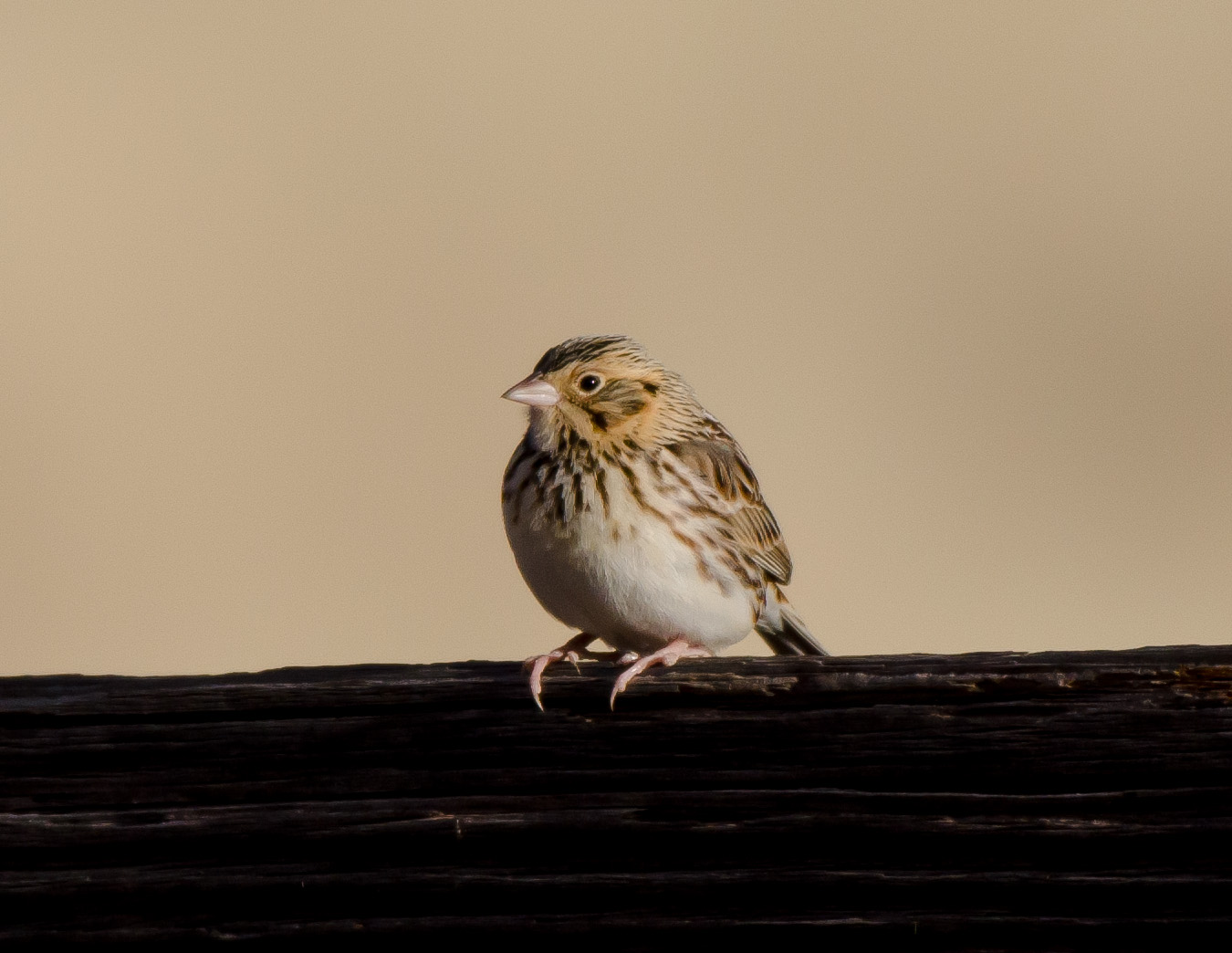
Baird's Sparrow

As mentioned earlier, other species of sparrows were present; Grasshopper, Savannah, and Vesper A well as several Eastern Meadowlarks.  So it was a great opportunity to observe the finer details in sparrow identification.

 Grasshopper Sparrow

Savannah Sparrow

Eastern Meadowlark

From here we headed to Madera Canyon and the Santa Rita Mountains.  Madera Canyon is one of my favorite places in Arizona and I never get tired of birding there. 

 Hammond's Flycatcher

 Hepatic Tanager

 Painted Redstart

Rufous-crowned Sparrow

The next day, we birded in and around the Phoenix area.  Was able to get the Cackling Goose at Glendale Recharge Ponds, luckily I had my scope to zero in on them as they were quite a ways out in the water.  Next stop was the Thrasher Spot where we were able to get the Sagebrush Sparrow, which is a bird he did not have due to the recent split of the Sage Sparrow.

Sagebrush Sparrow

We then headed back to the eastern part of the valley to do some birding, and on the way I was able to locate the returning winter resident dark-morph Ferruginous Hawk.  I think this is the first time I have been able to photograph in in sunshine instead of cloudy skies.

Ferruginous Hawk - (dark-morph)

Now that his 3 lifers had been confirmed, we started working on birds to add to his Arizona list, so a stop at the Gilbert Riparian Preserve and other various spots were in order.

 Chestnut-sided Warbler

 Hooded Merganser - Female

 Orange Crowned Warbler

Wilson's Snipe

We also visited the backyard of a resident that has an awesome back yard for birds.  He was kind enough to allow us in to spend some time and we were hoping for the Ruddy Ground-Dove that has been visiting his back yard.  It took about 1½ hours before it made its appearance, but it finally did.

Ruddy Ground-Dove

It is rather satisfying to be able to assist a person in adding some new life birds to their list, especially when they are approaching the 6500 number.  In retrospect, it is an educational opportunity to fine tune my skills on birds that I do not see that often.  Sparrows can be so challenging, but the more one is exposed to them, they getting easier to identify for any future sightings.  


Tuesday, March 3, 2015

Willcox and Lake Cochise

On Sunday, March 1, 2015, I headed down to the southeastern area of Arizona with Magill Weber riding along.  We were headed to Cochise Lake near Willcox, AZ to try our luck at locating a Red Phalarope that has been reported by many in the past week.  This is a bird that breeds along the Artic shores in the summer and spends its winters at sea; a rather rare bird inland.  I had seen only one of these birds once before and it was in the Pacific Ocean in 2013 about 20 miles out from Half
Moon Bay, California, so to have one show up in Arizona it is quite remarkable.  This would be a great bird to add to my Arizona list and I think Magill felt likewise.  So this was our target bird for the day an it did not take long to find it spinning around and back and forth in the water, foraging like phalaropes normally would.  At first it was a bit far out for photos, but we moved to another side of the lake and it eventually worked its way a bit closer for some identifiable photos.  Obviously this bird is not in its colorful reddish breeding plumage at this of the year, but still a remarkable bird none the less.
 
 Red Phalarope
 
Red Phalarope
 
One other bird dominated the landscape all around Cochise Lake; the Sandhill Crane.  Parts of Arizona is the winter home for this magnificent bird.  Arizona does not draw the biggest concentrations of them and I have seen them just about every winter in Maricopa County west of Phoenix as a small flock winters there.  A much larger concentration accumulates a bit further south from Willcox at Whitewater Draw and that place draws many birders to see them.  We were stunned by the sheer numbers in Willcox; we counted well over 1500 which brought back fond memories of Nebraska where they congregate along the Platte River in central Nebraska in the early spring every year and they number in the hundreds of thousands.  This was definitely impressive to see and hear and they actually allowed a bit of a close approach. 
 
 Sandhill Cranes - Need I say more?


As we work our way around the lake, I got to see my find Cinnamon Teal of the year.  (Yeah, that is kind of sad when I have them only about 6 miles from my home in Mesa at the Gilbert Riparian Water Preserve!)  I had to drive all the way to Willcox to see my first of the year.
 
Cinnamon Teal
 
We then made our way to the pond by the golf course where we found a stunning breeding plumage male Ruddy Duck.  Not a plumage we see too often and that blue bill really looks out of place, but also adds to its good looks.
 
Ruddy Duck
 
As we were driving out to head back a home, we were fortunate to have an Eastern Meadowlark sitting on a fence post and did not take off like most of them do when approached by humans.  We just stopped the car and enjoyed the view with the sunlight showing off its bright yellow chest.
 
 Eastern Meadowlark


We spent only about 1½ hours before we headed home, but it was a very productive day of birding in such a short time span.  Definitely worth the trip. 


Sunday, April 28, 2013

Above the Rim - Part 2

The 2nd day of my visit to the Heber/Overgaard area was spent checking out some new sites and returning to some familiar ones.  Most of this visit was to familiarize myself a bit more on where to go and how to get around in this upper elevation region.  On May 11th I will be taking part of the NAMBC (North American Migratory Bird Count).  This year I volunteered to assist in Navajo County, and it will be a new area with different birds and is an exciting adventure to look forward to in a couple of weeks.

Took a road trip early in the morning to Zeniff, which is an agricultural area about 30 minutes north and east of Heber/Overgaard and a totally different habitat with different birds.  This is high desert country and the tall conifers are absent in this area.  First thing I found when I turned off the highway was a Western Meadowlark perched on a fence post singing is very melodic song; one that I am very familiar with as it was a very common bird on the western plains of Nebraska.  About 200 yards further along the road I happened to find another meadowlark, but this one was singing a much different song; this was an Eastern Meadowlark.  These 2 species are almost identical in appearance, but their songs are so very different and this was a great opportunity to listen to the differences in song and make mental notes for the future.

 Eastern Meadowlark

Western Meadowlark (and a very poor photo)

I also counted 3 Swainson's Hawks at this location, and one of them perched close enough to capture a couple of photos.

 Swainson's Hawk

Swainson's Hawk

As I made my way back to H/O and Forest Road 86 on my way to Black Canyon Lake again, I stopped at the bridge over the stream and checked out the area and discovered a pair of House Wrens that had taken advantage of a hole in a dead tree trunk and was using it as their nest.  

 House Wren

House Wren - peeking out of its nesting cavity.

Finally I got to Black Canyon Lake once again and a couple free loaders came right up to the car to greet me and looking for handouts.  Apparently they have learned to rely on hand outs from the few people that visit this lake to fish.  The first was a Steller's Jay that flew into a tree on the opposite side of my car, less that 15 feet away.  He was so close that my zoom lens could not get the entire bird in one frame.  The other beggar was a Golden Mantled Squirrel, that came running up to the car as well.

 Golden Mantled Squirrel

Steller's Jay

This visit resulted in another unexpected find, a Bonaparte's Gull.  This species seems to show up every now and then in some remote place where they are not expected and this was the case with this one.

 Bonaparte's Gull

Bonaparte's Gull

This second day I also located a Spotted Sandpiper that I did not see the day before and as normal for this species, it kept running in the opposite direction from me.  I had also seen many 'Red-shafted' Northern Flickers just about everywhere I stopped to bird.  Was finally able to capture a photo of one before it disappeared into the trees.

 'Red-shafted' Northern Flicker

Spotted Sandpiper

As I made my way back to town, an Abert's Squirrel ran across the road in front of my car and then stopped.  Of course I stopped as well and shot some photos from the car.  Those ear tufts are just too fascinating.  With that I bid adieu to the northern areas above the Mogollon Rim and headed home to return to birding in my old hangouts.  But with migration in full swing, I have been seeing some wonderful birds since then.

Abert's Squirrel