Costa's Hummingbird

Costa's Hummingbird
Showing posts with label Lucy's Warbler. Show all posts

Sunday, May 8, 2016

A Prelude to Awesomeness

With a meeting planned at Slate Creek Divide with a couple more birders, I headed out early on April 28, 2016, to do a little birding on the way.  I first visited Sycamore Creek and then Bushnell Tank which are both located on Hwy 87, also known as the Beeline Highway.  The actual visit to Slate Creek Divide will be covered in the second post and it was an Awesome visit!

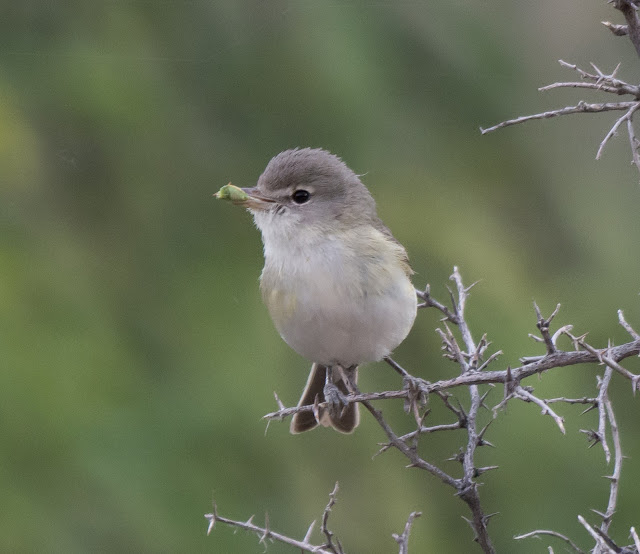
My first stop was Sycamore Creek and as soon as I parked my vehicle, a Bell's Vireo was so noisy and making sure I did not ignore it.  I have the feeling that it might have been feeding young in a nest somewhere close, however, I was not able to locate a nest. But it was actively hunting insects and was carrying one morsel around as it moved from bush to bush.

 Bell's Vireo with prey


Spring time is always a great time to enjoy the birds because many of them are migrating through Arizona.  Some have already arrived and have nested, such as the Bell's Vireo above.  But many more are still arriving.  Different species most generally have a their own migration schedule, so the viewing is an ever changing phenomenon.  

Black-headed Grosbeaks just started arriving a couple of weeks ago and are becoming more abundant. 

Black-headed Grosbeaks

Bullock's Orioles arrived a week or two before the grosbeaks, so they are probably already setting up breeding territories, as least for those that will be staying in Arizona.

Bullock's Oriole

Lucy's Warblers arrived about a month ago and many are already feeding babies about now.

Lucy's Warbler

The Zone-tailed Hawks were found at Bushnell Tank which is about 2 miles from a known nesting pair reside, so there is a good chance this is a second nesting pair, however I failed to find a nest.

 Zone-tailed Hawk


And being the nature lover that I am and intrigued by many different creatures, including butterflies, I take photos of them when offered a chance.  

 Dainty Sulphur Butterfly

 Variegated Fritillary Butterfly

Water bugs of some sort on top of the water at a small pool.

After visiting these 2 spots, I then headed up the rough and rocky road to the Mt Pelee Trailhead on Slate Creek Divide where I was planning on camping that night with a couple of others and we will going to do some nocturnal birding.  Stay tuned for part 2 of this 2 part post.


Monday, May 2, 2016

Another Chase in Arizona

I have been very negligent in updating my blog site with anything current.  It has been well over a month since I have contributed anything to this venture.  It is not that I have not been doing anything, Au contraire!  In fact, what I have discovered that being retired, I am busier than when I was employed.  But it is a good kind of busy, because now, I can pursue the things I want to do, like birding and enjoying nature. 

On March 24, 2016 a rare bird, a Rose-throated Becard was discovered in Graham County at Cluff Ranch which is south of the small town of Pima.  This spot is about a 2½ hour drive from Mesa.  Great birding friend Muriel Nedermeyer contacted me the day after it was discovered to see if I would be interested in chasing it the next day and of course I said yes.  I had seen this bird, male and female, in Chiapas, Mexico in July of 2015, so it would not be a life bird for me, but it would definitely be a solid United States, ABA, and Arizona bird for me.  So we quickly made plans to depart early the next morning.  We arrived nice and early and met up with Jeff Coker, a local that was already there, and he had not yet seen it.  He had seen it the day before and explained to us where it was seen and what trees it was favoring.  Before too long, 2 more birders showed up looking for it as well.  The group split up a bit to watch for it in different areas.  It was about an hour and 45 minutes after we arrived that Muriel spotted it up in a tree.  She was quick to get me on it and then we both yelled out to the others that we had found the bird.  We were desperately trying to keep tabs on it as they ran to get to our area.  It went deeper into the trees and it finally flew out the backside of one of the trees and we lost it again.  

The good news was that we knew that it was still there and had not departed to places unknown.  Once again the 5 of us spread out in trying to locate it.  After about a half hour one of them came back to us at the original spot and said that he had relocated it and showed us some photos that he took of it.  He then advised us where he found it and then he left.  At least it gave us hope that it was still around.  

With the sun coming up it started getting warm and and we started shedding some layers of clothing.  In the process of this, Jeff called out that he had relocated the bird, so I took off on a run and got there in time to snap a couple of quick photos. Definitely a bird worthy of a chase! 

 Rose-throated Becard


That was the last that we saw that bird that day.  This bird stayed around for several more days and thanks to our reports, many more birders traveled to Cluff Ranch and were able to see it and add it to their lists. 

During all the time we spent looking and waiting for this wonderful bird, we were entertained by many other birds and when a Lucy's Warbler decided to get a drink and take a bath in the stream of water, I could not resist snapping a couple of photos.   

 Lucy's Warbler


Cluff Ranch is located on the north side of Mt Graham which is one of the highest peaks in the infamous 'Sky Islands' of Arizona.  At an elevation of 10,720 feet, it naturally gets snow every winter in Arizona and the road to the top is closed in winter because of the snow.  

 Mt Graham


This is a beautiful place with some incredible biodiversity and offers some great birding and so much more with nature.  Always a great place to visit.


Tuesday, June 10, 2014

Bushnell Tanks Exploration

On May 26th, I decided to visit a spot that I had only explored once before and that was about 3 years ago, Bushnell Tanks, which is located on the opposite side of Sycamore Creek from Sunflower.  I don't recall much about my first visit, so maybe it was the time of the year that I visited that did not leave me with such a wonderful experience.  But this time it was much different and now I know that I need to visit this area more often.  I spent a total of almost 3 hours exploring this spot and hiked a total of 5.6 miles in the process.  (At least that is what my GPS app recorded on my phone; see last photos in this post.)  

The Brown-crested Flycatchers have returned for the summer.  This is a species that many new birders confuse with the more common Ash-throated Flycatcher.  They are very similar in appearance and have some minor visual differences, but those can sometimes be hard to tell when in the field.  Another aspect is to note the time of the year the bird is seen.  Brown-crested are migrants that return every year late April and into May and are usually gone by the end of September.  Ash-throated can be found throughout the year in Maricopa County.  But the best way to identify the differences is by learning their songs and calls.  And at this location in the spring and summer, both species occur making it so easy to listen to the different calls and songs.  And this trip presented this once again to me. 

Brown-crested Flycatcher

Ash-throated Flycatcher

The flycatchers were well represented as I also found both Western Kingbirds and Cassin's Kingbirds.  These 2 species can also confuse many new birders, but once again, the songs will set them apart and in the case of the 2 kingbirds, there are enough visual things to look for to tell the difference, such as the white outer tail feathers of the Western Kingbird.  No other kingbird has outer white tail feathers.

Cassin's Kingbird

Western Kingbird

During the entire time on this excursion, I was constantly under the watchful eyes of a pair of Zone-tailed Hawks.  If they had a nest in the area, it was out of my views and mostly likely very well concealed in one of the many sycamore trees.

Zone-tailed hawk

Zone-tailed hawk

A pair of Warbling Vireos were apparently having a warbling match to see which one could sing the loudest; but do not think a winner was declared this time around.

Warbling Vireos

One of the the day's most colorful birds happened to be the Summer Tanager.  This is a bird that I always love to see each and every spring.  The male and its bright red mantle of feathers is such an eye-opener, but the female is no slouch either in its covering of golden-yellow feathers.  At least this time she showed off a bit better than the male by perching in the sunlight.

Summer Tanager - Male

Summer Tanager - Female

Lucy's Warblers were probably one of the most numerous species of birds in this location as they were singing everywhere.  Oftentimes this bird just appears as a dull gray bird, but they do possess a couple of patches of a brick-red coloration; one on their rump and one on the top of head.  Many times those markings are not well seen.

Lucy's Warbler

Lucy's Warbler

The bird the won the award for the least well groomed was a very vocal and loudly singing Blue Grosbeak.  He was definitely trying to call in a female, but not sure what his luck was going to be this year as he had a lot of new blue feathers still missing for the breeding season.  I do not believe I have ever seen one of these beautiful birds in such a dull coat of feathers.  But maybe by now, it has shed all those dull feathers and it sporting a nice bright blue covering of feathers.

Blue Grosbeak - molting

Blue Grosbeak - molting

Other photos of note include a honeybee on a nice white thistle flower, an Ornate Tree Lizard on a rusty pipe. a Tiger Whiptail Lizard, and a beautiful purple flower that I believe is a species of spiderwort.

Honeybee

Ornate Tree Lizard

Tiger Whiptail


After spending 3 hours with all of this beauty and wonder, you know I will be returning to this place in the future.  After all, it is a great place to get in a good hike and some great solitude with some incredible wonders of nature.  And just to show the distance, here is the final reading on my GPS app showing distance, time and elevation irregularities.  

My hiking route - distance and path I took

Hiking route with time and elevation measurements

This is definitely one of those places that needs to be explored a bit more in the future.


Monday, March 24, 2014

Additions to an eBird Patch

When I go birding, I tend to keep records of what species that I find and how many of each species that are found.  Along with this, I also record the location, how much time is being spent at this location and what distance is traveled if walking.  All of this information is extremely easy to enter on a website that is called eBird which can be found here: http://ebird.org/content/ebird/
 
Once a person sets up an account on eBird, then this site basically keeps track of all your sightings including all your lists, locations, dates and various other information.  It is also a great place to use for research when one wants to try and locate a certain target bird.  It can also be used to explore 'Hotspots' to go birding in spots throughout the world.  A couple of years ago I had one of my most frequent birding spots close to home added as a 'Hotspot'; Pima Canyon Trail, South Mountain Park in Arizona.  This will never become an infamous birding spot, but it is unique enough to be designated as a Hotspot.  Its proximity to the city of Phoenix, being a dry desert wash, and the variety of birds found there is a little impressive.  These past 2 weekends I found a couple of new species in this location that pushed the number of species located in this location to 100.  Of the 100 species that have been reported in this location, I have recorded 87 of these species on my list from this location.  There are a few other birders that have also birded here and reported a few species that I have not found; yet!
 
This post is going to focus on a few of the birds that I have recorded recently in this location.  First off, the 2 newest birds that I have discovered.  A week ago I wanted to see if any warblers might have arrived and was passing through on migration and sure enough I discovered a Lucy's Warbler.  Not a rare bird in Arizona in the summer, but usually not is this habitat, this is one of the earliest warblers to return in the spring.
 
Lucy's Warbler
 
The second bird was from this past weekend and kind of caught me off guard, but when thinking about it after the fact, I am kind of wondering why it took so long for one of these to be seen here, a Sage Thrasher.  I have seen them in several places in Maricopa County, so it was a nice surprise to finally record one in this location.  This is also most likely a migrating bird.
 
 Sage Thrasher
 
Last weekend along with the Lucy's Warbler, I found a stunning male Costa's Hummingbird that was quite accommodating by landing in the tree close by.  This is a species that many think migrate south for the winter months, but for some reason or another, I found this species in this location in just about every month of the year (currently missing July and December).  Their numbers are not as common as the numbers of Anna's Hummingbirds, but can be found with a little patience and luck.
 
Costa's Hummingbird

Costa's Hummingbird
 
Here is a photo of an Anna's Hummingbird which are much more common.
 
Anna's Hummingbird
 
A couple of very common birds seen on that day included Gambel's Quail and Northern Mockingbirds.  Both of these species were very vocal in calling out all along the trails.  I am sure much of the calling involved the mating and breeding season that has arrived in Arizona.
 
Gambel's Quail

Northern Mockingbird
 
Other fairly common birds at this location include Ash-throated Flycatcher and Cactus Wren.  The Ash-throated Flycatcher is a bird tends to migrate south from much of Arizona for the winter, but for the past couple of years I have discovered that some are spending their winters in this location.  Many times they are fairly silent and can be hard to spot unless they fly out to capture an insect in flight.  The Cactus Wren is the state bird of Arizona and is beloved by many.  It is probably the easiest wren to identify due to its larger size and bold markings. They favor Cholla Cactus for their nests and this one was busy gathering material for a new nest.
 
 Ash-throated Flycatcher
 
Cactus Wren
 
The Gilded Flicker belongs to the woodpecker family and has found the dry desert habitat is perfectly suitable for existing and raising their families.  Nests cavities are usually made in the Saguaro Cactus and abandoned nests are frequently claimed and used by many other desert dwellers.  They can frequently be seen on the ground digging into the earth with their long and sturdy bills.
 
Gilded Flicker
 
One of my favorite birds to be found in this habitat is the Black-tailed Gnatcatcher.  These are small birds with long tails and they are forever on the move searching out insects in the trees and shrubs.  In breeding season the males don a nice distinguished looking black cap.  This one was probing the nearby trees and was rewarded with a small yellow spider which he immediately flew away with and was probably taking it to feed a fledgling in a nest somewhere.
 
Black-tailed Gnatcatcher
 
 The Rock Wren is a another very common bird in this location and can be heard calling from a short distance away.  They have a unique habit of bobbing up and down as they scamper over, under, and all around the rocky areas in search of those insects trying not to be seen.
 
 Rock Wren
 
This eBird Hotspot is a place that I have adopted as one of my eBird Patches.  It is a place that is easy access for me and has turned into a wonderful spot for birding.  Sometimes I see nothing but the regular birds, but I have encountered enough odd species to know that there will be more that show up in this spot and I hope that I am there when they do.  It is also a bit gratifying to know that all of my reports are in a very small way contributing to the data and study of ornithology.


Sunday, April 21, 2013

Sabino Canyon -- 13 April 2013

Many of you probably think that I have stopped blogging, but that really is not the case.  I had a week off from work and during that week I planned a couple of mini-vacations to do some birding outside of local Phoenix and Maricopa County.  Now that the week is over, I have a lot of blogging to catch up on.  Those mini trips were wonderful and I got to see a lot of great birds.  

First off, is Sabino Canyon located near Tucson, Arizona.  This was the first day of my 4 day trip to the southern part of the state and Sabino Canyon is a spot I had never been to.  It has a tram that one can purchase a ticket for and one can ride the tram from the bottom to the top with various stops along the way. Unfortunately, the ticket booth did not open until 9:00 am and I arrived at 6:30 am, so I decided hiking would be good as the road is paved all the way.  Of course I took a detour on the way to the top by checking out Sabino Dam and by the time I arrived at the top I had already hiked 6 miles uphill!  But without the detour on the way back, it was another 4 miles to the start, so it was a long haul, but very worthwhile.  This is a very popular spot for hikers and on the weekends even arriving at 6:30 am the parking lot was filling up quickly.  

One of the first birds I encountered was a Pyrrhuloxia.  This bird is the desert southwest cardinal and they are related.  However there are differences and I was able to photograph 2 different males in 2 different settings.  This was a good start to this wonderful hike.

 Pyrrhuloxia

Pyrrhuloxia

Also located in the lower desert areas was another one of those birds with a 'ph'unny name that starts with the letter 'P'.  The Phainopepla is also a bird with a crest, but not at all related to the Pyrrhuloxia.  

 Phainopepla--Male

Phainopepla--Female

The White-winged Doves (of Stevie Nicks fame) have returned for the summer and are a nice sight to see in the springtime.  These birds also frequent the lower desert areas as do the Northern Mockingbirds, Gambel's Quail. and Black-throated Sparrows.

White-winged Dove

 Northern Mockingbird

 Gambel's Quail

Black-throated Sparrow

In the area of Sabino Dam, I found a Cassin's Vireo along with many singing Bell's Vireos and Lucy's Warblers.

 Cassin's Vireo

 Bell's Vireo

Lucy's Warbler

Many spots along the road to the top were inhabited by Northern Cardinals including one at the top of the trail that allowed some great looks and a photo.

Northern Cardinal

On the trip back down and near the bottom I ran across one of those 'difficult' Empidonax Flycatchers.  I have decided that this is probably a Hammond's Flycatcher based on the longer projection of the primary feathers.  

Hammond's Flycatcher

I also took some photos of some flowers and some butterflies along the way.  Sorry, but I have not had time to figure out which species of butterflies I have here, but will so some research in the future to see if I can figure them out.


Nice start to a wonderful week off.