Costa's Hummingbird

Costa's Hummingbird
Showing posts with label American Pipit. Show all posts

Saturday, December 17, 2016

More Maricopa Birding

The more time that I spend birding in Maricopa County in Arizona, the more I begin to appreciate the birding diversity and what can be found.  It is a large county in area and covers a very diverse number of different ecological habitats.  For those readers that are not aware, yes, I am doing a Maricopa County 'Big Year'.  Final numbers will be released in January of next year in a separate blog post.  I plan on recapping some of the highlights and point out some of the incredible birds that can occur in Maricopa County.  Included in this post are a few of the great birds that have been added in just the month of December.

 Reports of a Tundra Swan returning to a golf course in Sun City West was intriguing to a lot of birders, and after some great sleuth work by friends Chris Rohrer and Magill Weber, it has become clear that this bird is most likely a 'wild' bird and not a captive bird as it has returned several years in a row.  Not really unexpected at this time of year, because Prescott, AZ, almost annually has Tundra Swans that overwinter in their surrounding lakes.  Why this Tundra Swan returns to the same location to hang out with one of the captive and tame Mute Swans is a bit perplexing, but it apparently has found a safe winter haven at this golf course.

 Tundra Swan

Tundra Swan dwarfing an American Coot

The Mute Swan is much larger than the Tundra Swan and it is also fairly tame, looking for handouts from humans.  It also approached me fairly quickly and came closer to me than the Tundra, which seemed to be a bit more cautious.

Mute Swan

Mute Swan - Close-up showing how tame it was

This pond also had a few Hooded Mergansers, and I never pass up a chance to photograph one of these beauties.

Hooded Mergansers - male and female

From this location and while I was in the western part of the valley, I headed out to the Buckeye/Arlington area to see if I could locate a Ross's Goose that had been in the company of 2 Snow Geese at Lower River Ponds.  Turned out to be an easy find, but at the distance where they were roosting, scope views were the best I could do to confirm the ID of the ROGO.  Never saw what spooked all the birds, but whatever it was, just about everything took flight and that is when I was able to get better looks and also a couple of photos.

 Ross's Goose in the middle with 2 Snow Goose

 Ross's Goose with 3 Snow Goose

Ross's Goose on the right with 2 Snow Goose

A drive through the agricultural lands out there is always prudent to see what else might be found.  At this time of year, the raptors are some of the stars with Red-tailed Hawks being the most numerous Buteo.  Here are a couple of photos that show the stark diversity in appearance of these raptors.  They can fool many novice birders due to their extreme differences in appearance, especially in western United States.

 Red-tailed Hawk - dark morph

  'Harlan's' Red-tailed Hawk - light morph - incredibly this is the 9th year for this hawk to return to the same place for the winter in Arlington

  On the day that I was exploring out west, birding buddy, Tommy DeBardeleben, was following up on a report of a Hooded Warbler that was discovered by Troy Corman the day before.  He was able to locate this bird and he proceeded to provide very good instructions on locating it in Seven Spring Wash.  This is not a place for a lot of people to undertake without a lot of hiking experience and some surefooted hiking abilities; no marked trail in a canyon with rocks and flowing water.  The Hooded Warbler is a bird that I had only seen once before and that was in May 2014 at High Island, Texas, and it was a fleeting glimpse at that.  I was not sure what my chances were in locating this one, but surprisingly, it was the 4 species of bird that I found on this trek.  I caught a glimpse of it and followed up with a view in my binoculars to make sure it was the right bird.  It quickly disappeared around a bend in the stream, but I cautiously followed and got a another quick view and was only able to get this horrible shot of it.

Hooded Warbler - the crappy first photo

Then I lost it and could not relocate it, however, I kept moving downstream looking for a Pacific Wren that Tommy had also discovered (but I was not so fortunate).  Finally, I returned back up the stream and when I reached the spot where the Hooded Warbler was originally seen, I decided to sit and wait awhile to see if it would return.  Sure enough,  about 15 minutes later, it did return,  Still kept its distance downstream, but this time I got a little better photos.  Would have like to have gotten better, but I can live with these photos.

 Hooded Warbler


A Painted Lady kept me occupied during my wait.

Painted Lady

About 5 days later, birding phenom, Caleb Strand and Laura Ellis, had a Long-tailed Duck fly by them at Lake Pleasant.  Did not think that it was chase-able at this point, but incredibly, Louis Hoeniger, then reported one the next day at Glendale Recharge Ponds.  Strangely, the first time I had seen this duck was at the exactly the same location on December 24, 2013, and it was a one-day wonder.  Then this past June, while in Wisconsin, I had the pleasure of seeing a stunning male, but it was far away and in some fairly turbid water, making it impossible for photos.  I headed out to Glendale Recharge Ponds within 30 minutes of the notification.  Once there, it did not take long to locate it, although it spent more time submerged and foraging than above the water.  This one was even better looking than the one from 3 years before.

Long-tailed Duck

On December 14th, I took part in the Salt/Verde Rivers CBC.  At the end of the day, one of the teams reported a Northern Waterthrush at Coon Bluff along the Salt River.  Well, this bird actually turned out to be a Louisiana Waterthrush, which is rarer, but very similar in appearance.  Tommy and I quickly made plans to try for it the next day.  We arrived early and found Ryan O'Donnell already at the spot also looking for it.  With 3 of us looking and listening, we definitely had improved our odds of finding it.  Eventually, Ryan spotted it and we followed it around to several of its favorite spots, but always staying a bit secretive and hard-to-get.  We were all getting mediocre photos of it during this time, so when it finally decided to do some foraging in the sunlight, it presented us with much better photos.  Ironically, I had only seen this species once before in southeastern Arizona and it was a fleeting glimpse of it when Tommy, Mark Ochs, and I took a trip on December 14, 2013.  That encounted was also 3 years ago.  I had never photographed this species until now, so this was a redemption viewing for me.  I liked these results so much more.

 Louisiana Waterthrush


A couple other photos from this location consist of an American Pipit, perched in an unusual spot at the top of a tree, and a Spotted Sandpiper also along the same water edge as the Louisiana Waterthrush.  Incidentally, the sandpiper and the waterthrush, both dip and bob their rear ends as they forage.  Quite an interesting behavior trait to observe at the same time on 2 different species.

 American Pipit in a tree - a rather rare perch for this species

Spotted Sandpiper

What more will I be able to add to my Maricopa list this year?  Maybe nothing, but the month of December is not over and who knows what might show up in the last couple of weeks.  Only time will tell.


Thursday, January 7, 2016

Yuma: A Rare Bird Chase

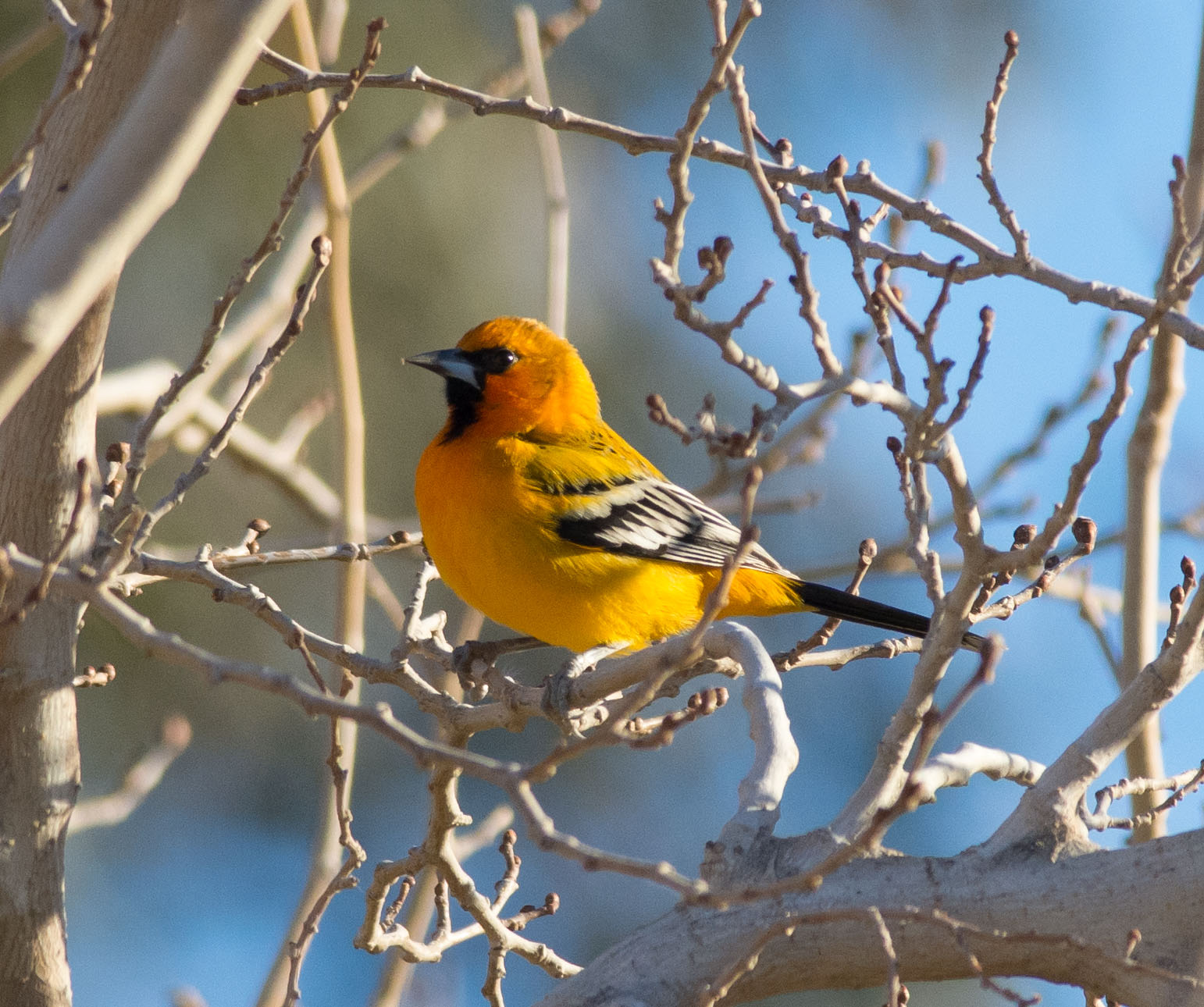
It is not often that I will travel 3 hours to chase a rare bird, but on New Year's Day, I did just that.  Yuma is about a 3 hour drive from the the Phoenix area and I had seen the reports and some photos of a rare Mexican bird that had showed up in Yuma; a male Streak-backed Oriole.  This was not going to be a new life bird for me as I had seen several in July of 2015 when I made a trip to Chiapas, Mexico. Even though it was not a life bird, it would be a new bird to my United States list and also my Arizona list.  They do show up in the United States from time to time, but are considered rare and are a review species for the Arizona Bird Committee to review and verify.  

The trigger that got me to go to Yuma for this bird was an email from Muriel Neddermeyer wanting to go birding and she suggested that as an option, so I kind of jumped on the band wagon, as it is much more fun to travel with a friend when on a long drive for a new bird.  At the last moment, we found out that good friend, Chris Rohrer, was going to be returning late the night before we left and he was interested in joining us.  So the 3 of us headed out in the dark on New Year's Day morning and we knew this was our goal so we were going to go straight to the oriole location, and not look at any other birds.  Well that is easier said than done because I was a passenger and when the sky started to get light before we reached our destination, I happened to spy a Red-tailed Hawk and a Common Raven along the road for my first 2 birds of 2016.

It was cold when we arrived and 2 other birders were already there staking out the place and they had not yet seen it.  It was not long until another 4 more birders also showed up and then a 5th, so we had 10 people watching and listening for this bird to make an appearance.  After about a half an hour I heard its chatter call as well as another good birder and sure enough it came in to the tree next to the palm tree where it liked to feed on the fruits of that palm.

 Streak-backed Oriole

 Streak-backed Oriole -showing the streaks on its back, hence its name.

 Feasting on a palm fruit.


Wow! What a stunning bird to observe on the first day of the year!  Since we were in Yuma, we decided to head to the agricultural fields south of the city as there had been some reports of high numbers of raptors, with Ferruginous Hawks being the most numerous.  We were amazed at the numbers of these marvelous raptors as we counted over 40 individuals.  One of them even managed to fly over our vehicle while we parked along the road which offered us some incredible close observations.  

 Ferruginous Hawk


With Yuma being a 3 hour drive home, we departed the area in early afternoon as we tried to do a little birding on the way home including a drive through some of the agricultural fields in and around the town of Maricopa, Arizona, which is in Pinal County.  We found one stretch of road where we were astonished by the number of Burrowing Owls.  Our final tally was about 30 of these cuties.  At one spot, we found a pair on a concrete ridge, so we tried to get the car in a position for photos.  First 2 photos are of the pair when we stopped the car.  Then one of them got a bit concerned and shy, and ducked down behind the concrete while the other just stayed perched and acted very nonchalant about the whole experience.  I love how the shy one was peeking up over the concrete to check on us.

 Burrowing Owl #1

 Burrowing Owl #2

 Burrowing Owl # 2 - showing its shyness

Burrowing Owl #1 - being very nonchalant

A couple more shots from the road were an American Pipit and a Loggerhead Shrike in the waning afternoon sunlight.

 American Pipit

Loggerhead Shrike

What an awesome day to start of the new year with an awesome bird!  The oriole was a life bird for Muriel and a state and national bird for both Chris and myself.


Saturday, January 2, 2016

Birding Birthday Bash

In the early part of December, I just happened to celebrate a landmark birthday and I was fortunate to have it fall on a Saturday.  What better way to celebrate a birthday than getting out in nature to see what cool birds one can find!  One of my best birding buddies, Chris Rohrer ventured north from Tucson and joined me in our quest to find some birds in and around the eastern suburbs of Gilbert, Mesa, Scottsdale, and Tempe.  

First stop was the Gilbert Riparian Water Preserve in the search for some rare Purple Finches that had been seen there for a week or so.  We did not have any luck with that species, but the birding was was still excellent with the highlight being a White-throated Sparrow.  Of course several others were gracious enough to allow photos as well; Neotropic Cormorant and Wilson's Snipe.

 White-throated Sparrow

 Neotropic Cormorant

 Wilson's Snipe well camouflaged

Wilson's Snipe zoomed in and cropped

Our next stop was Coon Bluff on the Salt River northeast of Mesa to search for another rarity, a Reddish Egret which had not been reported for a few days, so our hopes were not very high and once again, we dipped on this bird as well. But once again, several other species made our visit very enjoyable such as Cedar Waxwing and Vermilion Flycatcher.  And a couple more passerine species graciously gave me a chance to get photos with their reflection in the water, which is not too common; Say's Phoebe and American Pipit.

 Cedar Waxwings

 Cedar Waxwing

Vermilion Flycatcher

 American Pipit

Say's Phoebe

From here we headed to Scottsdale Ranch Park to look for a Red-breasted Sapsucker which had been reported there.  It is an uncommon winter migrant in Arizona; its more common winter range is the Pacific Coast from Baja California northward to Washington state and into British Columbia in Canada.  It is always a treat to see this bird in Arizona.  We arrived and spent some time searching in the trees that it favored and was not finding it.  As we decided to maybe head to the next location on our agenda, we met a handful of other birders also looking for it, but to no avail.  I started scanning its favorite tree one last time and Bingo! there it was!  I quickly got everyone else on it and it was quite accommodating to us all.

 Red-breasted Sapsucker


One last point of interest on our list: Tempe Town Lake.  Sorry to say, but we came here to actually locate a drake Mandarin Duck that had been seen here for some time  Although, it is non-countable as an ABA bird, you have to admit it really is quite a handsome specimen.  

Mandarin Duck

A nice adult Bald Eagle is always a bonus, and it is nice to find one is such an urban setting such as Tempe Town Lake.

Adult Bald Eagle

I was a great way to spend a milestone bi(rd)thday!  


Tuesday, February 3, 2015

Rosseau Sod Farms

On Sunday, January 25, birding buddy, Chris Rohrer, drove up from Tucson and we ventured out to the Rosseau Sod Farms north of Mesa and east of Scottsdale.  This is place that I had not been to in a long time.  There have been some really special birds spotted there in the past and now that I have a scope, I felt it might be worthwhile to check out the fields.  While we did not find anything rare, we most definitely found some good birds and really had a great time.  I even explored more roads than I ever did in the past.
 
As the sun was rising, we started scanning the sod fields and although we tried, we could not come up with anything rare, but we had hundreds of American Pipits, and they alone entertained us as we watched them foraging in the grass.  A flock would fly up into the air and then land a few yards away from where they took off.  Maybe the grass is greener on the other side of the irrigation pipes.  Some even ventured out onto the roads and along the sides of the roads. 
 
 American Pipit
 
American Pipit
 
As we drove the roads, we found canals and small ponds of water and one Common Merganser female allowed for a photo on the water and then when it took flight (they tend to be very skittish), if flew over us instead of away from us giving me my first attempt at capturing one of these birds in flight. 
 
 Common Merganser
 
Common Merganser
 
Some Mallards appeared to be playing a game of hide 'n seek in the tall green grass.  Almost a bit comical to see them stretch their heads up above the grass to take a peek at us.
 
 
Probably the coolest bird we saw in such an unusual habitat was an adult Bald Eagle perched on a dead tree in some desert habitat.  One photo which shows the habitat and then a close up photo that shows this bird in its majestic beauty.
 
 Bald Eagle
 
Bald Eagle
 
Next we ventured to the lower Salt River and stopped at Butcher Jones Beach on Saguaro Lake, a place Chris had not yet been to and we got to see many of the regular birds to be found there.  The Gray Flycatcher has been a resident in this location since before Christmas and at one of my visits I found two of them here.  Great place to get decent photos of this tail pumping bird 'empid'.  A Red-naped Sapsucker was also present and is definitely the most expected species in this area in the winter.  But one always has to check them out closely to rule out a much rarer species, the Yellow-bellied Sapsucker.  No luck on the YBSA on this day, but RNSA is always a good bird to find and watch.
 
 Gray Flycatcher
 
Red-naped Sapsucker
 
One last stop on the way home was a small pond along a golf course in a residential neighborhood where the locals apparently enjoy feeding the ducks.  And these ducks are spoiled and are easy to photograph.  I already photographed a couple Redhead males a few post ago in January, so this time I focused on the lady Redheads, and they obliged.  (Yes, I am guilty as charged, had to get another photo of a drake as well! I am a sucker for that irresistible red head!)
 
 Redhead - Female
 
 Redhead - Female
 
Redhead - Male
 
It was a great day of birding once again with another avid birder.  Chris is almost obsessed with birding and he might even agree with that description.