Costa's Hummingbird

Costa's Hummingbird
Showing posts with label Mountain Chickadee. Show all posts

Friday, August 29, 2014

A Graham County Weekend - Part 2

Saturday night we selected the Soldier Campground for our campsite, but there were many to chose from and on Sunday we found several more that might have been a bit better selection.  One of our neighbors arrived later than we and little did we know that they were much more prone to staying up late at night and were a bit noisier that what we would have liked once we retired for the night.  As we gathered firewood for our campfire, we noticed that much of the wood was very wet from some of the previous monsoon rains that prevailed near the summit in the past few weeks.  I am sure some of the neighboring campers were probably a bit amused at us lighting and getting our fire started, but we prevailed and had a great fire before long.  We were up early and broke camp and headed out to take advantage of what little time we had left.

We headed once more to Riggs Lake, which is at the western most point and close to where the road ends and we started heading back stopping at various spots along the way.  Yellow-eyed Juncos were the most numerous birds all over the top of the mountain and were seen at every place we stopped.  Their bright yellow eyes in adults separate them from the Dark-eyed Junco group which consists of several sub-species.  Yellow-eyed Junco is a totally separate species with a range that only extends into southeastern Arizona and extreme southwestern New Mexico in the United States.

 Yellow-eyed Junco

Yellow-eyed Junco

At Shannon Campground we ventured out on the trail that leads to Arcadia Campground for a bit.  This trail is about 6 miles in length and would be a great trail to follow on a future trip.  We did manage to get a Wilson's Warbler to make an appearance after Tommy heard its chip note call and then proceeding to do some pishing.  I must say that Tommy has many bird calls and chip notes memorized and this talent makes for better birding as many times, the hint a birder has of a bird being in the area is one of its calls or songs.  

Wilson's Warbler

Eventually the road brought us back to Arcadia Campground which was the most active spot we had the day before and it included the juvenile Spotted Owl.  Almost immediately after we parked, we got out and started pishing again and this resulted in a Mountain Chickadees and a Painted Redstart making an appearance.  At one point an Acorn Woodpecker actually responded to the pishing and came in to investigate.  Mountain Chickadees were another species that was very numerous on our trip and seen or heard at just about every higher elevation spot.

Mountain Chickadee

 Painted Redstart

Acorn Woodpecker

After finding the Spotted Owl the day before, we wanted to head back into the same area to see if we could relocate it again.  This time it was nowhere to be found, but it could have been hanging out up in tree with better cover watching us.  But shortly after this, Tommy spied another Spotted Owl higher up in a different tree and in much deeper shade and foliage.  This one turned out to be an adult; most likely one of the parents to the juvenile that we located the day before.  Once again the adrenaline was pumping for both of us.  As usual the adult did not seem too disturbed by our presence and went about preening its feathers while we watched.  Interestingly, some of the photos show those sharp talons and the feathering on the tarsus.  (I swear Tommy made me use the word tarsus!  He used it as we were admiring the owl and I liked it so much, decided to use it probably for the first time in a post!)

Spotted Owl - Adult

Spotted Owl - Adult

Spotted Owl - Adult 

Once we returned to the heat of the valley and cell phone service, we received word of the Anhinga sighting on Dankworth Pond the day before, which had been sighted about 3 hours after we had been there.  Of course we made a mad dash Back to Dankworth Pond, only to find several Neotropic cormorants and a couple of Black-crowned Night Herons, including this juvenile.  No signs of the Anhinga.  Oh why didn't it fly by about 3 hours earlier the day before????

Black-crowned Night Heron - Juvenile

To finish off this final post of our incredible trip to Graham County and Mount Graham itself, I will add a couple more photos of wildlife and some of the incredible scenery.  Photos really do not do justice to the scenery and the incredible views that we had from the road.  This place is really awesome and definitely deserves some return trips.  There is much more to be explored in this area.

Squirrel - they were common everywhere on Mount Graham

Clark's Spiny Lizard - courtship display

Roseate Skimmer

Tommy keeping records


Riggs Lake


Thursday, August 7, 2014

Exit From the White Mountains

Sunday was the day to return to the Phoenix metropolis, but before we were to depart, we took out time to enjoy a breakfast at the Rendezvous Restaurant.  If one elects to dine at one of the tables outside, they can be positioned next to a hummingbird feeder.  Of course we opted for one such table and we were constantly entertained with at least 3 species of hummers coming in to the feeders; Broad-tailed Hummingbirds, Calliope Hummingbirds, and the tyrants of the feeders, Rufous Hummingbirds.  I was most interested in the Calliope Hummingbirds, which are the smallest birds to be found in the United States at only 3¼ inches in length.  I have only seen this species a couple of times in the past and never got any decent photos of a male.  Seeing the males with their striped gorgets in the sunlight was really quite spectacular and special.  Once again, I had to resort to a photo with a feeder in it, but that is better than none at all.  Arizona is an awesome place to visit if one is interested in seeing a variety of hummingbirds!  One can see more species in Arizona than in any other state in the U.S.

 Calliope Hummingbird

Calliope Hummingbird

Although there were several Rufous Hummingbirds at these feeders, we also had one at our campsite that very aggressively defended the feeder that we hung from one of our trees.  

Rufous Hummingbird

And to add another bonus at breakfast, a Cordilleran Flycatcher was close by on the north side of the restaurant.  This is probably the closest I have been able observe one of these Empidonax flycatchers.  

Cordilleran Flycatcher

After breakfast, we headed back to the church camp area once again and it was very active this early in the morning.  We had visits from Mountain Chickadees, Olive-sided Flycatcher, Pine Siskin, and a Say's Phoebe that landed on a twig so close to me that I thought it would be too close to even focus on it for a photo.

 Mountain Chickadee

 Olive-sided Flycatcher

 Pine Siskin

Say's Phoebe

One more short trip to the Butler Trail head before heading out and we were blessed with more Cordilleran Flycatchers.  Once you get to know these birds, they quickly become very likable and always fun to see and observe.  They are part of a family of birds that can be tricky to identify, but the more one sees and hears the different species, then they become somewhat easier to identify.  

 Cordilleran Flycatcher

Cordilleran Flycatcher

Traveling west on Highway 260 we stopped off a small lake to see if we could find anything unusual.  Not much in the way of birds, but when we parked the car, we noticed some ground squirrels and we did happen to have a few peanuts with us.  They knew immediately what we had once we tossed a few their way.  They quickly ran out and grabbed a peanut and then ran under the shelter of a rock to start the feast.  A chipmunk also showed up and we made sure it got to take a peanut back to its burrow as well.  This is a good way to see the differences between ground squirrels and chipmunks.  Chipmunks have facial stripes, whereas ground squirrels do not.  Here is the Golden-mantled Ground Squirrel and the Cliff Chipmunk to compare.


 Cliff Chipmunk

Golden-mantled Ground Squirrel

Golden-mantled Ground Squirrel

And so our trip to the White Mountains came to an end, but none of us were disappointed in the whole trip.  Tommy stayed behind for another week with his family and had much more excitement during that time.  Such a great place that I think it deserves a visit every summer.


Friday, June 27, 2014

The Kaibab Plateau

Friday night was my first night camping out in a tent after a one night stay in the far southern fringes of Arizona in the ghost town of Ruby.  This time I was a bit better prepared with better camping equipment and supplies (and an air mattress!).  The winds were blowing all night long which did put a damper on our owling prospects; however we did hear a single Great Horned Owl, a Northern Saw-whet Owl, a Flammulated Owl, and at dawn a Northern Pygmy Owl.  We had picked out a very remote camp site just for this reason; owling is best done at night without a lot of other campers nearby.  

On Staurday, we were divided up into 3 teams and Chris and I took off and headed up to Jacob Lake to meet up with the 2 members that were not camping out; Mary Williams and Ann Hilliard.  Our team was to head west from Jacobs Lake and cover the areas from there to the Big Springs area.  We covered several miles with various stops along the way.  We got to see and count many different species of birds including a small flock of Bushtits, Cordilleran Flycatcher, Hermit Thrush, Lesser Goldfinch, MacGillivray's Warbler, Mountain Chickadee, and a lot of Broad-tailed Hummingbirds at the feeders at a cabin at Big Springs Lookout Tower.

 Bushtit - Female
Cordilleran Flycatcher

 Hermit Thrush


 Hermit Thrush on horse back - odd behavior for this bird


Lesser Goldfinch

 MacGillivray's Warbler


Mountain Chickadee

Broad-tailed Hummingbird

One of the saddest things that was found was a deceased Common Poorwill, which was found by Mary and Ann along one of the roads.  We can only speculate that it may have gotten hit by a vehicle at night.  They are a nocturnal bird and sometimes love to land on gravel roads at night.  Since they are nocturnal, it is not a bird that is often seen by the naked eye and even though this was an unfortunate find, we all got to get good looks of this awesome bird up close and really admire its dynamic plumage pattern and the whiskers around its beak.

Common Poorwill - deceased

Common Poorwill - deceased

Birds were not the only things that grabbed my attention.  Found several species of butterflies and some of them were new to me.  (Finally broke down and purchased a butterfly guide book after this trip!)

 Arizona Sister


 Pacuvius Duskywing


Rocky Mountain Duskywing - (not 100% certain of this ID)

 Silver-spotted Skipper


Weidemeyer's Admiral Butterfly

Once we returned to our base camp that evening, we were able to locate a couple of Downy Woodpeckers before nightfall.  This was a new Arizona bird for me.  They were quite common in Nebraska in my youth and I also found one in New Mexico earlier this year, so finding them in Arizona is just icing on the cake.

 Downy Woodpecker

What incredible 2nd day spent on the Kaibab Plateau.  The 3rd and final day was a short one since many of had a long trip home, but it was equally wonderful and a 3rd post is forthcoming on that last day.


Tuesday, May 27, 2014

Navajo County NAMBC 2014

Saturday morning arrived and we were up and on the road early as we had a lot of ground to cover.  This year, we were assigned some different areas; Twin Springs near Heber, Zeniff agricultural area, and then several spots in the Pintop/Lakeside area.  This is the second year for me taking part in the Navajo County NAMBC (North American Migratory Bird Count).  This is a day where the main focus is to count every bird one sees or hears at your designated spots within the county.  So photography and photos were secondary on this day.  Since we were birding in places at over 7000' elevation and there was a stiff wind out of the southwest, in spots it was quite chilly.  The winds also kept many birds low and hiding and made the counting a bit more difficult. 

At Twin Springs, a small spot off Highway 260 and FR122, we found a couple of Olive Warblers. Before this year I had only seen 3 Olive Warblers, but now this year I have seen 4 of them.  This is a bird that is not found on a regular basis in the United States outside of the states of Arizona and New Mexico.  Always a treat to find and see and I call it the warbler with a Zorro mask.

Olive Warbler

Olive Warbler

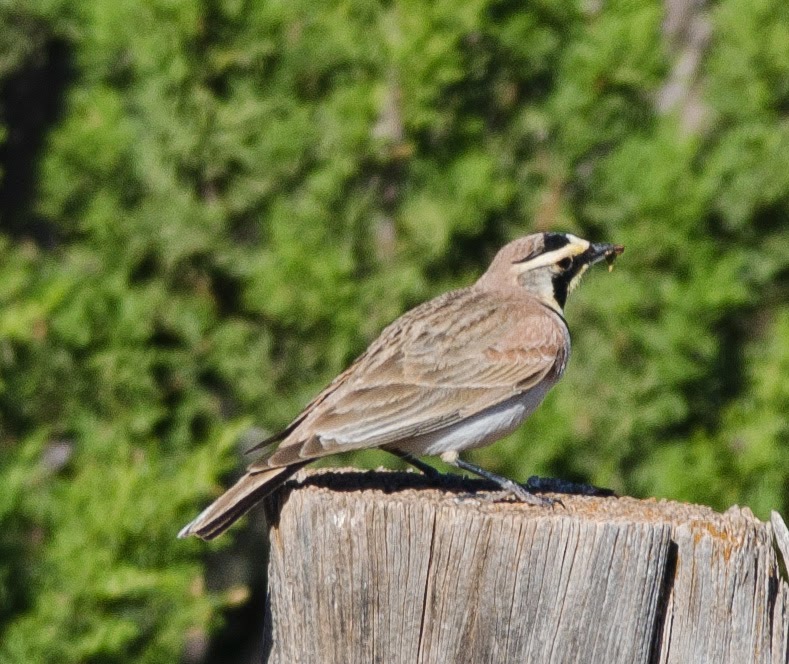
In the Zeniff area, the only photo that I able to get was one of a Horned Lark.  They were quite plentiful in the area along with both Eastern and Western Meadowlarks, a Bullock Oriole and several others.

Horned Lark

From there we headed east and south to the Pinetop/Lakeside community where we have several spots to visit.  The first was Jacques Marsh, which was a new spot for me.  Rather tricky finding the way into this area but quite the spot for birds associated with water.  On this day, the wind made the birding a little more difficult as the wind gusts were quite strong, up to 35 mph.  It is quite an extensive area with several ponds of water and lots of marshy areas.  I discovered a small flock of Canada Goose that included a leusictic one (a genetic mutation that occurs resulting in partial absence of melanin).  It occurs with some regularity in birds, but unfortunately many of the bird born with this fail to live to adulthood.  An odd colored one in a flock is an easier target for predators to focus on.  

Canada Geese - one leucistic

Canada Geese - one leucistic

We also had several Cinnamon Teal in this area and they are pretty darned close to being one of the best looking ducks around.  I have always found them a bit skittish and not always easy to capture in photos but at least one of them cooperated to some degree for me.

Cinnamon Teal

And Yellow-headed Blackbirds were in abundant numbers at this location.

Yellow-headed Blackbird

At Woodland Lake Park, we expected to see Lewis's Woodpeckers and were not disappointed. This is one of the most reliable spots to find this oddly colored woodpecker with its pinkish belly and its red facial patch.

 Lewis's Woodpecker

Lewis's Woodpecker

A Northern Rough-winged Swallow took some time out for a rest from the normal incessant flying like most swallows.  

Northern Rough-winged Swallow

At Billy Creek Trailhead we had several smaller birds including a Acorn Woodpecker and a Mountain Chickadee.  This is a spot that will need more attention in next year's count.

 Acorn Woodpecker

Mountain Chickadee

Also near the trail head and the residential area, an Abert's Squirrel attempted to hide from us by blending in with the branch of a tree.  Those ear tufts are quite an eye catching look.

Abert's Squirrel

We had a totally enjoyable day of birding and counting, even with the strong winds, so it was back to Heber for the night and a glass of wine for the evening.  The next day we were to head home, so we got up early to go to breakfast at one of the best little cafes around and found out they were not yet open, so with about 10 to 15 minutes to kill, we headed to the Navajo County Park in Overgaard and it was lucky that we did as we got to witness a fairly large flock of Pinyon Jays moving through.  Must have been 40 to 50 of them and I was finally able to get a photo of one of them to add to my photo gallery.

Pinyon Jay

Anytime one ends a birding trip with a Pinyon Jay is ending with a great bird!