Costa's Hummingbird

Costa's Hummingbird
Showing posts with label Turkey Vulture. Show all posts

Friday, October 2, 2015

The 2nd Meandering: The Salt River

After an interesting hike on Saturday, and really having an an epic moment or two, (see previous post), I opted for a place with some water nearby on Sunday, the Salt River area, specifically Coon Bluff and Granite Reef.  An early arrival at Coon Bluff found not too many people there except for a few people fishing.  I love coming to this place but this time I noticed that the grassy vegetation surrounding all the mesquites and trees is gone.  It always used to be a lush green carpet of grass.  I am not certain for the reason of this, but one theory is the wild horses of the Salt River might have contributed to its disappearance by overgrazing on land that cannot support the number of horses located there.  Or maybe it is due to some other reason.  Recently there was a big controversy about the wild horses and there was to be a round up to capture some of the horses to reduce their numbers and auction them off.  A big rally of support from many people got them to change their minds and they did not go through with the plan.  I too, enjoy seeing the horses along the Salt River and in fact I did see a few on Sunday morning.  But after seeing the grass vegetation gone, it made me contemplate the reasoning.  With no grass, it will greatly affect the wintering birds, especially sparrows and ground dwelling birds.  A year ago, a nice vagrant Harris's Sparrow spent the winter there with dozens of White-crowned Sparrows, but it is probably unlikely for that to happen again with these conditions.  Only time will tell if this habitat is in trouble or not.

Coon Bluff is quite frequently one of the best places to see Bald Eagles in Maricopa County and this day was no exception.  A pair of adults were waking from a night of slumber and in the first rays of sunlight, they made for a nice silhouette in a tree along the river.

Bald Eagles

A nice kettle of Turkey Vultures perched on a dead tree also greeted me before the sun had risen high enough to give them warmth for their first flight of the day.  They rely on the heating of the sun which creates those warm thermals that they rely on to glide almost effortlessly as they soar the skies hunting for a dead animal corpse to consume.

Turkey Vultures

One of the reasons that I love to come to this place is for the Vermilion Flycatchers; one of the most colorful birds in Arizona.  And as usual, they were present and actively foraging for insects in the air.  On this trip they were found in a bit different location than the normal campground where I used to see them.  But knowing where they are always makes the trip worthwhile.  Most non-birders are awe struck by the brilliant red of the males, but those females have a more muted coloration, but are really quite spectacular as well.  

 Vermilion Flycatcher - Female


Vermilion Flycatcher - Male

One of my favorite warblers, the Townsend's Warbler made an appearance, but was playing hard to get in the trees.  I will admit that this bird does make me ponder the thought that it might be a Townsend's x Hermit Warbler hybrid.  These 2 species do hybridize quite frequently and this bird does give me that vibe of possibly being a hybrid.

Townsend's Warbler?

A Spotted Sandpiper was resting on a rock out in the middle of the river as I explored the river as well.

Spotted Sandpiper

As I prepared to leave a Greater Roadrunner toured the parking lot and as I was headed out about 200 yards from the parking lot a second one ventured out onto the road in front of me and then crossed over to the left side and I was able to shoot photos out of the window of my vehicle.  (Guess that is why they are called 'roadrunners', they like to sometimes run on the roads!)

 Greater Roadrunner


After departing Coon Bluff, I decided to stop in at Granite Reef before returning home.  The most exciting observation at Granite Reef was a male Belted Kingfisher that was hovering over the water for sometime before taking a plunge into the water for a fish.  I knew it was successful in its plunge, but had a heck of a time detecting what it had caught as it appeared to carryout some moss or seaweed.  After reviewing my photos at home, I finally discovered it had captured a fish, but apparently some plant life came with it.  I love watching them hover like that while in a hunting mode.

 Belted Kingfisher - Male


 Belted Kingfisher - Note the tail of the fish under the wing on the right side.


And here it is carrying its fish and the seaweed as well.

Another fun and enjoyable outing to observe nature at its finest.  There is never a place too boring to return to for birding in Maricopa County of Arizona.


Tuesday, June 3, 2014

Mt Ord & Sunflower Again

On Sunday May 18th, I had the honor to show a gentleman from Sweden some birding spots in Maricopa County in Arizona.  Olle Pers, was spending a week in the Phoenix area and had a day to go birding.  He had contacted me through Birdingpal.org, http://www.birdingpal.org/ and we agreed upon visiting the Sunflower and Mt Ord areas.  May in Arizona usually has very pleasant nights, but days can get hot quite quick when the sun comes out in the morning.  For those reasons we selected the Sunflower and Mt Ord areas simply because these areas are a bit further from the city and most generally a bit cooler, especially Mt Ord.  Plus both locations offer a much different variety of birds than what is found in and around the Phoenix metropolis.  

We began at Sunflower in the early morning as we knew that the cooler temps on Mt Ord would be a big relief later in the day.  While we had a great variety of birds at Sunflower, oddly, I did not acquire much for photos in this spot, except for a Turkey Vulture sunning itself in the early morning hour.

Turkey Vulture

After a short visit to the Sunflower area, we then headed to Mt Ord.  This place is becoming one of my most favorite places to visit in Maricopa County.  It's higher elevation, (7128') presents a completely different habitat than what is found the in rest of Maricopa County.  It is a very interesting transition traveling the road to the top.  The road is rough and rocky and a high clearance vehicle is highly recommended.  At the turnoff from Highway 87, one starts out in high desert scrub which is perfect breeding habitat for Black-chinned Sparrows, Gray Vireos, Scott's Orioles, Rufous-crowned Sparrows, and many other species.  

Black-chinned Sparrow

About 2 miles up, the road come to the point of where the Ponderosa pine trees have covered the slopes.  There is a small place to pull over and park and on the south side of this spot is a vertical sign that indicates 1688, which is the the start of the 1688 Trail that I have come to love to hike and is totally within the boundary of Maricopa County.  It is about 2½ miles to the saddle area where one can start to explore the south side of the mountain.  This 2½ miles runs along the west side of Mt Ord and it covers a lot of wide open scrub oak habitat with occasional meanderings into the tall pines.  It is quite a convergence zone and creates a habitat that is suitable for a variety of birds.  We found Gray Vireos and Black-chinned sparrows at this elevation as well. We also had Spotted Towhees, Blue-gray Gnatcatchers, Western Tanagers, and Hooded Orioles. 

 Hooded Oriole - female

 Spotted Towhee

Western Tanager

Blue-gray Gnatcatcher

Not only we were searching for birds, but reptiles were of interest to Olle as well, and we successfully found several.  One of the coolest was the Greater Short-horned Lizard.  Olle found an adult in the lower elevations and near the top of Mt Ord, we found a baby one that was much smaller.  Other lizards included the Desert Grasslands Whiptail and a Plateau Lizard.

 Greater Short-horned Lizard - adult

 Greater Short-horned Lizard - juvenile

 Desert Grasslands Whiptail

Plateau Lizard

Even the butterflies caught our attention and one of the most beautiful is the Arizona Sister, which is always and welcome sighting.  Also had a Silver-spotted Skipper which was one that I was not familiar with, but with a bit of luck, I will remember this species the next time I run across one.

 Arizona Sister Butterfly - with an unknown beetle in the background

Silver-spotted Skipper

Olle has an extensive amount of birding in his background and I believe he mentioned that it has covered 5 continents and covering a few decades.  He has also done some extensive birding in the United States and Canada.  Some of the birds we found on this trip he has seen in Central America and elsewhere, but seeing them in the United States on some of their breeding grounds always carries a plus factor.  If I recall correctly, I think we were able to add about 13 new life birds to his list, which is remarkable considering his extensive birding history.  Mt Ord is such a quiet place to escape to when one wants to get out of the urban areas in and around Phoenix.  I thoroughly going to this area and most of the time, I have the 1688 trail to myself and the peace and solitude is part of my reward.   


Monday, April 29, 2013

Granite Reef & Sunflower - 21 April 2013

After all my travels from that week off from work, I was finally home on Saturday and a very good birder friend, Muriel, contacted me and asked me if I would like to go to Sunflower birding on Sunday since the last time we were there, we missed out on the Common Black Hawk.  I had already been thinking about going to Granite Reef on my own as I knew the Bullock's Orioles had returned.  So we decided to combine the 2 destinations and off we went early on Sunday morning.  The first stop at sunrise, was Granite Reef, and I was not disappointed as the Bullock's Orioles were easily found.  This is a bird that has always eluded me in photos (at least clear photos) and this time wasn't much better as they love the very tops of the trees and are often hidden by small twigs of foliage.  I did manage a much better photo this time around and am happy with the results.  But there is always room for improvement.


Bullock's Oriole

My goal was filled so off we headed to Sunflower and what a great idea this was.  The road in was particularly very birdy and we spent a long time walking along the road. We also found Muriel's target bird, the Common Black Hawk.  We first spied it on the east side of the road back among the trees and in poor lighting.  But then it decided to make our day and flew to the west side of the road on a clear open perch.  Yes, it was fairly high up in the tree, but still a great view of the magnificence of this bird.  We later also discovered its mate in another tree in a nest.

Common Black Hawk

There were lot of other birds happening about the same time, including a fly-over by a Zone-tailed Hawk and a Red-tailed Hawk.  Summer Tanagers had returned and were singing from every direction.  Turkey Vultures were sunning themselves in the cool of the morning air.  One of the most unexpected finds was a Cedar Waxwing that Muriel spied, while I was concentrating on a Vermilion Flycatcher nest.  Almost too much happening at once.

 Zone-tailed Hawk

Red-tailed Hawk

 Summer Tanager

Turkey Vulture

 Cedar Waxwing

Cedar Waxwing

With all this activity, we had a hard time deciding to continue the walk on the other side of where the road is closed for vehicle travel, but so glad we decided to continue our walk further up the road.  And it was definitely worth the extra walking.  We discovered the Zone-tailed Hawk nest with presumably the female sitting on the nest.  

Zone-tailed Hawk nest--you can see a head and part of the tail

The trees were alive with singing Yellow Warblers and Yellow-rumped Warblers.  The Yellow Warblers are returning migrants and the Yellow-rumped Warblers (Audubon's), are migrants thinking about heading north, but a few of them were sporting their bright breeding plumage.  And to top it off, another oriole was seen; this one being a Hooded Oriole.  Really made my day to get 2 oriole species.  In addition to all that color a very handsome Violet-green Swallow thought we were safe enough to stay perched for good looks from us.

 Yellow Warbler

Yellow-rumped Warbler (Audubon's)

Hooded Oriole

Violet-green Swallow

While we were making our return walk to the car and the parking area we had a friendly encounter with a fairly large Gophersnake (at least that is what I think it is). Growing up I remember my father catching these reptiles back on the farm and then releasing them in places to control the rodent population.  This one was quite long, about 3½ feet long and very nonchalant.  It was not at all aggressive or agitated with us in any way.  If fact, it had pretty much disappeared by the time we regained our composure and was retreating into the grass before I could think about photos.  If you ever get to Sunflower and run across this beautiful reptile, just let it know that Gordon and Muriel said 'Hi'!

Gophersnake as it slithers away.

What a great day of birding and some wonderful birds.  And I can thank Muriel for suggesting the trip and she just happens to be the person that has taught me just enough about photography to help me get a few good photos once in awhile.


Sunday, September 30, 2012

Tres Rios Wetlands - 29 Sept 2012

With the Arizona temps finally starting to fall, decided it was time to start visiting some local spots in and around Phoenix.  Ellen once again joined me on this visit and we saw some great birds.  Tres Rios is not open to the public and one needs to obtain permission before entering this place.  That is probably one of the reasons that this place is a very special place to go birding as there are relatively few humans in and around the area.  We tallied 43 species of birds during our 3 hour visit.
 
One of the highlights of the trip was actually viewing and being able to photograph a Least Bittern. This is a water bird that likes to hide deep in the reeds near water. I had caught glimpses of them in the past and have heard them on just about every trip I had made to this location, but this time around, we found one that allowed us some proper time for observation. Check out that foothold this bird is showing. Once it got tired of watching us, it very quietly disappeared back into the reeds.

Least Bittern
 
Another bird that showed off very well despite being one that also likes to hide in the reeds was a Marsh Wren.  This bird is another one that is more often heard than seen.
 
Marsh Wren
 
The most numerous birds were Neo-tropic Cormorants and Yellow-headed Blackbirds; which must have numbered in the hundreds, flying over constantly in large flocks.  Another very common bird was the Song Sparrow and they too were in the vegetation in and around the water, but they were a bit more easy to view, often coming to the top of shrubs and reeds to check things out like the one below.
 
Song Sparrow
 
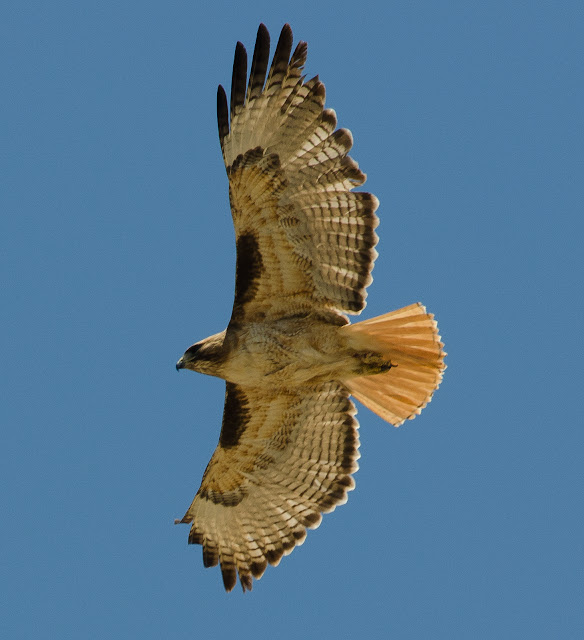
With many birds in flight through out the area, of course I had to attempt some in-flight shots.  The Osprey were the most numerous, we also saw a Red-tailed Hawk, a juvenile Black-crowned Night Heron and a distant American White Pelican. 
 
Osprey

Red-tailed Hawk

Black-crowned Night Heron-Juvenile


 American White Pelican
 
Also found many perching birds, including a Black Phoebe, a Turkey Vulture, a Belted Kingfisher, an Abert's Towhee (that really blends in with its background), and a White-crowned Sparrow peeking over the tops of some leaves.  We can expect to see these White-crowned Sparrows for the rest of the winter and into the spring when they will once again head north.

Black Phoebe
 
Turkey Vulture

Belted Kingfisher
 
 Abert's Towhee
 
White-crowned Sparrow

Also came across a Spotted Sandpiper which can be one of the easiest 'peeps' to identify by observing their behavior.  They are constantly dipping or bobbing their tail as they forage along the edges of ponds and lakes.  We also found an American Coot out of the water and walking on the trail, which seemed a bit unusual for them.  But it gave us a chance to observed its lobed toes. 
 

Spotted Sandpiper

American Coot

The last bird featured in photo is a Common Ground Dove.  (Not sure why it has a moniker with the word Common in it, as it is far from being common in central Arizona.)  Maybe it is common in places further south in Mexico.  But seeing it just reinforced the habit for a birder to study every bird you see as it would have been easy to pass this off as an Inca Dove.  When it first flew into out area, that was the first impression I got because of the red flight feathers under its wings, but once it landed and we took a look at it on the ground, we quickly realized that it was not an Inca Dove but a Common Ground Dove.  It has a distinct scaled appearance on the head and breast, a bill with a pink base, and a short tail.  
 
Common Ground Dove