
It is no secret that Nebraska is my home state, where I was born and raised. That is also where my first recollections and my fascination with our avian friends began. As a farm child growing up in very rural Nebraska, I have some very vivid memories of some of the birds that captured my interest as such a young age. Of course, and like most kids, the more colorful or unusual birds caught my eye back then. Now that I have matured a little more, it isn't always the most colorful birds that catch my eye all the time. (Still hard to ignore those colorful birds!)
Surprisingly, this year was the 50th year for my high school graduation and of course a get together was planned. My high school graduating class consisted of only 28 students. That tells you how small and sparsely populated some places in Nebraska happen to be. So I planned a trip in late May for this occasion and decided to add in a few extra days for birding and visiting family. Stayed with my sister and her family in McCook and took advantage of the birding opportunities that were there. The first morning, I headed out to Barnett Park on the south edges of McCook to see what I could find. It was amazing and I got the pleasure of seeing and photographing a lot of birds.
 Red-headed Woodpecker - Probably one of the best looking woodpeckers in the United States and I saw a lot of these birds during my visit.

 Downy Woodpecker
 Spotted Sandpiper - This one is in breeding plumage which we do not see very often in Arizona in the winter months. We normally see the drabber winter plumage without spots.
 Yellow Warbler - Male
 Yellow Warbler - Female
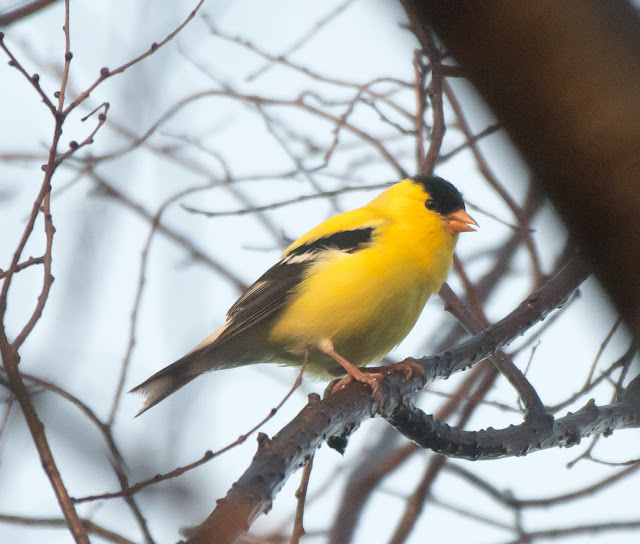 American Goldfinch - Male
 Baltimore Oriole - Male

 Cackling Goose - This was a new species for my Nebraska list. As a kid, I might have seen them, but just assumed they were probably Canada Geese. (Little did I know back then!)
 Cedar Waxwing


Later in the day, I headed north of town and visited Red Willow Lake. Saw many of the same birds, but also found a few different birds that I do not recall ever seeing in Nebraska before. No, they are not rare by any means, but I have been away so long, that one forgets what is possible.
 Bell's Vireo
 Field Sparrow - This was another bird that was not on my radar, but their range does reach Nebraska. Makes me wonder if they were around when I was a kid, but just shrugged them off since they were just LBJ's. (Little brown jobs! Ha Ha!)
 Tree Swallow - Another bird not on my radar, but apparently fairly common, note the man-made nestbox.
The next day, I headed even further north to the small town of Wellfleet, Nebraska. Not much of a town, but they have a nearby small lake. When I was young and had a great uncle and aunt living in this community and I remember spending a summer with them to help them with their farming. I can also recall our family spending time in the summer to help with the irrigation of the farm land. It was a really nice nostalgic visit and I was astonished by the birds that I found while exploring the town and the land around the town.
 Bars Swallow - These were very common on the farm as they nested in our barn and in the summer they entertained us when we milked cows every morning and night.
 Eastern Kingbird - Another bird that i was familiar with as we had them from time to time on the farm. Western Kingbirds were much more common.
 Gray Catbird - Do not recall this bird from my childhood, but due to their nature to be a bit secretive, they were probably overlooked as a kid.
 Orchard Oriole - This was another surprise to me. I do not remember this species as a kid, but had Baltimore Orioles every year. This bird was fairly common for me on this trip.
 Yellow-breasted Chat - A very enjoyable bird to see and hear, even though they can be tough to see sometimes, their calls and songs cannot be ignored.
The next 4 photos are the Indigo Bunting, plus a bonus photo at the end. This bird was one of my fondest memories of my interest in birding as a child. Being a farm family, we were very much involved in 4-H and in 1962, 4-H offered a bird course and I gladly signed up. We had to keep a record book, and the Indigo Bunting was the species that I focused on for my study bird. I have added a photo of the page from the record book showing what a talented artist I was back then! HaHa! Regardless, of all of that, this bird along with a Scissor-tailed Flycatcher that visited our farm back then, have been the impetus for my interest in birds. It was such a joyous occasion when the male in my photos below offered me a chance to get all these great photos. It is so blue that it almost blends in with the blue sky.
 Indigo Bunting - Female
 Indigo Bunting - Male


Surprisingly, this year was the 50th year for my high school graduation and of course a get together was planned. My high school graduating class consisted of only 28 students. That tells you how small and sparsely populated some places in Nebraska happen to be. So I planned a trip in late May for this occasion and decided to add in a few extra days for birding and visiting family. Stayed with my sister and her family in McCook and took advantage of the birding opportunities that were there. The first morning, I headed out to Barnett Park on the south edges of McCook to see what I could find. It was amazing and I got the pleasure of seeing and photographing a lot of birds.


Common Yellowthroat - These birds can be quite secretive and hard to photograph.

Swainson's Thrush - Not a bird that was on my radar, but found out that they are quite common. Helps to pull out the old field guides once in a while to study range maps!
`Later in the day, I headed north of town and visited Red Willow Lake. Saw many of the same birds, but also found a few different birds that I do not recall ever seeing in Nebraska before. No, they are not rare by any means, but I have been away so long, that one forgets what is possible.


The next day, I headed even further north to the small town of Wellfleet, Nebraska. Not much of a town, but they have a nearby small lake. When I was young and had a great uncle and aunt living in this community and I remember spending a summer with them to help them with their farming. I can also recall our family spending time in the summer to help with the irrigation of the farm land. It was a really nice nostalgic visit and I was astonished by the birds that I found while exploring the town and the land around the town.


The next 4 photos are the Indigo Bunting, plus a bonus photo at the end. This bird was one of my fondest memories of my interest in birding as a child. Being a farm family, we were very much involved in 4-H and in 1962, 4-H offered a bird course and I gladly signed up. We had to keep a record book, and the Indigo Bunting was the species that I focused on for my study bird. I have added a photo of the page from the record book showing what a talented artist I was back then! HaHa! Regardless, of all of that, this bird along with a Scissor-tailed Flycatcher that visited our farm back then, have been the impetus for my interest in birds. It was such a joyous occasion when the male in my photos below offered me a chance to get all these great photos. It is so blue that it almost blends in with the blue sky.


So now you all know a bit more about my childhood in Nebraska. It is fun to return after being away for so long and now that I have a much larger understand of birds. There is so much more of the state that I would like to explore. So maybe i need to plan a road trip in the future! Stay tuned for a second post covering this trip to Nebraska and my search for a special bird.
Here is a photo of the old farm where I spent the first 18 years of my life. The house is now vacant.


