Costa's Hummingbird

Costa's Hummingbird
Showing posts with label Sandhill Crane. Show all posts

Thursday, June 30, 2016

Wisconsin - Part 4

Must apologize to those that are following my journey in Wisconsin.  I had another commitment to show a friend from New York, the White Mountain area of Arizona and try to pursue some birds and I had to put the blogging on hold for about 3 days.  And another friend arrived into Mesa and we took in the Butterfly Wonderland in Scottsdale, so it has definitely put me behind in blogging.  

Next trip was to visit Horicon National Wildlife Refuge and on the way, we made a side trip to Killsnake State Wildlife Refuge and it did not take long to pickup my 10th new life bird on this Wisconsin adventure; the Bobolink.  This was my first viewing of this bird that has always intrigued me when studying field guides.  Reminds me of a blackbird in a tuxedo.  Before my trip came to an end, I got to see several of these birds.  

 Bobolink


As we started to exit this area, and as we were driving very slowly along the gravel road, we came upon a bird that has been a nemesis for me in Arizona; the Clay-colored Sparrow.  They occur regularly in Arizona in the winter months, although they are not common.  And they can be a bit difficult to identify from the many Brewer's Sparrows we see in winter in Arizona.  But looks are deceiving, because when they are singing, their songs are so different from each other.  In Arizona, they are very rarely singing.

 Clay-colored Sparrow


At Horicon, the Sandhill Cranes were scattered in many places and it was interesting to see them in breeding condition.  Spending 20 years in the Platte River Valley of Nebraska, I was used to seeing this bird yearly in spring migration in the hundreds of thousands.  I have also seen many in Arizona in the winter.  But these in Wisconsin were brown instead of gray!  Apparently this reddish-brown coloration is due to them preening with muddy bills and this coloration matches the color of many of the fields where they forage.  

 Sandhill Crane


Other birds that we found at Horicon, include Black Terns, Eastern Kingbirds, Eastern Wood-Pewee, Barn Swallows, and a fledgling Red-winged Blackbird.
  
 Red-winged Blackbird - Fledgling

 Black Tern

 Eastern Kingbird

 Eastern Wood-Pewee
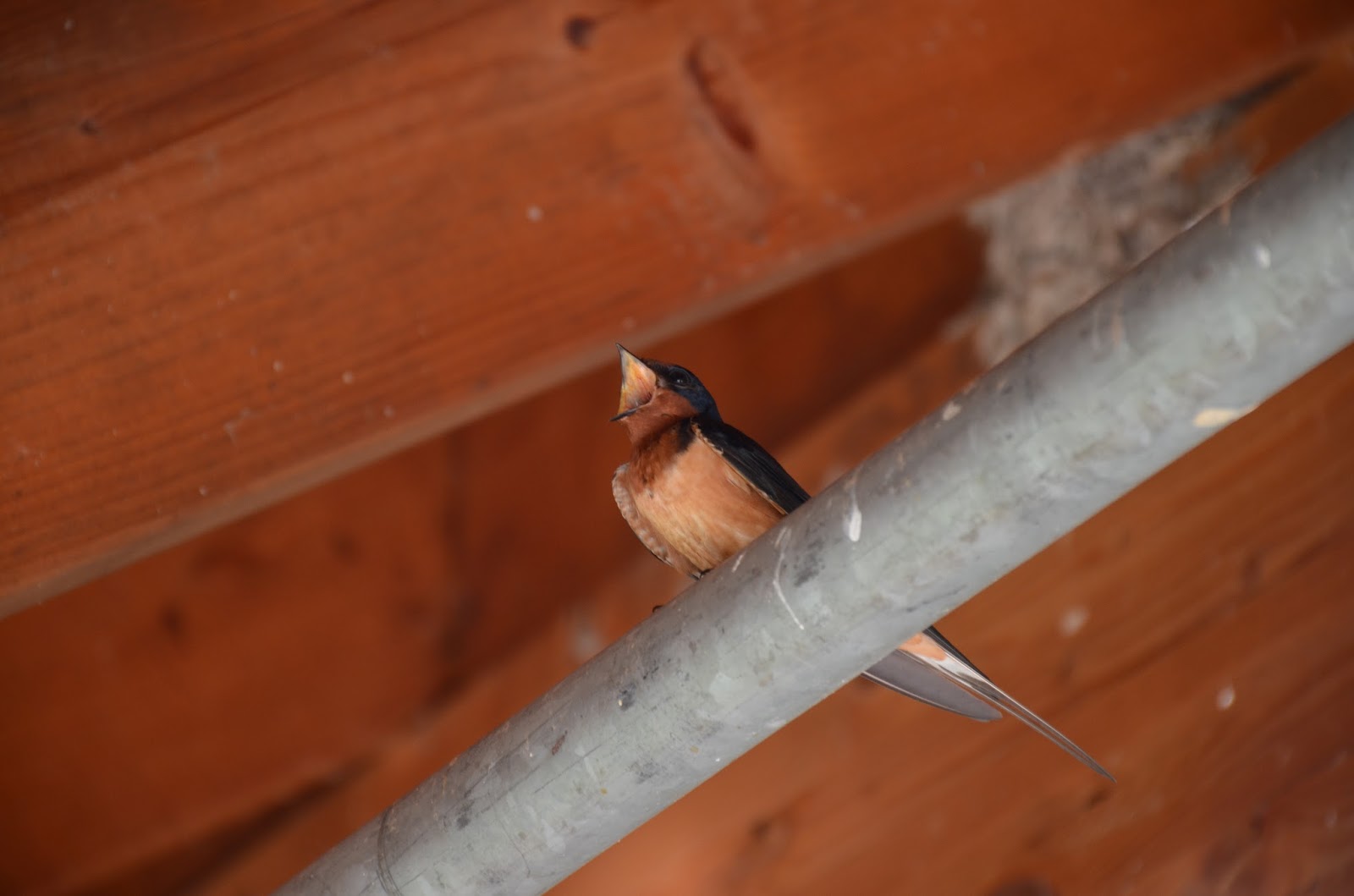
 Barn Swallow


For me, one of the coolest critters to find was a Snapping Turtle.  Not an animal that one wants to mess with because if they latch onto you, they have a lot of power in those jaws and they can break bones in fingers and they do not like to let go! 

 Snapping Turtle


Painted Turtle

Chris taking photos

We returned fairly early as we needed to prepare for the next part of our journey and it included some overnight stays in central and southwestern Wisconsin.  But on the way home, we made another stop of the Manitowoc Impoundment to see if anything new was being seen.  The American White Pelicans were in high numbers and had been absent for several years.  We also had high numbers of Caspian Terns and Bonaparte's Gulls.  

 American White Pelican


 Caspian Terns, Forster's Tern, and Bonaparte's Gulls

 Caspian Tern

Semipalmated Sandpiper

The next day we were to journey to the far corner of the state to pursue some warblers and some rarities in the central part of the state.


Tuesday, March 3, 2015

Willcox and Lake Cochise

On Sunday, March 1, 2015, I headed down to the southeastern area of Arizona with Magill Weber riding along.  We were headed to Cochise Lake near Willcox, AZ to try our luck at locating a Red Phalarope that has been reported by many in the past week.  This is a bird that breeds along the Artic shores in the summer and spends its winters at sea; a rather rare bird inland.  I had seen only one of these birds once before and it was in the Pacific Ocean in 2013 about 20 miles out from Half
Moon Bay, California, so to have one show up in Arizona it is quite remarkable.  This would be a great bird to add to my Arizona list and I think Magill felt likewise.  So this was our target bird for the day an it did not take long to find it spinning around and back and forth in the water, foraging like phalaropes normally would.  At first it was a bit far out for photos, but we moved to another side of the lake and it eventually worked its way a bit closer for some identifiable photos.  Obviously this bird is not in its colorful reddish breeding plumage at this of the year, but still a remarkable bird none the less.
 
 Red Phalarope
 
Red Phalarope
 
One other bird dominated the landscape all around Cochise Lake; the Sandhill Crane.  Parts of Arizona is the winter home for this magnificent bird.  Arizona does not draw the biggest concentrations of them and I have seen them just about every winter in Maricopa County west of Phoenix as a small flock winters there.  A much larger concentration accumulates a bit further south from Willcox at Whitewater Draw and that place draws many birders to see them.  We were stunned by the sheer numbers in Willcox; we counted well over 1500 which brought back fond memories of Nebraska where they congregate along the Platte River in central Nebraska in the early spring every year and they number in the hundreds of thousands.  This was definitely impressive to see and hear and they actually allowed a bit of a close approach. 
 
 Sandhill Cranes - Need I say more?


As we work our way around the lake, I got to see my find Cinnamon Teal of the year.  (Yeah, that is kind of sad when I have them only about 6 miles from my home in Mesa at the Gilbert Riparian Water Preserve!)  I had to drive all the way to Willcox to see my first of the year.
 
Cinnamon Teal
 
We then made our way to the pond by the golf course where we found a stunning breeding plumage male Ruddy Duck.  Not a plumage we see too often and that blue bill really looks out of place, but also adds to its good looks.
 
Ruddy Duck
 
As we were driving out to head back a home, we were fortunate to have an Eastern Meadowlark sitting on a fence post and did not take off like most of them do when approached by humans.  We just stopped the car and enjoyed the view with the sunlight showing off its bright yellow chest.
 
 Eastern Meadowlark


We spent only about 1½ hours before we headed home, but it was a very productive day of birding in such a short time span.  Definitely worth the trip. 


Tuesday, January 27, 2015

Birding With Jim - Day 1

Last weekend, birding friend, Jim Austin-Cole from New Jersey, was in Arizona for a week and together we spent two days searching for new life birds for Jim in Arizona. The first day we headed to the western side of the greater Phoenix area, specifically to the Buckeye/Arlington area.  Immediately after we turned off of Highway 85 and headed west on Baseline Road, the first bird to greet us was a very nice Ferruginous Hawk.  Our first real stop was the infamous 'Thasher Spot' at Baseline and Salome Hwy.  When we arrived we found another lost soul from Rhode Island there and he was also looking for the major prize, the Le Conte's Thrasher and he joined us.

The first thrasher we located was Bendire's Thrasher and as we made our way towards one of them we heard a thrasher call in the brush to the left of us that caught my attention and it was not long before we caught a glimpse of two Le Conte's scampering on the ground from one shrub to another. As we slowly tried to get closer for photos, one of them flew up into the branches of a tree and allowed good looks and some photos. This bird has never been easy to photograph but this pose was a dream come true.

Le Conte's Thrasher

As Jim and I departed the area we spied a few sparrows near the highway and mixed in just happened to be a few Brewer's Sparrows. We left this spot with 3 new life birds for Jim;  Bendire's Thrasher, Le Conte's Thrasher and Brewer's Sparrow.

Brewer's Sparrow
 
From the Thrasher Spot, we then headed out to cover the various spots along the many roads.  At one little stop along the road a Lincoln's Sparrow gave us an over-the-shoulder look before it took off for better cover and we did find a small flock of 55 Sandhill Cranes.  Not a common bird in Maricopa County, but there is a small flock that spends their winters in the Arlington area.  And we found huge numbers of Brewer's Blackbirds.
 
 Lincoln's Sparrow

 Sandhill Cranes

Sandhill Cranes
 
Brewer's Blackbird
 
After lunch in Buckeye, we headed to Friendship Park which is the place that I discover just two weeks before as a good place for the Lawrence's Goldfinch.  Since we were later in the day, we were only able to find one, but at least we got good looks at it and added another new life bird for Jim.  The only photos I took at this location was a bad one of a Common Yellowthroat (not an easy bird to photograph) and a Neotropic Cormorant that was busy preening its feathers.
 
 Common Yellowthroat

 Neotropic Cormorant

Neotropic Cormorant
 
Our last stop was Glendale Recharge Ponds which had large numbers of ducks and shorebirds.  Ducks were not so cooperative, but some of the shorebirds were a bit more accommodating, including Greater Yellowlegs and Lesser Yellowlegs feeding side by side which really made for a great comparison of the two species.  Had lots of Least Sandpipers and one of them was in the mood for taking a bath.
 
Greater Yellowlegs

Lesser Yellowlegs
 
 Least Sandpiper

Least Sandpiper
 
It was a great day of birding and I took off a day from work on Monday to take Jim to a totally different location and habitat.  That will be the focus of my next post.