Costa's Hummingbird

Costa's Hummingbird

Wednesday, May 14, 2014

Texas: The End

As my last day was quickly going to come to an end, I made one last visit to High Island.  The winds had changed direction and I was hoping that some more warblers might be dropping in that afternoon.  The Anahuac NWR has a much smaller areas known as the Skillern Tract about 7 miles east of the main location and it was on the way to High Island so I decided to make a quick stop to see what I could find and very glad I did as I picked up 2 new life birds in a short amount of time.  These 2 new birds were Couch's Kingbird and Red-bellied Woodpecker.  Neither one of them sat still for any length of time, so the photos were slim, but still good enough for an ID.

 Couch's Kingbird

Red-bellied Woodpecker

After about 40 minutes in this location, I continued on to High Island.  Once again started at Boy Scout Woods to see what new birds were being seen.  While watched the drip area a Brown Thrasher made an appearance.  This was another bird that I can recall from many years back in Nebraska, but this time I got to capture a couple of photos.  They appear to love mulberries as well as the Gray Catbirds.

Brown Thrasher

Next up was a Philadelphia Vireo and another new life bird.  Took me a while to finally convince myself that I had identified this bird correctly, but the black line from the base of the bill through and beyond the rear of the eye was the key field mark.  And down in the muddy area below the vireo was a Northern Waterthrush.

Philadelphia Vireo

Northern Waterthrush

From the main entrance, I headed down the path to another pond with a drip set up and as I was walking the pathway I caught a glimpse of a small bird foraging in the leaves in some deep brush and I was kind of dumbfounded because I did not think I would find an Ovenbird on my own.  Always thought this was a bird that I was going to need some help in finding and it has been high on my list for a long time.  Well it got my attention and I followed it for some time trying to get photos as it foraged in the deep shade of the trees.

 Ovenbird

 Ovenbird

Ovenbird

Finally I left Boy Scout Woods and headed to Smith Oaks where I spent the last of my time.  Visited the rookery one last time and got a photo of a Great Egret with babies.  Also found a Blue Grosbeak male nearby as well.  At Don's Drip in Smith Oaks I sat there for about 15 minutes with about 4 others watching the drip for anything and not finding anything.  But I looked up and into the distance quickly found a bird I recognized from Arizona, an Olive-sided Flycatcher, which I quickly pointed out to the others that were sitting there.  

 Great Egret with chicks

 Blue Grosbeak

Olive-sided Flycatcher

I suppose the Olive-sided Flycatcher was the sign that it was time to think about heading back to my suite and start the packing process.  Probably good I left when I did, as my rental car had developed a slow leak in the right front tire.  I got back to Wnnie in time to get it repaired so I did not have a flat tire in the morning which probably would have made me miss my flight back to AZ.  Great place to visit for birding and I definitely want to go back and maybe catch some of the birds I missed.  However, there are many more places to visit as well.  If I had the time and the funds I would plan a trip like this at least once a month.  
Adios to Texas for now; next visit to Texas, will probably be the Lower Rio Grande River Valley.


Tuesday, May 13, 2014

Texas: The Final Day

Wednesday April 30th was my last day for birding in Texas and I still had a couple of target birds I wanted to find, I did a little extra driving and headed east from Winnie to the small town of Anahuac.  Someone had suggested that Swallow-tailed Kites had frequented the area from time to time.  Well not this time, so I once again struck out on this bird and came home without this bird added to my list.  But while I was there and driving the streets, I did happen to find a pair of Purple Martins on a nest box built for them.  Not a bird that I see that often and although I prefer photos without man-made objects in them, I was happy to find them and add them to my Texas list.

Pair of Purple Martins with a neighboring House Sparrow

The rest of the day was spent by revisiting some of the places I had already been and first on the list was Anahuac National Wildlife Refuge.  It is one of those places that deserve a second visit and I have no regrets on the return visit as this time other birds showed themselves well and another critter was seen multiple times as well.  Fulvous and Black-bellied Whistling Ducks and Mottled Ducks are common in this location and I was able to find all 3 species with the Fulvous Whistling Duck and the Mottled Duck being a couple of life birds for me.  

 Black-bellied Whistling Ducks

 Fulvous Whistling Duck

Fulvous Whistling Duck

To many the Mottled Duck probably looks a lot like a female Mallard.  However, 2 key identification marks are the black spot at the gape of the bill and the absence of white feathers in the tail.

Mottled Duck

This day just happened to be the day of the Least Bittern.  I visually saw 4 of these elusive and secretive birds on this day and captured photos of 3 of them.

 Least Bittern - female

 Least Bittern - male

Least Bittern - female

An American Bittern was seen in the grass which is a bit uncharacteristic of this elusive bird.  Not sure if it thought it was invisible or not, but then once I got out of the car to snap photos it did not stick around very long and took flight in the opposite direction.

American Bittern

One of the biggest reasons to return to this place was because a rare bird had been reported here.  The Ruff is a Eurasian species that has a habit of showing up in the United States from time to time and this time one of them chose Texas and since I was in the neighborhood, I kind of thought it might be best to try and add it to my life bird list.  Surprisingly, when I arrived at the location that others had seen it, no one else was there and I was wondering if I would be able to pick it out.  Definitely was not a problem as it stood out from the rest of the 'peeps' in the shallow water.  Also had a couple of Stilt Sandpipers and a gorgeous female Wilson's Phalarope in the same pond.

 Ruff

 Ruff

 Stilt Sandpiper

Wilson's Phalarope - female

So many birds were present, some of them even common to Arizona.  Here are a few more photos of wading/water birds.

Green Heron

 Great Egret - note the bright green facial pattern, breeding plumage

Purple Galinule

On the way out, the Dickcissels were singing on both sides of the road and one male was quite content to let me capture a couple of photos even while a couple of Northern Bobwhite were calling nearby.

Dickcissel

And of course another photo of my non-nemesis bird, the Common Nighthawk.  Just had to have my daily dose of this bird, but I am definitely not complaining!

Common Nighthawk

And just to prove that birds were not my only interest, I happened upon one of the area's most notable reptiles, the Alligator.  I actually found 3 of them on this day in this location and 3 more in another location later that afternoon.  I liked this pose the best.  

Alligator

Once again I will have to complete one more blog post after this one to finish out my trip.  I ventured back to High Island to finish my final day and got some photos of one of my key target birds.


Monday, May 12, 2014

Texas: Bolivar Flats Bird Sanctuary

After spending most of the morning at Anahuac NWR, on April 29, my next destination was the Bolivar Flats Bird Sanctuary near the tip of the Bolivar Peninsula. Another great place for birding, but a notice to anyone planning a visit to this beach area; wear long sleeve shirts and pants, no shorts.  Or maybe make sure you have insect repellent applied as there are some large flies there that can really bite and leave a welt.  I learned the hard way, but the birds were worth it.  

This is a great place to see lots of shorebirds, along with gulls and terns.  One of my target birds was the Piping Plover, a bird that is listed by IUCN, (International Union for Conservation of Nature and Natural Resources) as 'near-threatened'.  Its breeding habitat is also popular with humans making its breeding efforts vulnerable.  Not only did I find this marvelous bird, but I found 6 of them!
  
Piping Plover

Piping Plover - there are 4 of them in this photo

Dunlin, Semipalmated Sandpipers and Wilson's Plovers were fairly common and could be seen running up and down the beaches.

Dunlin

Semipalmated Sandpiper

Wilson's Plover

Least Terns and Black Terns were also very common and the Least Terns were putting on a show with a male courting the female by offering her a small fish.

Black Tern and Least Tern

Least Tern

This spot is also a great spot for Reddish Egrets which is a species that I have seen in Arizona (rare) and also in Puerto Penasco, Mexico.  And I could see one far off in the distance, but upon closer inspection I found one a bit closer, but did not look quite like the normal bird that I have seen.  This one happened to be a much more uncommon color phase, the White-morph.  The distinctive bi-colored bill is the key field mark of all Reddish Egrets and helps to identify this bird and assure it is not a Snowy Egret or a juvenile Little Blue Heron.

White-morph Reddish Egret

One other bird of note was a fly-over by a Peregrine Falcon which looked a little out of place along a sandy shoreline.

Peregrine Falcon

After leaving this area I headed back and made a couple of stops along the way, including Roller Over Bridge.  This time and without extra people I was able to capture a couple extra photos of birds that I was not able to obtain with the group that I had the day before.

 Black-bellied Plover

 Black Skimmer

 Sanderling

Laughing Gull, Black Skimmer, Caspian, Royal and Forster's Terns

At another stop, a Willet was more than obliging for some photos.  This bird was very common just about any location where there was water.  The Willets in Texas have more of a brownish color than those in the west that tend to be gray.  They may appear to be a boring bird in the coloration department, but once they take flight, they are quite striking in appearance.  Just goes to show what is sometimes hidden in those wings.

 Willet

Willet

And the final bird?  Yes, another Common Nighthawk that landed in front of my car on a gravel road.  

Common Nighthawk

Day 3 comes to a close with an abundance of great birds and with one day left, I had to plan my time well to see what else I could add to my list of wonderful birds in Texas.


Wednesday, May 7, 2014

Texas: Anahuac National Wildlife Refuge

Day 3 and this time I had decided to visit Anahuac National Wildlife Refuge which is located a bit west of Highway 124 that connects Winnie and High Island.  Then also head south to the Bolivar Penisula and the Bolivar Flats Bird Sanctuary.  This is a huge area with a lot of marshy areas full of reeds, cattails and grasses but also with open areas of water.  One of the nicest assets to this area is the Shoveler Pond Loop; a paved one-way road that is about 2½ miles long around it and there are places to pull over to view and even a boardwalk or two going out into the marsh.  I fell in love with this place and was so glad I took the advice of another Texas birder, Sheridan Coffey, to pay a visit. I liked it so well that I came back the next day as well and found some more special birds and creatures.  But for day number 3, this is a brief synopsis of my findings and most of the photos were taken driving on the Shoveler Pond Loop.

One of my key life birds that I wanted to find on this trip was the Boat-tailed Grackle.  Now that I look back on this idea, I find it was a little absurd.  Not only did I find it, but I got to know it so well that I really became a bit annoyed with it; very common and very obnoxious! Very similar to the Great-tailed Grackles so common in Arizona in appearance and behavior.  Some other birds provided some decent photo opportunities along the way.

Boat-tailed Grackle

Eastern Kingbird

 Marsh Wren

Orchard Oriole

Blue Jay

While driving very slowly along the road, at one point I glanced in my rear view mirror and noticed a strange looking bird cross the road behind me.  I immediately stopped the car and headed back to where I last saw it disappear, which was a small area of grass and shrubs on the edge of the water.  Then it showed itself for a brief moment, (where I tried for photos and failed on the focus part) and when it called, I knew it was a King Rail.  This family of birds can be difficult to see as they tend to be very secretive so it was a great feeling to actually see one even if the photos left a lot to be desired.  This was a life bird I had not expected to see.

King Rail

Yellow-crowned Night Heron was another new addition to my list and I was able to see both adults and juveniles.

 Yellow-crowned Night Heron - adult

Yellow-crowned Night Heron- juvenile

Taking the road south from the visitor's center, I veered off from the paved road to take the road to the boating landing, and along the way, I discovered some more new found 'Common' birds; the Common Nighthawk which has been featured in just about every post from this trip, so here is one more.  This one appears to be sleeping on a post.

Common Nighhawk

Nearby were a pair of Forster's Terns taking a rest on posts.

Forster's Tern

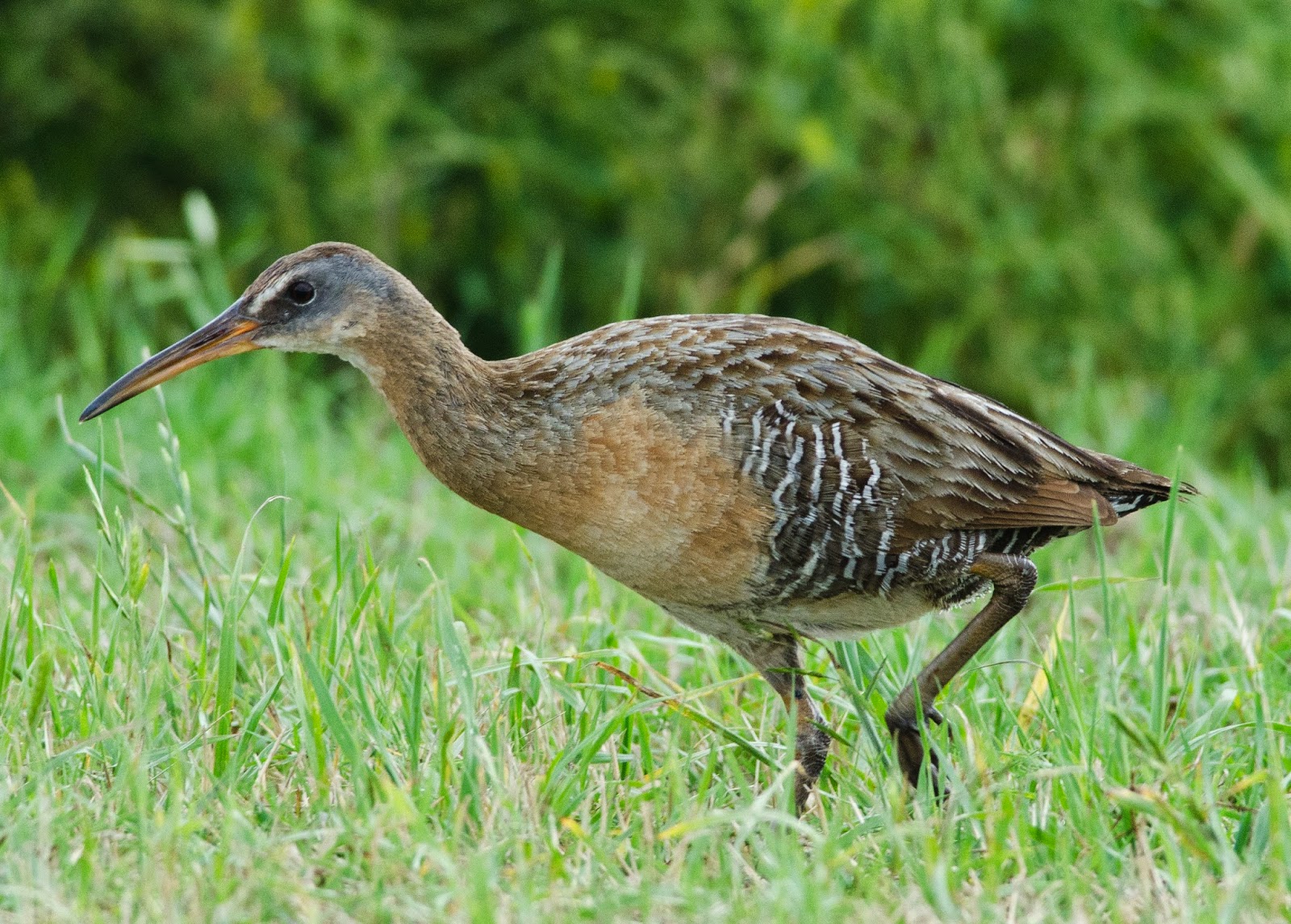
Just as I reached the parking area of the boat dock I happened to see another strange looking bird walking in the grass.  This was my first view of a Clapper Rail and I was stunned to find one in full view and allowing me to take photos.  A bit like the King Rail, they are most generally a secretive and elusive bird.

 Clapper Rail

Clapper Rail

My last photo is one of a Laughing Gull.  This was the most frequently encountered gull during my visit to Texas and are actually probably one of the most smartly dressed gulls there are.

Laughing Gull

After having such a successful visit to Anahuac NWR, I now turned my attention to the Bolivar Penisula and the Bolivar Flats Bird Sanctuary.  This will be covered in the next blog post which will probably be delayed due to assisting in the North America Migratory Bird Count this coming weekend.